Business
Taiwan Suspects a Chinese-Linked Ship of Damaging an Internet Cable


Taiwan is investigating whether a ship linked to China is responsible for damaging one of the undersea cables that connects Taiwan to the internet, the latest reminder of how vulnerable Taiwan’s critical infrastructure is to damage from China.
The incident comes as anxiety in Europe has risen over apparent acts of sabotage, including ones aimed at such undersea communication cables. Two fiber-optic cables under the Baltic Sea were severed in November, prompting officials from Sweden, Finland and Lithuania to halt a Chinese-flagged commercial ship in the area for weeks over its possible involvement.
In Taiwan, communications were quickly rerouted after the damage was detected, and there was no major outage. The island’s main telecommunications provider, Chunghwa Telecom, received a notification on Friday morning that the cable, known as the Trans-Pacific Express Cable, had been damaged. That cable also connects to South Korea, Japan, China and the United States.
That afternoon, Taiwan’s Coast Guard intercepted a cargo vessel off the northern city of Keelung, in an area near where half a dozen cables make landfall. The vessel was owned by a Hong Kong company and crewed by seven Chinese nationals, the Taiwan Coast Guard Administration said.
The damaged cable is one of more than a dozen that help keep Taiwan online. These fragile cables are susceptible to breakage by anchors dragged along the sea floor by the many ships in the busy waters around Taiwan.
Analysts and officials say that while it is difficult to prove whether damage to these cables is intentional, such an act would fit a pattern of intimidation and psychological warfare by China directed at weakening Taiwan’s defenses.
Taiwan said the cargo vessel it intercepted had registered under the flags of both Cameroon and Tanzania. “The possibility of a Chinese flag-of-convenience ship engaging in gray zone harassment cannot be ruled out,” the Coast Guard Administration said on Monday in a statement.
Such harassment, which inconveniences Taiwanese forces but stops short of overt confrontation, has a desensitizing effect over time, according to Yisuo Tzeng, a researcher at the Institute for National Defense and Security Research, a think tank funded by Taiwan’s defense ministry. That puts Taiwan at risk of being caught off guard in the event of a real conflict, Mr. Tzeng said.
Taiwan experiences near-daily incursions into its waters and airspace by the People’s Liberation Army. Last month, China sent nearly 90 naval and coast guard vessels into waters in the area, its largest such operation in almost three decades.
China has also deployed militarized fishing boats and its coast guard fleet in disputes around the South China Sea region, and stepped up patrols just a few miles off the shore of Taiwan’s outer islands, increasing the risk of dangerous confrontations.
Such harassment has been a “defining marker of Chinese coercion against Taiwan for decades, but over the last couple years has really stepped up,” said Gregory Poling, the director of the Asia Maritime Transparency Initiative at the Center for Strategic and International Studies.
And in situations like this one and the recent damage to the cables under the Baltic Sea, it is difficult for the authorities to calibrate their response when a ship’s true identity is uncertain.
“Do you deploy a Coast Guard vessel every time there is an illegal sand dredger or, in this case, a ship that is registered to a flag of convenience and has Chinese ties damages a submarine cable?” Mr. Poling asked.
Ship tracking data and vessel records analyzed by The Times show that the ship may have been broadcasting its positions under a fake name.
Taiwan said the ship appeared to use two sets of Automatic Identification System equipment, which is used to broadcast a ship’s position. On Jan. 3, at the moment that Taiwan said the cable was damaged, a ship named Shun Xing 39 was reporting its AIS positions in the waters off Taiwan’s northeastern coast.
About nine hours later, at around 4:51 p.m. local time, Shun Xing 39 stopped transmitting location data. That was shortly after the time that the Taiwan Coast Guard said it had located the ship and requested that it return to waters outside of Keelung port for an investigation.
One minute later, and 50 feet away, a ship called Xing Shun 39, which had not reported a position since late December, began broadcasting a signal, according to William Conroy, a maritime analyst in Wildwood, Mo., with Semaphore Maritime Solutions, who analyzed AIS data on the ship-tracking platform Starboard.
In the ship-tracking database, both Xing Shun 39 and Shun Xing 39 identify themselves as cargo ships with a class A AIS transponder. Typically, a cargo ship equipped with this class of transponder would be large enough to require registration with the International Maritime Organization and obtain a unique identification number known as an IMO number. Xing Shun 39 has an IMO number, but Shun Xing 39 does not appear in the IMO database. This suggests “Xing Shun 39” is the ship’s real identity and “Shun Xing 39” is fake, according to Mr. Conroy.
The Taiwan Coast Guard has publicly identified the vessel as Shun Xing 39, and said the ship used two AIS systems.
Vessel and corporate records show that Jie Yang Trading Ltd, a Hong Kong-based company, took over as the owner of Xing Shun 39 in April 2024.
The waves were too large to board the cargo vessel to investigate further, the Taiwan Coast Guard Administration said. Taiwan is seeking help from South Korea because the crew of the cargo vessel said it was headed to that country, the administration said.
In 2023, the outlying Matsu Islands, within view of the Chinese coast, endured patchy internet for months after two undersea internet cables broke. These fiber optic cables that connect Taiwan to the internet suffered about 30 such breaks between 2017 and 2023.
The frequent breakages are a reminder that Taiwan’s communication infrastructure must be able to withstand a crisis.
To help ensure that Taiwan can stay online if cables fail, the government has been pursuing a backup, including building a network of low-Earth orbit satellites capable of beaming the internet to Earth from space. Crucially, officials in Taiwan are racing to build their system without the involvement of Elon Musk, whose rocket company, SpaceX, dominates the satellite internet industry, but whose deep business links in China have left them wary.



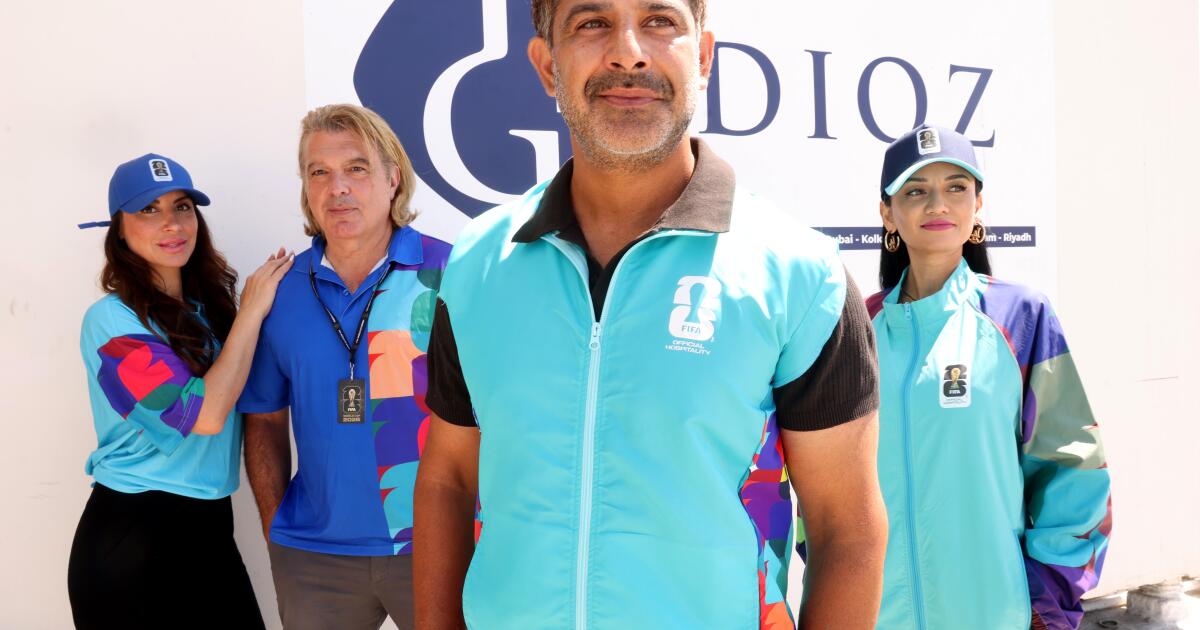
Johnny Beig may have played in a semi professional cricket league in Australia, but this summer he’s a big fan of soccer in the United States.
It’s not just because he’s rooting for the World Cup team, though.
FIFA emblems are featured on jerseys that were created by the Dioz Group and distributed for all employees at the 16 FIFA World Cup venues this summer.
(Genaro Molina / Los Angeles Times)
Last year, Beig’s Beverly Hills-based company, Dioz Group, won a $2.5 million contract with On Location, FIFA’s hospitality partner, to design, manufacture and distribute uniforms for all employees working at FIFA World Cup venues this summer.
These include the people welcoming attendees into stadiums, VIP lounge chefs, waiters and the flagbearers during the opening ceremony.
After a multi-step application process, including presentations of its planning and strategy, Dioz says it produced more than 50,000 clothing garments including suits, jackets, shirts and hats and delivered them to the 16 World Cup venues around the U.S., Canada and Mexico in June.
Thanks in part to the World Cup contract, the company’s revenue has reached $15 million so far this year, compared with $20 million last year, Beig said. He declined to disclose the company’s net income but said the business was profitable.
“We are working with larger names that we would have never imagined we would,” he said. “The FIFA World Cup is the pinnacle. Working with the largest sporting event in the world is what we’re very proud of. I don’t think it gets any bigger than that.”

Volunteers line up to prepare to display the Canadian flag before a World Cup round of 32 knock-out match between Canada and South Africa at SoFi Stadium on Sunday.
(Kelvin Kuo / Los Angeles Times)
Dioz is among the many small businesses across Los Angeles that are getting a boost from the global sporting event, said Kevin Klowden, a senior fellow at the Milken Institute.
The influx of hundreds of thousands of fans into the city has been a boon to hotels, transportation services and restaurants, in addition to those in the special events and logistics economy, Klowden said, calling the event the “equivalent of multiple Super Bowls.”
“The number of contracts that are there, it’s a big deal,” he said. “Given the fact that L.A.’s filming is only slowly recovering, having something like the World Cup is definitely a boost.”
Dioz was co-founded by Johnny, 44, and his brother Tony in 2006. The brothers were born in India and raised in Australia, where Johnny enjoyed a brief career as a semi professional cricket player.
He realized his future wasn’t as a professional athlete, but he wanted to stay connected to the sports world, so he began making uniforms for his cricket team in 2006.
He then got a referral to make uniforms for multiple teams in the area before starting an apparel company.
“I wanted to stick with something I was passionate about, which is sports,” he said.

Volunteers unravel the center field display before a World Cup round of 32 knock-out match between Canada and South Africa at SoFi Stadium on Sunday.
(Ronaldo Bolanos / Los Angeles Times)
In 2012, Beig moved to Los Angeles and established Dioz‘s Los Angeles headquarters to tap into the U.S. market. During the pandemic, the company started supplying medical apparel to hospitals and schools, and the business took off, with revenue doubling in 2020, Beig said.
Dioz now has over 150 employees, including 15 in L.A., and manufactures its apparel at factories in China, India, Bangladesh, Turkey and the Philippines. Tony runs an office in Dubai.
Before the World Cup, Dioz provided employee uniforms for events including Super Bowl LIX and Copa America, which may have given it a leg up on the FIFA contact.
Now, with a World Cup contract on their resume, Beig said he’s setting his sights on even bigger events.
“This gives us an edge over the next FIFA events worldwide as well, where we can showcase our skills and we can handle it,” Beig said. “So it gives us a good opportunity to work with sporting events like the UEFA Championship and Premier League.”
As companies get new business from the World Cup, Klowden said it’s important that they leverage their new position to continue that growth.
Companies that benefited from the World Cup might be in a position to bid on even bigger contracts, especially with the Olympics coming up in 2028, Klowden said.
“The really important part in any of these deals is that if a company ran something like this, then they are able to build off of that success,” Klowden said. “Let’s say you’re a company that did a big uniform order or a big food order, and the World Cup goes, and you invested in new manufacturing capacity, or you invested in new clothing machines, or whatever you do; suddenly you don’t have that market anymore, then you’ve just wasted all that money ramping up.”
Surcharges that California homeowners have been hit with statewide by insurers defraying the costs of Los Angeles County’s wildfires were ruled legal in a decision released late Tuesday.
L.A. County Superior Court Judge Tiana Murillo turned down a petition by advocacy group Consumer Watchdog to halt the charges, which insurers began levying last year after the state’s insurer of last resort couldn’t pay all its January 2025 fire claims.
The California FAIR Plan, financially backed and operated by the state’s licensed home insurers, needed a $1-billion bailout from the insurers after it was hit with some $4 billion in claims.
Under a deal Insurance Commissioner Ricardo Lara worked out with the FAIR Plan in 2024, the insurers could seek state approval to surcharge their residential policyholders for up to half of any assessment totaling $1 billion in case the plan needed a bailout in an “extreme worst case scenario” — as it turned out it did.
A total of 105 insurers, including State Farm General — California’s largest home insurer — Farmers and Mercury sought and received approval for the surcharges.
Because the FAIR Plan assessed its member insurers based on their share of the state’s home insurance market, the policyholder surcharges were in the same ballpark. The median fee for homeowners was $28, according to the department of insurance.
The fee can be more or less according to the size of a homeowner’s premium and is split into monthly payments that insurers can spread over one or two years. Condo owners and renters on average were surcharged less.
In a court filing, Consumer Watchdog said $420 million in surcharges were approved.
In its April 2025 lawsuit filed against Lara, the Los Angeles group made a series of arguments in seeking to overturn the residential surcharges, which it deemed an industry bailout. It did not sue over related commercial surcharges.
Consumer Watchdog contended in its lawsuit that the surcharges violated Proposition 103 — the 1988 measure that governs insurer rate hikes — because the proposition does not allow for them.
It also claimed Lara did not follow regulatory protocol in promulgating the new policy.
The group further alleged that the FAIR Plan’s governing statutes do not give Lara the authority to permit the surcharges — and that the statutes require insurers to share in the plan’s profits and losses, and not shift losses to policyholders.
Murillo, and another judge who previously heard the case, turned down all of the consumer group’s arguments in separate rulings, the last of which Murillo issued Tuesday night.
Lara celebrated his legal victory over Consumer Watchdog, which has accused Lara of having close ties to insurers and sought to oust him from office. His terms ends in January.
“This victory sends a loud and clear message: The era of allowing special interests to derail consumer choice is over. We have the momentum, we have the authority, and we will continue to fight until every Californian has access to the coverage they deserve,” Lara said in a statement.
Attorney Will Pletcher, litigation director of Consumer Watchdog, said the group disagreed with the decision and would “consider all options to move this forward.”
“It’s important to try to protect California consumers from these surcharges that we think are in pretty clear conflict with both Proposition 103 and the FAIR Plan,” he said.
Hilary McLean, a spokesperson for the plan, said in a statement it did not have any position on the ruling, given the plan “does not have a role in determining how insurers manage costs associated with assessment.”
Denni Ritter, vice president of state government relations for the American Property Casualty Insurance Assn., a major industry trade group, said the decision rejected “the reckless lawsuit brought by the self-interested group Consumer Watchdog…”
“This ruling preserves a vital tool to protect the stability of the California insurance market. Blocking cost recovery would have undermined the state’s last-resort coverage option,” she said in a statement.
The 2024 policy was issued in response to the rapid growth of the plan due to a series of wildfires over the last decade that prompted multiple insurers to retreat from the state’s home insurance market.
The plan had 264,000 homeowners on its rolls in September 2022, a figure that rose to 452,0000 in the months before the fires — and its residential policyholders have since increased to 663,000 as of March.
The FAIR Plan offers policies that typically cost more than those issued by regular insurers while offering less coverage.
A Times analysis last year found that in the Palisades and Eaton fire zones, the plan’s rolls nearly doubled to 28,440 from 2020 to 2024.
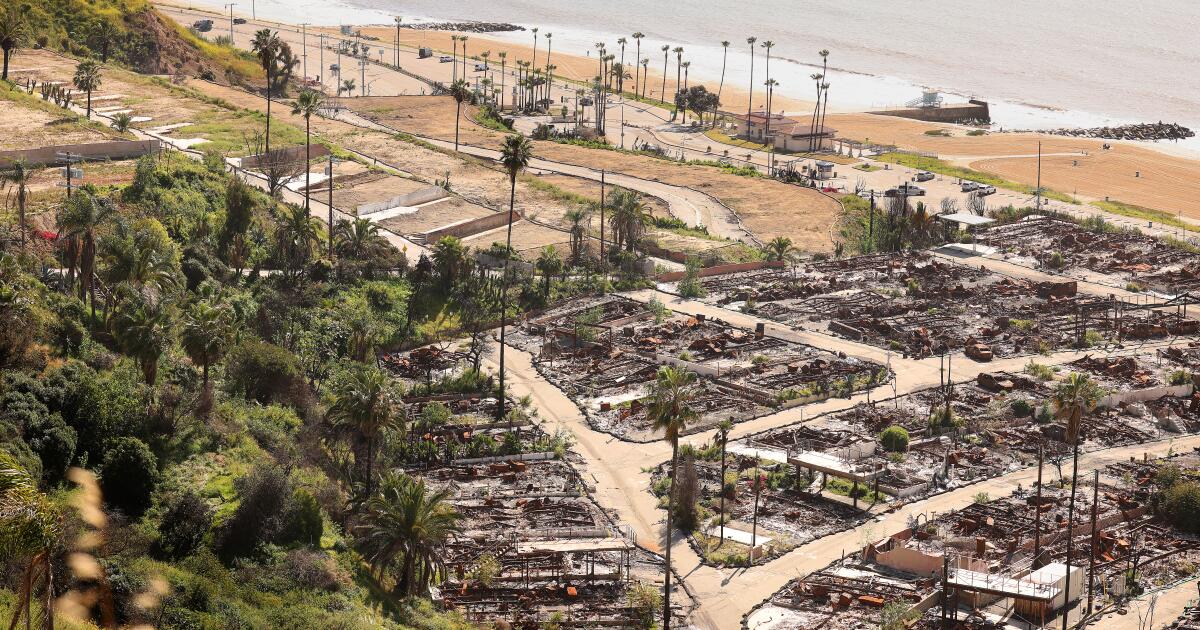
That concentration of policyholders led to the plan’s large losses during the Jan. 7 wildfires, which damaged or destroyed more than 18,000 structures, killing at least 31 people.
It’s been estimated that the insured losses for the wildfires could ultimately total as much as $40 billion, exceeding any past wildfires worldwide. Ritter said that so far insurers have paid $23.7 billion in claims.
The 2025 wildfires were not the only time the FAIR Plan has needed a bailout, though it is the first time its member insurers surcharged policyholders.
In 1993, it assessed carriers after fires in Altadena and Malibu, and in 1994 it did so after the Northridge earthquake. The assessments totaled $260 million.
The plan received approval this year from the insurance department for a 29% rate increase for its homeowner dwelling policy that will take effect in October.

An electric Tesla Semi truck crashed into two vehicles in Dayton, Nev., over the weekend, killing two people and raising questions about the truck’s safety features.
The Lyon County Sheriff’s Office responded to a major collision around 7 a.m. on Sunday at the intersection of Highway 50 and Traditions Parkway about 40 miles east of Reno, the office said.
The office confirmed a semi-truck was involved in the accident, and footage of the scene shows it was a Tesla Semi.
It is the first known crash involving a Tesla Semi, an electric Class 8 truck that Tesla is building in Nevada and plans to ramp up production of. As interest in Tesla’s electric passenger vehicles wanes, the company is betting on the truck to give it a needed boost.
The trucks do not have the Full Self-Driving mode available in Tesla cars, but Tesla’s website says they come standard “with active safety features that pair with advanced motor and brake controls to deliver traction and stability in all conditions.”
According to the Lyon County Sheriff’s Office, preliminary statements obtained at the scene suggest the truck driver may have fallen asleep behind the wheel.
The crash is under investigation by the Nevada State Police Highway Patrol, which said additional information may be released next week.
The Record-Courier identified the victims as Sergio and Jennifer Villanueva, a couple who got married in 2022.
Tesla has not clarified if its semitruck has an automatic emergency braking system. Federal regulators are currently weighing a mandate for emergency braking systems in vehicles more than 10,000 pounds.
-

 Rhode Island4 minutes ago
Water worries mount, outdoor water use banned in some parts of RI
-

 South-Carolina6 minutes ago
Tennessee Football 2026 SEC Opponent Summer QnA Preview: South Carolina | Rocky Top Insider
-

 South Dakota12 minutes ago
Trump at Mount Rushmore: Speech time, how to watch live
-

 Tennessee19 minutes ago
Too hot to handle? Cool off at these Middle Tennessee ice cream shops
-

 Texas21 minutes ago
Tesla driver charged with manslaughter over crash into Texas home
-

 Utah26 minutes ago
3 Trade Scenarios for the Utah Jazz to Find a New Center
-

 Vermont34 minutes ago
4 Burlington beaches closed due to algae blooms
-

 Washington36 minutes ago
Indie Films Opening July 3: ‘Young Washington’ Marches Into Theaters

