Business
Spotify woos video and podcast creators with new tools to better compete with YouTube

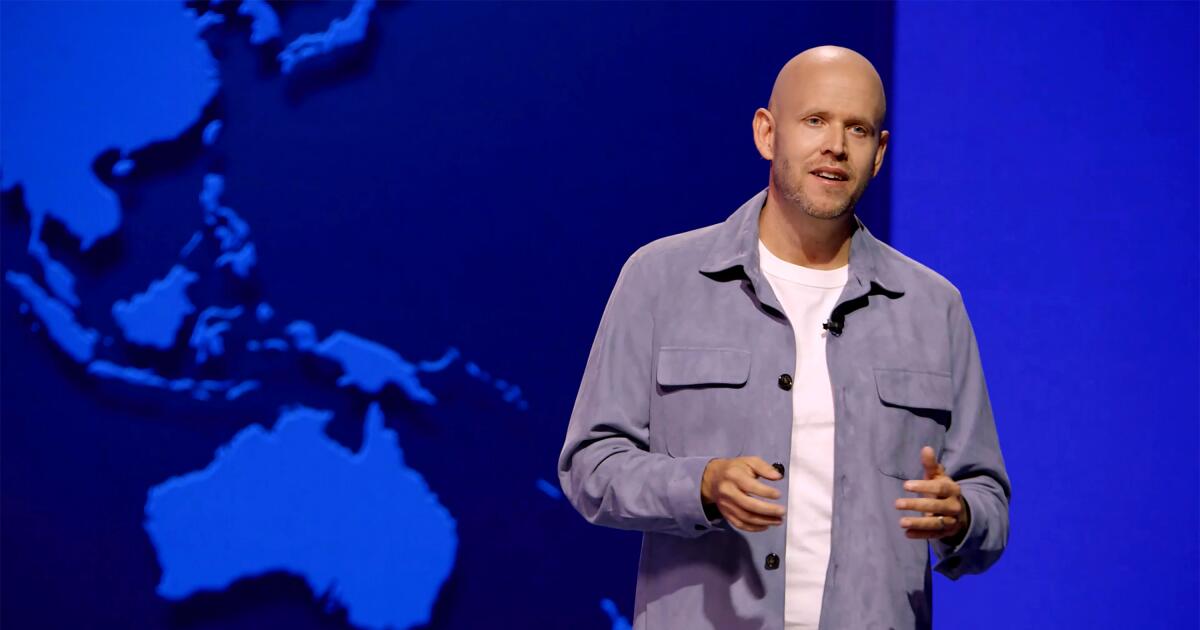
Swedish streaming audio giant Spotify is courting more video creators, podcasters and influencers in an effort to step up its competition with popular digital platforms such as YouTube, Instagram and TikTok.
The Stockholm-based company on Wednesday hosted creators at its office in Downtown L.A.’s Arts District, where executives showed off new features meant to make it easier for video makers to make money from their content and track their performance on the streaming service. The company is launching a new program to help creators earn more advertising and subscription revenue, Spotify said.
For example, Spotify Premium subscribers will soon be able to view videos on the service without ads. This comes after some video podcasters have groused about the number of commercial breaks in their shows, which can irritate paying listeners. Qualified creators can earn money based on how often the ad-free videos are streamed.
“Now, financial success and quality of your show aren’t at odds anymore — they are correlated,” said Spotify’s co-president and chief product and technology officer, Gustav Söderström, during the event.
Ad-free videos will start in January for premium users in the U.S., U.K., Australia and Canada. Spotify users who do not want to pay for a subscription can still listen to music, podcasts and audiobooks for free with ads. Video creators earn a share of those ad revenues. Audio-only podcasts will still have ads for Premium users.
Once a pure streaming music company, Spotify five years ago expanded into podcasting, buying podcast companies and later spending considerable sums to get exclusive deals with popular hosts including Joe Rogan and Alex Cooper. That helped diversify Spotify’s offering, but the company eventually pulled back on some big deals after overspending. It recalibrated its podcast strategy and laid off employees.
But podcasts remain a big draw for the service. Spotify has also added audiobooks to its catalog.
After the company’s review of its podcast strategy, Spotify moved away from its exclusive deals with podcasters and is now offering more financial incentives for creators to place videos on its platform, as consumer demand and creator interest in videos has gone up.
Spotify grew its video content in 2020, when the streaming service allowed podcasters to upload videos of their interviews and conversations. Today there are more than 300,000 video podcast shows on Spotify, the company said.
Spotify said more than 250 million users have streamed a video podcast. The number of creators posting videos monthly on the service has risen more than 50% year over year.
Bringing more video creators to the service could lead to users spending more time on its service. That could help Spotify decrease subscriber churn, increase advertising dollars and attract new customers.
Earlier this year, the streaming service launched music videos in around 100 markets (but not yet in the U.S.) and there are possibilities for other types of video content on the platform too.
“Who’s to say that we can’t imagine someday we’ll have authors talking about their books and (we would) be able to bridge you straight into listening to that book?” said Alex Norström, Spotify’s co-president and chief business officer, in an interview.
It also puts Spotify in a better position to compete with YouTube, which already shares advertising and subscription revenue with its video creators. YouTube offers its video library for free with ads and also sells YouTube Premium, which starts at $13.99 a month that gives ad-free access to its YouTube and YouTube Music.
Earlier this year, YouTube said it had more than 100 million Premium subscribers, including those on a trial subscription. YouTube’s free, ad-supported version has billions of users.
Spotify reported 640 million monthly active users in the third quarter, up 11% from a year ago. Spotify Premium has 252 million subscribers.
When asked by an analyst about Spotify’s scale, reach and engagement being smaller than YouTube’s, Spotify Chief Executive Daniel Ek said on an earnings call on Tuesday that “people make it out to be the winner-takes-all dynamic in that there’s only one player that can solve all of it,” but what creators want is to be on multiple platforms.
“That’s certainly what we learned in podcasting and that’s what we’re leaning into,” Ek said, adding that there are many creators on Spotify that only post parts of their content and “new creators that have needs which we aren’t yet fulfilling.”
Spotify executives said they believe the company has room to continue to grow. The company on Tuesday said it anticipates earning a full-year profit in 2024, which would make this Spotify’s first profitable year ever.


The luxury shopping center in Pacific Palisades will reopen next month after more than $100 million in renovations forced by the January 2025 wildfire that devastated the Los Angeles neighborhood.
Palisades Village will reopen Aug. 15, owner Rick Caruso announced Wednesday. The outdoor center survived the blaze that destroyed homes and other businesses but needed refurbishment to eliminate contaminants that the fire could have spread.
Crews are putting finishing touches on mall buildings after tearing them down to the studs, treating the wood and rebuilding the walls, Caruso said.
“Everybody’s working, and stores are moving their products in,” he said. “It’s a really cool feeling that people have really locked arms and are working together.”
An electrician installs lighting for a restaurant at Rick Caruso’s Palisades Village on Thursday. The shopping center is scheduled to reopen mid-August.
(Myung J. Chun / Los Angeles Times)
Pacific Palisades resident Allison Polhill, who is rebuilding the home of 30 years that her family lost in the blaze, said she is “thrilled” at the prospect of returning to the mall she used to frequent. Its comeback is a boost for the community, she said.
“Every single step that we make to reopen our commercial corridors is going to bring more people back into the Palisades,” said Polhill, who expects to move back into her home at the end of August.
A total of 6,822 structures were destroyed in the Palisades fire, including more than 5,500 residences and 100 commercial businesses, according to the California Department of Forestry and Fire Protection.
Caruso previously attributed the mall’s survival to the hard work of private firefighters and the fire-resistant materials used in the mall’s construction.
The $200-million shopping and dining center opened in 2018 with a movie theater and a roster of upmarket tenants, including Erewhon, which may be the only grocer in the heart of the fire-ravaged neighborhood when it opens.
Caruso’s company was able to fill the mall with tenants despite the long shutdown.
Palisades Village is 99% leased, with the majority of tenants returning, said Jackie Levy, chief financial and revenue officer. Nearly one-third of the shops and restaurants are new to the property.

A firefighter carries a hose back to his rig while walking through a destroyed home from the Palisades fire in Pacific Palisades on Jan. 7, 2025.
(Genaro Molina / Los Angeles Times)
Last year, Pacific Palisades-based fashion designer Elyse Walker said she would reopen her eponymous store in Palisades Village after losing her 25-year flagship location on Antioch Street to the inferno.
Other neighborhood shops destroyed in the fire that are reopening at the mall include K Bakery and Loomey’s Toys, which caters to children up to age 12 and used to be across the street from Palisades Elementary Charter School.
“It’s been a journey and I’m excited because I wasn’t sure that there was going to be a place to come back to,” said toy store owner Amanda Rastegar. “Hopefully we can bring some of that magic back.”
Rastegar’s home in the Palisades survived but was damaged by the fire. The family returned about eight weeks ago. Her last memory of the fire was a burning supermarket.
“I just couldn’t wrap my brain around what was happening,” she said. “By the time I left, Gelson’s was on fire.”
Among the returning tenants is Angelini Ristorante & Bar. Well-known Los Angeles chef Gino Angelini said he will be in the kitchen next month for a return of the Italian restaurant.
“We won’t do a big celebrity open,” he said. “We want to have a very soft opening and see our customers come back.”

Construction takes place at Rick Caruso’s Palisades Village on Thursday. The shopping center is scheduled to reopen mid-August.
(Myung J. Chun / Los Angeles Times)
An elaborate celebration would not feel “correct for me,” Angelini said, because the devastation has been “very sad” for so many.
Other new tenants include local chef Nancy Silverton, who has agreed to move in with a new Italian steakhouse called Spacca Tutto. Women’s activewear retailer LESET will open its first West Coast location.
Caruso said he is optimistic that customers will return to the center, even though many Pacific Palisades residents are still dispersed. One tracking system estimated that about 30% of the Village’s customer base was impacted by the fire, he said.
“That means 70% did not get impacted, so there’s a lot of customers still left out there,” Caruso said. Historically, the center drew customers from as far away as Beverly Hills and Calabasas, as well as Malibu, Brentwood and Santa Monica.
He also hopes many will be inspired to visit the revived mall.
“I believe in the goodness of people and I believe that people are going to want to support the Palisades,” he said. “They’re going to want to be there and support the businesses that have had the courage and the heart to reopen.”

Walmart is rapidly expanding its network of electric vehicle chargers designed for customers to use while they shop.
The network could help fill gaps in EV infrastructure in states with greater need for chargers. Walmart, which has more than 5,000 locations in the U.S. and hundreds in California, says more than 90% of Americans live within 10 miles of one of its stores.
The chargers also offer an incentive for customers to choose Walmart — Walmart Plus members will receive a 10% discount off an average price of $0.46 per kilowatt-hour of energy at the company’s chargers.
Walmart chargers are already available at more than 75 locations in 17 states, with Texas boasting the most charging stations, followed by Florida and Arizona.
Matthew Nelson, Walmart’s director of energy policy, said last week on LinkedIn that the network will soon reach 29 states, including California.
“We are delivering on the promise of affordable, reliable and convenient charging,” Nelson said in his post.
According to Walmart’s website, six charging stations are coming to California soon, though the company did not offer a specific timeline.
The chargers will be installed at stores in Antelope, Brea, Fresno, Stockton, Suisun City and Vallejo.
Most charging sites in California will include eight to 16 fast-charging stalls, said Walmart spokesperson Kelsey Bohl.
The company first announced plans in April 2023 to install its own EV chargers at Walmart and Sam’s Club stores, with a goal of installing thousands of chargers by 2030. Partnering with ABB E-Mobility and Alpitronic, it added 25 new charging sites this past May and six more in June.
“Walmart is building a leading retail-integrated EV fast-charging network, focused on delivering an affordable, reliable and convenient charging experience where customers already shop,” Bohl said in an emailed statement. “Customers can charge while they shop, access stations through the Walmart app they already use, and benefit from affordable pricing.”
The charging stations already available include 612 individual charging stalls using 400-kilowatt chargers. Each stall has a dual charging cord with both Combined Charging System and North American Charging Standard connectors. The standard connectors, designed by Tesla, are smaller and lighter than the combined systems.
The primary way to pay for the chargers is through the Walmart app, but the company is also experimenting with built-in credit card readers to allow those without the app to use the stations.
Customers can check charger availability on the Walmart app. The company said the chargers will be available 24 hours a day.

Robotaxis could be turning into robocops.
A self-driving Waymo reported two teens to San Mateo, Calif., police on Monday after they were found drinking alcohol and shooting toy guns in the back of the vehicle.
According to a social media post from the San Mateo Police Department, officers detained two 15-year-olds after the Waymo they were riding in contacted the department and stopped in a parking lot until law enforcement arrived.
“Parents do you know where your teens are?” the San Mateo Police Department wrote on Facebook following the incident. “Waymo does!”
Officers removed both teens from the vehicle and determined they were using toy guns to shoot Orbeez out the windows. Orbeez are small, water-absorbing beads sold at toy stores.
“Toy guns, water guns, and BB guns all pose real dangers, especially to an untrained eye,” the Police Department said. “The simple handling of them can cause fear in [passersby].” “
A video posted on Facebook shows at least five officers and a police dog responding to the scene and approaching the Waymo with their weapons raised.
Waymo did not immediately respond to a request for comment.
Waymo vehicles have internal cameras and microphones that may be used in an emergency or to “promote safety and security,” according to Waymo’s online support page.
The cameras are also used to ensure the vehicles are clean and to help find lost items, according to the support page.
The company said it does not use facial recognition or other biometric identification technologies to identify individuals.
“In more urgent circumstances, support may access live video during a trip,” the Waymo page said.
The San Mateo Police Department’s Facebook post has garnered nearly 60 comments, with one user accusing Waymo of “snitching.”
“At least they got a designated driver?!” one user commented.
-
World4 minutes ago
Le Pen, France’s Far-Right Leader, Launches Her Presidential Campaign
-
 Lifestyle46 minutes ago
We unpack the 2026 Emmy nominations : Pop Culture Happy Hour
-

 Technology54 minutes ago
Get a $30 credit when you reserve Samsung’s upcoming Galaxy phones
-

 World1 hour ago
Critics say Turkey’s verbal attacks on Israel have crossed into antisemitism
-

 Politics1 hour ago
WATCH: Dana White drops 2028 hints while raving about his favorite Trump cabinet secretary
-

 Health1 hour ago
Katie Couric couldn’t remember the year or the president during frightening brain episode
-

 Sports1 hour ago
Justin Verlander announces he will retire after this season: ‘I’ve realized that time has come’
-

 Technology1 hour ago
Apple AI security update proves hackers move fast

