Business
Snoopy is everywhere right now — from jewelry to pimple patches. Why?


As a child, Clara Spars, who grew up in Charles M. Schulz’s adoptive hometown of Santa Rosa, assumed that every city had life-size “Peanuts” statues dotting its streets.
After all, Spars saw the sculptures everywhere she went — in the Santa Rosa Plaza, at Montgomery Village, outside downtown’s Empire Cleaners. When she and her family inevitably left town and didn’t stumble upon Charlie Brown and his motley crew, she was perplexed.
Whatever void she felt then is long gone, since the beagle has become a pop culture darling, adorning all manner of merchandise — from pimple patches to luxury handbags. Spars herself is the proud owner of a Baggu x Peanuts earbuds case and is regularly gifted Snoopy apparel and accessories.
“It’s so funny to see him everywhere because I’m like, ‘Oh, finally!’” Spars said.
The spike in Snoopy products has been especially pronounced this year with the 75th anniversary of “Peanuts,” a.k.a. Snoopy’s 75th birthday. But the grip Snoopy currently has on pop culture and the retail industry runs deeper than anniversary buzz. According to Sony, which last week acquired majority ownership of the “Peanuts” franchise, the IP is worth half a billion dollars.
To be clear, Snoopy has always been popular. Despite his owner being the “Peanuts” strip’s main character and the namesake for most of the franchise’s adaptations, Snoopy was inarguably its breakout star. He was the winner of a 2001 New York Times poll about readers’ favorite “Peanuts” characters, with 35% of the vote.
This year, the Charles M. Schulz Museum celebrated the 75th anniversary of the “Peanuts” comic strip’s debut.
(Brennan Spark / Charles M. Schulz Museum)
But the veritable Snoopymania possessing today’s consumers really exploded with the social media boom of the early 2010s, said Melissa Menta, senior vice president of global brand and communications for Peanuts Worldwide.
That’s also when the company saw the first signs of uncharacteristically high brand engagement, Menta said. She largely attributed the success of “Peanuts” on social media to the comic strip’s suitability to visual platforms like Instagram.
“No one reads the comic strips in newspapers anymore,” Menta said, “but if you think about it, a four-panel comic strip, it’s actually an Instagram carousel.”
Then, in 2023, Peanuts Worldwide launched the campaign that made Snoopy truly viral.
That year, the brand partnered with the American Red Cross to create a graphic tee as a gift for blood donors. The shirt, which featured Snoopy’s alter ego Joe Cool and the message “Be Cool. Give Blood,” unexpectedly became internet-famous. In the first week of the collaboration, the Red Cross saw a 40% increase in donation appointments, with 75% of donors under the age of 34.
“People went crazy over it,” Menta said, and journalists started asking her, “Why?”
Her answer? “Snoopy is cute and cool. He’s everything you want to be.”

“Charles Schulz said the only goal he had in all that he created was to make people laugh, and I think he’s still doing that 75 years later,” Schulz Museum director Gina Huntsinger said.
(Brennan Spark / Charles M. Schulz Museum)
The Red Cross collaboration was so popular that Peanuts Worldwide brought it back this year, releasing four new shirt designs. Again, the Snoopy fandom — plus some Woodstock enthusiasts — responded, with 250,000 blood donation appointments made nationwide in the month after the collection’s launch.
In addition to the Red Cross partnership, Peanuts Worldwide this year has rolled out collaborations with all kinds of retailers, from luxury brands like Coach and Kith to mass-market powerhouses like Krispy Kreme and Starbucks. Menta said licensed product volume is greater than ever, estimating that the brand currently has more than 1,200 licensees in “almost every territory around the world,” which is approximately four times the number it had 40 years ago.
Then again, at that time, Schulz enjoyed and regularly executed veto power when it came to product proposals, and licensing rules were laid out in what former Times staff writer Carla Lazzareschi called the “Bible.”
“The five-pound, 12-inch-by-18-inch binder given every new licensee establishes accepted poses for each character and painstakingly details their personalities,” Lazzareschi wrote in a 1987 Times story. “Snoopy, for example, is said to be an ‘extrovert beagle with a Walter Mitty complex.’ The guidelines cover even such matters as Snoopy’s grip on a tennis racquet.”
Although licensing has expanded greatly since then, Menta said she and her retail development associates “try hard not to just slap a character onto a T-shirt.” Their goal is to honor Schulz’s storytelling, she added, and with 18,000 “Peanuts” strips in the archive, licensees have plenty of material to pull from.
Rick Vargas, the senior vice president of merchandising and marketing at specialty retailer BoxLunch, said his team regularly returns to the Schulz archives to mine material that could resonate with customers.
“As long as you have a fresh look at what that IP has to offer, there’s always something to find. There’s always a new product to build,” Vargas said.
Indeed, this has been one of BoxLunch’s strongest years in terms of sales of “Peanuts” products, and Snoopy merchandise specifically, the executive said.

BaubleBar co-founder Daniella Yacobovsky said the brand’s “Peanuts” collaboration was one of its most beloved yet.
(BaubleBar)
Daniella Yacobovsky, co-founder of the celebrity-favorite accessory retailer BaubleBar, reported similar high sales for the brand’s recent “Peanuts” collection.
“Especially for people who are consistent BaubleBar fans, every time we introduce new character IP, there is this huge excitement from that fandom that we are bringing their favorite characters to life,” Yacobovsky said.
The bestselling item in the collection, the Peanuts Friends Forever Charm Bracelet, sold out in one day. Plus, customers have reached out with new ideas for products linked to specific “Peanuts” storylines.
More recently, Peanuts Worldwide has focused on marketing to younger costumers in response to unprecedented brand engagement from Gen Z. In November, it launched a collaboration with Starface, whose cult-favorite pimple patches are a staple for teens and young adults. The Snoopy stickers have already sold out on Ulta.com, Starface founder Julie Schott said in an emailed statement, adding that the brand is fielding requests for restocks.
“We know it’s a certified hit when resale on Depop and EBay starts to spike,” Schott said.
The same thing happened in 2023, when a CVS plush of Snoopy in a puffer jacket (possibly the dog’s most internet-famous iteration to date) sold out in-store and started cropping up on EBay — for more than triple the original price.
The culprits were Gen-Zers fawning over how cute cozy Snoopy was, often on social media.

“People who love Snoopy adore Snoopy, whether you grew up with ‘Peanuts’ or connect with Snoopy as a meme and cultural icon today,” said Starface founder Julie Schott.
(Starface World Inc.)
Hannah Guy Casey, senior director of brand and marketing at Peanuts Worldwide, said in 2024, the official Snoopy TikTok account gained 1.1 million followers, and attracted 85.4 million video views and 17.6 million engagements. This year, the account has gained another 1.2 million followers, and racked up 106.5 million video views and 23.2 million engagements.
Guy Casey noted that TikTok is where the brand experiences much of its engagement among Gen Z fans.
Indeed, the platform is a hot spot for fan-created Snoopy content, from memes featuring the puffer jacket to compilations of his most relatable moments. Several Snoopy fan accounts, including one dedicated to a music-loving Snoopy plushie, boast well over half a million followers.
Caryn Iwakiri, a speech and language pathologist at Sunnyvale’s Lakewood Tech EQ Elementary School whose classroom is Snoopy-themed, recently took an impromptu trip to the Charles M. Schulz Museum in Santa Rosa after seeing its welcome center decked out with Snoopy decor on TikTok. Once she arrived, she realized the museum was celebrating the “Peanuts” 75th anniversary.

Last year, the Schulz Museum saw its highest-ever attendance, driven in large part by its increased visibility on social media.
(Brennan Spark / Charles M. Schulz Museum)
It’s a familiar story for Schulz Museum director Gina Huntsinger.
“Last December, we were packed, and I was at the front talking to people, and I just randomly asked this group, ‘Why are you here?’”
It turned out that the friends had traveled from Washington, D.C., and Las Vegas to meet in Santa Rosa and visit the museum after seeing it on TikTok.
According to Stephanie King, marketing director at the Schulz Museum, the establishment is experiencing its highest-ever admissions since opening in 2002. In the 2024–2025 season, the museum increased its attendance by nearly 45% from the previous year.
Huntsinger said she’s enjoyed watching young visitors experience the museum in new ways.
In the museum’s education room, where visitors typically trace characters from the original Schulz comics or fill out “Peanuts” coloring pages, Gen Z museumgoers are sketching pop culture renditions of Snoopy — Snoopy as rock band Pierce the Veil, Snoopy as pop star Charli XCX.
“When our social media team puts them up [online], there’s these comments among this generation that gets this, and they’re having conversations about it,” Huntsinger said. “It’s dynamic, it’s fun, it’s creative. It makes me feel like there’s hope in the world.”
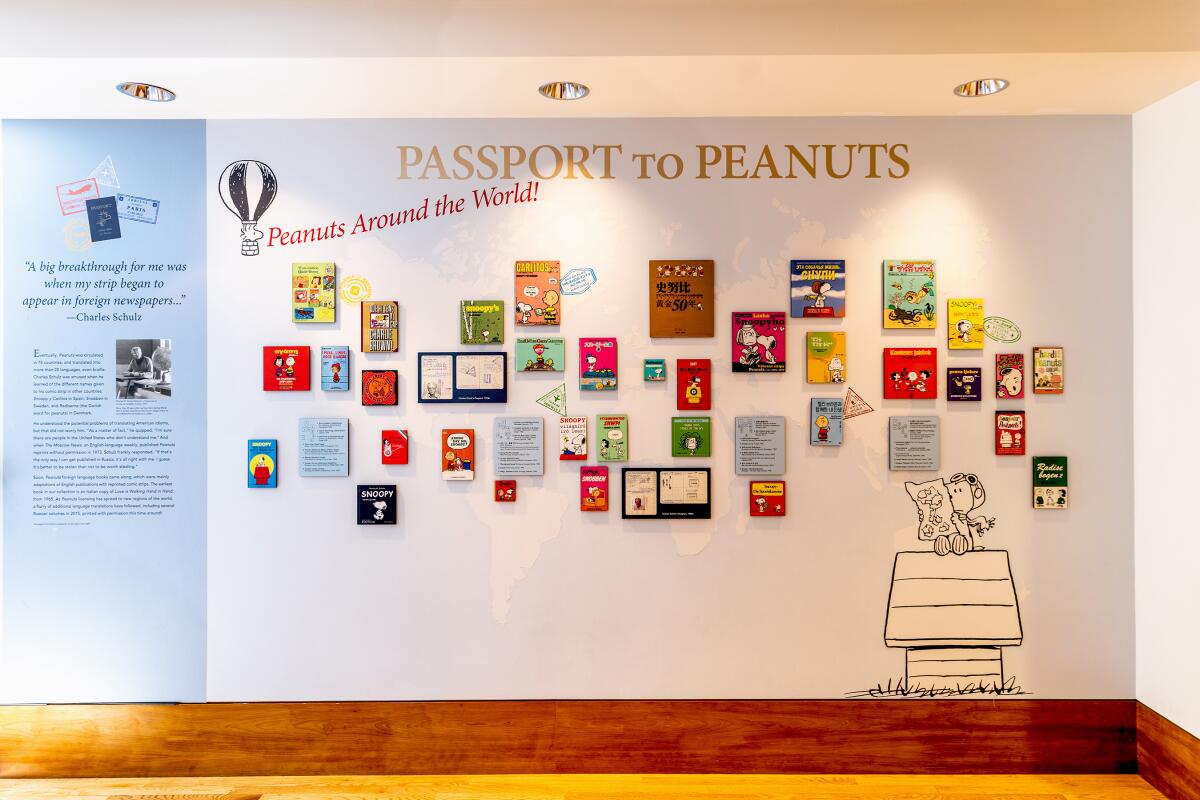
The Schulz Museum’s “Passport to Peanuts” exhibition emphasizes the comic’s global reach.
(Brennan Spark / Charles M. Schulz Museum)
Laurel Roxas felt similarly when they first discovered “Peanuts” as a kid while playing the “Snoopy vs. the Red Baron” video game on their PlayStation Portable. For Roxas, who is Filipino, it was Snoopy and not the “Peanuts” children who resonated most.
“Nobody was Asian. I was like, ‘Oh, I’m not even in the story,’” they said.
Because Snoopy was so simply drawn, Roxas added, he was easy to project onto. They felt similarly about Hello Kitty; with little identifying features or dialogue of their own, the characters were blank canvases for their own personification.
Roxas visited Snoopy Museum Tokyo with their brother last year. They purchased so much Snoopy merchandise — “everything I could get my hands on” — that they had to buy additional luggage to bring it home.
For some Snoopy enthusiasts, the high volume of Snoopy products borders on oversaturation, threatening to cheapen the spirit of the character.
Growing up, Bella Shingledecker loved the holiday season because it meant that the “Peanuts” animated specials would be back on the air. It was that sense of impermanence, she believes, that made the films special.
Now, when she sees stacks of Snoopy cookie jars or other trend-driven products at big-box stores like T.J. Maxx, it strikes her as a bit sad.
“It just feels very unwanted,” she said. For those who buy such objects, she said she can’t help but wonder, “Will this pass your aesthetic test next year?”
Lina Jeong, for one, isn’t worried that Snoopy’s star will fade.

“[Snoopy is] always able to show what he feels, but it’s never through words, and I think there’s something really poetic in that,” said Lina Jeong.
(Brennan Spark / Charles M. Schulz Museum)
Jeong’s affinity for the whimsical beagle was passed down to her from her parents, who furnished their home with commemorative “Peanuts” coffee table books. But she fell in love with Snoopy the first time she saw “Be My Valentine, Charlie Brown,” which she rewatches every Valentine’s Day.
This past year, she was fresh out of a relationship when the holiday rolled around and she found herself tearing up during scenes of Snoopy making Valentine’s crafts for his friends.
“Maybe I was hyper-emotional from everything that had happened, but I remember being so struck,” that the special celebrated platonic love over romantic love, Jeong said.
It was a great comfort to her at the time, she said, and she knows many others have felt that same solace from “Peanuts” media — especially from its dear dog.
“Snoopy is such a cultural pillar that I feel like fads can’t just wash it off,” she said.
Soon, she added, she plans to move those “Peanuts” coffee table books into her own apartment in L.A.



Business
Commentary: The latest government inflation and GDP figures are worthless, and will be for months to come

The federal government’s monthly releases of economic statistics — especially the inflation rate and growth as tracked by gross domestic product — have long occasioned partisan preening (or denunciation) and for a general public stock-taking of the health of the economy.
Not this month. This time, they’re the occasion for doubt and confusion.
On Dec. 18, the Bureau of Labor Statistics reported that inflation had fallen to an annual rate of 2.7% in November, down from 3% in September and well below the 3.1% consensus of economists. And on Tuesday, the Bureau of Economic Analysis reported that real gross domestic product had shot up by a surprising 4.3% annual rate in the third quarter of 2025 ended Sept. 30.
The numbers give you meaningful information about the system, but not about how people experience their actual lives.
— Zachary Karabell
Unsurprisingly, the Trump administration and its Republican acolytes seized on the figures to boast about Trump’s economic policies. White House economic advisor Kevin Hassett proclaimed the inflation figure to be “an absolute blockbuster report.” He described the GDP figure as “a great Christmas present for the American people.”
“America is winning again,” crowed House Speaker Mike Johnson (R-La.) after the GDP report. He called it “the direct result of congressional Republicans and President Trump delivering policies that drive growth and expand opportunity for American families and workers.”
Um, not so fast.
The economists whose jobs involve scrutinizing those statistics to glean what they really mean don’t view them as unalloyed support for Trumponomics. Quite the contrary. Many see them as artifacts of the long government shutdown, which halted the collection of data that go into those reports, severely distorting the results. Furthermore, they expect the flaws in those reports to persist well into 2026, undermining their usefulness as true economic indicators.
“You’ve got to take it with a grain of salt,” said Diane Swonk, chief economist at KPMG US, of the inflation report. “It’s confusing and it doesn’t quite square with prices that we’ve observed.”
A close examination of the GDP figures also underscores the narrow basis driving economic growth in recent months — it’s essentially the product of robust spending by wealthy consumers and massive corporate investments in AI technology. For middle- and lower-income Americans, the economic present and future don’t look anywhere as sunny as the numbers would suggest.
“The numbers give you meaningful information about the system, but not about how people experience their actual lives,” says financial analyst and economic commentator Zachary Karabell, whose 2014 book “The Leading Indicators” injected some perspective on how we interpret economic statistics and explained why our faith in them is often misplaced.
Indeed, consumer confidence has been sinking for months, according to the Conference Board. That points to an enduring question about the U.S. economy: Whose economy is it?
More than ever, it belongs to the rich, producing a “K-shaped” economy, which has been playing out in shopping patterns this holiday season, as my colleague Caroline Petrow-Cohen recently wrote.
According to Bank of America analysts, since this spring, spending by the highest-earning third of Americans has been soaring, while that of middle- and lower-income households has stagnated. In part that’s because the stock market has remained vibrant.
Since the top 20% of households as measured by income own about 87% of directly-held equities, stock market gains “tend to disproportionately benefit the higher-income cohort,” the BofA analysts noted. By contrast, “almost 30% of lower-income households appear to be living ‘paycheck to paycheck.’”
The highest-earning 10% of households now account for nearly half of all consumer spending, according to Moody’s Analytics. That’s the highest level since the data began to be collected in the 1980s, when the rich accounted for only about one-third of spending.
Job growth may already have turned negative, even if the published employment figures don’t yet show it, Federal Reserve Chairman Jerome Powell acknowledged during a Dec. 10 news conference following the Fed’s decision to lower interest rates by 0.25 percentage points.
Non-farm payroll gains have averaged about 40,000 a month since April, Powell observed. “We think there’s an overstatement in these numbers by about 60,000,” he said. “So that would be negative 20,000 per month.”
The divergence between the gross economic statistics and the lived experience of Americans is nothing new. It was remarked on by Robert F. Kennedy Sr. in a speech in March 1968, less than three months before his nascent presidential campaign was ended by an assassin’s bullet.
“Gross national product counts air pollution and cigarette advertising, and ambulances to clear our highways of carnage,” he observed. “It counts special locks for our doors and the jails for the people who break them. It counts the destruction of the redwood and the loss of our natural wonder in chaotic sprawl. It counts napalm and counts nuclear warheads and armored cars for the police to fight the riots in our cities. … Yet the gross national product does not allow for the health of our children, the quality of their education or the joy of their play. … It measures neither our wit nor our courage, neither our wisdom nor our learning, neither our compassion nor our devotion to our country, it measures everything in short, except that which makes life worthwhile.”
That brings us to the specific flaws in the latest statistics.
The government shutdown, which lasted 43 days from Oct. 1 to Nov. 12, was the most important cause of gaps in the collected data for the consumer price index calculation. As Swonk noted in a social media post, cutbacks at the BLS had already reduced the staff assigned to sampling prices by 25%. That prompted the agency to substitute “imputed” numbers for hard data.
“Those cases can show up as zeros in the percent change of the release,” Swonk wrote — obviously lowering the bottom-line figure. A sampling scheduled for mid-October had to be canceled, so figures dating from August were used instead — concealing any price increases in subsequent months.
A major problem concerns housing costs, which account for about one-third of the data inputs for the CPI. Because the BLS was unable to collect rental data for October, it implied that the monthly change in rents was 0% in October — further skewing the reported CPI lower. Experts say it will take at least six months to use newly collected data to provide a reliable estimate of housing inflation.
The delay in sampling, Swonk adds, means that some seasonal price phenomena were missed. She points specifically to airfares — the originally scheduled sampling would have incorporated a pre-Thanksgiving run-up in fares, but by the time the data were collected fares had returned to a non-holiday level.
Inflation data also are incorporated into GDP estimates — the lower the inflation rate, Swonk notes, the better the GDP looks. An artificially reduced inflation rate will translate into higher reported GDP growth.
All this might have a limited economic impact — corporations, banks and academic economists generally have sources other than the government to reach their conclusions — if not for the partisan political exploitation of the numbers.
As Karabell reported in his 2014 book, Simon Kuznets, the government statistician who helped to codify the collection of government figures in the 1930s, was concerned about how politics would give the statistics a misleading social significance.
“These numbers have turned into absolute markets of the human condition,” Karabell wrote, “when they are simply statistical descriptions of specific systems.”
Economists have warned that some economic factors haven’t yet fully played out. That includes Trump’s tariffs, which in their execution have been lower than they appeared on the surface, and higher healthcare premiums, which have been forecast or announced but won’t actually become effective until 2026.
If the job market continues to weaken, that will show up more vividly in 2026. The interplay between “a surging economy and a soft labor market,” argues Joseph Brusuelas, chief economist at the business consulting firm RSM, “is likely to be the major economic narrative next year.”

Four years ago, California startup Theta Labs’ cryptocurrency was soaring, and its future appeared bright when it landed a partnership with pop star Katy Perry.
The Bay Area company had built a marketplace for digital collectibles known as nonfungible tokens, or NFTs, and had teamed up with Perry to launch NFTs tied to her Las Vegas concert residency. Its THETA token jumped by more than 500% in early 2021, reaching a peak of more than $15, making it one of the world’s most valuable cryptocurrencies. Later in the year, the spotlight shone on the company when it announced the Perry partnership.
“I can’t wait to dive in with the Theta team on all the exciting and memorable creative pieces, so my fans can own a special moment of my residency,” Perry said in a June 2021 news release.
Today, like many cryptocurrencies, THETA is 95% off its 2021 peak. It took a hit this week after former executives accused it of manipulating markets to dupe consumers into buying its products. On Tuesday, it was trading at less than 30 cents.
Two former executives from Theta Labs sued the startup, alleging in separate lawsuits that the company and its chief executive, Mitch Liu, engaged in fraud and manipulated the cryptocurrency market for his benefit. Liu retaliated against them after the employees refused to engage in deceptive business practices and raised concerns, the lawsuits say.
Some of the alleged misconduct involved placing fake bids on Perry’s NFTs, engaging in token “pump and dump” schemes and using celebrity endorsements and “misleading” partnerships with high-profile companies such as Google to deceive the public, according to the December lawsuits filed in Los Angeles Superior Court.
Perry is not accused of any wrongdoing in the suit, and Theta denies the charges.
The lawsuits against Theta Labs are the latest controversy to rattle an industry beset by scandals.
Cryptocurrency exchange FTX collapsed, and its founder, Samuel Bankman-Fried, was sentenced to 25 years in prison in 2024 after being found guilty of multiple fraud charges. Binance founder and former Chief Executive Changpeng Zhao also got prison time after he pleaded guilty to violating money laundering laws, but President Trump pardoned him this year.
The U.S. Securities and Exchange Commission previously charged celebrities such as Kim Kardashian, Lindsay Lohan, Jake Paul and Ne-Yo for promoting crypto without disclosing they were paid to do so.
Theta Labs created a network that rewarded people with cryptocurrency for contributing spare bandwidth and computing power to enhance video streaming and lower content delivery costs. The company describes Theta Network as a “blockchain-powered decentralized cloud for AI, media and entertainment.” The network has two tokens: THETA, used to secure the network, and TFUEL, used to pay users for services and power operations.
The whistleblowers suing Theta Labs are Jerry Kowal, its former head of content, and Andrea Berry, previously the company’s head of business development.
“Liu used Theta Labs as his personal trading vehicle, perpetrating fraud, self-dealing, and market manipulation,” said Mark Mermelstein, Kowal’s attorney, in a statement. “His calculated ‘pump-and-dump’ schemes repeatedly wiped out employee and investor value. This suit is about demanding accountability and proving no one is above the law.”
Theta, Liu and its parent company, Sliver VR Technologies, deny the allegations and “intend to prove with evidence the fallacy of the stories being told in the lawsuits,” according to Kronenberger Rosenfeld, the law firm representing the defendants. The lawsuits are an attempt to paint the company in a negative light in hopes of securing a settlement, a lawyer for the firm said.
Kowal has sued his former employers before. In 2014, he accused Netflix of spreading false claims that he stole confidential information and Amazon of wrongful termination.
The latest lawsuits allege that Liu profited from buying and selling THETA tokens using insider knowledge about partnerships with celebrities, studios and others in the entertainment industry.
“Liu’s true motive in pursuing such partnerships was not to develop a sustainable content business but to generate publicity that could be used to artificially inflate token prices for Liu’s personal gain,” Kowal’s lawsuit says.
Kowal worked for Theta from 2020 to 2025.
In 2020, Liu traded and sold tokens knowing that the company would close a content licensing deal with MGM Studios, according to the lawsuit. After the deal’s announcement, THETA token’s market capitalization increased by more than $50 million in just 24 hours, the lawsuit says.
When NFTs started to take off in 2021, Kowal closed deals with high-profile partners such as Perry, Fremantle Media and Resorts World Las Vegas for the startup’s NFT marketplace.
As part of the deal with Perry, the singer received $8.5 million and additional warrants for the right to license her image and likeness for the NFTs.
To inflate the price and demand for these digital collectibles, Liu allegedly made bids on NFTs and directed employees to do the same. This led to people overpaying for the Perry NFTs.
Representatives for Perry didn’t immediately respond to a request for comment.
Multiple examples of alleged manipulation are outlined in the lawsuits. In one instance from 2022, the startup launched a new token called TDROP that employees also received as part of a bonus.
Liu gained control of 43% of the supply of the cryptocurrency, according to Kowal’s lawsuit. When the TDROP token reached a high, he then sold the token, and its price collapsed by more than 90% within months.
Berry’s lawsuit also alleges that Theta Labs announced “misleading” or fake partnerships with high-profile companies such as Google and entities including NASA to pump up the value of the THETA token. Theta paid for Google Cloud products but claimed it was a partner when it was a Google customer, according to the lawsuit.

Retired nurse Nancy Reed has been through the ringer trying to get insurance for her home next to a San Diego County nature preserve.
First, she was dropped by her longtime carrier and forced onto the state’s insurer of last resort, the California FAIR Plan, which offers basic fire policies — something thousands of residents have experienced at the hands of fire-leery insurance companies.
But what she didn’t expect was how hard it would be to find the extra coverage she needed to augment her FAIR Plan policy, which doesn’t cover common perils such as water damage or liability if someone is injured on a property.
She secured the “difference-in-conditions” policies from two insurers, only to be dropped by both before finally finding another for her Escondido home.
“I’ve lived in this house for 25 years, and I went from a very fair price to ‘we’re not insuring you anymore’ — and I’ve had three different difference-in-conditions policies,” said Reed, 71, who is paying about $2,000 for 12 months of the extra coverage. “And I’m holding my breath to see if I will be renewed next year.”
Now, a Department of Insurance regulation that would have required the FAIR plan to offer that additional coverage has been blocked by a state appeals court — leaving the plan’s customers to find that insurance in a market widely considered dysfunctional.
The court ruled earlier this month that the order would have forced the plan to offer liability insurance, which was not the intent of the Legislature when it established the plan in 1968 to offer essential insurance for those who couldn’t get it.
“We appreciate that the court confirmed the California FAIR Plan is designed and intended to operate as California’s insurer of last resort, providing basic property coverage when it cannot be obtained in the voluntary market,” said spokesperson Hilary McLean.
Insurance Commissioner Ricardo Lara said he is “looking at all available options” following the decision. “I’ve been fighting so people can have access to all of the coverage the FAIR Plan is required by law to provide,” he said in a statement.
Lara has faced criticism from consumer advocates who’ve called for his resignation over his response to the state’s ongoing property insurance crisis.
A FAIR Plan policy covers fires, lightning, smoke damage and internal explosions, as well as vandalism and some other hazards at an additional cost. But in addition to water damage and liability protection, it doesn’t cover such common perils as theft and the damage caused by trees falling on a house.
The demand for the additional coverage — commonly referred to as a “wrap-around” policy — has become even greater than in 2021 when Lara issued the order overturned on appeal.
The FAIR Plan at the time had about 160,000 active dwelling policies following a series of catastrophic wildfires, including the 2018 fire that nearly destroyed the mountain town of Paradise. By September, that number had grown to 646,000.
The insurance department lists less than two dozen companies that offer wrap-around policies, including major California home insurers such as Mercury and Farmers and a a number of smaller carriers.
Broker Dina Smith said that to find the coverage for her home insurance clients she needs to place about 90% of them with carriers not regulated by the state — with the combined coverage typically costing at least twice as much as a regular policy.
“The [market] is very limited,” said Smith, a managing director at Gallagher.
Safeco has not written California wrap-around coverage since the beginning of the year and will begin non-renewing existing policies next month. Smith also said carriers are being selective, with the ones that offer the coverage often demanding exclusions, such as for certain types of water damage.
“If I’ve got a newer home with no prior claims … for liability losses, it’s going to be easy to write. If I get a home that is built in the 1950s that might still have galvanized pipes … that’s going to be a tough one,” she said.
Attorney Amy Bach, executive director of United Policyholders, a San Francisco consumer group, said the difference-in-conditions, or DIC, market is getting just as problematic for homeowners as the overall market.
“The market is not as strong as it needs to be … given how many people are in the FAIR Plan, and there aren’t as many DIC options — with the DIC companies being just as picky as the primary insurers,” she said.
There is also confusion about the policies, she said. Her group is considering pushing for a law next year that would clearly label the coverage so consumers better understand what they are buying.

I re-created Google’s cute Gemini ad with my own kid’s stuffie, and I wish I hadn’t

Pope Leo XIV delivers first Christmas message calling for end to violence in Middle East, Russia-Ukraine war

Trump lists accomplishments, says ‘Radical Left Scum’ are ‘failing badly’ in Christmas message

Widely prescribed opioid shows minimal pain relief and higher heart risk, study finds

NFL’s Christmas games lose major star power as key quarterbacks sidelined with injuries

Florida High School Football Rankings: Top 25 teams – Oct. 21

Cleary's 21 help Le Moyne down Central Connecticut State 69-64 in OT

How old is Bo Nix? What to know about Oregon quarterback ahead of 2024 NFL Draft

99th annual Pony Swim held in Virginia

Video: ‘It Didn’t Have to Happen This Way:’ U.Va. Faculty Call for Review of Police Response to Protests
Trump lists accomplishments, says ‘Radical Left Scum’ are ‘failing badly’ in Christmas message

Ukraine accepts demilitarised zone to end Russia war, but do DMZs work?

Into the void: how Trump killed international law

Nearly 20 states sue HHS over declaration to restrict gender transition treatment for minors

Europe defends its digital rules after US targets Breton with visa ban
-

 Maine1 week ago
Elementary-aged student killed in school bus crash in southern Maine
-

 New Mexico1 week ago
Family clarifies why they believe missing New Mexico man is dead
-

 Massachusetts1 week ago
MIT professor Nuno F.G. Loureiro, a 47-year-old physicist and fusion scientist, shot and killed in his home in Brookline, Mass. | Fortune
-

 Detroit, MI1 week ago
‘Love being a pedo’: Metro Detroit doctor, attorney, therapist accused in web of child porn chats
-

 Health1 week ago
‘Aggressive’ new flu variant sweeps globe as doctors warn of severe symptoms
-

 World6 days ago
Putin says Russia won’t launch new attacks on other countries ‘if you treat us with respect’
-

 Culture1 week ago
Try This Quiz and See How Much You Know About Jane Austen
-

 Education1 week ago
Video: How We Tested Earplugs for Sleeping