Business
SEC has issued a subpoena to bankrupt carmaker Fisker, indicating possible probe

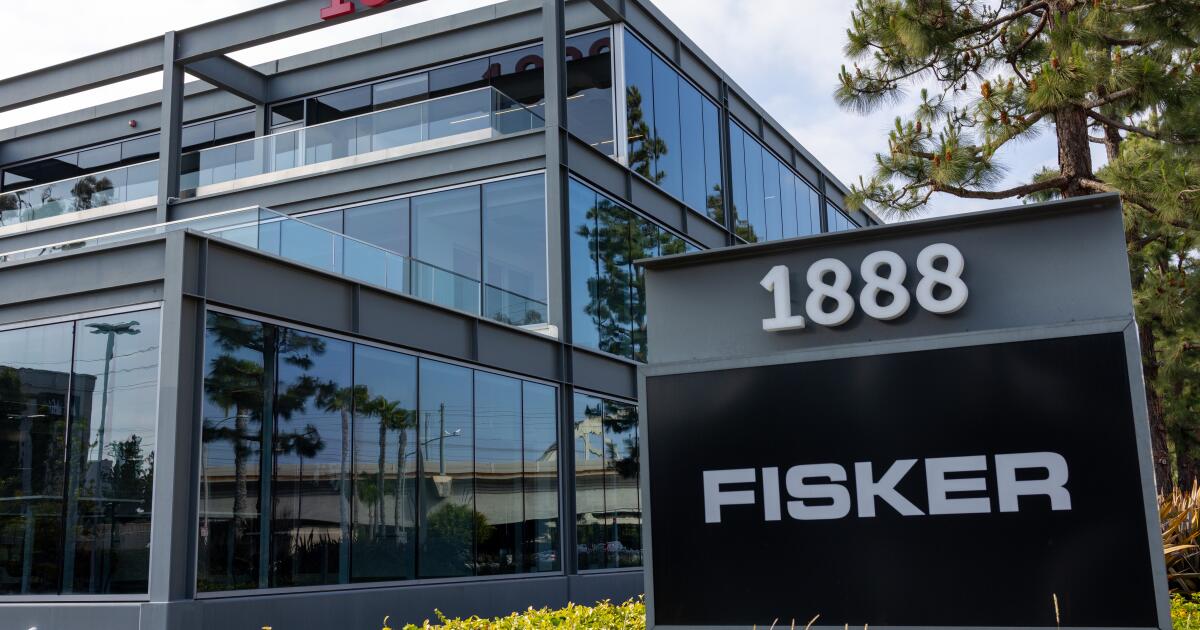
Fisker Inc. has received a subpoena from the Securities and Exchange Commission, indicating the bankrupt Southern California electric vehicle maker could be under investigation by Wall Street’s top cop, according to a court filing.
SEC subpoenas, which typically seek either records or testimony, are confidential, but a mention of the agency’s demand for information was included in a U.S. Bankruptcy Court filing this week in Delaware, where the troubled automaker filed for Chapter 11 protection on June 18 under a heavy debt load. The subpoena was included in a list of ongoing legal proceedings against Fisker; the filing did not provide any details about why the agency issued the subpoena.
As the company’s stock price has plummeted, shareholders have experienced large stock losses. Fisker is a defendant in a pending shareholder class-action lawsuit and five shareholder derivative complaints regarding a sharp drop in its stock price last fall. Derivative suits are filed by shareholders on behalf of the company and typically accuse officers or directors of wrongdoing.
Shaneeda Jaffer, a white-collar defense attorney at Benesch in San Francisco, said that although it’s an “absolute possibility” that Fisker is the target of an investigation, the agency also issues subpoenas to parties that might be able to provide information about other probes.
“Or you could be a subject of an investigation where you haven’t necessarily been put in either of those buckets. Companies and individuals receive subpoenas from the SEC all the time,” she said.
If wrongdoing is found, SEC investigations can lead to civil allegations or referrals to the Department of Justice for potential criminal investigation and possible charges.
A spokesperson for the agency said it does not comment on whether it is conducting an investigation. Fisker also declined to comment.
Fisker, based in Manhattan Beach until it moved to Orange County earlier this year, was founded in 2016 by auto designer Henrik Fisker. It went public in 2020 amid a surge of investor interest in electric vehicles, raising about $1 billion in capital, and was valued at close to $8 billion a year later.
Fisker’s stock reached an all-time high of $31.96 in March 2021 before dropping below $10 the next year and falling off a cliff late last year to under $2 a share. It now trades for less than a penny.
Last year, it released its first model, an SUV called the Ocean that was intended to compete with Tesla’s Model Y. But it had trouble meeting production goals at its contract manufacturer in Austria and delivering the vehicles to customers. The car also was plagued by software glitches. The company was reportedly in talks this year with Nissan to build a pickup truck domestically but failed to reach an agreement.
The lawsuits similarly allege that Henrik Fisker, the company’s chairman and chief executive; his wife, Geeta Gupta-Fisker, the company’s co-founder and chief financial and operating officer; and others, including board members, violated their fiduciary duties and/or securities laws. The company declined comment.
The allegations generally stem from a series of events that began with a news release issued in August 2023 that stated Fisker would produce up to 23,000 Oceans that year. However, it disclosed in November that in the third quarter it had built only 4,725 of the vehicles, with 1,097 delivered to customers.
The company also announced in November that its third-quarter results would be delayed due to the departure of its chief accounting officer, whose replacement resigned within days. When it released the results, Fisker said it had to make “material adjustments” to its financials and had identified a “material weakness in internal controls.” The company’s share price fell that month by more than half, to less than $2.
James Lucas, 52, a Fisker shareholder who said he lost more than $100,000 investing in the company, said shareholders also are angry over a series of media appearances by Henrik Fisker during which he touted the company’s prospects, even as its fortunes declined.
“There were a lot of comments made by mostly Henrik Fisker that had these kind of broad visions about the number of vehicles that were going to be produced. Whether it was just a failure to execute, who knows,” said the L.A. County resident. “As an investor you take senior managers’ word on a lot of things.”
Lucas, who participates in a Telegram group of Fisker investors, said he has filed complaints with the SEC against Fisker citing multiple issues and believes other aggrieved investors also have done so.
In March 2023, before the company had released the Ocean, Fisker boasted on CNBC that the automaker would make money on the first cars it shipped because its vehicle was being built by its contract manufacturer. “I can just sit counting the cash,” he said during the interview, which included a projection that Fisker would sell 1 million cars in 2027.
One year later on March 1, Fisker told an interviewer on Bloomberg TV that the company would “conservatively” deliver 20,000 to 22,000 to a new dealer network it had decided to put together. “In fact, we have a few dealers telling us, are you sure you can deliver us enough cars because we think we can sell more cars than what you’re offering us right now,” he said.
That same day, he told Yahoo Finance that he was confident the share price would rise above $1 a share to avoid being delisted from the New York Stock Exchange. “I feel very optimistic about our future,” he said. The shares were delisted the next month.
Fisker produced only somewhat more than 10,000 vehicles before it filed for bankruptcy.
With the stock now trading for less than a penny in bankruptcy, Henrik Fisker has suffered big losses too, with his stake in the company worth little to nothing. But he also sold about $20 million worth of stock in 2021 well before the steep decline.
The company said that Henrik Fisker was not speaking to the media.
Andrew Fiorella, a securities litigator in Cleveland also at Benesch, said it was highly unlikely Fisker shareholders would be able to recover their losses, given that secured debt holders and others with claims against the bankrupt company have priority over common shareholders.
“There’s almost certainly going to be nothing left at the end of the day,” he said.
Fisker is not the only California startup electric vehicle maker that has experienced troubles amid a sales slowdown that is at least partially attributable to a rise in interest rates that has made financing more costly.
Rivian in Irvine and Lucid in the Bay Area, which both went public in 2021, also have seen sharp price declines as the hype over EVs has faded. However, each company has deep-pocketed institutional investors, and both are still operating.


A proposal to build a truck parking lot near the Port of Los Angeles is facing backlash from nearby residents.
Port officials say the parking lot would provide much-needed designated space for cargo trucks waiting to pick up loads from the port, helping to ease congestion in the area.
But some neighborhood groups say the proposed staging area would only increase traffic and air pollution in Wilmington.
Gina Martinez, chair of the executive board of the Wilmington Neighborhood Council, said the land in question provides a vital buffer between port activity and residential communities.
“It’s been a bad deal from the beginning,” Martinez said in an interview. “We want open space because we’ve been promised for decades a clear separation from port activities.”
The Los Angeles Harbor Commission signed off on the project in a meeting on June 11, but it was vetoed by the Los Angeles City Council this week.
The veto does not permanently ban the project, but allows for more time to discuss the implications for stakeholders and the community.
Los Angeles City Councilmember Tim McOsker, who introduced a special motion to halt the truck plans, said he was acting on behalf of community residents. McOsker represents Harbor City, Harbor Gateway, San Pedro, Watts, and Wilmington.
“Generally, folks in the community would say, ‘we don’t want the port industrial properties to creep into neighborhoods. We want them to retract or hold the line,’” McOsker told The Times.
The John S. Gibson Truck & Chassis Parking Lot, which was originally proposed in 2023 by the Port of Los Angeles, would cover 18 acres of privately owned land and include 393 truck and chassis parking stalls.
The land is currently designated as open space, though it’s undeveloped and not available for any recreational use. The completion of the parking lot would require a Port of Los Angeles master plan amendment to switch the land’s designation from open space to maritime support.
Martinez said the land should have never been sold to private developers because it’s included in the California State Lands Commission’s tidelands trust, which says certain land near the ocean must be available for public enjoyment.
Building a truck and chassis waiting lot on that space would increase congestion on the freeways and in Wilmington neighborhoods, add particulate matter into the air and increase already-problematic noise pollution from the port, she said.
“Of all the things Wilmington needs, it is not another parking lot for trucks,” Martinez said at a Los Angeles Harbor Commission meeting earlier this month. “It is not the responsibility of our community to take on every single truck that runs through the port.”
At the same meeting, Noel Gould of the Coastal San Pedro Neighborhood Council said the council is supporting the project after working closely with the developers to reach compromises.
The parking lot would prevent port-bound trucks from idling near schools and parks, he said. The lot would also include landscaping with native coastal plants.
“We didn’t start out in a position of support, but we worked very closely with them to get to a place where we felt it was really something that would benefit the community,” Gould said at the meeting.
In an interview, McOsker said there is already space set aside for trucks to wait to access the port.
At the Los Angeles City Council meeting Wednesday, the council unanimously approved what’s known as a 245 motion, which gives the council authority to temporarily veto certain actions taken by city boards and commissions.
“The 245 gives us the opportunity to meet and confer and see if there are revisions or additions or mitigation that can better protect the full community,” McOsker said.
The motion sends the project proposal back to the Harbor Commission for further review.
Supporters of the parking lot say the land is currently uninhabited and requires consistent police presence to deter criminal activities.
The Port of Los Angeles also clashed with coastal communities last year over the possible raising of the Vincent Thomas Bridge. The bridge was already slated to be redecked by the California Department of Transportation, but Port of Los Angeles executive director Gene Seroka proposed raising the bridge height as well.
Raising the bridge would allow larger cargo ships to pass under its deck, helping create jobs and keep the port relevant, Seroka said at the time. Most painfully for local commuters and businesses, it would mean the bridge will be closed for around 28 months rather than the originally planned 16 months.
Last December, the California State Transportation agency rejected the proposal to raise the bridge.
Business
Commentary: Puncturing the myth of Alan Greenspan, whose policies gave us the Great Recession

Noah Cross, the archvillain of the movie “Chinatown,” had the definitive line on how old age brings respectability. “‘Course I’m respectable,” he tells Jake Gittes. “I’m old. Politicians, ugly buildings and whores all get respectable if they last long enough.”
I wouldn’t necessarily slot former Federal Reserve Chairman Alan Greenspan into any of those categories, but the general reaction to his death Monday at age 100 puts the lie to Cross’ observation.
As much as he was revered during his nearly two decades as Fed chairman for protecting the stock market from a series of crashes and near-crashes, his obituaries take a more measured view. The headline on the Wall Street Journal’s main take on his legacy is: “The Myth of Alan Greenspan as ‘The Maestro.’”
Stripped of its academic jargon, the welfare state is nothing more than a mechanism by which governments confiscate the wealth of the productive members of a society to support a wide variety of welfare schemes.
— Alan Greenspan, writing as an Ayn Rand cultist (1966)
The Journal blames Greenspan for fostering “the great credit mania of the mid-2000s” and observes that “the music stopped in 2008, producing the panic that did so much harm to the free-market economy that Greenspan promoted.” That was the Great Recession, which started with the 2008 crash in the housing market and persisted into 2012.
That is from a publication that was more or less in accord with Greenspan’s goals of less regulation and lower taxes. His contemporary adversaries were harsher. “R.I.P. Alan Greenspan: You were charming, thoughtful, powerful, and wrong,” writes Robert Reich, who served as Bill Clinton’s Labor secretary while Greenspan led the Fed.
The Great Recession, “in which in which millions of Americans lost their jobs, their savings, and even their homes — resulted from the deregulation of Wall Street that Greenspan advocated,” Reich wrote. But he had to admit that Greenspan’s “iron grip” over Fed policy forced Clinton “to do exactly what Greenspan wanted — which was to reduce the federal budget deficit and thereby destroy much of the agenda Clinton ran on.”
It would be unfair to depict Greenspan’s influence as invariably pernicious. Social Security advocates still think highly of his work chairing the so-called Greenspan Commission of 1982-1983, which developed a series of changes in benefits and revenues for that program to address a looming, immediate fiscal crisis.
Greenspan led the bipartisan panel “masterfully,” recalls William J. Arnone, the former chief executive of the National Academy of Social Insurance, who witnessed its deliberations as a consultant to the New York Citizens Committee on Aging.
Before the commission’s formation, “Republicans and Democrats fiercely disagreed over underlying data,” Arnone told me. “Greenspan used his expertise as an economic empiricist to convince both sides to agree on a singular, shared set of actuarial facts. Quite an accomplishment.”
To the public, Greenspan was known for his impenetrably cryptic speaking style and for the relative tranquility in the American economy during his tenure, which has been termed “the great moderation” despite recurrent short-term crises.
Greenspan was the second-longest serving Fed chair. But he may have had the weirdest background. Having grown up in an affluent New York household, he was talented enough on clarinet and saxophone to have sat in with Stan Getz’s band and attended Juilliard for a time.
He began his economics education in 1945 at New York University and got as far as a master’s degree, but by then he was already working on Wall Street, where his skill at financial analysis propelled him toward the top echelons of high finance.
Somewhere along the line he fell in with the arch-libertarian Ayn Rand, becoming part of her inner circle of economic cultists. Referring to his dour mien and predilection for charcoal gray garb, Rand called him her “undertaker.”
Greenspan provided a veneer of rigorous economic analysis for Rand’s ideology, which lionized the rich and described them as fighting a ferocious battle with the lazy and grasping hoi polloi. He contributed three essays to her 1966 anthology “Capitalism: The Unknown Ideal.”
His association with Rand was seldom highlighted during his Fed tenure, but even a casual reading of those essays exposes the Randian underpinnings — and the Randian self-contradictions — of his Fed policies.
One essay defended the gold standard, which had been discredited in the 1930s. Greenspan blamed “welfare-state advocates” for the developed world’s abandonment of the gold standard.
He wrote, “Stripped of its academic jargon, the welfare state is nothing more than a mechanism by which governments confiscate the wealth of the productive members of a society to support a wide variety of welfare schemes…. Gold stands in the way of this insidious process. It stands as a protector of property rights” — language that could have come right out of the text of Rand’s “Atlas Shrugged.”
Another essay called for the dismantling of government regulators such as the Food and Drug Administration and the Securities and Exchange Commission. Greenspan’s argument was that the consumer was adequately protected by the businessman’s profit-seeking, which in turn depended on maintaining a reputation for honesty and fair-dealing.
For drug companies, he wrote, “the loss of reputation through the sale of a shoddy or dangerous product would sharply reduce the market value of the drug company.” The same goes for securities brokers — “The slightest doubt as to the trustworthiness of a broker’s word or commitment would put him out of business overnight.”
One might ask what inspired Greenspan’s faith in, well, the faithfulness of business enterprises, given centuries of proof otherwise. Anyway, he refuted his own argument. “The guiding purpose of the government regulator is to prevent rather than to create something,” he wrote. “He gets no credit if a new miraculous drug is discovered by drug company scientists; he does if he bans thalidomide.”
He didn’t bother to question why his trustworthy drug companies had tried to market as a morning-sickness drug in the U.S. a formulation that already had been shown to produce severe birth defects in the children of mothers who took it overseas. (American families were largely saved from this tragedy by Frances Oldham Kelsey, who blocked its importation as an official of, yes, the FDA.)
To stock market investors, Greenspan’s chief legacy was the “Greenspan Put.” This was an implicit commitment by the Fed to counteract sharp declines in the market by pumping liquidity into the economy through the mass purchase of Treasury bonds.
The term comes from the options market, in which a “put” gives the holder the right to sell the underlying stock at a set price in the future, even if the market price has fallen below that price. In effect, it establishes a floor to the investor’s losses in a downturn.
The Greenspan put first appeared on Oct. 19, 1987, when the stock market suffered its greatest one-day percentage crash ever, 20.47%. Greenspan had been in office for only a few weeks, but his Fed issued a statement promising to inject liquidity into the system and cut interest rates. “We will back you,” he told bankers in a series of phone calls.
In truth, Greenspan had no legal authority to make that pledge. In any event, the market recovered the next day, and the Fed’s image as a willing bulwark against market declines was born.
The problem was that the idea that the Fed would act in a market crisis encouraged ever more flagrant risk-taking on Wall Street.
The harvest was a series of crises, notably the 1998 collapse of the hedge fund Long Term Capital Management, which was founded by Nobel economics laureates to pursue abstruse arbitrage trades. It was brought low by market moves that confounded their projections. LTCM was so deeply embedded in Wall Street trading it had to be saved with a $3.6-billion bailout the Fed orchestrated.
The Greenspan put, like so many other such grand schemes, worked well right up until it stopped working. That moment came in 2008, with a crash and a long, throbbing hangover.
Testifying to Congress in 2008, Greenspan acknowledged that maybe self-regulation, that watchword of his economic worldview, didn’t work.
“I made a mistake in presuming that the self-interest of organizations, specifically banks and others, were such that they were best capable of protecting their own shareholders and their equity in the firms…. Something which looked to be a very solid edifice, and, indeed a critical pillar to market competition and free markets, did break down.”
That, he said, “shocked me.” It was a rare admission of blame by a man who, as my former colleagues Thomas S. Mulligan and Don Lee reported in their Greenspan obituary, had told CNBC a few months earlier that he had “no regrets” about his policies.

San José tech company Cisco plans to cut 471 workers in three Bay Area offices, according to layoff notices filed to a state agency.
The company, which provides networking devices along with other services including video conferencing and cybersecurity, told employees in May that it was going to cut fewer than 4,000 jobs or less than 5% of its workforce.
The notices, processed by the California Employment Development Department this week, provide more details about what jobs Cisco will cut in California.
The artificial-intelligence boom has fueled more investments in data centers, commercial real estate and other areas. But advancements in AI tools have also been reshaping jobs, especially in Silicon Valley, the epicenter of the tech industry.
Cisco’s layoffs in California impacted workers in its San José, Milpitas and San Francisco offices. The company cut a variety of roles in software engineering, product management, design, business operations and other areas, the notices show.
Cisco said it didn’t have anything additional to share beyond what it published in May about its restructuring plans.
Tech companies have been citing various reasons for layoffs including prioritizing investments in artificial intelligence. As workers use AI-powered tools to generate code, words and other content, some executives have said they don’t need as many employees. There’s also skepticism, though, about how big a role AI is playing at companies with a large amount of workers globally.
From January to May, U.S. technology companies announced 123,653 cuts, up 66% from the same period in 2025, according to a June report from global outplacement and executive coaching firm Challenger, Gray & Christmas. The firm said that AI was the leading reason companies cited for cuts but it still isn’t the “jobpocalypse some predicted.”
Meta, Snap, Block, Oracle and Amazon are among tech companies that have announced mass layoffs this year.
Cisco markets itself as a company that “provides critical infrastructure for the AI era” and has benefited from the AI boom, reaching a record revenue of $15.8 billion in the third quarter this year. The company’s net income grew 35% to $3.4 billion year-over-year during that quarter.
Cisco Chief Executive Chuck Robbins told employees in May it’s cutting costs in certain areas while prioritizing other investments. That includes employee use of AI across the company.
He said Cisco will be among winners in the AI era, but that means “making hard decisions — about where we invest, how we’re organized, and how our cost structure reflects the opportunity in front of us.”
As of July 2025, Cisco had roughly 86,200 employees, according to its annual report.
-

 New York53 minutes ago
Metropolitan Diary Challenge Day 1: What Is Your N.Y. Story?
-

 Los Angeles, Ca60 minutes ago
LASD releases video of man shot by deputy after allegedly charging them with knife
-

 Detroit, MI1 hour ago
Rick Mahorn returns to coaching Detroit basketball with BIG3 Amps
-

 San Francisco, CA1 hour ago
Suspect arrested after shooting near San Francisco Pride events, police say
-

 Dallas, TX2 hours ago
Dallas shooting injures 2 as police search for suspect
-

 Miami, FL2 hours ago
Colombia wins Group K after 0-0 draw with Portugal in Miami Stadium; both teams advance to World Cup knockouts
-

 Boston, MA2 hours ago
Beyond the frame: ‘Where’s Boston?’ revisited through new oral histories – Boston News, Weather, Sports | WHDH 7News
-

 Denver, CO2 hours ago
Arizona Cardinals will face Denver Broncos QB Bo Nix for 1st time

