Business
RFK Jr. Sought to Stop Covid Vaccinations 6 Months After Rollout


Robert F. Kennedy Jr., President-elect Donald J. Trump’s choice to lead the nation’s health agencies, formally asked the Food and Drug Administration to revoke the authorization of all Covid vaccines during a deadly phase of the pandemic when thousands of Americans were still dying every week.
Mr. Kennedy filed a petition with the F.D.A. in May 2021 demanding that officials rescind authorization for the shots and refrain from approving any Covid vaccine in the future.
Just six months earlier, Mr. Trump had declared the Covid vaccines a miracle. At the time Mr. Kennedy filed the petition, half of American adults were receiving their shots. Schools were reopening and churches were filling.
Estimates had begun to show that the rapid rollout of Covid vaccines had already saved about 140,000 lives in the United States.
The petition was filed on behalf of the nonprofit that Mr. Kennedy founded and led, Children’s Health Defense. It claimed that the risks of the vaccines outweighed the benefits and that the vaccines weren’t necessary because good treatments were available, including ivermectin and hydroxychloroquine, which had already been deemed ineffective against the virus.
The petition received little notice when it was filed. Mr. Kennedy was then on the fringes of the public health establishment, and the agency denied it within months. Public health experts told about the filing said it was shocking.
John Moore, a professor of immunology at Weill Cornell Medical College, called Mr. Kennedy’s request to the F.D.A. “an appalling error of judgment.” Gregg Gonsalves, an epidemiologist at the Yale School of Public Health, likened having Mr. Kennedy lead the federal health agencies to “putting a flat earther in charge of NASA.”
Dr. Robert Califf, commissioner of the Food and Drug Administration, described Mr. Kennedy’s effort to halt the use of Covid vaccines as a “massive error.”
Mr. Kennedy’s transition spokeswoman did not respond to requests for comment, but has said recently that he does not want to take vaccines away.
Asked in November by an NBC reporter about his general opposition to Covid vaccines — and whether he would have stopped authorization — Mr. Kennedy said he was concerned that the vaccines did not prevent transmission of the virus.
“I wouldn’t have directly blocked it,” he said. “I would have made sure that we had the best science, and there was no effort to do that at that time.”
Mr. Kennedy’s early opposition to Covid vaccines has alarmed public health experts, many of whom contend that it should disqualify him from overseeing health agencies with the power to authorize, monitor and allocate funding for millions of vaccines each year.
They are also concerned about how he might handle a possible bird flu pandemic, which could necessitate a rapid deployment of vaccines.
As Mr. Kennedy prepares for his confirmation hearings before two Senate committees, he and his allies have insisted that he is not anti-vaccine.
In fact, in mid-2023, he told a House panel that he had taken all recommended vaccines — except for the Covid immunization.
At his confirmation hearings, he’ll most likely face scrutiny of his broader statements on vaccines, including that the polio vaccine cost more lives than it saved.
Mr. Trump has stepped forward in recent weeks to defend Mr. Kennedy after The New York Times reported that one of Mr. Kennedy’s lawyers had previously petitioned the F.D.A. to revoke approval or pause distribution of several polio vaccines over safety concerns.
“I think he’s going to be much less radical than you would think,” Mr. Trump said last month.
After the Times report, Mr. Trump and Mr. Kennedy expressed their support for the polio vaccine.
If confirmed by the Senate as secretary of the Health and Human Services Department, Mr. Kennedy would assume oversight of $8 billion in funding for the Vaccines for Children program and would have the authority to appoint new members to a panel that makes influential vaccine recommendations to states.
At the time Mr. Kennedy challenged the Covid vaccines, some of his objections touched on wider concerns about their rapid development. Emergency-use authorization — a preliminary form of approval — for immunizations was unusual. Others argued that a public health emergency dictated a speedier rollout.
Dr. Jennifer Nuzzo, director of the Pandemic Center at Brown University School of Public Health, said it would be reasonable to debate whether Covid vaccines should have been subject to additional study.
But she profoundly disagreed with Mr. Kennedy’s views, saying that “the idea that in early 2021 that you could be saying that people over the age of 65 don’t need Covid vaccines — that’s just nuts.”
Vaccines have rare side effects, and there have been cases of injury from the Covid shots. Government officials weigh the harms against the potential to save lives. An estimate released in early 2024 found that the Covid vaccines and mitigation measures saved about 800,000 lives in the United States.
Another study found that in late 2021 and 2022, Covid death rates among unvaccinated people were 14 times the rates of those who had received a Covid booster shot. Researchers also estimated that from May 2021 through September 2022, more than 230,000 deaths could have been prevented among people who declined initial Covid inoculations.
From the start of the Covid vaccine campaign, Mr. Kennedy’s view that the Covid vaccines were dangerous put him at odds with Mr. Trump, whose Operation Warp Speed to develop the vaccines was one of his policy triumphs. And Mr. Kennedy went on a concerted campaign against the vaccine.
Mr. Kennedy told Louisiana lawmakers in late 2021 that the Covid vaccine was the “deadliest vaccine ever made.”
He has remained a plaintiff in a lawsuit against President Biden and others, contesting efforts by government officials to limit his ability to suggest on social media that Covid vaccines were not safe.
In January 2021, Mr. Kennedy suggested on Facebook that the death of the baseball legend Hank Aaron, 86, was related to a Covid vaccine he had received 17 days earlier. It was “part of a wave of suspicious deaths” following Covid vaccines, he claimed. A doctor who was vaccinated alongside Mr. Aaron and the county medical examiner dismissed the claim.
In May, when Mr. Kennedy petitioned the F.D.A. to “immediately remove Covid vaccines from the market,” he was joined by Dr. Meryl Nass, a member of the Children’s Health Defense scientific advisory board and a physician in Maine.
Her medical license was initially suspended on an emergency basis in early 2022 for prescribing ivermectin and hydroxychloroquine to patients with severe cases of Covid, including one who was intubated, Maine medical board records show.
She later sued the board, claiming that it retaliated against her for exercising her right to free speech. The case is pending.
In 2022, Mr. Kennedy and others filed a lawsuit against the F.D.A. on behalf of Children’s Health Defense and parents who said they were concerned that their children would be given Covid vaccines without their knowledge or consent. The amended lawsuit, filed in July 2022, sought a court order requesting that the agency reconsider granting authorization for Pfizer and Moderna Covid vaccines for children.
A Texas appeals court dismissed the case in early 2024, concurring with a lower court that the plaintiffs did not face a “concrete or imminent” risk of harm. In June, the Supreme Court declined to hear an appeal.
Mr. Kennedy also sent letters to the F.D.A. threatening legal action if vaccine authorizations for children were granted.
Covid vaccines by Pfizer and Moderna for infants and children 6 months to 11 years old remain in use under emergency authorization, according to the F.D.A. Spokesmen for Pfizer and for Moderna said the companies are pursuing full approval for all ages.
Mr. Kennedy claimed in the censorship case that top Biden administration officials had coerced social media platforms to silence him, mostly during the summer of 2021. At the time, vaccine rates were stalling. People who were not vaccinated began to die at higher rates. Some who died were young; their loved ones said they were confused by conflicting messages on social media — or regretted that they had not gotten the vaccine.
Records in the lawsuit outline a briefing that summer with Jen Psaki, the White House press secretary at the time, and Dr. Vivek Murthy, the U.S. surgeon general, both of whom criticized social media companies for allowing the spread of misinformation that was influencing people against vaccination.
“And we can’t wait longer for them to take aggressive action because it’s costing people their lives,” Dr. Murthy said on July 15, 2021.
Mr. Biden expressed outrage the following day, telling reporters that social media companies that hosted vaccine misinformation were “killing people.”
In legal filings, Mr. Kennedy said that he had been named one of the “Disinformation Dozen” by a prominent advocacy group — and that he was one of the people the White House was targeting. Exhibits in the lawsuit show that White House officials leaned on social media companies to take down misinformation.
Within a month, a senior Facebook executive reported to Dr. Murthy that it had removed a number of pages or groups, including Mr. Kennedy’s, court records show.
The Supreme Court dismissed an associated case last summer, and an appeals court dismissed Mr. Kennedy’s case late last year. Lawyers representing Mr. Kennedy and others are still working on obtaining depositions of about 30 people, mostly Biden administration officials.
Sheryl Gay Stolberg and Dylan Freedman contributed reporting.



Business
‘It’s killing everything.’ California’s truckers are buckling under country’s priciest diesel
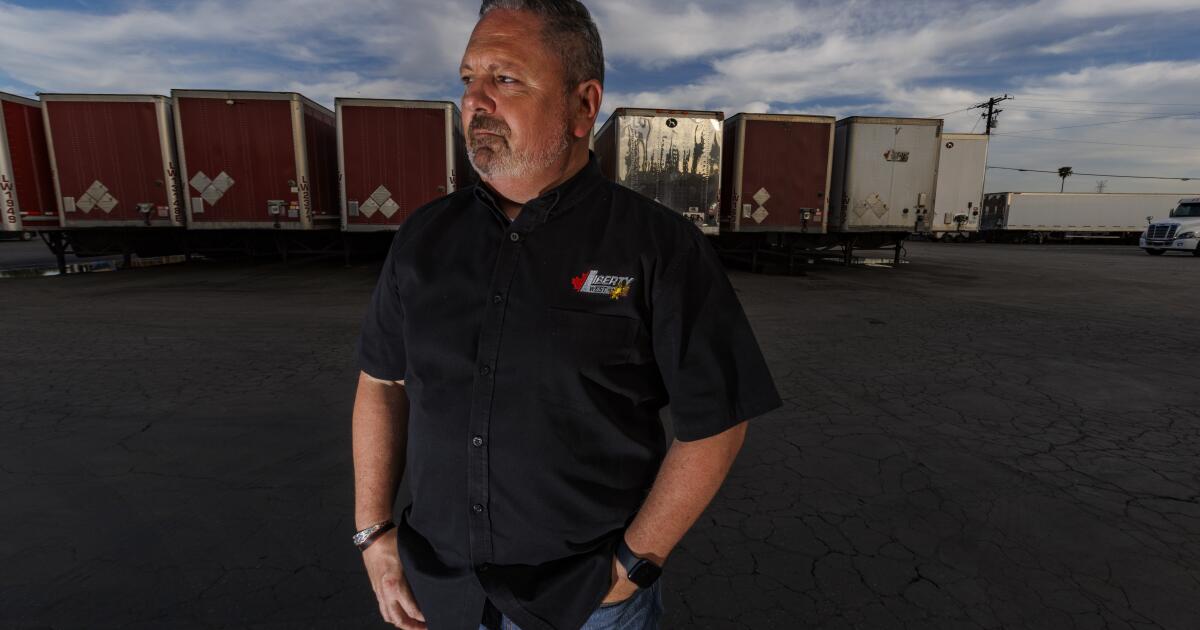
Record diesel prices are crushing California’s truckers, forcing them to adjust to avoid losses as they grapple with the most expensive pump prices in the country.
Greg Dubuque’s 40 drivers are in a constant diesel-devouring loop. Their big rigs pick up loads of electronics, office furniture and other goods around Los Angeles. They drive close to 1,000 miles through the Mojave Desert and over the Rocky Mountains to Denver. They bring back containers full of everything from pinto beans to home remodeling products.
One tank of gas for his vehicles cost $600 a couple of months ago. Today it costs $1,000. That’s a record high and more than 35% above the country’s average.
“California sets itself apart from the rest of the country when it comes to pricing,” said Dubuque, a third-generation trucker and general manager of Liberty Linehaul West. “Now it’s really out of control.”
The average price of a gallon of diesel in California got close to $7.75 this week, up 50% from a month ago, according to the American Automobile Assn. The national average of diesel is closer to $5.65 at recent peaks.
Dubuque, general manager of Liberty Linehaul West, says small truckers are hurting with out-of-control gas prices.
(Gina Ferazzi / Los Angeles Times)
The trucking industry was already reeling from a prolonged freight recession, a crackdown on immigrant drivers, and the adverse impacts of tariffs, all of which contributed to a significant increase in bankruptcy filings in the industry.
Now, the price shock from the war with Iran has become yet another headache for the beleaguered industry that hauls 70% of all freight in America.
“It’s got a tremendous impact on the industry,” said Eric Sauer, the chief executive of California Trucking Assn.
And it is not just truckers being affected. The rising prices of ground and air transportation will eventually be paid for by consumers.
The biggest companies are already passing the extra transportation costs on to consumers. FedEx, United Parcel Service, the U.S. Postal Service and Amazon said they will all start charging an extra fee. Amazon said it would apply a 3.5% charge to merchants for its fulfillment service. USPS will charge an 8% delivery fee for certain packages.
“The longer energy prices remain elevated, the more households will need to confront tradeoffs,” said Philip N. Jefferson, vice chairman of the Federal Reserve, at a recent lecture.

Liberty Linehaul West trucking company keeps a daily list of fuel prices to help its truckers on April 3 in Montebello, Calif.
(Gina Ferazzi / Los Angeles Times)
This could eventually dampen demand for other products and further hurt the economy, Jefferson noted.
“Families who depend on petroleum products to commute to jobs and school and to heat their homes may need to pull back on more discretionary forms of spending,” he said. “That could potentially result in lower spending at restaurants or retailers. It could also result in households carrying elevated levels of debt.”
Truckers often rely on fuel surcharges to cover rising fuel costs. It’s an industry practice for customers to pay a fuel surcharge, on top of the base freight rate, to offset unexpected fuel price increases. The fee is calculated based on a weekly diesel price index.
Sukhdeep Singh, who owns Merced County-based Cali Brothers Truck Lines, said standard surcharge policies are insufficient when there are wild swings in fuel prices.
“It’s killing everything,” he said.
Singh’s business faced challenges earlier this year when a crackdown on immigrant drivers led to sudden departures, shrinking the available labor pool and leaving 15 of his trucks unused. Despite the diminished fleet, his weekly fuel expenses have surged from $80,000 to $130,000.
Smaller trucking companies are getting hit first.
Major carriers with thousands of trucks have different ways to hedge against price fluctuations that insulate them from temporary volatility. They have long-term shipping contracts and have greater flexibility in surcharges.
Smaller carriers are often paid at a flat rate and have no certainty about whether they will recover the higher fuel costs.
On a recent trip to Denver, one of Dubuque’s trucks had to consider returning empty, as the going rate barely covered gas to get back to Los Angeles.
“I wouldn’t be able to cover my cost,” he said.
He has been instructing drivers to save on fuel by planning their routes, finding truck stops with the best rates, and avoiding California when possible.
“Where we’re trying to avoid buying fuel is here in the state of California,” he said.
He is also asking his regular customers to pitch in.

A Roadies Inc. truck, right, leaves for a delivery in Bakersfield on Nov. 29.
(Myung J. Chun / Los Angeles Times)
Liberty Linhaul West’s fleet also works with L.A.’s entertainment and event industries, transporting staging, lighting and other equipment for events such as the Oscars, Grammys and Country Music Awards. He’s started calling customers with whom he had flat rates to renegotiate prices.
“We started calling customers, saying, ‘Okay, we need some emergency help here,’” Dubuque said.
While he appreciates that the extra fees and restrictions on fuel help build roads and protect the environment in California, he would love to see more support from the state.
“I think the government needs to interact with the oil and fuel world and talk about how they can take this pain away from us, or at least try to lessen this blow,” he said.
Without an end to high oil prices or some help from the government, customers can expect the same sticker shock the trucking industry is struggling with.
“Whether you’re a grocer, a meatpacking plant, a vegetable grower, that cost has to be factored in, because it doesn’t matter who you are, you’re faced with it,” Dubuque said. “The impact was so hard and so fast, I would think we’re going to start seeing just another increase to the cost of goods for people.”

A New York coffee startup known for its TikTok-friendly matcha drinks is making its West Coast debut.
Blank Street, the fast-growing, venture capital-backed coffee chain that launched during the pandemic, plans to open four stores in Los Angeles County this year, starting in Beverly Hills and Studio City. The first two stores will open in June.
Blank Street Chief Executive Issam Freiha told The Times he has long romanticized L.A. — the place where he fell in love with his wife — and hoped to open stores in the region, but held off until the company was fully ready.
Blank Street has spent several years refining its menu, sharpening its brand identity and developing a hospitality experience that can be scaled, he said. The “handoff” step, in which a barista calls a customer’s name and finishes making their drink in front of them, is a key part of that experience. Customers often record the moment and share it on TikTok.
The chain has nearly 100 global stores, many in New York City and London. Blank Streets are expected to open at the Sunset Plaza in West Hollywood and off the Pacific Coast Highway in Malibu in late fall.
Blank Street wanted to kick off its California expansion in Beverly Hills because of its high profile.
The city represents what most people envision when they think of L.A.: Rodeo Drive, the Beverly Hills Hotel and towering palm trees, said Evan Mateen, head of U.S. real estate for Blank Street. The location, a Tudor Revival-style building on Bedford Drive, was attractive for its visibility, parking spaces and proximity to daily services and salons, he said.
Blank Street’s roots trace back to 2020, when co-founders Freiha and Vinay Menda began selling coffee out of a pale-green coffee cart in the Williamsburg neighborhood of New York City.
They believed there was a gap in the coffee industry. On one end, there were innovative, high-end specialty coffee brands. On the other, there were chains setting the industry standard. They hoped to offer something in the middle, providing high-quality drinks in high-volume settings at an affordable price point.
“We don’t need to be the most amazing cup of coffee you’ve ever had,” Freiha told the New York Times in 2022. “We want to be the really good cup of coffee that you drink twice a day, every day.”
Investors loved the concept. The company raised $67 million in 2021 from investors including General Catalyst, the venture capital firm that funded Airbnb, and Tiger Global, the investment firm that backed shoe brand Allbirds, according to the New York Times. In 2023, a third co-founder, Ignacio Llado, joined, and the company transitioned from carts to small retail stores.
Freiha declined to disclose financials but said Blank Street has a $500-million valuation, is profitable and sells about three times as many drinks per store as it did three years ago.
Blank Street’s target demographic appears to be Gen Z. The company has partnered with celebrities like influencer Emma Chamberlain and singer Sabrina Carpenter, who “worked” a shift at a Blank Street in London to promote her 2024 song “Espresso.”
The chain is set to land on the West Coast on Friday, serving strawberry shortcake matchas and cherry glaze cold brew lattes to an invite-only crowd at Kendall Jenner’s 818 Outpost at Coachella.
Freiha thinks Blank Street’s speed can help it compete in the L.A. region’s competitive coffee and matcha scene.
The best cafes in L.A. tend to have “extremely long lines,” he said. “It’s a very large market with a lot of opportunity.”
Blank Street stores use automatic espresso machines, which improve consistency and reduce labor costs. Matcha, which has recently skyrocketed in popularity and represents half the chain’s business, is prepared in batches for cold drinks, he said. The chain aims to finish assembling drinks within two minutes and thirty seconds from the moment an order is placed.
Blank Street has since shifted to a larger store concept with trendy interior design and ample seating. Freiha said the change was to accommodate the afternoon crowd, which tends to arrive in groups and wants a place to socialize.
The company does not have immediate plans to further expand on the West Coast until the first four stores have “solidified” and have regular customers, Freiha said.
“We need to prove that we meet that bar that people in L.A. have for what a great coffee shop can be,” Freiha said. “That’s our work now.”
Business
Commentary: Trump wants you to invest your 401(k) in crypto and private equity. Should you bite?
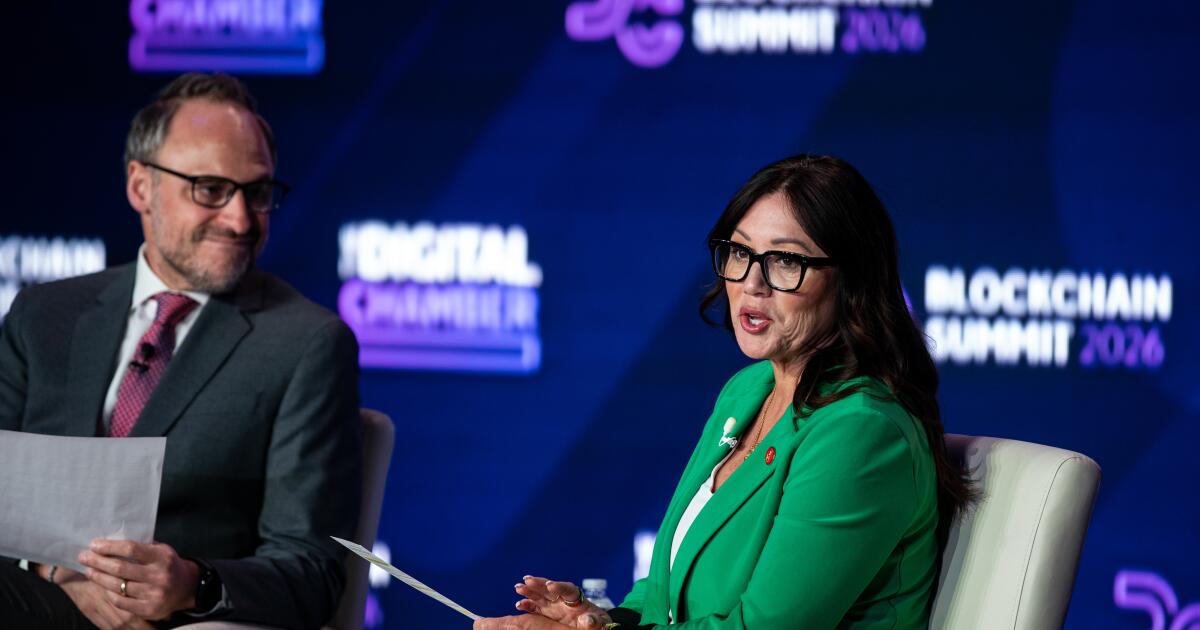
Trump is opening the door to risky ‘alternative investments’ such as crypto and private equity in 401(k) plans. But employers have had good reasons to keep them out of their plans.
If you believe Labor Secretary Lori Chavez-DeRemer, American 401(k) accounts are about to get much better.
Thanks to President Trump’s “bold new vision of a new golden age for America,” Chavez-DeRemer wrote in the Wall Street Journal on March 30, her agency is taking steps to open these crucial retirement accounts to a raft of new investment options, such as cryptocurrencies and private equity funds.
Her goal, she wrote, is to “unwind regulatory overreach and litigation abuse that have stifled innovation.” Her instrument is a proposed regulation that in effect would provide a safe harbor for plan sponsors — that is, employers — to offer those options in their employees’ plans without risking lawsuits or government scrutiny over whether they’re sufficiently prudent for workers to choose.
We have seen a number of proposals from private equity funds where the returns are really not calculated in a manner that I would regard as honest.
— Warren Buffett (2019)
Notwithstanding Chavez-DeRemer’s assertion that this change would be all to the good for workers, the truth is that she and Trump are acting at the behest of alternative investment promoters, who have long slavered for access to the nearly $14 trillion in assets held in 401(k)s and other such defined contribution retirement plans.
Far be it for me to offer anyone investment advice. But there are a few things that Trump and DeRemer aren’t telling you about these proposed new options. Namely, the dangers they present to unwary small investors.
The first clue that something is being hidden appeared in DeRemer’s op-ed, in which she blamed “Washington bureaucrats” and “plaintiff lawyers” for stifling the financial innovation that people supposedly have been clamoring to put in their retirement accounts.
You know who rails against “Washington bureaucrats” and “plaintiff lawyers”? Businesses that are fearful that government regulators and juries will clamp down on their wrongdoing. These critiques are often described as efforts to get government off the backs of the people. What they don’t explain is that once government has climbed off, big business will saddle up.
(As I’ve reported, among the businesses that have recently been demonizing plaintiff lawyers is Uber, which is pushing a ballot measure in California that would all but shut the courthouse doors to some passengers injured during Uber rides.)
So let’s examine the unacknowledged issues with “innovative” alternative investments. Private equity firms are known for buying companies that are either held privately, or are public companies due to be taken private. In many cases, they turn profits for their investors by cutting payrolls and reducing services at their portfolio companies, then draining what’s left until there is nothing left. Cryptocurrencies, as I’ve written, are a scam all their own.
We’ll start with the implicit and explicit rules guiding employers when they decide what investment choices to offer workers in their 401(k)s.
“Employers are fiduciaries, which means they must make decisions about retirement investments that are in their employees’ best interest,” observes Eileen Applebaum of the Center for Economic and Policy Research. “They must be prudent in curating a menu of retirement plan options for their workers. And they have been successfully sued for lack of prudence by workers whose retirement accounts held high fee, illiquid, risky investments that failed to perform.”
The fiduciary standards are developed in part by government bureaucrats. And the successful lawsuits? They’re brought by plaintiff lawyers.
In 2021, the Biden-era Labor Department warned that most sponsors of 401(k) plans and other defined contribution plans “are not likely suited to evaluate the use of [private equity] investments” in those plans. The administration shied away from outlawing such investments outright in 401(k)s. Nevertheless, employers understandably saw the warning as a yellow light, if not a flashing red light.
As of 2024, only about 4% of plan sponsors offered alternative investments, Applebaum reported. The threat of litigation also stayed their hand; 66 lawsuits were filed against plan sponsors that year, according to Encore Financial, a personal finance firm. High fees and other fiduciary failures were at the heart of most of the cases.
This isn’t the first time that Trump has tried to wedge private equity investments into 401(k)s. In 2020, during his first term, then-Labor Secretary Eugene Scalia issued an opinion that the mere presence of private equity investments among 401(k) choice was not in itself a fiduciary violation.
Scalia said his goal was to “remove barriers to the greatest engine of economic prosperity the world has ever known: the innovation, initiative, and drive of the American people.”
Until then, individuals were effectively barred from the investments by a Securities and Exchange Commission rule allowing only “accredited” investors — those who could show annual income of more than $200,000 or net worth of $1 million or more, not including their homes.
I didn’t offer an opinion then about the wisdom of these investments, but wrote only that “if I were inclined to invest my 401(k) money in private equity, I would hope that my family would arrange to have my head examined.”
My reasoning then was that private equity funds produce limited disclosure, or no useful disclosure at all; there are no commonly accepted formulas to measure their returns; and they’re subject to management fees immensely higher than conventional stock, bond or money market funds.
No less an experienced investor than Warren Buffett warned his own shareholders away from the sector, I pointed out.
“We have seen a number of proposals from private equity funds where the returns are really not calculated in a manner that I would regard as honest,” Buffett said at the May 2019 annual meeting of Berkshire Hathaway, which held his corporate investment portfolio.
Since then — indeed, since the Great Recession of 2007-2009 — the private equity sector has been promoting itself as a source of financial returns superior than those of conventional stock portfolios while glossing over cavils such as Buffett’s.
The promoters boast that their funds have low correlations with public markets — that is, when the public markets falter, the private markets gain; that they’re skilled at finding bargains among targeted businesses; and that they impose profit-gaining efficiencies on their acquired businesses.
In recent years, however, the private equity argument has faded. “Current data raises questions concerning these predicate assumptions,” wrote Nori Gerardo Lietz of Harvard Business School in 2024. Private equity fund performance, she observed, has “eroded materially.”
That’s true. From 2022 through the first three quarters of 2025, according to the research firm MSCI, private equity firms turned in annualized returns of 5.8%, while the Standard & Poor’s 500 index of public firms yielded 11.6%. Institutional investors such as public employee pension funds have begun to ask whether the sector deserves their money.
In the last year, the Yale University endowment and the public employee pension fund of New York City have sold off billions of dollars in private equity investments, some at a discount to their stated values. (To be fair, the California Public Employees’ Retirement System, or CalPERS, has remained a fan, attributing its recent improvement in overall returns to a strengthened investment in private equity.)
The doubts being voiced by these major investors has turbocharged the push by the private equity sector to reach into individual retirement accounts. By some measures, however, individual investors have even less tolerance for some of the features of private equity than do institutions. Unlike publicly traded stocks, these investments are illiquid, meaning they can’t be sold at will and they can’t be reliably priced.
As for crypto, the other major alternative investment being touted by Trump, its shortcomings are well documented.
In contrast to conventional stocks and bonds, they don’t represent stakes in anything concrete and as a result are extremely volatile.
Bitcoin, for instance, ran as high as $126,000 in October; as of Thursday it was priced below $72,000. Among other queasy-induced crashes, bitcoin lost 35% of its value in less than four weeks between mid-January and early February, falling from $96,929 on Jan. 13 to $62,702 on Feb. 4.
These are all factors demanding notice from small investors contemplating adding these sectors to their retirement funds. For that reason, some retirement professionals doubt that even the Trump administration’s favor will persuade many plan sponsors to open their doors to alternative investments. Trump’s regulators may be taking a hands-off approach to these sectors, but plaintiff lawyers aren’t likely to back off.
For individual investors, these are sectors that were made for the phrase “caveat emptor.” If you don’t know your Latin, it means “buyer beware.”

Jazz lose by winning in the ‘Tanking Super Bowl’ — but optimism reigns as team imagines possibilities for next season
VT Lottery Mega Millions, Gimme 5 results for April 10, 2026

‘Don’t Fairfax Me’: How Virginia’s largest county became center of antiredistricting campaign – WTOP News

Report: Wisconsin transfer John Blackwell down to six schools, not two
Trump promised to cut electric costs in half. In energy-rich West Virginia, bills now top mortgages

Florida High School Football Rankings: Top 25 teams – Oct. 21

How old is Bo Nix? What to know about Oregon quarterback ahead of 2024 NFL Draft

Cleary's 21 help Le Moyne down Central Connecticut State 69-64 in OT

99th annual Pony Swim held in Virginia

Indiana Members Credit Union announced as new anchor tenant at Bottleworks District

Trump adversary running for Senate borrows his filibuster playbook

Russian propaganda unit targets Hungary’s elections

WATCH: Artemis II astronauts splash down on Earth

Swalwell’s former female staffer drops bombshell allegations of sexual assault, exposing himself: report

NASA’s Artemis II prepares for splashdown on Earth
-

 Atlanta, GA6 days ago
1 teenage girl killed, another injured in shooting at Piedmont Park, police say
-

 Education1 week ago
Video: Toy Testing with a Discerning Bodega Cat
-

 Movie Reviews1 week ago
Vaazha 2 first half review: Hashir anchors a lively, chaos-filled teen tale
-

 Georgia4 days ago
Georgia House Special Runoff Election 2026 Live Results
-

 Pennsylvania5 days ago
Parents charged after toddler injured by wolf at Pennsylvania zoo
-

 Arkansas20 hours ago
Arkansas TV meteorologist Melinda Mayo retires after nearly four decades on air
-
 Milwaukee, WI5 days ago
Potawatomi Casino Hotel evacuated after fire breaks out in rooftop HVAC system
-
 Entertainment1 week ago
Inside Ye’s first comeback show at SoFi Stadium