Business
Protesters are chasing federal agents out of L.A. County hotels: ‘A small victory’


At Pasadena’s AC Hotel earlier this month, dozens of protesters gathered in an effort to confront federal agents who had arrived in town amid demonstrations against the Trump administration’s mass deportation effort.
Pasadena Mayor Victor Gordo was among those present on June 7 as demonstrators holding signs with “ICE out of Pasadena” and other messages chased federal vehicles out of the luxury hotel’s parking garage, cheering and recording it all on their cellphones.
The mayor said the protest forced the agents to leave the place they were using for local accommodations during their L.A. operations, which involved protecting federal buildings downtown.
“Word got out that there were Homeland Security vehicles parked at the hotel,” Gordo told The Times. “People wanted to express their 1st Amendment rights and they did so in a lawful, nonviolent and respectful manner.”
After hours of noisy rallying, the hotel staff asked the feds to pack up their things and go, according to Gordo. By sunset, uniformed agents from the Federal Protective Service, part of the Department of Homeland Security, were seen walking out of the hotel with their bags stacked on a luggage cart in a video of the incident that went viral online. Their vehicles were escorted out of the garage by local police as protesters trailed behind.
Hotels have emerged as hot spots for confrontations between community members and immigration agents. Federal agencies, including U.S. Immigration and Customs Enforcement, sometimes rent blocks of rooms in places where agents are dispatched for major operations.
Hotels have emerged as hot spots for confrontations between community members and immigration agents.
(Jason Armond / Los Angeles Times)
The showdown in Pasadena was one of several recent instances of protesters coming together at hotels across the Los Angeles region to put pressure on their proprietors to offer no quarter to federal personnel during the Trump administration’s crackdown. The businesses, which rely on immigrant workers for cleaning and maintenance, have been cast into an awkward position — one that requires balancing politics with protecting their employees.
From Whittier to Hawaiian Gardens to Brea, concerned citizens have repeatedly taken to social media and whisper networks to share locations where they have spotted who they believe are federal agents. And people have followed up on such information by staging protests outside hotels in communities including Long Beach, Downey and Glendale.
Employees at the AC Hotel Pasadena referred inquiries to a spokeswoman, who did not immediately provide a comment. It was back to business as usual Tuesday afternoon at the Marriott property, which opened earlier this year. A man on a plush couch worked on his laptop, a woman sipped a beer at the bar and staff milled about.
Gordo said he had confirmed that there are no longer any Homeland Security agents staying at the property.
The Homeland Security press office did not immediately provide comment, and agencies under the department’s umbrella, including ICE and U.S. Customs and Border Protection, did not respond to inquires.
Protesters have been arrested this month for allegedly interfering with federal officers, and federal agencies have expressed concerns about the repercussions of people “doxxing” agents by sharing their locations and other personal information online.
“People are out there taking photos of the names, their faces and posting them online with death threats to their family and themselves,” Reuters reported acting ICE chief Todd Lyons said last week.

Pasadena police block the entrance to the Hotel Dena in Pasadena last week.
(Jason Armond / Los Angeles Times)
The crowd-sourced effort to spread information about where federal agents are holed up plays out mostly online.
In some instances, the unverified reports come from people who work at the hotels. Other times, hotel guests or area residents see suspected agents outside or in the lobby, or walk through parking lots in search of federal vehicles.
During the first days after the L.A. enforcement effort began, it was fairly easy to tell where agents were staying by looking for vehicles with agency logos. But it appears that they have caught on to the surveillance tactics of those who would like to see them go home.
On Monday, a Times reporter visited 13 hotels in three Southland counties — from Westchester to Garden Grove to Ontario — where federal immigration agents recently had been rumored to be staying, according to social media posts and alerts on apps and websites dedicated to tracking ICE activity. No vehicles in any of the hotels’ parking lots bore clear visual indications that they were federal agents’ cars, vans or trucks.
At five hotels, employees approached by The Times declined to comment. At three, employees agreed to speak but declined to give their names, citing corporate policies. Two of them said in brief interviews that they were not sure whether agents were staying on the premises. A third, who works at a chain hotel in Anaheim, said he had seen who he believed were ICE agents at the property last week, but they were no longer staying there.

Workers at the Hilton Pasadena show support for community members taking part in a June 12 protest.
(Jason Armond / Los Angeles Times)
“They didn’t bother anyone,” said the man, who declined to provide his name out of fear of reprisal from his employer or immigration authorities. “There were maybe, like, a dozen of them. It was a little concerning.”
Workers such as him have been subjected to political whiplash in recent days. Last week, President Trump wrote on Truth Social that “Our great Farmers and people in the Hotel and Leisure business have been stating that our very aggressive policy on immigration is taking very good, long time workers away from them.” That same day, a senior ICE official sent guidance to regional ICE officials directing them to avoid raiding farms, hotels and restaurants and instead emphasize other targets.
The development gave hotel employees hope that they were out of the crosshairs. But the Trump administration quickly reversed course, saying this week that there is now no reprieve for hotel workers and others who Trump had praised just days earlier.
Andrew Mark, a pastor at Pasadena Covenant Church, also addressed the crowd at the June 7 rally outside the AC Hotel. He said in an interview that he was impressed — but not surprised — that the community came together and forced change.
“There’s a deep pride in Pasadena. So I think that for agents to be staying in a hotel here, you feel … a sense that we don’t want this to be a place where they can stage and go out and target people,” he said. “The fact that they were based in a hotel in our community was unsettling.”
On Tuesday, Manuel Vicente sat behind his makeshift desk in a soundproof room at the Pasadena Community Job Center, which helps connect day laborers with employment opportunities. As director of Radio Jornalera, he creates audio and video content to help migrant workers, including content that informs them of the rights they have during encounters with immigration enforcement agents.
Vicente said he believes the successful protest at the AC Hotel Pasadena is an example of a saying he likes to quote, “Pueblo salva el pueblo,” or “Only the people save the people.”
“When they were kicked out of the hotel, everybody was excited,” he said. “It was a small victory, but our efforts made a difference. We need to be together to protect our community, to protect our workers.”



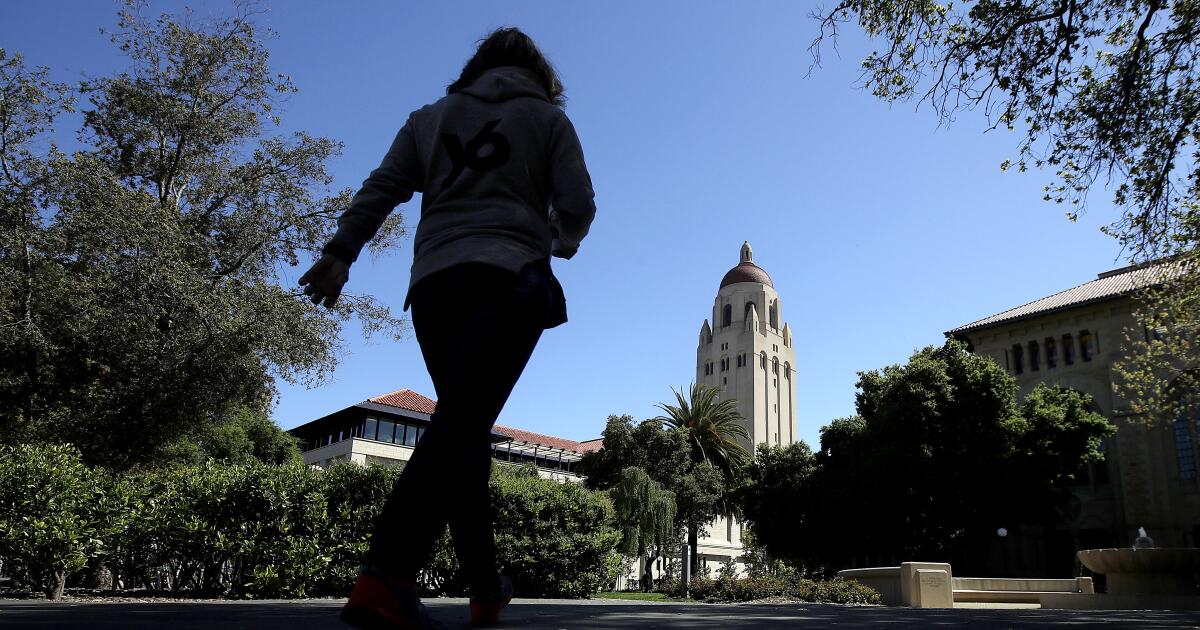
A Stanford software engineering degree used to be a golden ticket. Artificial intelligence has devalued it to bronze, recent graduates say.
The elite students are shocked by the lack of job offers as they finish studies at what is often ranked as the top university in America.
When they were freshmen, ChatGPT hadn’t yet been released upon the world. Today, AI can code better than most humans.
Top tech companies just don’t need as many fresh graduates.
“Stanford computer science graduates are struggling to find entry-level jobs” with the most prominent tech brands, said Jan Liphardt, associate professor of bioengineering at Stanford University. “I think that’s crazy.”
While the rapidly advancing coding capabilities of generative AI have made experienced engineers more productive, they have also hobbled the job prospects of early-career software engineers.
Stanford students describe a suddenly skewed job market, where just a small slice of graduates — those considered “cracked engineers” who already have thick resumes building products and doing research — are getting the few good jobs, leaving everyone else to fight for scraps.
“There’s definitely a very dreary mood on campus,” said a recent computer science graduate who asked not to be named so they could speak freely. “People [who are] job hunting are very stressed out, and it’s very hard for them to actually secure jobs.”
The shake-up is being felt across California colleges, including UC Berkeley, USC and others. The job search has been even tougher for those with less prestigious degrees.
Eylul Akgul graduated last year with a degree in computer science from Loyola Marymount University. She wasn’t getting offers, so she went home to Turkey and got some experience at a startup. In May, she returned to the U.S., and still, she was “ghosted” by hundreds of employers.
“The industry for programmers is getting very oversaturated,” Akgul said.
The engineers’ most significant competitor is getting stronger by the day. When ChatGPT launched in 2022, it could only code for 30 seconds at a time. Today’s AI agents can code for hours, and do basic programming faster with fewer mistakes.
Data suggests that even though AI startups like OpenAI and Anthropic are hiring many people, it is not offsetting the decline in hiring elsewhere. Employment for specific groups, such as early-career software developers between the ages of 22 and 25 has declined by nearly 20% from its peak in late 2022, according to a Stanford study.
It wasn’t just software engineers, but also customer service and accounting jobs that were highly exposed to competition from AI. The Stanford study estimated that entry-level hiring for AI-exposed jobs declined 13% relative to less-exposed jobs such as nursing.
In the Los Angeles region, another study estimated that close to 200,000 jobs are exposed. Around 40% of tasks done by call center workers, editors and personal finance experts could be automated and done by AI, according to an AI Exposure Index curated by resume builder MyPerfectResume.
Many tech startups and titans have not been shy about broadcasting that they are cutting back on hiring plans as AI allows them to do more programming with fewer people.
Anthropic Chief Executive Dario Amodei said that 70% to 90% of the code for some products at his company is written by his company’s AI, called Claude. In May, he predicted that AI’s capabilities will increase until close to 50% of all entry-level white-collar jobs might be wiped out in five years.
A common sentiment from hiring managers is that where they previously needed ten engineers, they now only need “two skilled engineers and one of these LLM-based agents,” which can be just as productive, said Nenad Medvidović, a computer science professor at the University of Southern California.
“We don’t need the junior developers anymore,” said Amr Awadallah, CEO of Vectara, a Palo Alto-based AI startup. “The AI now can code better than the average junior developer that comes out of the best schools out there.”
To be sure, AI is still a long way from causing the extinction of software engineers. As AI handles structured, repetitive tasks, human engineers’ jobs are shifting toward oversight.
Today’s AIs are powerful but “jagged,” meaning they can excel at certain math problems yet still fail basic logic tests and aren’t consistent. One study found that AI tools made experienced developers 19% slower at work, as they spent more time reviewing code and fixing errors.
Students should focus on learning how to manage and check the work of AI as well as getting experience working with it, said John David N. Dionisio, a computer science professor at LMU.
Stanford students say they are arriving at the job market and finding a split in the road; capable AI engineers can find jobs, but basic, old-school computer science jobs are disappearing.
As they hit this surprise speed bump, some students are lowering their standards and joining companies they wouldn’t have considered before. Some are creating their own startups. A large group of frustrated grads are deciding to continue their studies to beef up their resumes and add more skills needed to compete with AI.
“If you look at the enrollment numbers in the past two years, they’ve skyrocketed for people wanting to do a fifth-year master’s,” the Stanford graduate said. “It’s a whole other year, a whole other cycle to do recruiting. I would say, half of my friends are still on campus doing their fifth-year master’s.”
After four months of searching, LMU graduate Akgul finally landed a technical lead job at a software consultancy in Los Angeles. At her new job, she uses AI coding tools, but she feels like she has to do the work of three developers.
Universities and students will have to rethink their curricula and majors to ensure that their four years of study prepare them for a world with AI.
“That’s been a dramatic reversal from three years ago, when all of my undergraduate mentees found great jobs at the companies around us,” Stanford’s Liphardt said. “That has changed.”

Walt Disney Co. is expanding its presence in the Middle East, inking a deal with Saudi media conglomerate MBC Group and UAE firm Anghami to form a streaming bundle.
The bundle will allow customers in Bahrain, Kuwait, Oman, Qatar, Saudi Arabia and the UAE to access a trio of streaming services — Disney+; MBC Group’s Shahid, which carries Arabic originals, live sports and events; and Anghami’s OSN+, which carries Arabic productions as well as Hollywood content.
The trio bundle costs AED89.99 per month, which is the price of two of the streaming services.
“This deal reflects a shared ambition between Disney+, Shahid and the MBC Group to shape the future of entertainment in the Middle East, a region that is seeing dynamic growth in the sector,” Karl Holmes, senior vice president and general manager of Disney+ EMEA, said in a statement.
Disney has already indicated it plans to grow in the Middle East.
Earlier this year, the company announced it would be building a new theme park in Abu Dhabi in partnership with local firm Miral, which would provide the capital, construction resources and operational oversight. Under the terms of the agreement, Disney would oversee the parks’ design, license its intellectual property and provide “operational expertise,” as well as collect a royalty.
Disney executives said at the time that the decision to build in the Middle East was a way to reach new audiences who were too far from the company’s current hubs in the U.S., Europe and Asia.

Fancy grocer Erewhon will return to Pacific Palisades in an entirely rebuilt store, as the neighborhood’s luxury mall, owned by developer Rick Caruso, undergoes renovations for a reopening next August.
Palisades Village has been closed since the Jan. 7 wildfire destroyed much of the neighborhood. The outdoor mall survived the blaze but needed to be refurbished to eliminate contaminants that the fire could have spread, Caruso said.
The developer is spending $60 million to bring back Palisades Village, removing and replacing drywall from stores and restaurants. Dirt from the outdoor areas is also being replaced.
Demolition is complete and the tenants’ spaces are now being restored, Caruso said.
“It was not a requirement to do that from a scientific standpoint,” he said. “But it was important to me to be able to tell guests that the property is safe and clean.”
Erewhon’s store was taken down to the studs and is being reconfigured with a larger outdoor seating area for dining and events.
When it opens its doors sometime next year, it will be the only grocer in the heart of the fire-ravaged neighborhood.
The announcement of Erewhon’s comeback marks a milestone in the recovery of Pacific Palisades and signals renewed investment in restoring essential neighborhood services and supporting the community’s long-term economic health, Caruso said.
A photograph of the exterior of Erewhon in Pacific Palisades in 2024.
(Kailyn Brown/Los Angeles Times)
“They are one of the sexiest supermarkets in the world now and they are in high demand,” he said. “Their committing to reopening is a big statement on the future of the Palisades and their belief that it’s going to be back stronger than ever.”
Caruso previously attributed the mall’s survival to the hard work of private firefighters and the fire-resistant materials used in the mall’s construction. The $200-million shopping and dining center opened in 2018 with a movie theater and a roster of upmarket tenants, including Erewhon.
“We’re honored to join the incredible effort underway at Palisades Village,” Erewhon Chief Executive Tony Antoci said in a statement. “Reopening is a meaningful way for us to contribute to the healing and renewal of this neighborhood.”
Erewhon has cultivated a following of shoppers who visit daily to grab a prepared meal or one of its celebrity-backed $20 smoothies.
The privately held company doesn’t share financial figures, but has said its all-day cafes occupy roughly 30% of its floor space and serve 100,000 customers each week.
Erewhon has also branched out beyond selling groceries.
Its fast-growing private-label line now includes Erewhon-branded apparel, bags, candles, nutritional supplements and bath and body products.
Erewhon will also open new stores in West Hollywood in February, in Glendale in May and at Caruso’s The Lakes at Thousand Oaks mall in July 2026.
About 90% of the tenants are expected to return to the mall when it reopens, Caruso said, including restaurants Angelini Ristorante & Bar and Hank’s. Local chef Nancy Silverton has agreed to move in with a new Italian steakhouse called Spacca Tutto.
In May, Pacific Palisades-based fashion designer Elyse Walker said she would reopen her eponymous store in Palisades Village after losing her 25-year flagship location on Antioch Street in the inferno.

Fashion designer Elyse Walker announced the reopening of her flagship store at the Palisades Village in May.
(Myung J. Chun/Los Angeles Times)
“People who live in the Palisades don’t want to leave,” Walker said at the time. “It’s a magical place.”
Caruso carried on annual holiday traditions at Palisades Village this year, including the lighting of a 50-foot Christmas tree for hundreds of celebrants Dec. 5. On Sunday evening, leaders from the Chabad Jewish Community Center of Pacific Palisades gathered at the mall to light a towering menorah.
A total of 6,822 structures were destroyed in the Palisades fire, including more than 5,500 residences and 100 commercial businesses, according to the California Department of Forestry and Fire Protection.
Caruso said he hopes the shopping center’s revival will inspire residents to return. His investment “shows my belief that the community is coming back,” he said. “Next year is going to be huge.”

Detroit Fire Department brings Christmas joy to family who lost everything in house fire

New SF supervisor supports reopening Great Highway on weekdays

Don Stone, Dallas philanthropist and arts advocate, dies

Jumpshots Galore: Keys for the Miami Heat to overcome the Boston Celtics

Power outages in Massachusetts affecting tens of thousands amid stormy weather

Florida High School Football Rankings: Top 25 teams – Oct. 21

Cleary's 21 help Le Moyne down Central Connecticut State 69-64 in OT

How old is Bo Nix? What to know about Oregon quarterback ahead of 2024 NFL Draft

99th annual Pony Swim held in Virginia

Video: ‘It Didn’t Have to Happen This Way:’ U.Va. Faculty Call for Review of Police Response to Protests

Takeaways from an eventful 2025 election cycle

Judge tosses Trump-linked lawsuit targeting Chief Justice Roberts, dealing setback to Trump allies

Who was Osman Hadi; why is Bangladesh on fire over his death?

Putin tells news conference that Kremlin’s military goals will be achieved in Ukraine

Video: Trump Mocks Obama, Biden in His Presidential ‘Walk of Fame’
-

 Iowa5 days ago
Addy Brown motivated to step up in Audi Crooks’ absence vs. UNI
-

 Iowa6 days ago
How much snow did Iowa get? See Iowa’s latest snowfall totals
-

 Maine3 days ago
Elementary-aged student killed in school bus crash in southern Maine
-

 Maryland5 days ago
Frigid temperatures to start the week in Maryland
-

 Technology1 week ago
The Game Awards are losing their luster
-

 South Dakota5 days ago
Nature: Snow in South Dakota
-

 Nebraska1 week ago
Nebraska lands commitment from DL Jayden Travers adding to early Top 5 recruiting class
-

 Sports1 week ago
Pro Football Hall of Famer Troy Aikman critiques NIL landscape, transfer rules and Lane Kiffin’s LSU move