Business
Overnight lines, mall fights and instant sellouts: Labubu toy mania comes to America


Every few Fridays, in the middle of the night, a line forms outside the Pop Mart store at Westfield Century City.
It’s the same scene over at Glendale Galleria. And at South Coast Plaza. Victoria Gardens in Rancho Cucamonga, too.
They come by the hundreds, all vying for the latest Labubu, a furry toy character with rabbit-like ears and a nightmarish grin stretched wide over a row of serrated teeth. Labubu, her legion of fans will tell you, is female, the size of a cat and a tad mischievous. She belongs to a Nordic tribe of elves known as the Monsters. She is very soft. They insist her boyfriend is a look-alike figure named Zimomo, but Pop Mart denies the relationship.
A global buying frenzy for all things Labubu erupted in April when Lisa, a member of the popular K-pop girl group Blackpink, posted a video on Instagram of her hugging a large Labubu plush doll. The 27-year-old megastar, who isn’t a brand spokesperson, further fueled the mania by accessorizing her luxury handbags with small Labubu pendants.
Since then, every new release and restock of the plush dolls has sold out within minutes in stores and within seconds online. Grown men and women — Labubu’s core customers are adults, not kids — have fought over her and police recently had to manage an unruly crowd at a Singapore toy show where Labubus were being sold. Last month, a family allegedly broke into a claw machine filled with boxes of Labubus and stole three of them. Fakes and resellers have flooded the market.
It’s a sudden and astonishing ascent for an ugly-cute character that debuted nearly a decade ago, and fortuitous timing for Pop Mart as it makes a major push into the U.S.
Founded in 2010, the Chinese toy maker has seen enormous success overseas for its artist-designed collectibles, growing to around 500 retail shops and 2,500 toy vending machines in 30 countries. The company’s stock price has more than tripled this year, giving Pop Mart a market cap of $12.1 billion. It opened its first permanent U.S. store in September 2023 and has quickly expanded to 16 locations around the country, seven of them in California.
Pop Mart, which makes Labubu and other designer toys, is opening stores around the U.S. after seeing huge success overseas. The Chinese company reported record revenue of $638.5 million for the first half of 2024, a 62% year-over-year increase.
Opened in February, the Century City Pop Mart is a maximalist shrine of whimsical characters such as Skull Panda and Dimoo and their many, many related products: vinyl plush dolls in all sizes, action figures, keychains, stationery, purses and tote bags, cups, hair clips, smartphone and earphone cases, lamps and night lights.
These days Labubu is the must-have character, with her merch universe ranging from an $8.99 fridge magnet to a “Mega 1000%” — a giant 31-inch plastic figurine that sells for $959.90.
Blind boxes are in high demand: The packages are sealed and contain a random product from a collection, injecting an element of surprise and tempting customers to buy boxes over and over until they get the exact figure they want. Similar to packs of baseball trading cards, a few lucky boxes contain rare “secret” figurines that are not part of the regular series.
“It’s a high and it’s excitement,” said Jon Shapiro, 48, who arrived at 2:30 a.m. to be first in line at a recent Pop Mart release in Century City. “You start buying sets and you’re like, ‘OK, well I need the whole collection.’ It’s like you have a mission.”
Shapiro, who owns a home inspection company, visited Pop Mart for the first time in January during a trip to Paris and “just got addicted.”
“It would blow your mind,” he said of the number of Pop Mart collectibles he has since acquired, which span “almost every collection” and fill his living room in downtown L.A. from floor to ceiling. “I would say I’ve probably spent minimum $10,000.”
“I’m not a collector of anything else,” he said. “But for some reason, Pop Mart got me.”
On that Friday morning in late October, more than 100 superfans had gathered outside the Pop Mart store before 9 a.m., having learned about the product drop from the brand’s social media posts.
Up for grabs: 29 large Zimomo dolls, 30 six-box blind sets of Labubu pendants and 40 Labubu purses.
1

2

1. Labubu vinyl plush pendants on display. 2. The Century City Pop Mart store had only 40 Labubu purses for sale during an October launch. They sold out in less than an hour.
A squabble had broken out a few hours earlier over line position, store manager Henry Nguyen said, and mall security stepped in to restore order. “There was an escalation,” he said. “It was chaotic.”
Just a few days before, an Australian TikTok user posted a video from a different Pop Mart that showed hordes of shoppers waiting for the store to open, some sleeping on the ground outside the shopping center’s sliding doors overnight.
“Everyone started screaming, shoving and rushing in, and people even got crushed at the sides of the doors,” Lawrence Yu said in the video, which has been viewed 1.2 million times. “There was a group of poor Asian aunties that had all got pushed to the floor. They grazed their knees and they also snapped a few nails, too.”
I’m not a collector of anything else. But for some reason, Pop Mart got me.
— Jon Shapiro, 48, a Pop Mart superfan
The phenomenon has forced staff at each Pop Mart store to devise their own crowd control plans on the fly. To get the line in Century City moving, Nguyen decided to open an hour early, reminding customers that they were limited to one Zimomo doll ($289.99) or one complete Labubu blind set ($131.94).
Once they made it through the doors, elated shoppers grabbed blind boxes and vigorously shook them to try to discern what was inside. A mother and daughter from Inglewood filmed an unboxing video for TikTok as soon as they finished paying. The store has several Instagram group chats filled with hundreds of customers, and those on the scene posted real-time updates to let others know how many items were left.
It was all over in about an hour, with people toward the back of the line dispersing once it became clear they wouldn’t make the cutoff. Some grumbled about resellers, who sell their Labubu hauls at exorbitant markups, being among those who had swarmed the release.

Shoppers wait in line outside the Century City store in October. Some arrived as early as 2:30 a.m.
Shopping online is just as disheartening, they lamented, because of bots programmed to hoover up products the instant they’re available. The night before, the Zimomo plush sold out in less than a minute on Pop Mart’s website and TikTok Shop.
“We’re not trying to manufacture” scarcity, said Emily Brough, head of licensing for Pop Mart North America, which is headquartered in Glendale.
“It’s not like we’re just sending 12 to the store so that there’s this craze and nobody gets what they want,” she said. “We want people to get what they want, and we do try to stock up for the demand.”
Brough attributed the limited quantities to the Beijing-based company’s supply chain timeline — Pop Mart places its orders months in advance, sometimes before a particular toy has taken off. The company said it is working on strategies to make things more fair and to better manage the masses at its U.S. stores on product launch days.
Pop Mart reported record revenue of $638.5 million for the first half of 2024, a 62% increase over the same period a year earlier. Sales in its burgeoning North America segment totaled $24.9 million; more than three-fourths of its revenue comes from Southeast Asia and East Asia.
Plush toys, a hot category in the toy industry, did monster numbers: Pop Mart said revenue skyrocketed nearly 1,000% in the first half of the year, to $62.5 million. The company declined to discuss Labubu-specific sales figures or to comment on whether it was ramping up production.
Creating a viral hit is the dream for toy makers, and there is no “exact formula,” Brough said. “This is the first time that we’ve seen anything like this in North America.”
Pop Mart has benefited from some right-place-right-time luck: Its Labubu pendants double as bag charms, which have been a huge trend in the fashion world. “Kidults” — adults who are big consumers of products traditionally made for children — have been on the rise. And the organic social media love from Lisa and other celebrities was also invaluable.
1

2

1. An employee rings up a Labubu purse for a customer. 2. The most coveted item during a recent Pop Mart launch was a large Zimomo doll for $289.99.
But more than anything, Pop Mart has mastered the hype playbook.
Collectors say they became hooked by the psychological thrill of the blind-box chase and the satisfaction of completing a set; the steady release of special collaborations and seasonal collections (a recent Halloween-themed Labubu had the elf wearing a pumpkin outfit); and the feeling of desperation that comes with wanting something in short supply.
There are also surprise, midday product drops in stores and online. That unpredictability has led people to compulsively check the stores’ Instagram Stories for news of spontaneous restocks.
Whenever one is posted, customers within quick driving or running distance descend upon the store, as they did last Thursday afternoon after the Century City Pop Mart used red siren emojis to announce it had 83 Labubus for sale: “Hot restock announcement… sales start right now.” A shopper who rushed over said everything was gone in less than 20 minutes.
They’re very limited, so that’s why you want it. You kind of crave it.
— Justine Cristobal, 34, a Labubu collector from Pico Rivera
The challenge will be to keep it going.
“The biggest problem with the industry is these things are really popular when they’re popular, and then they’re just not relevant anymore,” said Jaime Katz, an equity analyst at Morningstar. “You have to change the storyline, you have to evolve what you’re selling, you have to think about what would get consumers to make that next purchase.”
Pop Mart began as a general merchandise retailer selling third-party toys and other products. Over time, it pivoted to making designer toys, working closely with independent artists via licensing deals. The toys, which are mainly manufactured in China, found a broad audience among Gen Z.
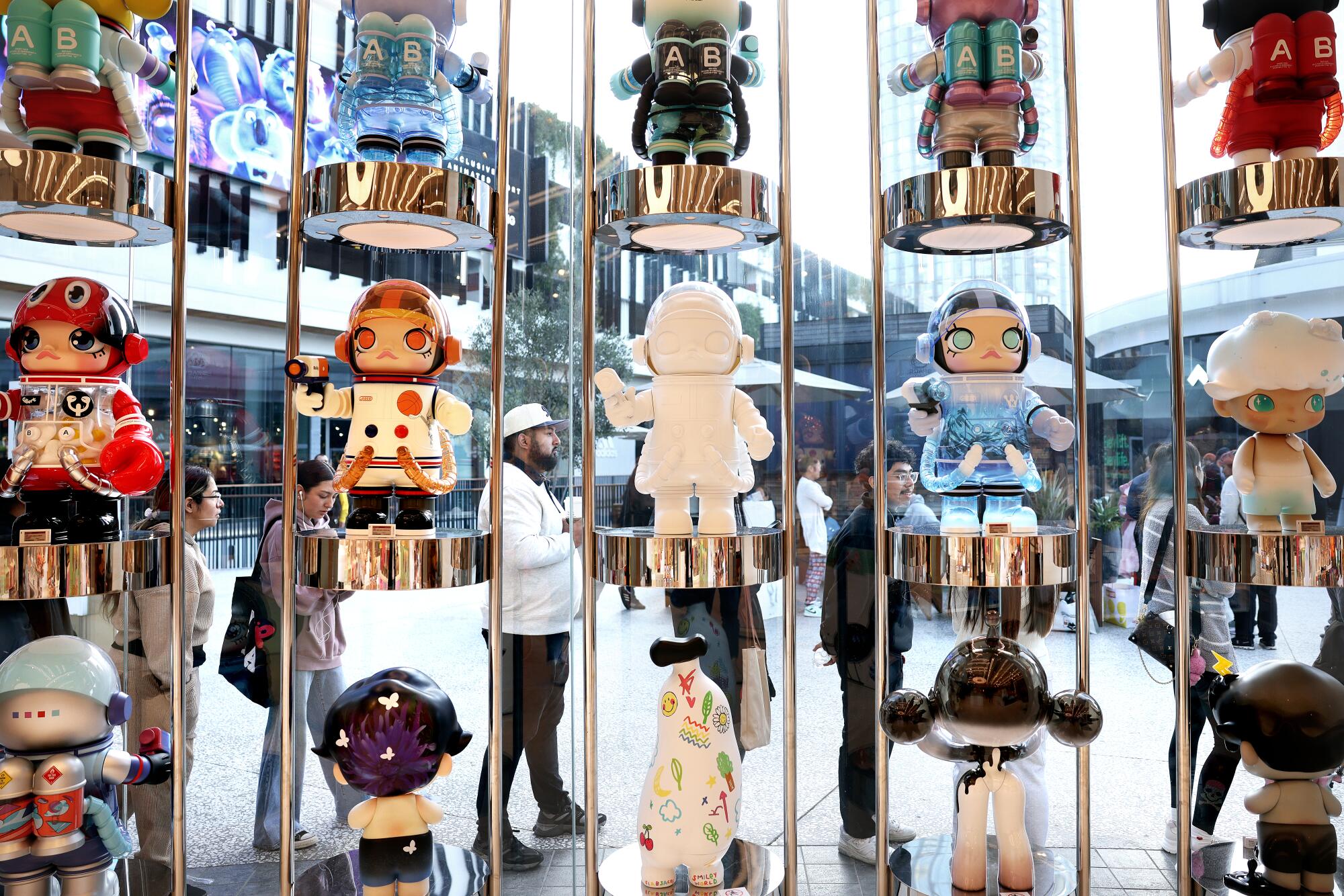
Mega Space Molly figurines line Pop Mart’s window display in Century City. The company is known for its artist-designed collectible toys.
Hong Kong-born artist Kasing Lung is the creator of Labubu and the other Monsters creatures, which first appeared in 2015 in a series of picture books; Pop Mart began selling Labubu merchandise four years later.
Lung told The Times that he incorporated elements of his own personality into Labubu’s narrative, such as her “naughtiness,” which he believed made the character more compelling.
He realized the impish elf had become a runaway success when “one day my parents asked me for a Labubu doll,” he said. “That was the specific moment for me.”
Now, obsessed fans are showcasing them in acrylic display cases in their homes, clipping them onto their backpacks and purses, and customizing them with fake eyelashes, tiny clothes and braces.
Justine Cristobal and her partner, Marivene Del Rosario, began buying Labubu in September. In two months, they’ve spent $2,500 on 28 small plushes and three large ones, driving to Pop Marts all over Southern California twice a week and meeting other collectors in coffee shops and at their homes to swap figurines.
“Sometimes we go to different Pop Marts just to check out what they have in the same day,” said 34-year-old Cristobal, a nurse from Pico Rivera.
But the secret chestnut-cocoa Labubu — there’s only one in every 72 boxes — has eluded them.
“It’s a reason for us to buy more and then we’ll just trade the ones that we already have,” she said. “They’re very limited, so that’s why you want it. You kind of crave it.”


The luxury shopping center in Pacific Palisades will reopen next month after more than $100 million in renovations forced by the January 2025 wildfire that devastated the Los Angeles neighborhood.
Palisades Village will reopen Aug. 15, owner Rick Caruso announced Wednesday. The outdoor center survived the blaze that destroyed homes and other businesses but needed refurbishment to eliminate contaminants that the fire could have spread.
Crews are putting finishing touches on mall buildings after tearing them down to the studs, treating the wood and rebuilding the walls, Caruso said.
“Everybody’s working, and stores are moving their products in,” he said. “It’s a really cool feeling that people have really locked arms and are working together.”
An electrician installs lighting for a restaurant at Rick Caruso’s Palisades Village on Thursday. The shopping center is scheduled to reopen mid-August.
(Myung J. Chun / Los Angeles Times)
Pacific Palisades resident Allison Polhill, who is rebuilding the home of 30 years that her family lost in the blaze, said she is “thrilled” at the prospect of returning to the mall she used to frequent. Its comeback is a boost for the community, she said.
“Every single step that we make to reopen our commercial corridors is going to bring more people back into the Palisades,” said Polhill, who expects to move back into her home at the end of August.
A total of 6,822 structures were destroyed in the Palisades fire, including more than 5,500 residences and 100 commercial businesses, according to the California Department of Forestry and Fire Protection.
Caruso previously attributed the mall’s survival to the hard work of private firefighters and the fire-resistant materials used in the mall’s construction.
The $200-million shopping and dining center opened in 2018 with a movie theater and a roster of upmarket tenants, including Erewhon, which may be the only grocer in the heart of the fire-ravaged neighborhood when it opens.
Caruso’s company was able to fill the mall with tenants despite the long shutdown.
Palisades Village is 99% leased, with the majority of tenants returning, said Jackie Levy, chief financial and revenue officer. Nearly one-third of the shops and restaurants are new to the property.

A firefighter carries a hose back to his rig while walking through a destroyed home from the Palisades fire in Pacific Palisades on Jan. 7, 2025.
(Genaro Molina / Los Angeles Times)
Last year, Pacific Palisades-based fashion designer Elyse Walker said she would reopen her eponymous store in Palisades Village after losing her 25-year flagship location on Antioch Street to the inferno.
Other neighborhood shops destroyed in the fire that are reopening at the mall include K Bakery and Loomey’s Toys, which caters to children up to age 12 and used to be across the street from Palisades Elementary Charter School.
“It’s been a journey and I’m excited because I wasn’t sure that there was going to be a place to come back to,” said toy store owner Amanda Rastegar. “Hopefully we can bring some of that magic back.”
Rastegar’s home in the Palisades survived but was damaged by the fire. The family returned about eight weeks ago. Her last memory of the fire was a burning supermarket.
“I just couldn’t wrap my brain around what was happening,” she said. “By the time I left, Gelson’s was on fire.”
Among the returning tenants is Angelini Ristorante & Bar. Well-known Los Angeles chef Gino Angelini said he will be in the kitchen next month for a return of the Italian restaurant.
“We won’t do a big celebrity open,” he said. “We want to have a very soft opening and see our customers come back.”

Construction takes place at Rick Caruso’s Palisades Village on Thursday. The shopping center is scheduled to reopen mid-August.
(Myung J. Chun / Los Angeles Times)
An elaborate celebration would not feel “correct for me,” Angelini said, because the devastation has been “very sad” for so many.
Other new tenants include local chef Nancy Silverton, who has agreed to move in with a new Italian steakhouse called Spacca Tutto. Women’s activewear retailer LESET will open its first West Coast location.
Caruso said he is optimistic that customers will return to the center, even though many Pacific Palisades residents are still dispersed. One tracking system estimated that about 30% of the Village’s customer base was impacted by the fire, he said.
“That means 70% did not get impacted, so there’s a lot of customers still left out there,” Caruso said. Historically, the center drew customers from as far away as Beverly Hills and Calabasas, as well as Malibu, Brentwood and Santa Monica.
He also hopes many will be inspired to visit the revived mall.
“I believe in the goodness of people and I believe that people are going to want to support the Palisades,” he said. “They’re going to want to be there and support the businesses that have had the courage and the heart to reopen.”

Walmart is rapidly expanding its network of electric vehicle chargers designed for customers to use while they shop.
The network could help fill gaps in EV infrastructure in states with greater need for chargers. Walmart, which has more than 5,000 locations in the U.S. and hundreds in California, says more than 90% of Americans live within 10 miles of one of its stores.
The chargers also offer an incentive for customers to choose Walmart — Walmart Plus members will receive a 10% discount off an average price of $0.46 per kilowatt-hour of energy at the company’s chargers.
Walmart chargers are already available at more than 75 locations in 17 states, with Texas boasting the most charging stations, followed by Florida and Arizona.
Matthew Nelson, Walmart’s director of energy policy, said last week on LinkedIn that the network will soon reach 29 states, including California.
“We are delivering on the promise of affordable, reliable and convenient charging,” Nelson said in his post.
According to Walmart’s website, six charging stations are coming to California soon, though the company did not offer a specific timeline.
The chargers will be installed at stores in Antelope, Brea, Fresno, Stockton, Suisun City and Vallejo.
Most charging sites in California will include eight to 16 fast-charging stalls, said Walmart spokesperson Kelsey Bohl.
The company first announced plans in April 2023 to install its own EV chargers at Walmart and Sam’s Club stores, with a goal of installing thousands of chargers by 2030. Partnering with ABB E-Mobility and Alpitronic, it added 25 new charging sites this past May and six more in June.
“Walmart is building a leading retail-integrated EV fast-charging network, focused on delivering an affordable, reliable and convenient charging experience where customers already shop,” Bohl said in an emailed statement. “Customers can charge while they shop, access stations through the Walmart app they already use, and benefit from affordable pricing.”
The charging stations already available include 612 individual charging stalls using 400-kilowatt chargers. Each stall has a dual charging cord with both Combined Charging System and North American Charging Standard connectors. The standard connectors, designed by Tesla, are smaller and lighter than the combined systems.
The primary way to pay for the chargers is through the Walmart app, but the company is also experimenting with built-in credit card readers to allow those without the app to use the stations.
Customers can check charger availability on the Walmart app. The company said the chargers will be available 24 hours a day.

Robotaxis could be turning into robocops.
A self-driving Waymo reported two teens to San Mateo, Calif., police on Monday after they were found drinking alcohol and shooting toy guns in the back of the vehicle.
According to a social media post from the San Mateo Police Department, officers detained two 15-year-olds after the Waymo they were riding in contacted the department and stopped in a parking lot until law enforcement arrived.
“Parents do you know where your teens are?” the San Mateo Police Department wrote on Facebook following the incident. “Waymo does!”
Officers removed both teens from the vehicle and determined they were using toy guns to shoot Orbeez out the windows. Orbeez are small, water-absorbing beads sold at toy stores.
“Toy guns, water guns, and BB guns all pose real dangers, especially to an untrained eye,” the Police Department said. “The simple handling of them can cause fear in [passersby].” “
A video posted on Facebook shows at least five officers and a police dog responding to the scene and approaching the Waymo with their weapons raised.
Waymo did not immediately respond to a request for comment.
Waymo vehicles have internal cameras and microphones that may be used in an emergency or to “promote safety and security,” according to Waymo’s online support page.
The cameras are also used to ensure the vehicles are clean and to help find lost items, according to the support page.
The company said it does not use facial recognition or other biometric identification technologies to identify individuals.
“In more urgent circumstances, support may access live video during a trip,” the Waymo page said.
The San Mateo Police Department’s Facebook post has garnered nearly 60 comments, with one user accusing Waymo of “snitching.”
“At least they got a designated driver?!” one user commented.
-

 Rhode Island1 minute ago
Handshake Initiative instills confidence, motivation in students
-

 South-Carolina6 minutes ago
ESPN recruiting writers break down five-star Josh Dobson’s fit with South Carolina
-

 South Dakota13 minutes ago
South Dakota man faces abuse charges after authorities called to NW Iowa casino
-

 Tennessee16 minutes ago
Data centers driving up Tennessee power bills, report finds
-

 Texas21 minutes ago
Family demands investigation after US man killed by ICE agent in Texas
-

 Utah28 minutes ago
Turn your miles into meals
-

 Vermont31 minutes ago
Poll: Most young Vermonters say they’re likely to leave state amid affordability concerns – VTDigger
-

 Virginia36 minutes ago
MEOC Organization hosts annual summer picnic for Southwest Virginia seniors

