Business
Michael Crichton's estate sues Warner Bros., Noah Wyle, others over 'ER' reboot

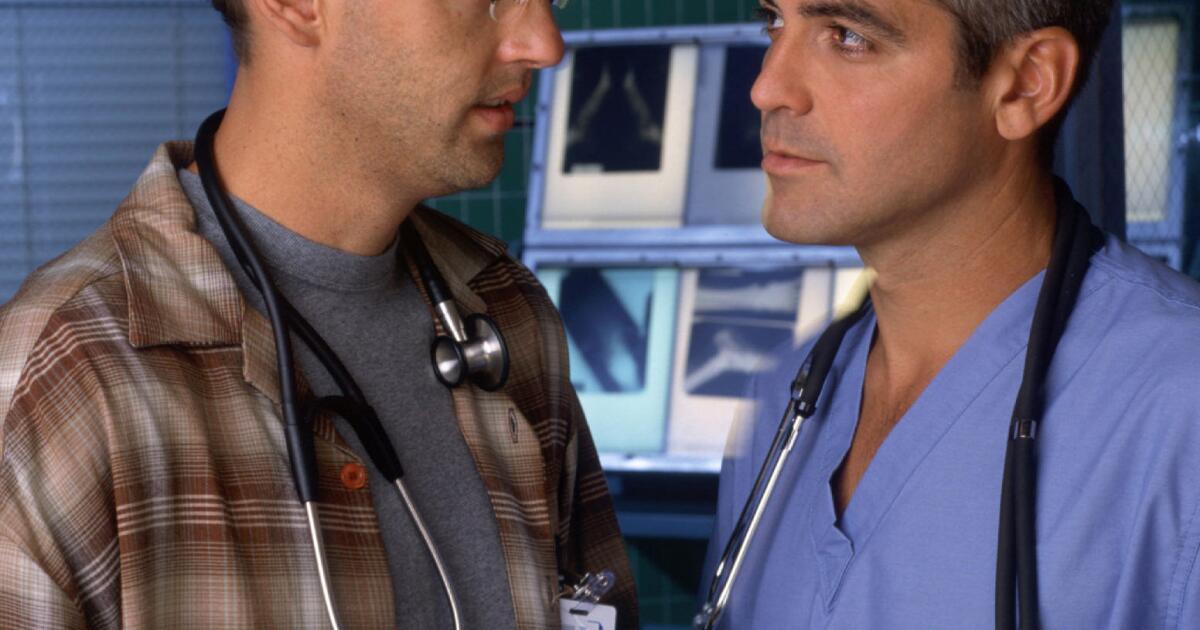
The estate of mega-selling author Michael Crichton filed suit against Warner Bros. Television, actor Noah Wyle and producer John Wells for breach of contract over the reboot of the blockbuster series “ER.”
According to the complaint filed Tuesday in Los Angeles Superior Court, the Crichton estate spent nearly a year unsuccessfully negotiating with Warner Bros. for the right to reboot the celebrated medical drama that ran on NBC.
When the parties did not reach an agreement, the studio “simply moved the show from Chicago to Pittsburgh, rebranded it ‘The Pitt,’ and has plowed ahead without any attribution or compensation for Crichton and his heirs,” the lawsuit alleges.
The move is a “callous disregard for Crichton’s inception of ‘ER,’” a “personal betrayal” of a 30-year friendship between the author and John Wells, the original series’ showrunner, and “an effort to rob his heirs of the fruits of one of his greatest creations,” the complaint states.
Wells has been announced as executive producer of “The Pitt” and Wyle is set to both star and serve as an executive producer.
“The lawsuit filed by the Crichton Estate is baseless, as ‘The Pitt’ is a new and original show. Any suggestion otherwise is false, and Warner Bros. Television intends to vigorously defend against these meritless claims,” said in a spokesperson for the studio in a statement.
Spokespersons for Wells and Wyle were not immediately available for comment.
Before he died in 2008, Crichton was a prolific, bestselling author who wrote 25 novels that sold more than 250 million copies worldwide, 13 of which were made into films including “Jurassic Park.” His novels, films and television series have collectively grossed over $10 billion to date, according to the suit.
In 1974, he wrote the screenplay for what became “ER’s” two-hour pilot, inspired by his own experiences as a medical intern in the emergency room of an urban hospital.
Fifteen years later, Crichton and Steven Spielberg developed his script into the groundbreaking series that ran on NBC for 15 seasons between 1994 and 2009, earning 124 Emmy nominations, winning 23. The show delivered “billions of dollars” to Warner Bros., states the complaint.
Before entering into an agreement with Warner Bros., Crichton extracted a series of contractual promises, including a “frozen rights” provision that prohibited the studio from making any sequels, remakes, spinoffs, or other productions derived from “ER” without his “express consent,” according to the suit. Further, the author would receive the appropriate credit, while his heirs would “receive compensation commensurate with the ultimate success of ‘ER,’ in connection with any future productions.”
After Crichton died, the lawsuit says that Warner Bros. made a series of moves that “betray[ed] his trust and diminish[ed] — and ultimately erase[d] him from his work, including the HBO remake of “Westworld,” based on the 1973 film that Crichton wrote and directed. Instead of giving Crichton a “created by” credit, he received a ‘’’based upon’ credit buried deep in the end credits.”
Then, in 2020, the suit alleges that Warner Bros. began developing an “ER” reboot to air on its struggling HBO Max service, “without ever shopping the project to ascertain its true value” and without informing the author’s widow, Sherri Crichton, the guardian of the estate that controls her late husband’s “ER” assets for the benefit of his children and in violation of the “frozen rights” provision.
After nearly two years of development, the studio informed Sherri Crichton and the estate of the planned reboot, “pressur[ing] them to consent, without regard for how Crichton would be credited or his heirs would financially benefit from the project,” according to the complaint.
After rocky discussions, the estate was prepared to approve the project in exchange for a “created by” credit give to Crichton and a $5-million nonperformance guarantee.
However, the suit alleges, the studio and Wells then rescinded those terms and demanded that the estate “waive the guarantee,” and proceeded to work on the reboot without its consent, initially in secret.
In a statement to The Times, a spokesperson for Sherri Crichton called Warner Bros.’ actions a “shameful betrayal.”
“Sixteen years after his death, Warner Bros. is effectively rebooting ‘ER,’ and seeking to boost the more than $3 billion profit it has already earned from his creation, without crediting Crichton and without obtaining consent as they are obligated to do under Crichton’s contract. Changing the show’s name does not change the fact that ‘The Pitt’ — which has exactly the same premise, structure, themes, pace, producers, and star — is ‘ER’ through and through.”




The race to bring air travel to the sky is heating up as Santa Cruz-based Joby Aviation and Toyota launch a joint venture to commercially produce air taxis.
The companies said in a news release Tuesday that they will work together on productivity, quality and costs and move toward mass production of Joby’s electric vertical takeoff aircraft. Joby and Toyota were first linked when Toyota made a nearly $400-million investment in the company in 2020. It has since increased its backing of the company to $900 million.
“It’s really meaningful for us to take on this challenge together with Joby, a partner that shares the same vision,” Toyota Chair Akio Toyoda said. “We believe this strengthened relationship is an important step forward in realizing the future mobility society.”
Joby‘s all-electric vertical takeoff vehicles are designed to hold four passengers and a pilot and can travel at up to 200 mph. The vehicle uses six tilting propellers to achieve vertical takeoff before switching to forward flight.
In February, Joby announced a partnership with Uber to start service in the United Arab Emirates this year, bringing on-demand air taxi rides to the country. It plans to expand to the U.S. after the completion of its final stage of Federal Aviation Administration testing.
Prior to its full FAA certification, Joby is hoping to launch early flight operations later this year as part of a White House program that will bring flights to several states, including New York, Texas and Arizona. Flights in California will not begin until after obtaining FAA certification.
Joby has been in a fierce battle to be the first with taxis in the sky with its Northern California competitor Archer Aviation. The two companies are involved in overlapping lawsuits, with Joby alleging corporate espionage against Archer, and Archer filing a suit alleging dubious ties to China that sparked an investigation into Joby by the U.S. International Trade Commission.
“Toyota has been by Joby’s side for nearly a decade, providing invaluable guidance and support as we built the foundation for manufacturing our aircraft,” JoeBen Bevirt, Joby’s chief executive and founder, said in the news release. “Together, we share a vision of making aerial mobility an everyday reality, and we look forward to delivering on that promise together.”
Joby Aviation’s shares, which have fallen more than 30% this year, climbed 3% on Tuesday to $8.92.
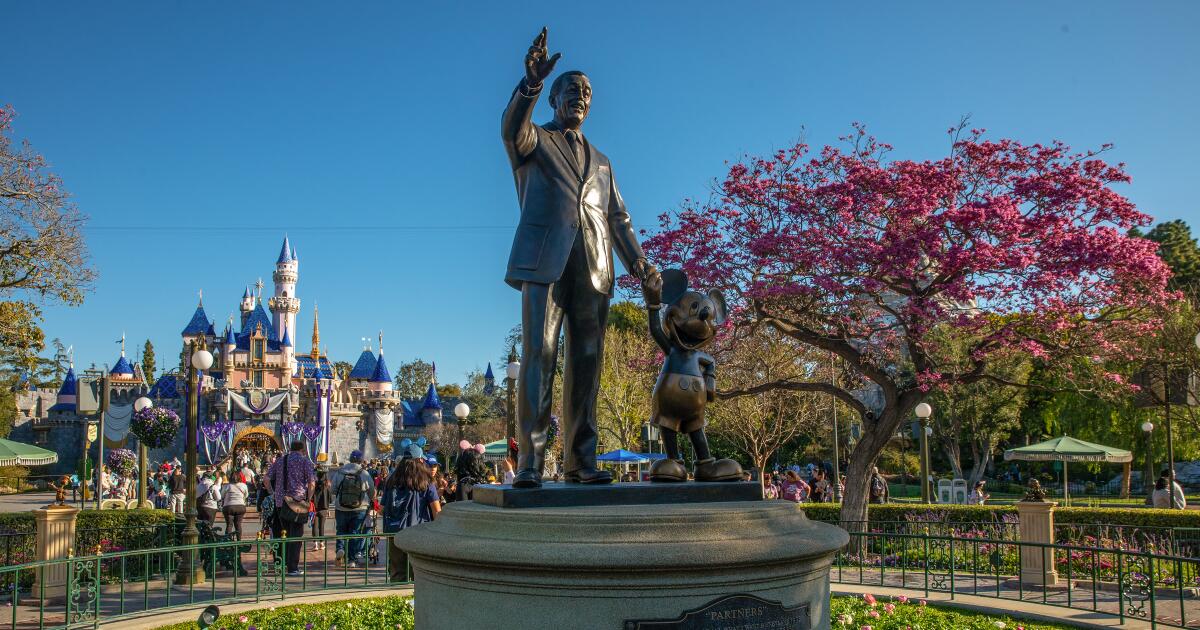
Disneyland Resort in Anaheim will offer $59 tickets for select evening admission to either theme park as part of a new promotion.
The one-day, one-park evening ticket offer will allow attendees to enter Disney California Adventure at 5 p.m. or Disneyland at 7 p.m. Park reservations are still required, as has been the case since the COVID-19 pandemic.
The offer only applies for admission from July 12 through Aug. 5 on Sundays to Wednesdays.
Disneyland Resort is commemorating its 70th anniversary through Aug. 9, and has introduced new shows and additions to rides as part of the occasion.
Walt Disney Co.’s theme parks and experiences business are a crucial boost to its finances, making up about 56% of the company’s operating income last fiscal year.
During the Burbank-based company’s most recent earnings call in May, Disney executives said attendance at its U.S.-based parks was down 1% compared with the prior year, a shift they attributed to “continued softness” in international visitations. However, the company said at the time that it was starting to move past those issues.
Disney’s experiences division reported $9.5 billion in revenue in that fiscal second quarter, up 7% compared with the same period a year ago, something executives said was due to higher guest spending domestically and more capacity on its cruise line.

An aging downtown office complex will be converted into apartments as part of an ambitious plan by local real estate companies to create 4,000 affordable housing units in Los Angeles.
The first project will be a $200-million makeover of the L.A. World Trade Center, a sprawling white elephant of an office complex on Figueroa Street built in the 1970s that will be turned into 512 apartments in one of the largest affordable housing conversions to date downtown.
Future projects being planned in the central city for delivery over the next five years will include other office-to-apartment conversions and new housing built from the ground up.
The 10-story World Trade Center, right, at Figueroa and Fourth streets in downtown Los Angeles, was built in the mid-1970s.
(Myung J. Chun / Los Angeles Times)
Behind the building campaign unveiled Monday are two of the region’s largest real estate companies, Jamison and Kennedy Wilson. Jamison is the city’s most prolific converter of offices to market-rate apartments and currently has a major makeover of a downtown office skyscraper underway for tenants who can pay top rents.
Kennedy Wilson, a real estate investment company based in Beverly Hills, owns Vintage Housing, which builds and operates affordable housing using tax credits and other state and federal financing to help fund it.
Vintage Housing and Jamison’s new affordable housing division, Arden Residential, will take on the campaign to build the housing where qualified tenants will pay rents below market rates.
Rents in the World Trade Center — which will be renamed Sky Castle when it opens in early 2028 — are expected to start at $937 for a one-bedroom unit. Some two- and three-bedroom units would rent for $1,100 and $1,300 per month, respectively, developers said.
Sky Castle will have shared amenities found in more expensive modern apartments, the developers said, such as a fitness center, resident lounge and co-working space. It already has six tennis courts on the roof, which may be converted to pickleball courts, Jamison Chief Executive Garrett Lee said.
The goal is to build higher quality affordable housing by using efficient construction methods Jamison has learned through building more than 8,000 market-rate apartments in the past, Lee said. The makeover of the World Trade Center will mark Jamison’s 15th conversion of an office building to housing.
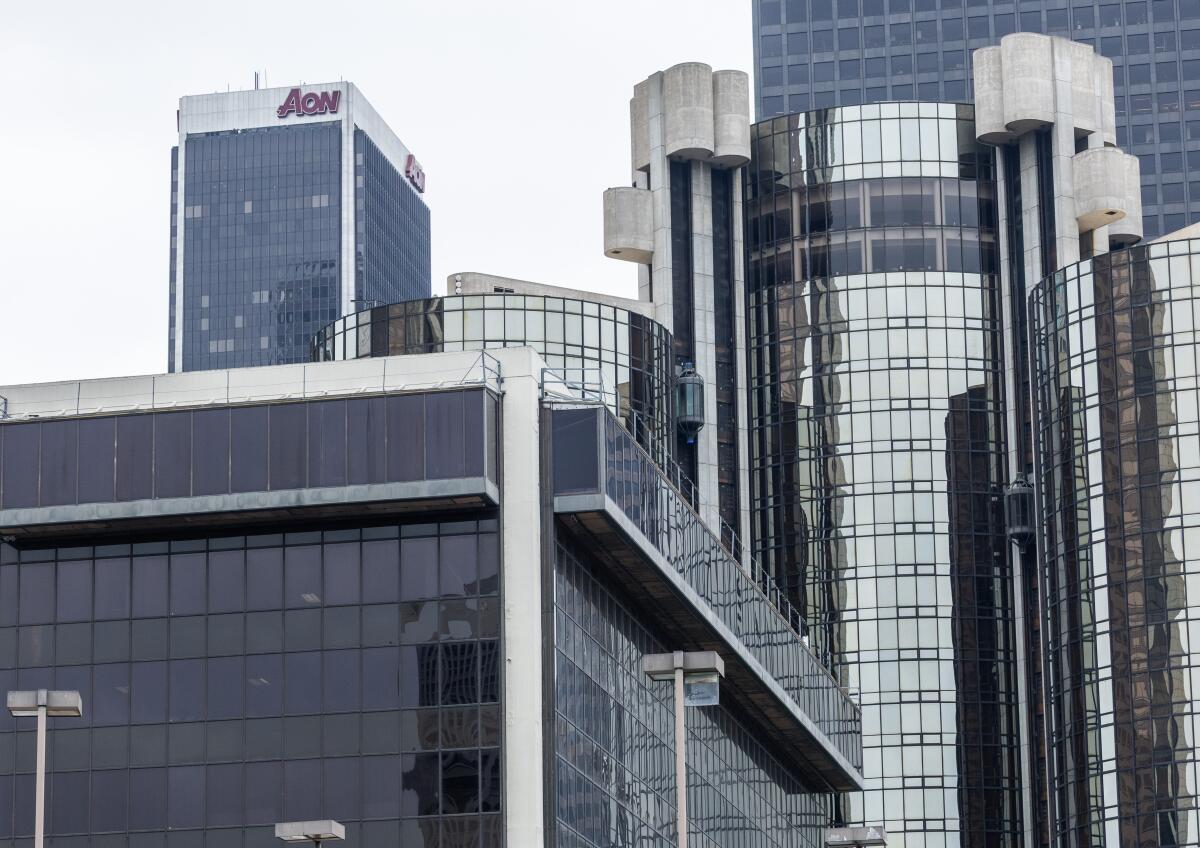
The plan to redevelop the L.A. World Trade Center, bottom left, is one of the largest affordable housing conversions to date downtown.
(Myung J. Chun / Los Angeles Times)
The 10-story World Trade Center was built in the mid-1970s to fanfare saying it would be home to international companies. In 1976, The Times described the center as a place to prepare for an overseas trip where visitors could get passports and visas, as well as exchange dollars for francs, marks, rubles and other currency. There was a language school and branches of U.S., Swiss and Japanese banks.
By the mid-1980s, the 400,000-square-foot office complex covering a city block at Figueroa and Fourth streets had lost its international flavor and was falling out of favor with corporate tenants who were moving into glossy new skyscrapers on Bunker Hill and in other locations.
The building has been cleared of remaining office tenants to allow work to begin in August, Lee said.
Kennedy Wilson is a nationwide operator of market-rate apartments that has also moved into building affordable housing in the last decade, said Nicholas Bridges, global head of capital markets at the company.
Building affordable, workforce housing “in almost all cases requires public subsidies,” Bridges said, and Kennedy Wilson has developed expertise in assembling “a cocktail of public financing sources” that includes low-income housing tax credits and tax-exempt bonds.
In the past, many housing developers have shied away from building affordable housing because assembling the subsidies needed to make construction profitable is challenging.

An artist’s rendering shows what the L.A. World Trade Center could look like after being redeveloped into affordable housing. The new complex is to be called Sky Castle.
(Ian Camarillo)
“It’s complicated,” Bridges said, “and not for the faint of heart.”
Eligible tenants must earn between 30% and 80% of the median income in the area where the housing is built.
Jamison and Kennedy Wilson will develop about 15 affordable housing projects between downtown and the 405 Freeway, Bridges said, many of them in aging office buildings such as the World Trade Center that are already owned by Jamison and are close to public transit.
Substantial potential for affordable housing lies in L.A.’s underused office buildings, he said.
“In this post-COVID world, the way people are utilizing office buildings, particularly older office buildings, has just fundamentally changed,” he said.
It makes sense for developers of conventional multifamily housing to move to building affordable housing, Lee said, because the government supports it through subsidies, zoning reform and the fast-tracking of construction permits. The city of Los Angeles also recently streamlined its adaptive reuse rules to make it easier to convert office buildings to housing.
“There are a lot of incentives pushing us in this direction,” Lee said.
-

 Massachusetts3 minutes ago
Mass. Legislature reaches compromise on $63.4B state budget. Here’s what’s in it
-

 Minnesota10 minutes ago
Minnesota Wild Signs Goaltender Calvin Pickard to a One-Year Contract | Minnesota Wild
-
Mississippi13 minutes ago
New autopsy of a baby killed by police in Mississippi deepens outrage
-
 Missouri18 minutes ago
In Missouri, Software ‘Bug’ Leads to Tax Deadline Extension
-

 Montana25 minutes ago
University of Montana welcomes Jeremiah Shinn as 20th president
-

 Nebraska28 minutes ago
Two high schools will represent Nebraska in the National Independence Day Parade
-
 Nevada33 minutes ago
Tesla Semi involved in first fatal crash, killing 2 in Nevada
-

 New Hampshire40 minutes ago
Have You Ever Actually Talked to a New Hampshire Police Officer? Here’s Your Chance

