Business
Malibu businesses struggling in the aftermath of fire and PCH restrictions


Two months after twin fires destroyed large swaths of two Southern California communities, many of the businesses left behind are struggling to revive sales in the face of displaced customers, road closures and a massive rebuilding effort that is projected to drag on for years.
The secondary crisis has hit hard in Malibu because of the ongoing closure of Pacific Coast Highway to most vehicle traffic — isolating the beachside community from customers coming from the Westside.
Some businesses have closed and others say they are struggling to stay open. Sales for some restaurants and shops have plummeted to less than half what they were before the Palisades fire roared through the east end of the city in early January.
A woman passes mostly closed stores in the Malibu Country Mart on Thursday.
(Etienne Laurent / For The Times)
Leaders in the city government and business community have urged the state transportation agency, Caltrans, to expand access to PCH as soon as possible. But with the U.S. Army Corps of Engineers only about to begin clearing hundreds of destroyed homes along the highway, the crucial coastal route seems likely to remain as a choke point for months and possibly years.
In the meantime, Malibu’s government and business leaders are reminding outsiders that most of the town did not burn and that restaurants and shops are waiting for customers to return.
“The main thing we want people to know is, Malibu is open for business,” said Mayor Doug Stewart. “Yes, it’s hard to come in from the east [Santa Monica side] but there are lots of other ways to get here. Malibu is not destroyed. Our retail and restaurants are open for everyone.”
Wildfires and floods have beset the city of about 10,000 with striking regularity. But in recent years the onslaught has been particularly challenging. First came the 2018 Woolsey fire, which destroyed 465 homes, with fewer than 40% rebuilt by this year.
Landslides closed PCH last year. The Franklin fire gutted 20 structures in central Malibu, also shutting down power for days. Then came January’s Palisades fire, which burned the vast majority of homes along the ocean from Topanga Canyon to Las Flores Canyon, just a part of the 798 total structures lost in Malibu, according to the Army Corps.

Fire crews from Mountain Home in Tulare County and Gabilan in Monterey County help clean up at Duke’s restaurant in Malibu on Feb. 14.
(Myung J. Chun / Los Angeles Times)
“If the businesses here were a boxer, at that point they might have called it a TKO [technical knockout],” Stewart said. “This has hit them really hard and they are struggling.”
Mitch Taylor, longtime manager of the Becker surf shop in central Malibu, agreed: “It’s a guarantee here in Malibu that something nasty happens every five to 10 years. But this isn’t just nasty, it’s devastating.”

Becker Surfboards manager Mitch Taylor, amid surfboards on sale in Malibu on Thursday.
(Etienne Laurent / For The Times)
Epitomizing the challenges for local business is John’s Garden, a beloved sandwich, salad and soup shop in the Malibu Country Mart. Though it survived the fire, the restaurant has seen its receipts drop by more than half, with many of its non-local customers unable to pass PCH checkpoints.
Even workers who have passes to get through the checkpoints find the drive painfully slow, with the highway reduced to one lane in each direction and the speed limit cut to 25 mph as work vehicles jam the roadway.
Many workers are forced to take the longer route, from the 101 Freeway to Las Virgenes/Malibu Canyon Road. The change has lengthened the one-way commute for some from perhaps 40 minutes to two hours, sometimes more.
When they arrive at work in the Country Mart, its to a quaint shopping center hushed by the absence of visitors. On a bright, windy day Thursday, a patio that can be jammed with diners sat mostly empty.
Boyan Kinov, a Bulgarian immigrant who bought John’s Garden a dozen years ago, said he is straining to stay afloat. Already, a neighboring boutique and a gym have closed. Other high-end retailers are open shorter hours. He worries that, if other businesses fail, it could further reduce foot traffic at the Cross Creek Road shopping center.

Kalin Kinov, who operates John’s Garden with his brother Boyan, inside the Malibu lunch and snack shop on Thursday.
(Etienne Laurent / For The Times)
Kinov said his insurer is balking at paying on a portion of his policy for receipts lost to business interruption, saying it is only responsible for the days the business actually shut its doors, not deficits linked to the restricted highway access.
“We’re one of the oldest businesses in Malibu. We celebrate our 50-year anniversary in July,” Kinov said. “We’re like a staple, an institution. And we have zero support from any kind of agencies or the government.
“I feel like defeat, you know? It’s unsustainable the way it is. It’s very sad, and even unbelievable, to have to consider closing the doors.”

A man looks at his phone in the empty covered area of Malibu Country Mart, where businesses have suffered in the wake of the Palisades fire.
(Etienne Laurent / For The Times)
Others local mainstays, like Duke’s Malibu, Tramonto Bistro and Caffe Luxxe on PCH near Carbon Beach, have not yet reopened. Those businesses are even harder to reach, hemmed in by checkpoints on both the east and west.
Like other businesses in Malibu, John’s Garden reminds customers from outside that they can still reach the city. The highway up the coast from the Country Mart remains open and traffic can also come over Kanan Dume Road and Malibu Canyon from the Valley.
But the bulk of visitors have always come from “town” — Pacific Palisades, Santa Monica and points beyond — making greater access to PCH critical.
At Paradise Cove Beach Cafe, where business is down more than 60%, owner Bob Morris called on political leaders up to the governor to focus on a quicker expansion of access to the highway, also known as State Route 1.

A playground at the Malibu Country Mart shopping center stands deserted.
(Etienne Laurent / For the Times)
Morris said leaders should consider offering the kind of incentive given to the freeway contractor who rebuilt the Santa Monica Freeway after the 1994 Northridge earthquake. That builder earned a $14.5-million bonus for restoring a collapsed section of the freeway 74 days ahead of schedule.
Glen Gerson, owner of Calamigos Beach Club restaurant on PCH, suggested Caltrans use reversible dividers on the highway to provide two lanes of traffic in the predominant commuting direction, and one lane in the other direction.
“Nobody needs to get hurt. We have to do it safely,” Morris said. “But we’ve got to get this highway open, and in the government somebody’s got to push to make it happen.”
The highway through most of Malibu consists of a total of five lanes — two for traffic in each direction and a center lane for left turns. There is also a lane on each side for parking along most of both sides of PCH.
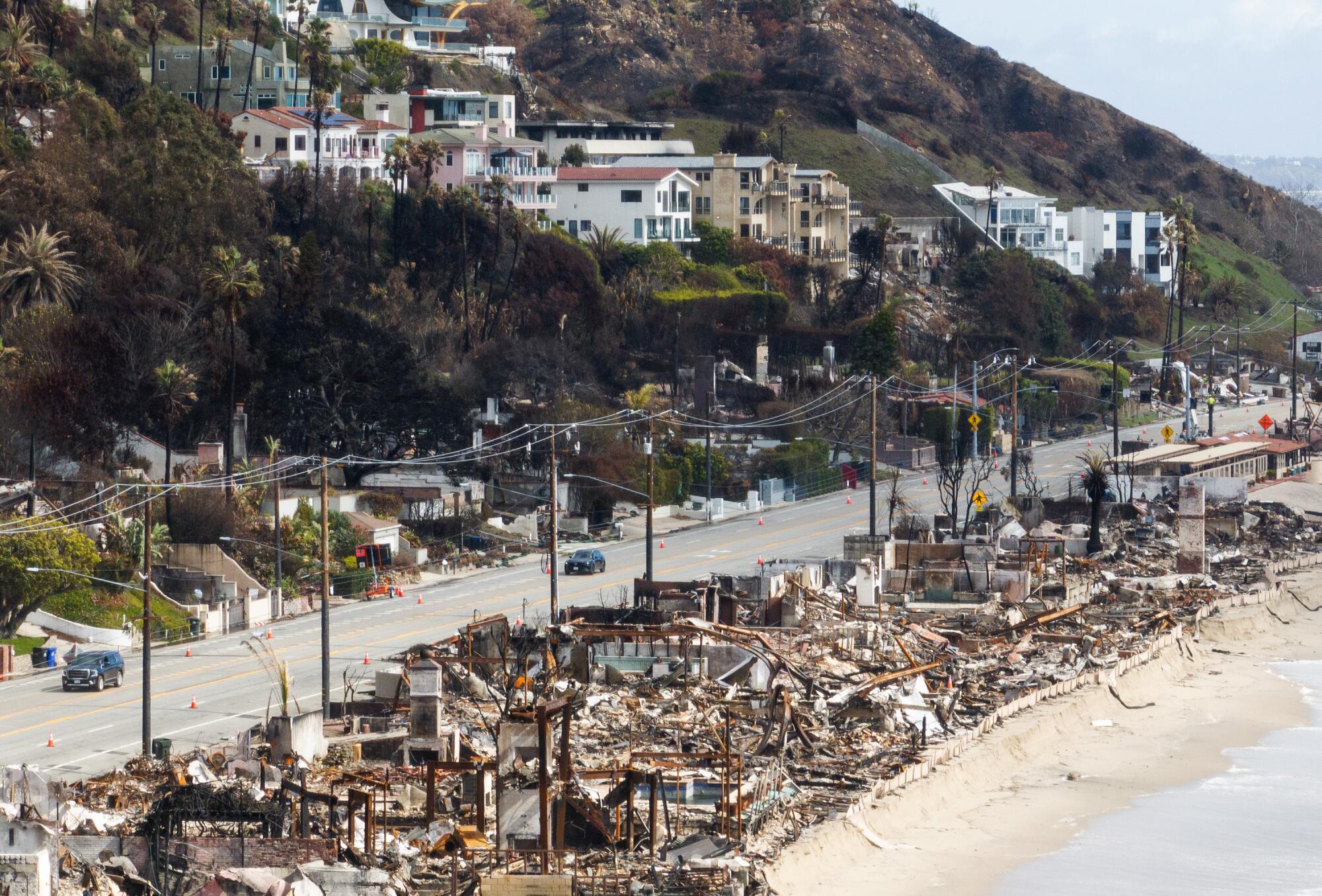
Houses on Pacific Coast Highway in Malibu destroyed by the Palisades fire.
(Myung J. Chun / Los Angeles Times)
Now orange traffic cones limit vehicles to one lane in each direction. And the highway will soon be crowded with trucks hauling debris to be removed by the Army Corps of Engineers and private contractors.
In the whole Palisades fire burn zone, it’s estimated it will take 90,000 truckloads to finish the job. The Corps has said the work will be complete in both the Palisades and Altadena burn areas “within a year,” without giving more precise estimates for PCH and other sections of the work.
Caltrans spokesperson Nathan Bass said the agency is moving “toward opening as soon as we possibly can,” adding that recovery workers remain busy in the area and that they must “work through” their tasks, including removal of hazards, before opening PCH for people other than first responders, healthcare workers, residents, contractors and essential employees.

A Los Angeles sanitation worker walks past fire debris last month to take a water sample at Topanga State Beach in Malibu.
(Christina House / Los Angeles Times)
Locals and visitors who mostly now come from up the coast or from the San Fernando Valley are trying to fill in for the missing customers.
The city of Malibu is buying lunch at various local restaurants, every day, for roughly 100 city employees, Stewart said. On March 15, Morris plans to host a “Day of Hope” at the Paradise Cove restaurant, with free meals for first responders and those affected by the fire.
Service resumed recently on the Metro bus line traveling from Santa Monica to Trancas Canyon Road, near the far western end of the city. Some locals have wondered whether a ferry service could be launched, to deliver day trippers from Santa Monica Pier to Malibu Pier — an alternative that the city tried during a major landslide decades ago.
Kinov and other Malibu businesspeople said their spirits have been lifted by customers who made a special effort to buy extra meals or gifts.
Lisa Barron, who lost her home above La Costa Beach, said she came to John’s Garden for a sandwich to help bolster a place she has come to love.
“We don’t want what’s still surviving to die before the rest of us can rebuild and get back,” said Barron, a former business professor at UC Irvine. “With these businesses and the people who are still living here, we’ve got to keep them alive and healthy and safe so the community doesn’t go downhill.”

A customer eats lunch at the Malibu Country Mart on Thursday.
(Etienne Laurent / For The Times)
With the same thought in mind, Vanessa Abbott, a film editor who lives in Calabasas, popped over the hill Thursday for lunch. “Everything is still here, and I want to do my part to support it,” Abbott said, “one sandwich at a time.”
Lynn Schulz, general manager of Marmalade Cafe in the Country Mart, said the feeling of support operates in both directions.
“We feel our role in the community, even during this tragedy, is to be here, to be open, to be cranking out meals, or to do catering, whatever anyone needs,” Schulz said. “We’re doing everything we can to be here and be part of the community.”

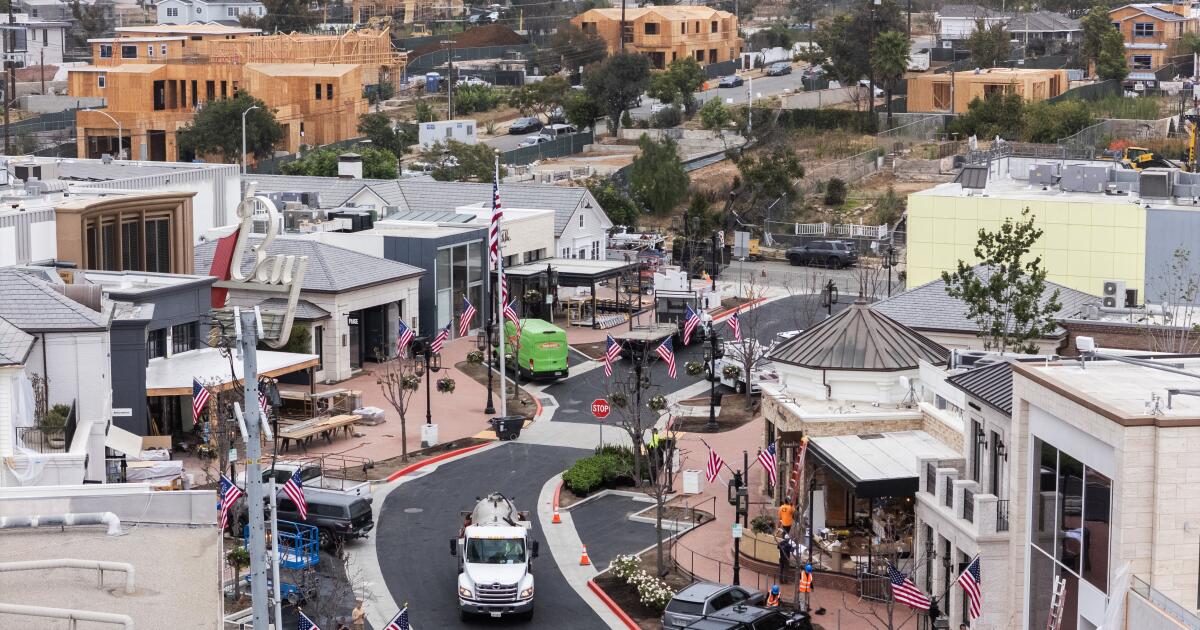
The luxury shopping center in Pacific Palisades will reopen next month after more than $100 million in renovations forced by the January 2025 wildfire that devastated the Los Angeles neighborhood.
Palisades Village will reopen Aug. 15, owner Rick Caruso announced Wednesday. The outdoor center survived the blaze that destroyed homes and other businesses but needed refurbishment to eliminate contaminants that the fire could have spread.
Crews are putting finishing touches on mall buildings after tearing them down to the studs, treating the wood and rebuilding the walls, Caruso said.
“Everybody’s working, and stores are moving their products in,” he said. “It’s a really cool feeling that people have really locked arms and are working together.”
An electrician installs lighting for a restaurant at Rick Caruso’s Palisades Village on Thursday. The shopping center is scheduled to reopen mid-August.
(Myung J. Chun / Los Angeles Times)
Pacific Palisades resident Allison Polhill, who is rebuilding the home of 30 years that her family lost in the blaze, said she is “thrilled” at the prospect of returning to the mall she used to frequent. Its comeback is a boost for the community, she said.
“Every single step that we make to reopen our commercial corridors is going to bring more people back into the Palisades,” said Polhill, who expects to move back into her home at the end of August.
A total of 6,822 structures were destroyed in the Palisades fire, including more than 5,500 residences and 100 commercial businesses, according to the California Department of Forestry and Fire Protection.
Caruso previously attributed the mall’s survival to the hard work of private firefighters and the fire-resistant materials used in the mall’s construction.
The $200-million shopping and dining center opened in 2018 with a movie theater and a roster of upmarket tenants, including Erewhon, which may be the only grocer in the heart of the fire-ravaged neighborhood when it opens.
Caruso’s company was able to fill the mall with tenants despite the long shutdown.
Palisades Village is 99% leased, with the majority of tenants returning, said Jackie Levy, chief financial and revenue officer. Nearly one-third of the shops and restaurants are new to the property.
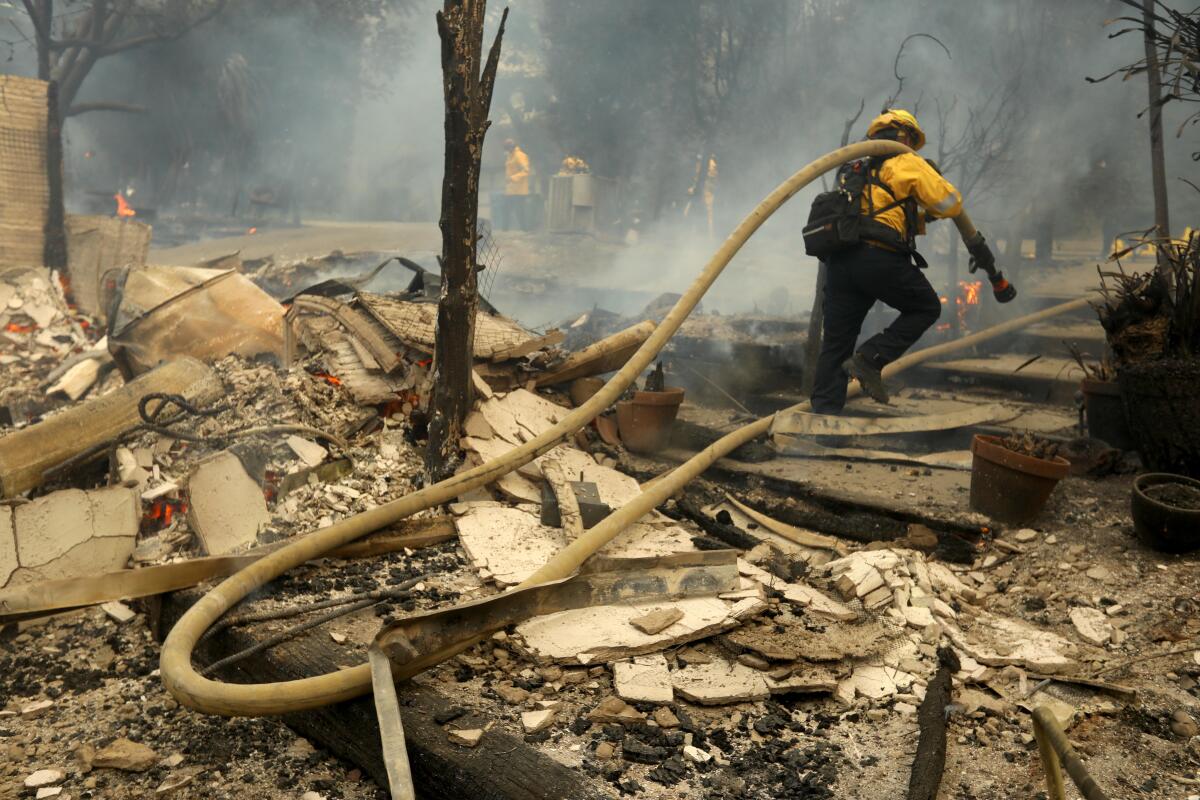
A firefighter carries a hose back to his rig while walking through a destroyed home from the Palisades fire in Pacific Palisades on Jan. 7, 2025.
(Genaro Molina / Los Angeles Times)
Last year, Pacific Palisades-based fashion designer Elyse Walker said she would reopen her eponymous store in Palisades Village after losing her 25-year flagship location on Antioch Street to the inferno.
Other neighborhood shops destroyed in the fire that are reopening at the mall include K Bakery and Loomey’s Toys, which caters to children up to age 12 and used to be across the street from Palisades Elementary Charter School.
“It’s been a journey and I’m excited because I wasn’t sure that there was going to be a place to come back to,” said toy store owner Amanda Rastegar. “Hopefully we can bring some of that magic back.”
Rastegar’s home in the Palisades survived but was damaged by the fire. The family returned about eight weeks ago. Her last memory of the fire was a burning supermarket.
“I just couldn’t wrap my brain around what was happening,” she said. “By the time I left, Gelson’s was on fire.”
Among the returning tenants is Angelini Ristorante & Bar. Well-known Los Angeles chef Gino Angelini said he will be in the kitchen next month for a return of the Italian restaurant.
“We won’t do a big celebrity open,” he said. “We want to have a very soft opening and see our customers come back.”

Construction takes place at Rick Caruso’s Palisades Village on Thursday. The shopping center is scheduled to reopen mid-August.
(Myung J. Chun / Los Angeles Times)
An elaborate celebration would not feel “correct for me,” Angelini said, because the devastation has been “very sad” for so many.
Other new tenants include local chef Nancy Silverton, who has agreed to move in with a new Italian steakhouse called Spacca Tutto. Women’s activewear retailer LESET will open its first West Coast location.
Caruso said he is optimistic that customers will return to the center, even though many Pacific Palisades residents are still dispersed. One tracking system estimated that about 30% of the Village’s customer base was impacted by the fire, he said.
“That means 70% did not get impacted, so there’s a lot of customers still left out there,” Caruso said. Historically, the center drew customers from as far away as Beverly Hills and Calabasas, as well as Malibu, Brentwood and Santa Monica.
He also hopes many will be inspired to visit the revived mall.
“I believe in the goodness of people and I believe that people are going to want to support the Palisades,” he said. “They’re going to want to be there and support the businesses that have had the courage and the heart to reopen.”

Walmart is rapidly expanding its network of electric vehicle chargers designed for customers to use while they shop.
The network could help fill gaps in EV infrastructure in states with greater need for chargers. Walmart, which has more than 5,000 locations in the U.S. and hundreds in California, says more than 90% of Americans live within 10 miles of one of its stores.
The chargers also offer an incentive for customers to choose Walmart — Walmart Plus members will receive a 10% discount off an average price of $0.46 per kilowatt-hour of energy at the company’s chargers.
Walmart chargers are already available at more than 75 locations in 17 states, with Texas boasting the most charging stations, followed by Florida and Arizona.
Matthew Nelson, Walmart’s director of energy policy, said last week on LinkedIn that the network will soon reach 29 states, including California.
“We are delivering on the promise of affordable, reliable and convenient charging,” Nelson said in his post.
According to Walmart’s website, six charging stations are coming to California soon, though the company did not offer a specific timeline.
The chargers will be installed at stores in Antelope, Brea, Fresno, Stockton, Suisun City and Vallejo.
Most charging sites in California will include eight to 16 fast-charging stalls, said Walmart spokesperson Kelsey Bohl.
The company first announced plans in April 2023 to install its own EV chargers at Walmart and Sam’s Club stores, with a goal of installing thousands of chargers by 2030. Partnering with ABB E-Mobility and Alpitronic, it added 25 new charging sites this past May and six more in June.
“Walmart is building a leading retail-integrated EV fast-charging network, focused on delivering an affordable, reliable and convenient charging experience where customers already shop,” Bohl said in an emailed statement. “Customers can charge while they shop, access stations through the Walmart app they already use, and benefit from affordable pricing.”
The charging stations already available include 612 individual charging stalls using 400-kilowatt chargers. Each stall has a dual charging cord with both Combined Charging System and North American Charging Standard connectors. The standard connectors, designed by Tesla, are smaller and lighter than the combined systems.
The primary way to pay for the chargers is through the Walmart app, but the company is also experimenting with built-in credit card readers to allow those without the app to use the stations.
Customers can check charger availability on the Walmart app. The company said the chargers will be available 24 hours a day.

Robotaxis could be turning into robocops.
A self-driving Waymo reported two teens to San Mateo, Calif., police on Monday after they were found drinking alcohol and shooting toy guns in the back of the vehicle.
According to a social media post from the San Mateo Police Department, officers detained two 15-year-olds after the Waymo they were riding in contacted the department and stopped in a parking lot until law enforcement arrived.
“Parents do you know where your teens are?” the San Mateo Police Department wrote on Facebook following the incident. “Waymo does!”
Officers removed both teens from the vehicle and determined they were using toy guns to shoot Orbeez out the windows. Orbeez are small, water-absorbing beads sold at toy stores.
“Toy guns, water guns, and BB guns all pose real dangers, especially to an untrained eye,” the Police Department said. “The simple handling of them can cause fear in [passersby].” “
A video posted on Facebook shows at least five officers and a police dog responding to the scene and approaching the Waymo with their weapons raised.
Waymo did not immediately respond to a request for comment.
Waymo vehicles have internal cameras and microphones that may be used in an emergency or to “promote safety and security,” according to Waymo’s online support page.
The cameras are also used to ensure the vehicles are clean and to help find lost items, according to the support page.
The company said it does not use facial recognition or other biometric identification technologies to identify individuals.
“In more urgent circumstances, support may access live video during a trip,” the Waymo page said.
The San Mateo Police Department’s Facebook post has garnered nearly 60 comments, with one user accusing Waymo of “snitching.”
“At least they got a designated driver?!” one user commented.
-

 Health3 minutes ago
Katie Couric couldn’t remember the year or the president during frightening brain episode
-

 Sports10 minutes ago
Justin Verlander announces he will retire after this season: ‘I’ve realized that time has come’
-

 Technology13 minutes ago
Apple AI security update proves hackers move fast
-
Business18 minutes ago
Fire-damaged Pacific Palisades shopping center sets reopening date
-
 Entertainment25 minutes ago
Rhea Seehorn celebrates her ‘Pluribus’ Emmy nomination as she waits to hear about Carol and the atom bomb
-

 Lifestyle28 minutes ago
Urban Jürgensen: Introducing Elite Watchmaking to New Audiences
-
 Politics33 minutes ago
Commentary: On Skid Row, it’s been decades of frustration. Will the next mayor have a plan?
-
 Science40 minutes ago
What’s the deal with … coffee enemas?

