Business
Lyft says San Francisco overcharged it $100 million in taxes, according to lawsuit


The ride-hailing company Lyft accused San Francisco of overcharging it $100 million in taxes over the last five years in a lawsuit filed last week.
Lyft, which is headquartered in the city, said in the complaint that the fees paid by riders to drivers are not part of the company’s revenue and should not be taxed. The company considers its drivers as customers, not employees, the company said.
“Lyft does not treat drivers as employees for any purpose,” the complaint said. “Lyft serves a broker/middleman role in the transaction between drivers and riders, and as such, its taxable gross receipts must be limited to the amounts charged to drivers for use of its marketplace services.”
Lyft makes the bulk of its money from the fees it charges drivers. It also brings in some revenue from other sources, including subscriptions and advertising.
“Lyft recognizes revenue from rideshare as being comprised of fees paid to Lyft by drivers, not charges paid by riders to drivers,” said the complaint, filed in San Francisco Superior Court.
San Francisco wrongly included driver income as part of Lyft’s revenue when calculating taxes between 2019 and 2023, Lyft said. The company is now seeking refunds for overpaid taxes as well as interest and penalties.
“Lyft doesn’t take operating in San Francisco for granted and we love serving both riders and drivers in our hometown city,” the company said in a statement. “We believe the city is incorrect with how it calculated our gross receipts tax. … We filed this lawsuit to help correct this issue.”
Lyft called San Francisco’s tax methodology “distortive” and is waiting for a formal response from the city.
“We will review the complaint and respond accordingly,” said Jen Kwart, a spokesperson for the San Francisco city attorney.
This isn’t the first time a business has disputed a high tax bill from San Francisco. Last year, Detroit-based automaker General Motors sued the city, seeking to recoup more than $100 million in back taxes, claiming the taxes were improperly calculated.
The Lyft lawsuit comes amid debate over how rideshare drivers should be classified and how gig economy companies such as Lyft and Uber should be taxed. Lyft’s complaint notes that neither the U.S. Securities and Exchange Commission nor federal tax authorities consider driver compensation as part of company revenue.
Ride-hailing companies classify their drivers as independent contractors in the United States instead of employees, meaning the companies don’t have to provide workers certain benefits such as sick leave and overtime pay.
Unions fighting for better working conditions say drivers are improperly labeled but lost a legal battle this year in California over the issue. The California Supreme Court upheld a voter initiative known as Proposition 22 that allowed companies such as Lyft to classify their workers as contractors, a law ride-hailing services say is vital to their business model.
Lyft has also faced scrutiny from the federal government over allegations that it made false and misleading statements about how much its drivers would earn. In November, Lyft agreed to pay $2.1 million in civil penalties to resolve the accusations.


Google took internet searches to the next level. Could it do the same for mosquito control?
The Silicon Valley-based tech giant is seeking to release up to 64 million sterilized male mosquitoes in California and Florida over two years, according to a notice in the Federal Register. It’s part of an ambitious effort to curb the diseases the insects spread.
Google says it can harness technology to optimize a concept that’s been around for decades, but hasn’t been successfully scaled with mosquitoes to rein in disease.
For example, the process often involves separating the insects by sex to isolate the males. Currently, that’s done manually and can be time consuming. Google says it’s “developing new technologies that combine sensors, algorithms and novel engineering to take advantage of unique aspects of mosquito biology to quickly and accurately sort males from females.”
The company also says it’s building software and monitoring tools to guide releases of sterile males, and its scientists and engineers are creating sensors, traps and software to decide which areas need to be treated and treated again.
-
Share via
Called Debug, the project targets Aedes aegypti mosquitoes, which are native to Africa but have infiltrated nearly half of California’s counties since first being detected in the state in 2013. Not only do they drive residents nuts with itchy bites, but they can carry a number of potentially serious diseases, including dengue, Zika, chikungunya and yellow fever.
The plan is to infect males — which don’t bite — with a bacteria called Wolbachia, which effectively renders them sterile. They are then released to seek out wild females and mate. Females will lay eggs but these won’t hatch, which experts say drives down the population over time.
There are other methods to sterilize male mosquitoes. Vector control districts serving Los Angeles, Orange and San Bernardino counties have irradiated males and released them in recent years.
Early results are promising. Two neighborhoods treated by the Greater Los Angeles Vector Control District saw a more than 80% reduction in the female Aedes aegypti population in 2024 and 2025.
But as the Greater L.A. district seeks to expand its operations, cost poses a problem. Last year, business owners signaled they weren’t willing to shell out more every year to make it happen. District officials are still hoping to sway them.
If Google moves forward, it wouldn’t be the first time it has been involved in such an effort. In 2018, the company conducted a large-scale trial in Fresno County, releasing 14.4 million Wolbachia-infected males in three neighborhoods.
“At peak mosquito season, the number of female mosquitoes was 95.5% lower in release areas compared to non-release areas, with the most geographically isolated neighborhood reaching a 99% reduction,” a 2020 paper reported.
Google has applied for a permit from the Environmental Protection Agency to carry out the releases in California and Florida, for which the federal agency is currently seeking comments before deciding whether to grant approval.
The company aims to release up to 16 million Wolbachia-infected males in California, and the same in Florida, per year for two years, the Federal Register announcement said, for a total of 64 million.
Urgency to tamp down the invasive mosquito population in California has increased since 2023, when the state logged its first locally acquired dengue cases — meaning people were infected in their communities, not while traveling. The following year, the number of locally acquired cases ballooned to 18, with 14 of them in Los Angeles County.
A study published last week in “The Lancet Regional Health — Americas” found that approximately 18.2 million Californians — primarily in the Central Valley, L.A. and San Diego areas — live in regions where conditions are probably suitable for local dengue transmission.
“Under moderate scenarios of climate warming and urban expansion, an additional 4.1 million residents may be at risk by mid-century,” according to the study led by UC Berkeley’s Lisa Couper. Researchers note the current and future risk of transmission remains low except during summer in the Central Valley and Southern California.
“I’m pretty much in favor of whichever [sterile insect technique] approach gets us the disease prevention and nuisance control we need and at the lowest price,” Susanne Kluh, general manager of the Greater L.A. County Vector Control District, said in an email.
She said her district went with radiation because it was the only approved technique when they wanted to launch their pilot, and that it’s “also the only one where some company does not make a profit in the middle.” However, she wouldn’t rule out using Wolbachia if it turned out to be the most affordable option.
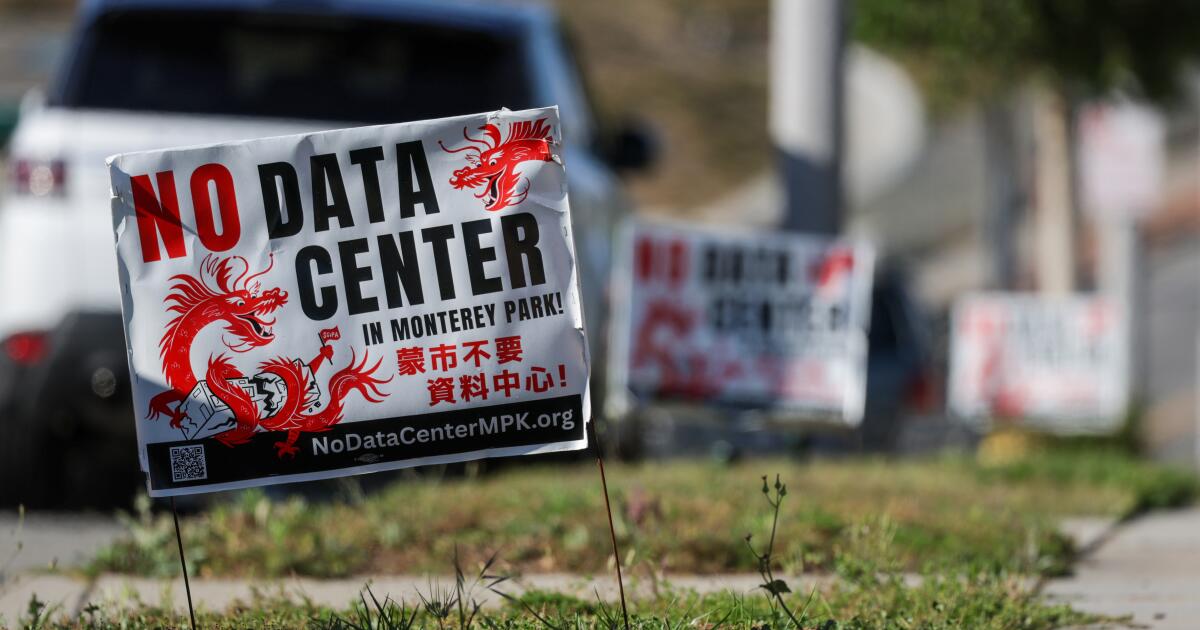
Residents of Monterey Park voted overwhelmingly to ban data centers on election day, making the San Gabriel Valley city the first in the nation to do so by public vote.
As of Wednesday, 86% of votes were in favor of Measure NDC, the city ban, according to the Los Angeles County registrar-recorder/county clerk.
Other cities and towns have passed moratoriums on data centers, as a wave of opposition sweeps the country. But the Monterey Park vote can only be overturned by another ballot measure, making it the most permanent data center ban in a jurisdiction.
Monterey Park’s City Council had already banned data centers by ordinance, after a proposed 247,000-square-foot data center met an outpouring of public anger and concern. The developer withdrew that plan.
That facility would have been less than 500 feet away from the nearest home, and would have used three times the electricity of the entire 60,000-person city. Residents said it would have caused noise and air pollution and driven up electricity rates.
“This ensures long-lasting protections for current and future generations,” Amy Wong, co-founder of the group San Gabriel Valley Progressive Action, said of the vote. “It means that future city councils cannot overturn a data center ban, even if data center developers wanted to spend money to fund pro-data center candidates.”
The measure had no formal opposition. The developer of the proposed facility, investment firm HMC StratCap, said it wouldn’t engage in the ballot fight when it withdrew in March.
The Data Center Coalition, an industry trade group, expressed disappointment in the vote.
“It sends a signal that the area is closed for business, both for data centers and for other significant economic development projects,” state policy director Khara Boender said.
“It deprives local residents of the opportunity to compete for jobs and investment, while also causing the area to relinquish substantial long-term economic investment, high-wage jobs, and critical tax revenue to neighboring areas or other states.”
SGV Progressive Action worked with hyperlocal groups including No Data Center Monterey Park to rally support for the measure.
The group is now focused on stopping data center proposals in the City of Industry and fighting a move by City of Industry, Santa Fe Springs, Vernon and City of Commerce to welcome data centers and other industry with fast-tracked permitting and tax incentives.
City of Industry, in the San Gabriel Valley, and Vernon, south of downtown L.A., are primarily industrial areas, each with around 300 permanent residents. They are employment centers, and tens of thousands of workers commute in daily.
There has been little vocal opposition to data centers among the few residents of these cities. Wong said the protest is primarily coming from the surrounding neighborhoods.
“If a data center gets built in City of Industry, residents across the region would bear the brunt of pollution and increased utility costs,” Wong said, noting that it is surrounded by 16 other cities and unincorporated communities.
Data center proposals have been limited in California compared to Virginia, Texas, Georgia, Illinois and Arizona, which sit at the center of a recent boom in hyperscaler facilities to power artificial intelligence.
California has the third-most data centers in the country, with 300, but high electricity rates, expensive land and regulatory hurdles mean that fewer, and smaller, facilities are currently planned than in other hotspots.
That doesn’t mean opposition hasn’t been fierce. In Coachella and Imperial County, residents are showing up in droves to protest local proposals.
In the San Gabriel Valley, Montebello, El Monte and Baldwin Park have all enacted temporary moratoriums, and Alhambra recently banned data centers as part of a zoning code update.
Wong said she hoped the ballot measure vote would galvanize the opposition. “The vote is a testament to the people power of our region,” she said. “Our region is worth protecting, and we won’t let data centers determine our future.”

A rule intended to prevent rent gouging in the wake of the Eaton and Palisades fires has lapsed in Los Angeles County, possibly exposing some renters to hikes.
The executive order that blocked rent increases was issued by Gov. Gavin Newsom amid the devastating wildfires last year. Under the order, landlords couldn’t increase rents by more than 10% above their prefire levels.
The rule, which was supposed to be temporary and was repeatedly extended, ended Friday after a vote to extend it again failed to garner enough votes. Supervisor Lindsey Horvath, whose district includes Pacific Palisades, sounded the alarm in a motion to extend price protections that failed to pass at the Board of Supervisors’ May 19 meeting.
“These price gouging protections continue to be necessary as construction and rebuilding continue, and as thousands of people remain displaced,” the motion said. “Families which signed short-term leases could face drastic price increases of 50% or more without further price gouging protection.”
Los Angeles County is home to more than 1 million rental properties, though not all of them needed protection from the new rule. There are already stricter rent increase caps for many residences, depending on the location, type and age of the building. Despite the rent control in the region, the people of Los Angeles pay among the highest rents in the country.
It is uncertain whether renters will face rapidly rising rents now that the protection has lapsed. But some real estate experts and policymakers said there was no need for the temporary rule that was part of the governor’s state of emergency.
Supervisors Kathryn Barger, Janice Hahn and Holly Mitchell abstained from voting on the motion to extend the protection, while Supervisors Hilda Solis and Horvath supported it.
“I abstained because I did not see sufficient evidence to justify extending this emergency ordinance, nor did I see evidence to eliminate it entirely,” Hahn said.
Barger’s office said she supported allowing the protections to sunset while waiting to see whether new information emerged.
“Market data already shows countywide rents are only about 2% above pre-emergency levels and rental inventory has grown,” Barger representative Helen E. Chavez Garcia said. “The Supervisor is also mindful of the burden these ongoing protections place on small property owners throughout the county.”
Mitchell did not immediately respond to a request for comment.
There haven’t been steep rent hikes in neighborhoods within three miles of the Palisades fire, according to a Times analysis of data from Zillow, the property listing company.
In ZIP Codes within three miles of the Palisades fire, rent increased 4.8% from December 2024 to April 2025. In areas around the Eaton fire, which destroyed swaths of Altadena, rent jumped 5.2% in the same period.
In L.A. County, ZIP Codes farther from the fires saw only about a 2% increase.
A landlords representative, Jesus Rojas of the Apartment Owners Assn. of Greater Los Angeles, told the supervisors during public comment at the meeting that the county’s rent-gouging rules have “long outlived the emergency they were intended to address” and are now being “wrongfully used to harm thousands of rental housing providers throughout the county.”
“There is no proof that multifamily rental housing providers are hugely increasing rents for impacted homeowners,” Rojas said.
Indeed, there are strong signs that the property market in the Los Angeles area has at last begun to cool.
L.A. metro-area rent prices recently fell to a four-year low, with the median rent slipping to $2,167 in December.
Meanwhile, condominium sales had their slowest start of the year in decades. Condo sales in Los Angeles have plummeted to a 20-year low, with fewer than 2,000 units sold in January and February — the worst start to the year since 2005.
Newsom defended the price-gouging protections shortly after they went into effect.
“In the days following the Los Angeles firestorms, we worked quickly to protect Los Angeles survivors from any form of exploitation,” he said in February 2025. “The state has the tools in place to not only block price gouging during this emergency, but also to prosecute bad actors.”
The Los Angeles County Department of Consumer and Business Affairs said it received more than 2,000 complaints after the fires, alleging that retailers and landlords were taking advantage of people put in hardship by their losses, and sent out more than 2,000 cease-and-desist letters to businesses and landlords for alleged price gouging, said Morine Merritt, who oversees department investigations into consumer and real estate fraud.
“Close to 90% of the complaints that we received involved allegations of rent increases,” Merritt said in an interview. Now that the fire-related protections have expired, existing laws and “regular market conditions determine price increases for goods and services, including rents,” she said.
Crackdowns on fire-related rent gouging have been rare, said Chelsea Kirk of the activist organization the Rent Brigade, which analyzed L.A. County’s rental market in the year after the fires. It reported 18,360 potential examples of price gouging in listings but said that few lawsuits had been filed by authorities so far.
Last week, Rent Brigade announced what it said was the first private civil lawsuit brought by a family that claimed to be rent-gouged in the aftermath of the wildfires. Plaintiffs Randall and Candy Renick, whose Altadena home was damaged, said they were charged nearly three times the maximum permitted rate for nearly 10 months. They seek restitution of $96,000 plus civil penalties and attorneys’ fees.
The rental market has probably stabilized since the fires, Kirk said, but other families may still be “locked into illegal rents” that they agreed to pay when they were in a rush to find housing after they were displaced.
-

 New Mexico5 minutes ago
South Valley business estimates $1M in damages after recycling plant fire
-

 North Carolina8 minutes ago
J.R. Smith Graduates From North Carolina A&T, Fulfilling A Promise Years In The Making | Essence
-

 North Dakota13 minutes ago
The Worst Prisons In The USA: Where Does The ND State Pen Rank?
-

 Ohio20 minutes ago
Ohio auditor describes how widespread Medicaid fraud affects taxpayers | Fox News Video
-

 Oklahoma23 minutes ago
One injured in auto-pedestrian crash in northwest Oklahoma City
-

 Oregon28 minutes ago
Woman dies after falling into Devil’s Punchbowl on Oregon coast
-

 Pennsylvania35 minutes ago
Half of child deaths left unreviewed in Pennsylvania since 2020 as counties struggle with ‘unfunded mandate’
-

 Rhode Island38 minutes ago
He grew up in the kitchen. Then he rewrote the menu, and the future of his parents’ restaurant – The Boston Globe

