Business
In big win for business, Supreme Court dramatically limits rulemaking power of federal agencies

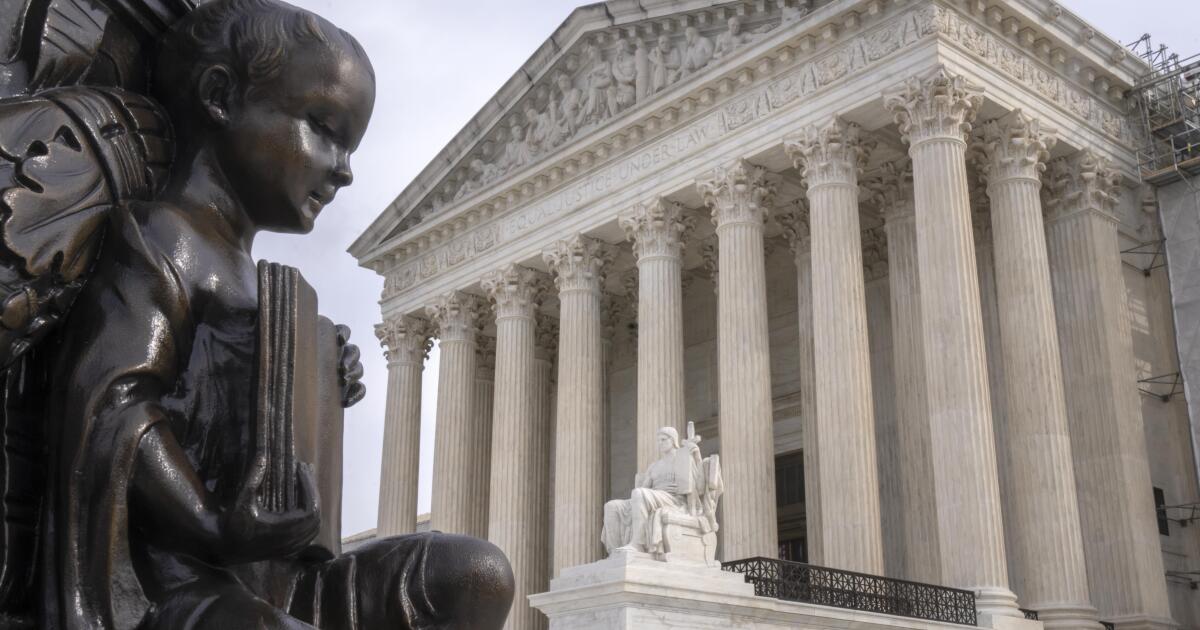
In a major victory for business, the Supreme Court on Friday gave judges more power to block new regulations if they are not explicitly authorized by federal law.
The court’s conservative majority overturned a 40-year-old rule that said judges should defer to agencies and their regulations if the law is not clear.
The vote was 6 to 3, with the liberal justices dissenting.
The decision signals a power shift in Washington away from agencies and in favor of the businesses and industries they regulate. It will give business lawyers a stronger hand in challenging new regulations.
At the same time, it deals a sharp setback to environmentalists, consumer advocates, unions and healthcare regulators. Along with the Biden administration, they argued that judges should defer to agency officials who are experts in their fields and have a duty to enforce the law.
This deference rule, known as the Chevron doctrine, had taken on extraordinary importance in recent decades because Congress has been divided and unable to pass new laws on pressing matters such as climate change, online commerce, hospitals and nursing care and workplace conditions.
Instead, new administrations, and in particular Democratic ones, sought to make change by adopting new regulations based on old laws. For example, the climate change regulations proposed by the Obama and Biden administrations were based on provisions of the Clean Air Act of 1970.
But that strategy depended on judges being willing to defer to the agencies and to reject challenges from businesses and others who maintained the regulations went beyond the law.
The court’s Republican appointees came to the case skeptical of the Chevron doctrine. They fretted about the “administrative state” and argued that unelected federal officials should not be afforded powers typically reserved for lawmakers.
“Chevron is overruled,” Chief Justice John G. Roberts Jr. wrote Friday for the majority. “Courts must exercise their independent judgment in deciding whether an agency has acted within its statutory authority.” Judges “may not defer to an agency interpretation of the law simply because a statute is ambiguous,” he added.
In dissent, Justice Elena Kagan said the Chevron rule was crucial “in supporting regulatory efforts of all kinds — to name a few, keeping air and water clean, food and drugs safe, and financial markets honest. And the rule is right,” she said. It now “falls victim to a bald assertion of judicial authority. The majority disdains restraint, and grasps for power.” Justices Sonia Sotomayor and Ketanji Brown Jackson agreed.
Senate Majority Leader Charles E. Schumer (D-N.Y.) voiced outrage. “In overruling Chevron, the Trump MAGA Supreme Court has once again sided with powerful special interests and giant corporations against the middle class and American families. Their headlong rush to overturn 40 years of precedent and impose their own radical views is appalling.”
Experts said the impact of the ruling may not be clear for some time.
Washington attorney Varu Chilakamarri said the ruling means “industry’s interpretation of the law will be viewed as just as valid as the agency’s. It will be some time before we see the effects of this decision on the lawmaking process, but going forward, agency action will be under even greater scrutiny and there will likely be more opportunities for the regulated community to challenge agency rules and adjudications.”
In decades past, the Chevron doctrine was supported by prominent conservatives, including the late Justice Antonin Scalia. In the 1980s, he believed it was better to entrust decisions about regulations to agency officials who worked for the president rather than to unelected judges. He was also reflecting an era when Republicans, from Richard Nixon and Gerald Ford to Ronald Reagan and George H.W. Bush, controlled the White House.
But since the 1990s, when Democrat Bill Clinton was president, conservatives have increasingly complained that judges were rubber-stamping new federal regulations.
Business lawyers went in search of an attractive case to challenge the Chevron doctrine, and they found it in the plight of four family-owned fishing boats in New Jersey.
Their case began with a 1976 law that seeks to conserve the stocks of fish. A regulation adopted by the National Marine Fishery Service in 2020 would have required some herring boats to not only carry a federal monitor on board, but also pay the salary of the monitor. Doing so was predicted to cost more than $700 a day, or about 20% of what the fishing boats earned on average.
The regulation had not taken effect, but it was upheld by a federal judge and the D.C. Circuit Court’s appellate judges who deferred to the agency’s interpretation of the law.



The iPic dine-in movie theater chain has filed for Chapter 11 bankruptcy protection and intends to pursue a sale of its assets, citing the difficult post-pandemic theatrical market.
The Boca Raton, Fla.-based company has 13 locations across the U.S., including in Pasadena and Westwood, according to a Feb. 25 filing in U.S. Bankruptcy Court in the Southern District of Florida, West Palm Beach division.
As part of the bankruptcy process, the Pasadena and Westwood theaters will be permanently closed, according to WARN Act notices filed with the state of California’s Employment Development Department.
The company came to its conclusion after “exploring a range of possible alternatives,” iPic Chief Executive Patrick Quinn said in a statement.
“We are committed to continuing our business operations with minimal impact throughout the process and will endeavor to serve our customers with the high standard of care they have come to expect from us,” he said.
The company will keep its current management to maintain day-to-day operations while it goes through the bankruptcy process, iPic said in the statement. The last day of employment for workers in its Pasadena and Westwood locations is April 28, according to a state WARN Act notice. The chain has 1,300 full- and part-time employees, with 193 workers in California.
The theatrical business, including the exhibition industry, still has not recovered from the pandemic’s effect on consumer behavior. Last year, overall box office revenue in the U.S. and Canada totaled about $8.8 billion, up just 1.6% compared with 2024. Even more troubling is that industry revenue in 2025 was down 22.1% compared with pre-pandemic 2019’s totals.
IPic noted those trends in its bankruptcy filing, describing the changes in consumer behavior as “lasting” and blaming the rise of streaming for “fundamentally” altering the movie theater business.
“These industry shifts have directly reduced box office revenues and related ancillary revenues, including food and beverage sales,” the company stated in its bankruptcy filing.
IPic also attributed its decision to rising rents and labor costs.
The company estimated it owed about $141,000 in taxes and about $2.7 million in total unsecured claims. The company’s assets were valued at about $155.3 million, the majority of which coming from theater equipment and furniture. Its liabilities totaled $113.9 million.
The chain had previously filed for bankruptcy protection in 2019.

In an expansion of its business of processing pharmaceuticals in Earth’s orbit, Varda Space Industries is renting a large El Segundo plant where toy manufacturer Mattel used to design Hot Wheels and Barbie dolls.
The plant in El Segundo’s aerospace corridor will be an extension of Varda Space Industries’ headquarters in a much smaller building on nearby Aviation Boulevard.
Varda will occupy a 205,443-square-foot industrial and office campus at 2031 E. Mariposa Ave., which will give it additional capacity to manufacture spacecraft at scale, the company said.
Originally built in the 1940s as an aircraft facility, the complex has a history as part of aerospace and defense industries that have long shaped the South Bay and is near a host of major defense and space contractors. It is also close to Los Angeles Air Force Base, headquarters to the Space Systems Command.
Workers test AstroForge’s Odin asteroid probe, which was lost in space after launch this year.
(Varda Space Industries)
Varda is one of a new generation of aerospace startups that have flourished in Southern California and the South Bay over the last several years, particularly in El Segundo, often with ties to SpaceX.
Elon Musk’s company, founded in 2002 in El Segundo, has revolutionized the industry with reusable rockets that have radically lowered the cost of lifting payloads into space. Though it has moved its headquarters to Texas, SpaceX retains large-scale operations in Hawthorne.
Varda co-founder and Chief Executive Will Bruey is a former SpaceX avionics engineer, and the company’s spacecraft are launched on SpaceX’s workhorse Falcon 9 rockets from Vandenberg Space Force Base in Santa Barbara County.
Varda makes automated labs that look like cylindrical desktop speakers, which it sends into orbit in capsules and satellite platforms it also builds. There, in microgravity, the miniature labs grow molecular crystals that are purer than those produced in Earth’s gravity for use in pharmaceuticals.
It has contracts with drug companies and also the military, which tests technology at hypersonic speeds as the capsules return to Earth.
Its fifth capsule was launched in November and returned to Earth in late January; its next mission is set in the coming weeks. Varda has more than 10 missions scheduled on Falcon 9s through 2028.
For the last several decades, the Mariposa Avenue property served as the research and development center for Mattel Toys. El Segundo has also long been a center for the toy industry as companies like to set up shop in the shadow of Mattel.
The Mattel facility “has always been an exceptional property with a legacy tied to aerospace innovation, and leasing to Varda Space Industries feels like a natural continuation of that story,” said Michael Woods, a partner at GPI Cos., which owns the property.
“We are proud to support a company that is genuinely pushing the boundaries of what’s possible, and are excited to watch Varda grow and thrive here in El Segundo,” Woods said.
As one of the country’s most active hubs of aerospace and defense innovation, El Segundo has seen its industrial property vacancy fall to 3.4% on demand from space companies, government contractors and technology startups, real estate brokerage CBRE said.
Successful startups often have to leave the neighborhood when they want to expand, real estate broker Bob Haley of CBRE said. The 9-acre Mattel facility was big enough to keep Varda in the city.
Last year, Varda subleased about 55,000 square feet of lab space from alternative protein company Beyond Meat at 888 Douglas St. in El Segundo, which it started moving into in June.
Varda will get the keys to its new building in December and spend four to eight months building production and assembly facilities as it ramps up operations. By the end of next year, it expects to have constructed 10 more spacecraft.
In the future, Varda could consolidate offices there, given its size. Currently, though, the plan is to retain all properties, creating a campus of three buildings within a mile of one another that are served by the company’s transportation services, Chief Operating Officer Jonathan Barr said.
“We already have Varda-branded shuttles running up and down Aviation Boulevard,” he said.

Ships near the Strait of Hormuz before and after attacks began
Every day, around 80 oil and gas tankers typically pass through the Strait of Hormuz, the narrow waterway off Iran’s southern coast that carries a fifth of the world’s oil and a significant amount of natural gas.
On Monday, just two oil and gas tankers appear to have crossed the strait, according to a New York Times analysis of shipping activity from Kpler, an industry data firm. Since then, one tanker passed through.
“It’s a de facto closure,” said Dan Pickering, chief investment officer of Pickering Energy Partners, a Houston financial services firm. “You’ve got a significant number of vessels on either side of the strait but no one is willing to go through.”
Tankers have been staying away from Hormuz since the U.S.-Israeli attacks on Iran that began on Saturday. A prolonged conflict could ripple broadly across the global economy, threatening the energy supplies of countries halfway around the world and stoking inflation.
International oil prices have climbed 12 percent since the fighting began, trading Tuesday around $81 a barrel, and natural gas prices have surged in Europe and in Asia.
A senior Iranian military official threatened on Monday to “set on fire” any ships traveling through the Strait of Hormuz. Vessels in the region have already come under attack. Several oil and gas facilities have also been struck or affected by nearby shelling, though the damage did not initially appear to be catastrophic.
Where ships and energy facilities have been damaged
A fire broke out Tuesday at a major energy hub in Fujairah, United Arab Emirates, from the falling debris of a downed drone, the authorities said. On Monday, Qatar halted production of liquefied natural gas, or fuel that has been cooled so that it can be transported on ships, after attacks on its facilities.
The sharp reduction in tanker traffic is reducing the supply of oil and gas to world markets, pushing up prices for both commodities. And the longer that ships stay away from the Strait of Hormuz, the less oil and gas get out to the world, which could raise prices even more.
Shipping companies have paused their tankers to protect their crew and cargo, and because insurance companies are charging significantly more to cover vessels in the conflict area.
On Tuesday, President Trump said that “if necessary,” the U.S. Navy would begin escorting tankers through the strait. He also said a U.S. government agency would begin offering “political risk insurance” to shipping lines in the area.
In addition to tankers, other large vessels regularly go through the strait, including car carriers and container ships. In normal conditions, nearly 160 make the trip each day.
Some ships in the region turn off the devices that broadcast their positions, while others transmit false locations — making it hard to give a full picture of the traffic in the strait.
The Shiva is a small oil tanker that has repeatedly faked its location, according to TankerTrackers.com, which tracks global oil shipments. It is suspected of carrying sanctioned Iranian oil, according to Kpler. The Shiva was one of the two tankers that crossed the strait on Monday.
The oil and gas that typically move through the strait come from big producing countries like Saudi Arabia, Iraq, Iran and United Arab Emirates, and are exported around the world.
Where tankers moving through the Strait have traveled
In 2024, more than 80 percent of the oil and gas transported through the Strait of Hormuz went to Asia. China, India, Japan and South Korea were the top importers, according to the U.S. Energy Information Administration.
Countries have energy stockpiles that could last them into the coming months, but a continued shutdown of the strait could damage their economies.
Several big disruptions have roiled supply chains in recent years, but the tanker standstill in the Strait of Hormuz could have an outsize impact.

Detroit Tigers 2026 roster prediction 2.0: Is Kevin McGonigle ready?

Latest California-based gig work app lets people book content creators, editors

Study says the real value of a $100K salary in Dallas is…less than that

Miami’s own Marcello Hernandez delivers special tribute to former teacher on SNL

When did Southie get richy-rich? – The Boston Globe

Florida High School Football Rankings: Top 25 teams – Oct. 21

Cleary's 21 help Le Moyne down Central Connecticut State 69-64 in OT

How old is Bo Nix? What to know about Oregon quarterback ahead of 2024 NFL Draft

99th annual Pony Swim held in Virginia

Indiana Members Credit Union announced as new anchor tenant at Bottleworks District

DHS defends McLaughlin against allegations husband’s company profited millions from ad contracts: ‘Baseless’

Sánchez defies Trump in political gamble as Madrid say no to war

Satellite images show Iran school strike hit more buildings than earlier reported

US submarine sinks Iranian warship by torpedo in a first since World War II

Which oil and gas facilities in the Gulf have been attacked?
-

 World1 week ago
Exclusive: DeepSeek withholds latest AI model from US chipmakers including Nvidia, sources say
-

 Massachusetts1 week ago
Mother and daughter injured in Taunton house explosion
-

 Wisconsin3 days ago
Setting sail on iceboats across a frozen lake in Wisconsin
-

 Maryland4 days ago
AM showers Sunday in Maryland
-

 Denver, CO1 week ago
10 acres charred, 5 injured in Thornton grass fire, evacuation orders lifted
-

 Florida4 days ago
Florida man rescued after being stuck in shoulder-deep mud for days
-

 Oregon6 days ago
2026 OSAA Oregon Wrestling State Championship Results And Brackets – FloWrestling
-

 Massachusetts2 days ago
Massachusetts man awaits word from family in Iran after attacks