Business
I was forced to evacuate my home. Do I still need to pay my mortgage, rent, utility bills?


During a disaster, getting to safety is the top priority. But for many Angelenos displaced by the devastating wildfires raging across Los Angeles County, questions loom about what comes next.
The fires have destroyed thousands of structures and forced roughly 92,000 residents to evacuate. With some homes sitting empty and others reduced to rubble, here are answers you might need.
My home burned down. Do I still have to pay my mortgage?
Homeowners affected by a disaster are often eligible to reduce or suspend their mortgage payments for up to 12 months, according to Fannie Mae, the Federal National Mortgage Assn.
If your home was destroyed in a wildfire, contact your mortgage servicer as soon as possible to discuss your options. You may be qualified for a forbearance plan that will temporarily lower or eliminate your monthly payment and prevent late fees and foreclosure.
You will eventually have to pay what you owe once your forbearance plan expires. Fannie Mae offers resources to avoid paying a lump sum in these circumstances, including disaster payment deferral.
What about my property taxes?
If your home or business was affected by the windstorms or fires, you may be eligible for temporary property tax relief through the Los Angeles County assessor’s office. You should file a misfortune or calamity claim to request reassessment of your property.
You will qualify for tax relief only if the damage to your property exceeds $10,000 and you file your claim within 12 months of the incident. If approved, your reduced tax rate will remain in effect until your property is restored or rebuilt.
My rented home or business was damaged or destroyed. Do I still need to pay rent?
Under California law, your rental agreement will become void if the rental unit is completely destroyed in a disaster. You will no longer be required to pay rent and your landlord must return your security deposit.
If your rental unit is partially destroyed and can’t be lived in, you can choose to end your rental agreement or wait for your landlord to make the necessary repairs. You will not have to pay rent while waiting for repairs, unless you move back into the unit.
If you’re a landlord, you’re responsible for repairs after a disaster and have an obligation to make the unit livable as soon as possible.
I live in an area not directly affected by the fires. Will my rent go up?
California’s anti-price-gouging law is now in effect, which limits rent increases to no more than 10% above pre-emergency levels after an emergency is declared. The limit applies to both existing tenants and new leases.
Price-gouging protections apply anywhere in the state where displacement increases demand for housing, according to the California Apartment Assn.
The cap on rent increases triggered by the wildfires will expire Feb. 6, unless extended through executive orders or local declarations.
If you believe you have evidence of rent gouging, you can submit a complaint with the attorney general’s office at this webpage. The Coalition for Economic Survival, a tenants rights organization, is also holding Saturday workshops to inform people of their rights.
Do I need to pay my utility bills?
Whether you have to continue paying your gas, water and power bills depends on your providers, where you live and the condition of your home.
Southern California Edison, which provides power to the Altadena area, suspended billing for all customers who live in mandatory evacuation zones, said company spokesperson Gabriela Ornelas. The suspensions went into effect Jan. 8. The company is also working with Los Angeles County to get the addresses of homes that have been completely destroyed, which will be permanently removed from the billing list.
Southern California Gas customers who lost their home or business do not need to contact the company to end service, said company spokesperson Erica Berardi. The natural gas provider will forgive the current bill and the most recent bill for customers whose properties have been destroyed.
Customers who have had their natural gas service turned off by SoCalGas for safety reasons will not be billed during the outage.
The Los Angeles Department of Water and Power paused billing notices in areas directly affected by the fires, said spokesperson Michelle Figueroa. It also encouraged customers facing financial hardship to contact the utility about managing their bill.
“We are here to support you and make sure that your utility bill is not a burden at this time,” LADWP told customers.
Where can I get help finding temporary housing?
A rush to snatch up vacant units is on, and some landlords are raising rents far beyond what the anti-price-gouging law allows. This is going make it difficult for many people to find an affordable place to live.
If you can’t find housing with friends or family, there are a few options for free or discounted housing.
Airbnb.org, a nonprofit that works with Airbnb hosts, is providing free, temporary housing for those displaced by the fires, and you can sign up here.
Some hotels are offering discounted rates. The Balaciano Group, a landlord with several apartment complexes in the San Fernando Valley, is also offering discounts to fire victims.
Is government aid available?
You can receive $770 from the Federal Emergency Management Agency under its serious needs assistance program, which can help you pay for things such as water, baby formula and food. To apply, call 1-800-621-3362 or visit https://www.disasterassistance.gov/.
FEMA also offers temporary housing assistance, however, California must request that assistance for it to kick in.
Amy Palmer, a spokesperson with the Governor’s Office of Emergency Services, said Monday evening that the state should formally make the request “within hours” and that it has been working with FEMA since last week to ensure the “fastest possible assistance.”
What can renters insurance do?
If you have renter’s insurance, file a claim as soon as you can.
Rick Dinger, president of Crescenta Valley Insurance, said renters policies often offer at least $25,000 to replace damaged personal property and help you find and pay for a new place to live.
If you are one of the many people who do not have renters insurance, you can apply for a low-interest loan from the federal government to replace things such as clothes, furniture and cars. The loans are available through the Small Business Administration. You don’t need to own a business to qualify, and renters can borrow up to $100,000.
More information is available here.


The luxury shopping center in Pacific Palisades will reopen next month after more than $100 million in renovations forced by the January 2025 wildfire that devastated the Los Angeles neighborhood.
Palisades Village will reopen Aug. 15, owner Rick Caruso announced Wednesday. The outdoor center survived the blaze that destroyed homes and other businesses but needed refurbishment to eliminate contaminants that the fire could have spread.
Crews are putting finishing touches on mall buildings after tearing them down to the studs, treating the wood and rebuilding the walls, Caruso said.
“Everybody’s working, and stores are moving their products in,” he said. “It’s a really cool feeling that people have really locked arms and are working together.”
An electrician installs lighting for a restaurant at Rick Caruso’s Palisades Village on Thursday. The shopping center is scheduled to reopen mid-August.
(Myung J. Chun / Los Angeles Times)
Pacific Palisades resident Allison Polhill, who is rebuilding the home of 30 years that her family lost in the blaze, said she is “thrilled” at the prospect of returning to the mall she used to frequent. Its comeback is a boost for the community, she said.
“Every single step that we make to reopen our commercial corridors is going to bring more people back into the Palisades,” said Polhill, who expects to move back into her home at the end of August.
A total of 6,822 structures were destroyed in the Palisades fire, including more than 5,500 residences and 100 commercial businesses, according to the California Department of Forestry and Fire Protection.
Caruso previously attributed the mall’s survival to the hard work of private firefighters and the fire-resistant materials used in the mall’s construction.
The $200-million shopping and dining center opened in 2018 with a movie theater and a roster of upmarket tenants, including Erewhon, which may be the only grocer in the heart of the fire-ravaged neighborhood when it opens.
Caruso’s company was able to fill the mall with tenants despite the long shutdown.
Palisades Village is 99% leased, with the majority of tenants returning, said Jackie Levy, chief financial and revenue officer. Nearly one-third of the shops and restaurants are new to the property.
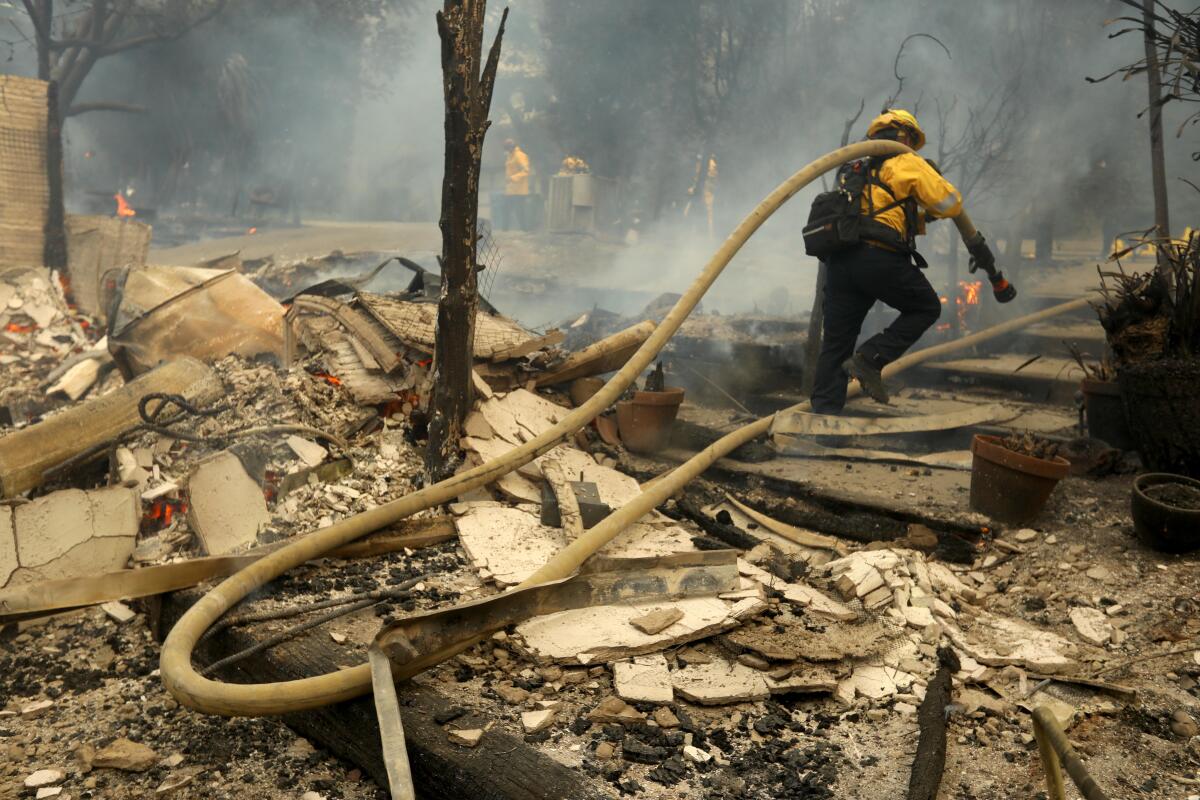
A firefighter carries a hose back to his rig while walking through a destroyed home from the Palisades fire in Pacific Palisades on Jan. 7, 2025.
(Genaro Molina / Los Angeles Times)
Last year, Pacific Palisades-based fashion designer Elyse Walker said she would reopen her eponymous store in Palisades Village after losing her 25-year flagship location on Antioch Street to the inferno.
Other neighborhood shops destroyed in the fire that are reopening at the mall include K Bakery and Loomey’s Toys, which caters to children up to age 12 and used to be across the street from Palisades Elementary Charter School.
“It’s been a journey and I’m excited because I wasn’t sure that there was going to be a place to come back to,” said toy store owner Amanda Rastegar. “Hopefully we can bring some of that magic back.”
Rastegar’s home in the Palisades survived but was damaged by the fire. The family returned about eight weeks ago. Her last memory of the fire was a burning supermarket.
“I just couldn’t wrap my brain around what was happening,” she said. “By the time I left, Gelson’s was on fire.”
Among the returning tenants is Angelini Ristorante & Bar. Well-known Los Angeles chef Gino Angelini said he will be in the kitchen next month for a return of the Italian restaurant.
“We won’t do a big celebrity open,” he said. “We want to have a very soft opening and see our customers come back.”

Construction takes place at Rick Caruso’s Palisades Village on Thursday. The shopping center is scheduled to reopen mid-August.
(Myung J. Chun / Los Angeles Times)
An elaborate celebration would not feel “correct for me,” Angelini said, because the devastation has been “very sad” for so many.
Other new tenants include local chef Nancy Silverton, who has agreed to move in with a new Italian steakhouse called Spacca Tutto. Women’s activewear retailer LESET will open its first West Coast location.
Caruso said he is optimistic that customers will return to the center, even though many Pacific Palisades residents are still dispersed. One tracking system estimated that about 30% of the Village’s customer base was impacted by the fire, he said.
“That means 70% did not get impacted, so there’s a lot of customers still left out there,” Caruso said. Historically, the center drew customers from as far away as Beverly Hills and Calabasas, as well as Malibu, Brentwood and Santa Monica.
He also hopes many will be inspired to visit the revived mall.
“I believe in the goodness of people and I believe that people are going to want to support the Palisades,” he said. “They’re going to want to be there and support the businesses that have had the courage and the heart to reopen.”

Walmart is rapidly expanding its network of electric vehicle chargers designed for customers to use while they shop.
The network could help fill gaps in EV infrastructure in states with greater need for chargers. Walmart, which has more than 5,000 locations in the U.S. and hundreds in California, says more than 90% of Americans live within 10 miles of one of its stores.
The chargers also offer an incentive for customers to choose Walmart — Walmart Plus members will receive a 10% discount off an average price of $0.46 per kilowatt-hour of energy at the company’s chargers.
Walmart chargers are already available at more than 75 locations in 17 states, with Texas boasting the most charging stations, followed by Florida and Arizona.
Matthew Nelson, Walmart’s director of energy policy, said last week on LinkedIn that the network will soon reach 29 states, including California.
“We are delivering on the promise of affordable, reliable and convenient charging,” Nelson said in his post.
According to Walmart’s website, six charging stations are coming to California soon, though the company did not offer a specific timeline.
The chargers will be installed at stores in Antelope, Brea, Fresno, Stockton, Suisun City and Vallejo.
Most charging sites in California will include eight to 16 fast-charging stalls, said Walmart spokesperson Kelsey Bohl.
The company first announced plans in April 2023 to install its own EV chargers at Walmart and Sam’s Club stores, with a goal of installing thousands of chargers by 2030. Partnering with ABB E-Mobility and Alpitronic, it added 25 new charging sites this past May and six more in June.
“Walmart is building a leading retail-integrated EV fast-charging network, focused on delivering an affordable, reliable and convenient charging experience where customers already shop,” Bohl said in an emailed statement. “Customers can charge while they shop, access stations through the Walmart app they already use, and benefit from affordable pricing.”
The charging stations already available include 612 individual charging stalls using 400-kilowatt chargers. Each stall has a dual charging cord with both Combined Charging System and North American Charging Standard connectors. The standard connectors, designed by Tesla, are smaller and lighter than the combined systems.
The primary way to pay for the chargers is through the Walmart app, but the company is also experimenting with built-in credit card readers to allow those without the app to use the stations.
Customers can check charger availability on the Walmart app. The company said the chargers will be available 24 hours a day.

Robotaxis could be turning into robocops.
A self-driving Waymo reported two teens to San Mateo, Calif., police on Monday after they were found drinking alcohol and shooting toy guns in the back of the vehicle.
According to a social media post from the San Mateo Police Department, officers detained two 15-year-olds after the Waymo they were riding in contacted the department and stopped in a parking lot until law enforcement arrived.
“Parents do you know where your teens are?” the San Mateo Police Department wrote on Facebook following the incident. “Waymo does!”
Officers removed both teens from the vehicle and determined they were using toy guns to shoot Orbeez out the windows. Orbeez are small, water-absorbing beads sold at toy stores.
“Toy guns, water guns, and BB guns all pose real dangers, especially to an untrained eye,” the Police Department said. “The simple handling of them can cause fear in [passersby].” “
A video posted on Facebook shows at least five officers and a police dog responding to the scene and approaching the Waymo with their weapons raised.
Waymo did not immediately respond to a request for comment.
Waymo vehicles have internal cameras and microphones that may be used in an emergency or to “promote safety and security,” according to Waymo’s online support page.
The cameras are also used to ensure the vehicles are clean and to help find lost items, according to the support page.
The company said it does not use facial recognition or other biometric identification technologies to identify individuals.
“In more urgent circumstances, support may access live video during a trip,” the Waymo page said.
The San Mateo Police Department’s Facebook post has garnered nearly 60 comments, with one user accusing Waymo of “snitching.”
“At least they got a designated driver?!” one user commented.
-
 Louisiana2 minutes ago
$604 Mega Millions jackpot has Louisiana players dreaming big
-

 Maine7 minutes ago
Graham Platner says he’ll withdraw from Senate race in Maine
-

 Maryland14 minutes ago
Maryland man sentenced to 15 years for attempting to join ISIS
-

 Michigan17 minutes ago
Sherrone Moore’s former assistant sues University of Michigan over alleged FOIA violations
-

 Massachusetts22 minutes ago
Max McColgan and Joseph Lenane share stroke play medals at 118th Massachusetts Amateur Championship – The Boston Globe
-

 Minnesota29 minutes ago
Man seriously injured in north Minneapolis shooting; no arrests
-

 Mississippi32 minutes ago
Ben Crump seeks independent autopsy in Nolan Wells death
-

 Missouri37 minutes ago
Missouri politicians champion unity, diversity on America’s 250th

