Business
Fisker Inc. files for bankruptcy protection amid heavy losses and struggling EV market

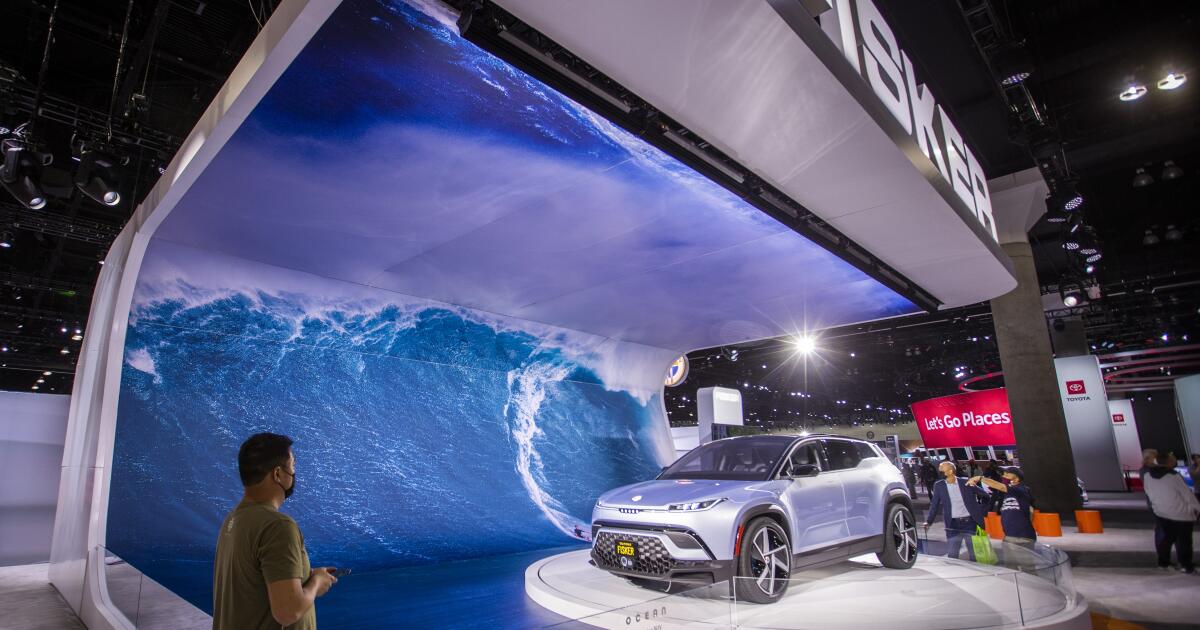
Fisker Group Inc., the struggling Manhattan Beach electric vehicle manufacturer, said it filed for Chapter 11 bankruptcy protection.
After failing to secure financing to offset losses, the company reported in a filing with the U.S. Bankruptcy Court in Delaware that it had estimated liabilities between $100 million and $500 million and more than 200 creditors. It listed estimated assets between $500 million and $1 billion.
“Like other companies in the electric vehicle industry, we have faced various market and macroeconomic headwinds that have impacted our ability to operate efficiently,” the company said in a prepared statement late Monday. “After evaluating all options for our business, we determined that proceeding with a sale of our assets under Chapter 11 is the most viable path forward for the company.”
The bankruptcy filing marked the latest sign of struggles among EV-makers and came after Fisker had failed to line up financing from undisclosed automakers, reportedly including Nissan.
In March, Fisker said it failed to reach a strategic alliance with a major automaker, a requirement to obtain $150 million in additional financing. Its shares collapsed to pennies, prompting the New York Stock Exchange to delist the stock.
The company was founded in 2017 by Henrik Fisker, 60, a respected Danish American auto designer who worked on vehicles for BMW and Aston Martin. In 2007, he founded a prior company, Fisker Automotive, that produced the Fisker Karma, a $100,000-plus hybrid that drew rave reviews for its styling — and Hollywood celebrities for owners. However, the company went under in 2013 after several setbacks, including the bankruptcy of its battery supplier.
Fisker raised $1 billion in capital through its initial public offering in 2020 and was valued at over $2.9 billion at the time when there was widespread optimism about a rapid shift from gas models.
However, the rise in interest rates raised the price of vehicle loans and EV-makers struggled to expand the market beyond the first adopters and affluent customers who made Tesla one of the world’s most valuable companies.
The company’s flagship and only current model, a midsized SUV called the Ocean, is made at a contract manufacturing plant in Austria that has had production problems. Fisker had hoped to make as many as 42,400 Oceans last year but instead produced just 10,193 and delivered 4,929. The troubles took a toll on its finances, with the company reporting an annual loss of $762 million on sales of $273 million in 2023.
In an effort to clear its inventory and raise funds, Fisker in March slashed more than 30% off the suggested retail price of its 2023 lineup: three versions of the Ocean, including a base model that already started at just $38,999. In a delayed annual report finally released in April, the company said it had delivered more than 6,400 Oceans as of April 16.
However, its financial condition had continued to deteriorate. The company reported a cash balance of $326 million as of Dec. 31, which fell to $54 million in unrestricted funds as of April 16, according to regulatory filings.
In February, Fisker announced layoffs of 15% of its workforce and a six-week pause in production to clear inventory. It had 1,135 employees as of April 19, a reduction from 1,560 at the end of last year.
Last month, the company closed its Manhattan Beach headquarters that once housed 300 employees, and moved its remaining workers to an engineering and distribution facility in La Palma in Orange County.
In its latest venture, Fisker decided to sell vehicles with a flair that would appeal to a mass market. The Ocean, with its California beach-inspired design, features a full-length solar roof, an interior composed of “vegan” recycled plastic and a drop-down rear window that can fit a surfboard.
The design won awards, but the cars produced by Fisker’s contract manufacturer in Graz, Austria, were riddled with software glitches, causing it to be ripped apart online. Fisker acknowledged the problems and issued a major software update in February, promising additional ones for the life of the vehicle.
In April, the National Highway Traffic Safety Administration opened an investigation into reports of the Ocean’s door latches and emergency override failing, making it impossible to open a door from either the inside or outside.
Fisker’s plan to sell the Ocean direct to customers, a model Tesla popularized, also didn’t work out, and the company shifted this year to a franchise network who would market, sell and service its vehicles. It has been in the process of signing up franchisees in North America and Europe, where it planned a hybrid sales model that still included direct sales.
Fisker is far from the only automaker that has suffered from the slowdown in electric vehicle demand.
Rivian, an Irvine maker of electric trucks, has seen its stock drop by more than half since January and announced that it was pausing construction of its $5 billion manufacturing plant in Georgia.
Early this year, Apple pulled the plug on its self-driving electric vehicle program, reportedly after spending $10 billion over a decade.
And Lucid Motors, a maker of luxury electric vehicles in the Bay Area city of Newark, received a $1 billion infusion last month from an affiliate of the Saudi’s sovereign wealth fund — the kind of big backer that Fisker didn’t have.
The Associated Press contributed to this report.



Welcome to the age of AI hacking, in which the right prompts make amateurs into master hackers.
A group of cybercriminals recently used off-the-shelf artificial intelligence chatbots to steal data on nearly 200 million taxpayers. The bots provided the code and ready-to-execute plans to bypass firewalls.
Although they were explicitly programmed to refuse to help hackers, the bots were duped into abetting the cybercrime.
According to a recent report from Israeli cybersecurity firm Gambit Security, hackers last month used Claude, the chatbot from Anthropic, to steal 150 gigabytes of data from Mexican government agencies.
Claude initially refused to cooperate with the hacking attempts and even denied requests to cover the hackers’ digital tracks, the experts who discovered the breach said. The group pummelled the bot with more than 1,000 prompts to bypass the safeguards and convince Claude they were allowed to test the system for vulnerabilities.
AI companies have been trying to create unbreakable chains on their AI models to restrain them from helping do things such as generating child sexual content or aiding in sourcing and creating weapons. They hire entire teams to try to break their own chatbots before someone else does.
But in this case, hackers continuously prompted Claude in creative ways and were able to “jailbreak” the chatbot to assist them. When they encountered problems with Claude, the hackers used OpenAI’s ChatGPT for data analysis and to learn which credentials were required to move through the system undetected.
The group used AI to find and exploit vulnerabilities, bypass defences, create backdoors and analyze data along the way to gain control of the systems before they stole 195 million identities from nine Mexican government systems, including tax records, vehicle registration as well as birth and property details.
AI “doesn’t sleep,” Curtis Simpson, chief executive of Gambit Security, said in a blog post. “It collapses the cost of sophistication to near zero.”
“No amount of prevention investment would have made this attack impossible,” he said.
Anthropic did not respond to a request for comment. It told Bloomberg that it had banned the accounts involved and disrupted their activity after an investigation.
OpenAI said it is aware of the attack campaign carried out using Anthropic’s models against the Mexican government agencies.
“We also identified other attempts by the adversary to use our models for activities that violate our usage policies; our models refused to comply with these attempts,” an OpenAI spokesperson said in a statement. “We have banned the accounts used by this adversary and value the outreach from Gambit Security.”
Instances of generative AI-assisted hacking are on the rise, and the threat of cyberattacks from bots acting on their own is no longer science fiction. With AI doing their bidding, novices can cause damage in moments, while experienced hackers can launch many more sophisticated attacks with much less effort.
Earlier this year, Amazon discovered that a low-skilled hacker used commercially available AI to breach 600 firewalls. Another took control of thousands of DJI robot vacuums with help from Claude, and was able to access live video feed, audio and floor plans of strangers.
“The kinds of things we’re seeing today are only the early signs of the kinds of things that AIs will be able to do in a few years,” said Nikola Jurkovic, an expert working on reducing risks from advanced AI. “So we need to urgently prepare.”
Late last year, Anthropic warned that society has reached an “inflection point” in AI use in cybersecurity after disrupting what the company said was a Chinese state-sponsored espionage campaign that used Claude to infiltrate 30 global targets, including financial institutions and government agencies.
Generative AI also has been used to extort companies, create realistic online profiles by North Korean operatives to secure jobs in U.S. Fortune 500 companies, run romance scams and operate a network of Russian propaganda accounts.
Over the last few years, AI models have gone from being able to manage tasks lasting only a few seconds to today’s AI agents working autonomously for many hours. AI’s capability to complete long tasks is doubling every seven months.
“We just don’t actually know what is the upper limit of AI’s capability, because no one’s made benchmarks that are difficult enough so the AI can’t do them,” said Jurkovic, who works at METR, a nonprofit that measures AI system capabilities to cause catastrophic harm to society.
So far, the most common use of AI for hacking has been social engineering. Large language models are used to write convincing emails to dupe people out of their money, causing an eight-fold increase in complaints from older Americans as they lost $4.9 billion in online fraud in 2025.
“The messages used to elicit a click from the target can now be generated on a per-user basis more efficiently and with fewer tell-tale signs of phishing,” such as grammatical and spelling errors, said Cliff Neuman, an associate professor of computer science at USC.
AI companies have been responding using AI to detect attacks, audit code and patch vulnerabilities.
“Ultimately, the big imbalance stems from the need of the good-actors to be secure all the time, and of the bad-actors to be right only once,” Neuman said.
The stakes around AI are rising as it infiltrates every aspect of the economy. Many are concerned that there is insufficient understanding of how to ensure it cannot be misused by bad actors or nudged to go rogue.
Even those at the top of the industry have warned users about the potential misuse of AI.
Dario Amodei, the CEO of Anthropic, has long advocated that the AI systems being built are unpredictable and difficult to control. These AIs have shown behaviors as varied as deception and blackmail, to scheming and cheating by hacking software.
Still, major AI companies — OpenAI, Anthropic, xAI, and Google — signed contracts with the U.S. government to use their AIs in military operations.
This last week, the Pentagon directed federal agencies to phase out Claude after the company refused to back down on its demand that it wouldn’t allow its AI to be used for mass domestic surveillance and fully autonomous weapons.
“The AI systems of today are nowhere near reliable enough to make fully autonomous weapons,” Amodei told CBS News.

The iPic dine-in movie theater chain has filed for Chapter 11 bankruptcy protection and intends to pursue a sale of its assets, citing the difficult post-pandemic theatrical market.
The Boca Raton, Fla.-based company has 13 locations across the U.S., including in Pasadena and Westwood, according to a Feb. 25 filing in U.S. Bankruptcy Court in the Southern District of Florida, West Palm Beach division.
As part of the bankruptcy process, the Pasadena and Westwood theaters will be permanently closed, according to WARN Act notices filed with the state of California’s Employment Development Department.
The company came to its conclusion after “exploring a range of possible alternatives,” iPic Chief Executive Patrick Quinn said in a statement.
“We are committed to continuing our business operations with minimal impact throughout the process and will endeavor to serve our customers with the high standard of care they have come to expect from us,” he said.
The company will keep its current management to maintain day-to-day operations while it goes through the bankruptcy process, iPic said in the statement. The last day of employment for workers in its Pasadena and Westwood locations is April 28, according to a state WARN Act notice. The chain has 1,300 full- and part-time employees, with 193 workers in California.
The theatrical business, including the exhibition industry, still has not recovered from the pandemic’s effect on consumer behavior. Last year, overall box office revenue in the U.S. and Canada totaled about $8.8 billion, up just 1.6% compared with 2024. Even more troubling is that industry revenue in 2025 was down 22.1% compared with pre-pandemic 2019’s totals.
IPic noted those trends in its bankruptcy filing, describing the changes in consumer behavior as “lasting” and blaming the rise of streaming for “fundamentally” altering the movie theater business.
“These industry shifts have directly reduced box office revenues and related ancillary revenues, including food and beverage sales,” the company stated in its bankruptcy filing.
IPic also attributed its decision to rising rents and labor costs.
The company estimated it owed about $141,000 in taxes and about $2.7 million in total unsecured claims. The company’s assets were valued at about $155.3 million, the majority of which coming from theater equipment and furniture. Its liabilities totaled $113.9 million.
The chain had previously filed for bankruptcy protection in 2019.

In an expansion of its business of processing pharmaceuticals in Earth’s orbit, Varda Space Industries is renting a large El Segundo plant where toy manufacturer Mattel used to design Hot Wheels and Barbie dolls.
The plant in El Segundo’s aerospace corridor will be an extension of Varda Space Industries’ headquarters in a much smaller building on nearby Aviation Boulevard.
Varda will occupy a 205,443-square-foot industrial and office campus at 2031 E. Mariposa Ave., which will give it additional capacity to manufacture spacecraft at scale, the company said.
Originally built in the 1940s as an aircraft facility, the complex has a history as part of aerospace and defense industries that have long shaped the South Bay and is near a host of major defense and space contractors. It is also close to Los Angeles Air Force Base, headquarters to the Space Systems Command.
Workers test AstroForge’s Odin asteroid probe, which was lost in space after launch this year.
(Varda Space Industries)
Varda is one of a new generation of aerospace startups that have flourished in Southern California and the South Bay over the last several years, particularly in El Segundo, often with ties to SpaceX.
Elon Musk’s company, founded in 2002 in El Segundo, has revolutionized the industry with reusable rockets that have radically lowered the cost of lifting payloads into space. Though it has moved its headquarters to Texas, SpaceX retains large-scale operations in Hawthorne.
Varda co-founder and Chief Executive Will Bruey is a former SpaceX avionics engineer, and the company’s spacecraft are launched on SpaceX’s workhorse Falcon 9 rockets from Vandenberg Space Force Base in Santa Barbara County.
Varda makes automated labs that look like cylindrical desktop speakers, which it sends into orbit in capsules and satellite platforms it also builds. There, in microgravity, the miniature labs grow molecular crystals that are purer than those produced in Earth’s gravity for use in pharmaceuticals.
It has contracts with drug companies and also the military, which tests technology at hypersonic speeds as the capsules return to Earth.
Its fifth capsule was launched in November and returned to Earth in late January; its next mission is set in the coming weeks. Varda has more than 10 missions scheduled on Falcon 9s through 2028.
For the last several decades, the Mariposa Avenue property served as the research and development center for Mattel Toys. El Segundo has also long been a center for the toy industry as companies like to set up shop in the shadow of Mattel.
The Mattel facility “has always been an exceptional property with a legacy tied to aerospace innovation, and leasing to Varda Space Industries feels like a natural continuation of that story,” said Michael Woods, a partner at GPI Cos., which owns the property.
“We are proud to support a company that is genuinely pushing the boundaries of what’s possible, and are excited to watch Varda grow and thrive here in El Segundo,” Woods said.
As one of the country’s most active hubs of aerospace and defense innovation, El Segundo has seen its industrial property vacancy fall to 3.4% on demand from space companies, government contractors and technology startups, real estate brokerage CBRE said.
Successful startups often have to leave the neighborhood when they want to expand, real estate broker Bob Haley of CBRE said. The 9-acre Mattel facility was big enough to keep Varda in the city.
Last year, Varda subleased about 55,000 square feet of lab space from alternative protein company Beyond Meat at 888 Douglas St. in El Segundo, which it started moving into in June.
Varda will get the keys to its new building in December and spend four to eight months building production and assembly facilities as it ramps up operations. By the end of next year, it expects to have constructed 10 more spacecraft.
In the future, Varda could consolidate offices there, given its size. Currently, though, the plan is to retain all properties, creating a campus of three buildings within a mile of one another that are served by the company’s transportation services, Chief Operating Officer Jonathan Barr said.
“We already have Varda-branded shuttles running up and down Aviation Boulevard,” he said.

Rapper Tee Grizzley plans mixed-use apartment project in Brush Park

5 teens, 3 adults arrested in San Francisco double stabbing at Dolores Park

Dallas City Council approves resolution to explore leaving Dallas City Hall

Miami Gardens mother gets probation after her 2-year-old shot himself

Boston honors first casualty of American Revolution – The Boston Globe

Florida High School Football Rankings: Top 25 teams – Oct. 21

Cleary's 21 help Le Moyne down Central Connecticut State 69-64 in OT

How old is Bo Nix? What to know about Oregon quarterback ahead of 2024 NFL Draft

99th annual Pony Swim held in Virginia

Indiana Members Credit Union announced as new anchor tenant at Bottleworks District

Map: 4.9-Magnitude Earthquake Shakes Louisiana

Paxton vows he’s ‘staying in this race’ even if Trump backs Cornyn in Texas GOP clash

Which Kurdish groups is the US rallying to fight Iran?

Man accused of plot to assassinate Trump testifies Iran pressured him, says Biden and Haley were other possible targets

DHS defends McLaughlin against allegations husband’s company profited millions from ad contracts: ‘Baseless’
-

 World1 week ago
Exclusive: DeepSeek withholds latest AI model from US chipmakers including Nvidia, sources say
-

 Wisconsin4 days ago
Setting sail on iceboats across a frozen lake in Wisconsin
-

 Massachusetts1 week ago
Mother and daughter injured in Taunton house explosion
-

 Maryland5 days ago
AM showers Sunday in Maryland
-

 Massachusetts3 days ago
Massachusetts man awaits word from family in Iran after attacks
-

 Florida5 days ago
Florida man rescued after being stuck in shoulder-deep mud for days
-

 Denver, CO1 week ago
10 acres charred, 5 injured in Thornton grass fire, evacuation orders lifted
-

 Oregon6 days ago
2026 OSAA Oregon Wrestling State Championship Results And Brackets – FloWrestling