Business
Election deepfakes and high-profile bankruptcies: Here's what AI will bring in 2024


If 2023 was the year that AI finally broke into the mainstream, 2024 could be the year it gets fully enmeshed in our lives — or the year the bubble bursts.
But whatever happens, the stage is set for another whirlwind 12 months, coming in the wake of Hollywood’s labor backlash against automation; the rise of consumer chatbots, including OpenAI’s GPT-4 and Elon Musk’s Grok; a half-baked coup against Sam Altman; early inklings of a regulatory crackdown; and, of course, that viral deepfake of Pope Francis in a puffer jacket.
To gauge what we should expect in the new year, The Times asked a slate of experts and stakeholders to send in their 2024 artificial intelligence predictions. The results alternated between enthusiasm, curiosity and skepticism — an appropriate mix of sentiments for a technology that remains both polarizing and unpredictable.
Regulators will step in, and not everyone will be happy about it.
When a surgeon or a stockbroker goes to work, they do so with the backing of a license or certification. Could 2024 be the year we start holding AI to the same standard?
“In the next year, we may require AI systems to get a professional license,” said Amy Webb, chief executive of the Future Today Institute, a consulting firm. “While certain fields require professional licenses for humans, so far algorithms get to operate without passing a standardized test. You wouldn’t want to see a urologist for surgery who didn’t have a medical license in good standing, right?”
It’d be a development in line with political changes over the last few months, which saw several efforts to more conscientiously regulate this powerful new technology, including a sweeping executive order from President Biden and a draft Senate policy aimed at reining in deepfakes.
“I’m particularly concerned about the potential impact [generative AI] could have on our democracy and institutions in the run-up to November’s elections,” Sen. Chris Coons (D-Del.), who co-sponsored the deepfakes draft, said of the coming year. “Creators, experts and the public are calling for federal safeguards to outline clear policies around the use of generative AI, and it’s imperative that Congress do so.”
Regulation isn’t just a domestic concern, either. Justin Hughes, a professor of intellectual property and trade law at Loyola Law School, said he expects the European Union will finalize its AI Act next year, triggering a 24-month countdown for broad AI regulations in the EU. Those would include transparency and governance requirements, Hughes said, but also bans on dangerous uses of AI such as to infer someone’s ethnicity and sexual orientation or manipulate their behavior. And as with many European regulations, the effects could trickle down to American firms.
Yet the rising calls for guardrails have already triggered a backlash. In particular, a movement known as effective accelerationism — or “e/acc” — has picked up steam by calling for rapid innovation with limited political oversight.
Julie Fredrickson, a tech investor aligned with the e/acc movement, said she envisions the new year bringing further tensions around regulation.
“The biggest challenge we will encounter is that using [tools that] compute IS speech and that raises critical constitutional issues here in the United States that any regulatory framework will need to deal with,” Fredrickson said. “The public must make our government understand that it cannot make trade-offs restricting our fundamental rights like speech.”
Authenticity will grow more important than ever.
Imagine being able to know with certainty whether that vacation photo your friend just posted on Instagram was taken in real life or generated on a server farm somewhere.
Mike Gioia, co-founder of the AI workflow startup Pickaxe, thinks it might soon be possible. Specifically, he predicts Apple will launch a “Photographed on iPhone” stamp next year that would certify AI-free photos.
Other experts agree that efforts to bolster trust and authenticity will only grow more important as AI floods the internet with synthetic text, photos and videos (not to mention bots aimed at imitating real people). Andy Parsons, senior director of Adobe’s Content Authenticity Initiative, said he anticipates the increased adoption of “Content Credentials,” or metadata embedded in digital media files that, almost like a nutrition label, would record who made something and with what tools.
Such stopgaps could prove particularly important as America enters a presidential election year — its first in history that will take place amid a torrent of cheap, viral AI media.
Bill Burton, former deputy press secretary for the Obama administration, predicted: “The most viewed and engaged videos in the 2024 election are generated by AI.”
The steam engine of innovation will keep chugging along …
Last year brought substantial advances in AI technology, from the launch of mainstream products — ChatGPT, deemed the fastest-growing consumer app in history, released its fourth version — to continued breakthroughs in AI research and development.
Many AI insiders think that pace of innovation will continue into the new year.
“Every business and consumer app user will be using AI and they won’t know it,” said Ted Ross, general manager of the City of Los Angeles Information Technology Agency. “I predict that artificial intelligence features and high-visibility [generative] AI platforms, such as ChatGPT, will rapidly integrate into existing business and consumer applications with the user often unaware.”
Other developments could be more niche but no less impactful. Some experts predict a rise in leaner and more targeted alternatives to the “large language models” that underlie ChatGPT and Grok. The AI itself could get better at self-improvement, too.
“There hasn’t been a lot of tooling that targets speeding up AI research,” said Anastasis Germanidis, chief technology officer of the synthetic video startup Runway. “We’ll likely see more of those tools emerge in the coming year,” including to help write or debug code.
… Unless the bubble bursts.
The AI market is frothy right now, but not everyone thinks the glory days can last.
“A hyped AI company will go bankrupt or get acquired for a ridiculously low price” at some point in 2024, Clément Delangue, chief executive of the open source AI development community Hugging Face, wrote in a recent tweet.
Eric Siegel, a former Columbia University professor and the author of “The AI Playbook: Mastering the Rare Art of Machine Learning Deployment,” has struck an even warier tone.
“There will be growing consternation as the lack of a killer [generative] AI app becomes increasingly apparent,” Siegel told The Times, referencing an app that would drive widespread adoption of AI. “Disillusionment will ultimately set in as today’s grandiose expectations fail to be met.”
Eventually, he warned, we could even enter an “AI Winter,” or a period of declining interest — and investment — in the technology.
But that is probably still a few years away, he added: “The current ‘craze’ has built incredible momentum, and that momentum will continue to be fueled as new impressive-looking and potentially valuable capabilities continue to pop up.”
Even the skeptics, it seems, anticipate a banner year for AI.


The race to bring air travel to the sky is heating up as Santa Cruz-based Joby Aviation and Toyota launch a joint venture to commercially produce air taxis.
The companies said in a news release Tuesday that they will work together on productivity, quality and costs and move toward mass production of Joby’s electric vertical takeoff aircraft. Joby and Toyota were first linked when Toyota made a nearly $400-million investment in the company in 2020. It has since increased its backing of the company to $900 million.
“It’s really meaningful for us to take on this challenge together with Joby, a partner that shares the same vision,” Toyota Chair Akio Toyoda said. “We believe this strengthened relationship is an important step forward in realizing the future mobility society.”
Joby‘s all-electric vertical takeoff vehicles are designed to hold four passengers and a pilot and can travel at up to 200 mph. The vehicle uses six tilting propellers to achieve vertical takeoff before switching to forward flight.
In February, Joby announced a partnership with Uber to start service in the United Arab Emirates this year, bringing on-demand air taxi rides to the country. It plans to expand to the U.S. after the completion of its final stage of Federal Aviation Administration testing.
Prior to its full FAA certification, Joby is hoping to launch early flight operations later this year as part of a White House program that will bring flights to several states, including New York, Texas and Arizona. Flights in California will not begin until after obtaining FAA certification.
Joby has been in a fierce battle to be the first with taxis in the sky with its Northern California competitor Archer Aviation. The two companies are involved in overlapping lawsuits, with Joby alleging corporate espionage against Archer, and Archer filing a suit alleging dubious ties to China that sparked an investigation into Joby by the U.S. International Trade Commission.
“Toyota has been by Joby’s side for nearly a decade, providing invaluable guidance and support as we built the foundation for manufacturing our aircraft,” JoeBen Bevirt, Joby’s chief executive and founder, said in the news release. “Together, we share a vision of making aerial mobility an everyday reality, and we look forward to delivering on that promise together.”
Joby Aviation’s shares, which have fallen more than 30% this year, climbed 3% on Tuesday to $8.92.
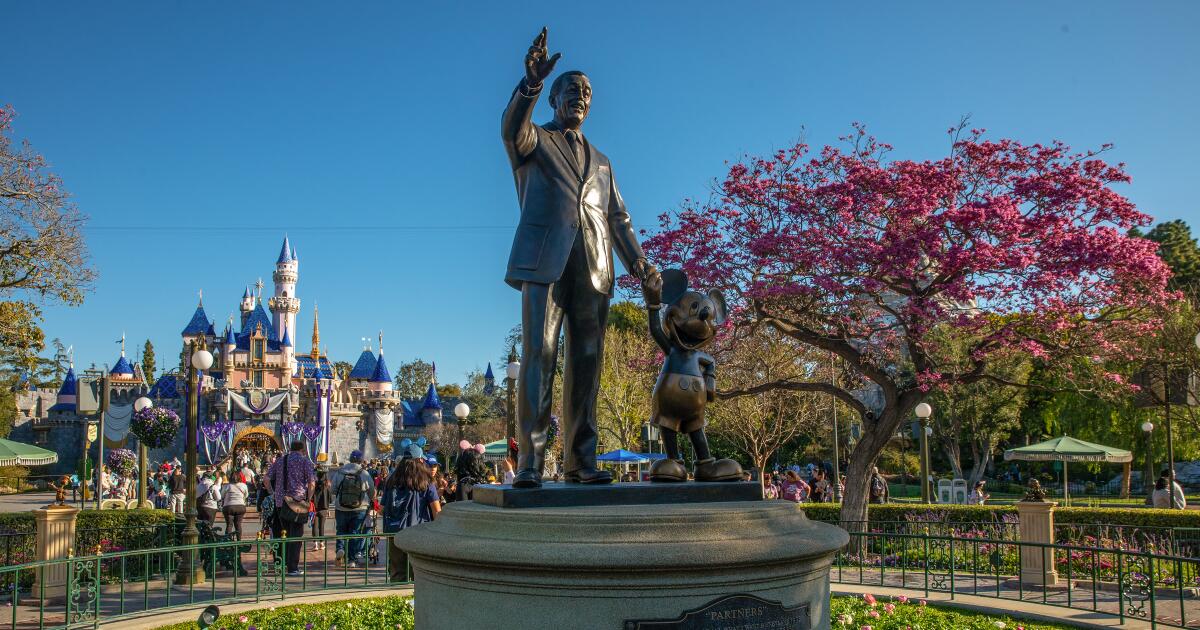
Disneyland Resort in Anaheim will offer $59 tickets for select evening admission to either theme park as part of a new promotion.
The one-day, one-park evening ticket offer will allow attendees to enter Disney California Adventure at 5 p.m. or Disneyland at 7 p.m. Park reservations are still required, as has been the case since the COVID-19 pandemic.
The offer only applies for admission from July 12 through Aug. 5 on Sundays to Wednesdays.
Disneyland Resort is commemorating its 70th anniversary through Aug. 9, and has introduced new shows and additions to rides as part of the occasion.
Walt Disney Co.’s theme parks and experiences business are a crucial boost to its finances, making up about 56% of the company’s operating income last fiscal year.
During the Burbank-based company’s most recent earnings call in May, Disney executives said attendance at its U.S.-based parks was down 1% compared with the prior year, a shift they attributed to “continued softness” in international visitations. However, the company said at the time that it was starting to move past those issues.
Disney’s experiences division reported $9.5 billion in revenue in that fiscal second quarter, up 7% compared with the same period a year ago, something executives said was due to higher guest spending domestically and more capacity on its cruise line.

An aging downtown office complex will be converted into apartments as part of an ambitious plan by local real estate companies to create 4,000 affordable housing units in Los Angeles.
The first project will be a $200-million makeover of the L.A. World Trade Center, a sprawling white elephant of an office complex on Figueroa Street built in the 1970s that will be turned into 512 apartments in one of the largest affordable housing conversions to date downtown.
Future projects being planned in the central city for delivery over the next five years will include other office-to-apartment conversions and new housing built from the ground up.
The 10-story World Trade Center, right, at Figueroa and Fourth streets in downtown Los Angeles, was built in the mid-1970s.
(Myung J. Chun / Los Angeles Times)
Behind the building campaign unveiled Monday are two of the region’s largest real estate companies, Jamison and Kennedy Wilson. Jamison is the city’s most prolific converter of offices to market-rate apartments and currently has a major makeover of a downtown office skyscraper underway for tenants who can pay top rents.
Kennedy Wilson, a real estate investment company based in Beverly Hills, owns Vintage Housing, which builds and operates affordable housing using tax credits and other state and federal financing to help fund it.
Vintage Housing and Jamison’s new affordable housing division, Arden Residential, will take on the campaign to build the housing where qualified tenants will pay rents below market rates.
Rents in the World Trade Center — which will be renamed Sky Castle when it opens in early 2028 — are expected to start at $937 for a one-bedroom unit. Some two- and three-bedroom units would rent for $1,100 and $1,300 per month, respectively, developers said.
Sky Castle will have shared amenities found in more expensive modern apartments, the developers said, such as a fitness center, resident lounge and co-working space. It already has six tennis courts on the roof, which may be converted to pickleball courts, Jamison Chief Executive Garrett Lee said.
The goal is to build higher quality affordable housing by using efficient construction methods Jamison has learned through building more than 8,000 market-rate apartments in the past, Lee said. The makeover of the World Trade Center will mark Jamison’s 15th conversion of an office building to housing.
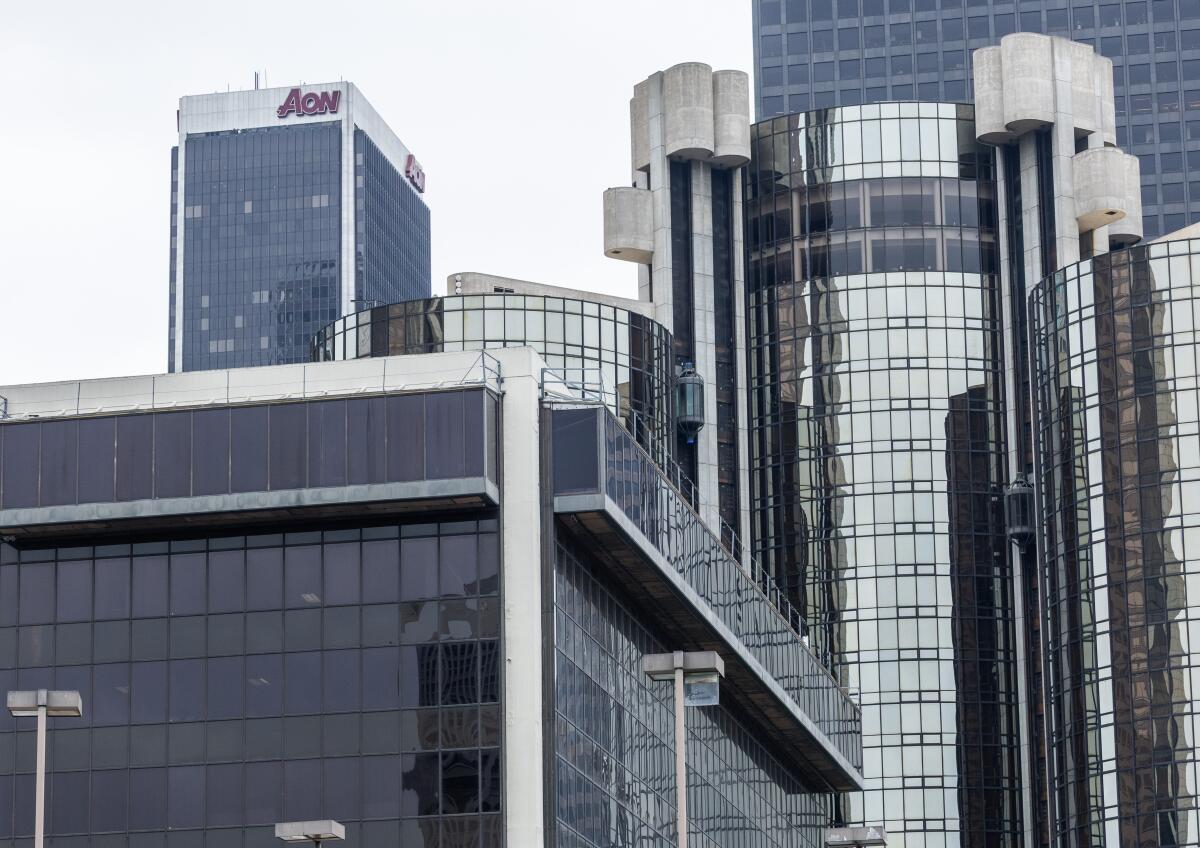
The plan to redevelop the L.A. World Trade Center, bottom left, is one of the largest affordable housing conversions to date downtown.
(Myung J. Chun / Los Angeles Times)
The 10-story World Trade Center was built in the mid-1970s to fanfare saying it would be home to international companies. In 1976, The Times described the center as a place to prepare for an overseas trip where visitors could get passports and visas, as well as exchange dollars for francs, marks, rubles and other currency. There was a language school and branches of U.S., Swiss and Japanese banks.
By the mid-1980s, the 400,000-square-foot office complex covering a city block at Figueroa and Fourth streets had lost its international flavor and was falling out of favor with corporate tenants who were moving into glossy new skyscrapers on Bunker Hill and in other locations.
The building has been cleared of remaining office tenants to allow work to begin in August, Lee said.
Kennedy Wilson is a nationwide operator of market-rate apartments that has also moved into building affordable housing in the last decade, said Nicholas Bridges, global head of capital markets at the company.
Building affordable, workforce housing “in almost all cases requires public subsidies,” Bridges said, and Kennedy Wilson has developed expertise in assembling “a cocktail of public financing sources” that includes low-income housing tax credits and tax-exempt bonds.
In the past, many housing developers have shied away from building affordable housing because assembling the subsidies needed to make construction profitable is challenging.

An artist’s rendering shows what the L.A. World Trade Center could look like after being redeveloped into affordable housing. The new complex is to be called Sky Castle.
(Ian Camarillo)
“It’s complicated,” Bridges said, “and not for the faint of heart.”
Eligible tenants must earn between 30% and 80% of the median income in the area where the housing is built.
Jamison and Kennedy Wilson will develop about 15 affordable housing projects between downtown and the 405 Freeway, Bridges said, many of them in aging office buildings such as the World Trade Center that are already owned by Jamison and are close to public transit.
Substantial potential for affordable housing lies in L.A.’s underused office buildings, he said.
“In this post-COVID world, the way people are utilizing office buildings, particularly older office buildings, has just fundamentally changed,” he said.
It makes sense for developers of conventional multifamily housing to move to building affordable housing, Lee said, because the government supports it through subsidies, zoning reform and the fast-tracking of construction permits. The city of Los Angeles also recently streamlined its adaptive reuse rules to make it easier to convert office buildings to housing.
“There are a lot of incentives pushing us in this direction,” Lee said.
-

 Wyoming5 minutes ago
Young bull moose captured wandering Laramie, relocated by Game and Fish
-

 Crypto8 minutes ago
Webinar: Crypto and public pensions—risks, rewards, and fiduciary duties
-

 Finance13 minutes ago
Wednesday’s Campaign Round-Up, 7.1.26: Justices help GOP with campaign finance ruling
-

 Fitness20 minutes ago
I’ve been doing the bird dog exercise instead of planks to improve my core strength – it’s even better for beginners
-

 Movie Reviews28 minutes ago
Neil’s Movie Reviews
-

 World38 minutes ago
Russia Approved Secret China Military Training At Top Level: Reuters
-

 Science58 minutes ago
This Cell Feeds, Grows and Reproduces. And It’s Manmade.
-
 Lifestyle1 hour ago
Greetings from London, where Banksy’s flag man is a warning cry

