Business
Did Dodgers underestimate value of Shohei Ohtani's first homer? It may be worth $100,000

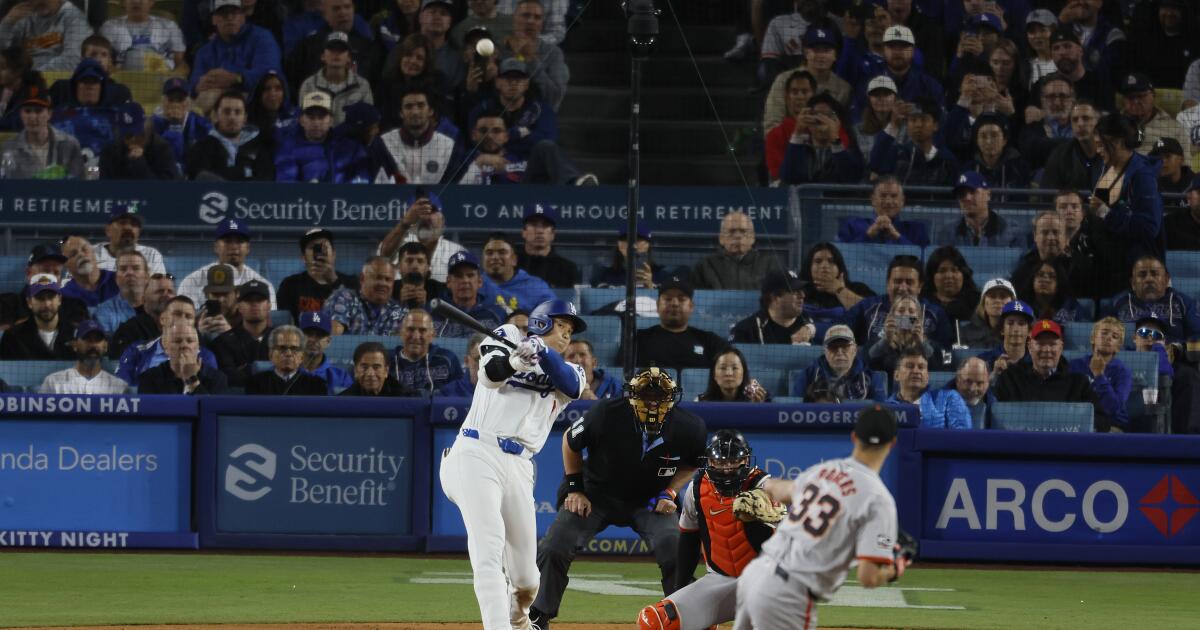
A baseball falls from the sky and into a fan’s hands. Or at least it comes to rest near their feet and they reach down and secure it. The fan has taken possession of something that might have monetary value. It is theirs to do with as they wish.
Ambar Roman’s seat in the Dodger Stadium right-field pavilion April 3 became the resting point of Shohei Ohtani’s first home run as a Dodger. The 28-year-old Whittier woman picked up the ball and her world became a swirl.
Roman and her husband, Alexis Valenzuela, say Dodgers security personnel persuaded her to surrender the ball for a bat, a ball and two caps, all autographed by Ohtani. Why? Ohtani wanted the genuine article and told reporters after the game, “For me, it’s a very special ball, so I’m thankful.”
Two experts at auction houses that regularly auction baseball memorabilia said the ball is worth approximately $100,000, while the signed merchandise Roman received in exchange for the ball would sell for less than $10,000.
The current bid for Mike Trout’s 2024 opening day home run baseball is $7,010.00. The MLB hologram sticker authenticated the ball.
(MLB)
Gary Cypres, founder of the Sports Museum of Los Angeles and owner of the greatest collection of Dodgers memorabilia anywhere, said, “I might be willing to pay a little more than the $100,000” but that other Dodgers collectors probably would pay $50,000 to $75,000.
Roman and Valenzuela said the Dodgers told her the ball would be worthless if she took it home because it would not be “authenticated,” a word with a precise meaning regarding sports memorabilia in general and a baseball hit into the stands in particular. The Dodgers have disputed that, saying she was only told that the ball could not be authenticated by MLB.
The couple also said Dodgers personnel would not allow Valenzuela to participate in his wife’s negotiation and did not escort them to the parking lot with their Ohtani-autographed merchandise, resulting in a public relations black eye for a franchise generally regarded as operating with class and in the best interests of its fan base.
The episode isn’t over: Roman and her family are invited to Dodger Stadium on Friday — on her birthday, no less! — during which she will receive more memorabilia and premium seats for giving the ball to Ohtani, who a Dodgers official said is expected to meet her. Onlookers undoubtedly will be calculating whether her haul is roughly equivalent to the six-figure valuation.
Fans applaud Shohei Ohtani as he heads to the dugout after hitting his first homer with the Dodgers.
(Allen J. Schaben / Los Angeles Times)
The Dodgers also said they’re going to analyze how they interact with fans who secure milestone baseballs.
“We’re excited to host them again for a special night and give them a special Dodger experience,” said Lon Rosen, the Dodgers’ executive vice president and chief marketing officer. “And we’re going to review the process.”
Still, the episode raised questions. Did the Dodgers drop the ball by not providing Roman with authentication? If Roman had left the stadium with the ball, would it be worth less at an auction because it wasn’t authenticated? Is the ball authenticated as Ohtani’s first home run even now, in Ohtani’s possession?
And, how does authentication work, anyway?
Fake sports memorabilia and forged autographs were rampant in the 1990s, prompting the FBI to launch a probe called “Operation Bullpen.” San Diego Padres great Tony Gwynn was recruited to participate because he’d flagged several items in a Padres gift shop that featured his forged signature.
The investigation resulted in the convictions of more than 50 people and the dismantling of a dozen or so forgery rings by 2001, the same year Major League Baseball implemented an authentication protocol to protect fans and players alike from fake items in the burgeoning memorabilia market.
Rangers catcher Jonah Heim with the authenticated baseball that was the last out of the 2023 World Series. The authentication hologram sticker is visible at the top of the ball.
(MLB)
The technology used by MLB authenticators — most of whom are current or former law enforcement officers with chain-of-custody training — has evolved. Today, an authenticator sits in each dugout of every game, witnesses the use of every conceivable item from baseballs to bats to bases to lineup cards to uniforms to gloves, and affixes a tamper-proof numbered hologram to identify its authenticity.
An exception? Balls that fly off a bat and into the stands. Chain-of-custody integrity can be compromised as soon as a ball leaves the field. Therefore, home runs such as Ohtani’s initial blast as a Dodger cannot be authenticated — at least not through the strict MLB protocol.
This is where the Dodgers’ version of what transpired with Roman diverges. She told The Times’ Bill Plaschke that the Dodgers informed her that if she kept the ball, the team would not authenticate it and the ball would be worthless. Two Dodgers executives who requested anonymity because of the sensitive nature of the topic said Roman was told the ball could not be authenticated, period. It had nothing to do with whether she chose to take it home or not.
In fact, even in Ohtani’s possession, the ball is not MLB authenticated. Common sense might dictate that video captured Roman holding the ball and celebrating, and that moments later Dodgers security personnel made a beeline to her seat and whisked her away with the ball.
Does anyone really believe she somehow swapped out the ball for another official major league ball that never kissed Ohtani’s lumber?
“The authentication program has a strict rule about not authenticating a ball once it goes into the stands because we know fans bring balls to games and can also get balls from batting practice,” said an MLB spokesman who requested anonymity because they weren’t authorized to speak on the record. “Above all else though, the program does not allow for authenticating balls in the stands because it is a chain-of-custody and witness-based program.”
Although the Dodgers may have underestimated the potential value of Ohtani’s first home run with the team and the interest it would generate, MLB makes the decisions pertaining to authentication.
MLB could have implemented “covert marking,” an I-spy-like term meaning that baseballs used during Ohtani’s at-bats would have been marked ahead of time with a combination of letters and numbers. However, the authentication official said covert marking is reserved for milestones, not for “player firsts” such as Ohtani’s first Dodger homer.
Recent examples include career home runs Nos. 500, 600 and 700; career hit number 3,000; the final hits by Derek Jeter and David Ortiz; and the last out at old Yankee Stadium. Cost, the spokesman said, has never been a consideration.
The practice was utilized when Barry Bonds chased Hank Aaron’s career record of 755 home runs in 2007 and most recently was used ahead of Aaron Judge’s 62nd home run in 2022 and Albert Pujols’ 700th career homer that same season.
“The fans that caught the balls were brought under the stadium and had the balls authenticated once the covert marking was confirmed by the authenticator in a private, secure area,” the spokesman said. “This was and always is agnostic of the [fans’] plans for the ball.”
Any item authenticated by MLB can be verified on a website by typing in the hologram identification combination — usually two letters and six numbers.
Before holograms and staff authenticators, memorabilia was authenticated primarily through a photo match. The jersey a player purportedly wore during a milestone moment, for example, could be matched against a photo of the player wearing the jersey in that game. The system wasn’t perfect, but it was better than blindly taking someone’s word.
The technological advances and resources MLB and other leagues have put into authentication is appreciated by David Kohler, owner and president of Orange County-based SCP Auctions for 45 years.
“One of the best things to happen in the thriving memorabilia market is authentication and the authentication process,” he said. “It’s real. Authentication is why prices have gone up. There is a process and it’s great. It makes our job easier.”
Kohler said that while the Dodgers are “a class organization,” the MLB authenticator could have assisted Roman had she opted to keep the ball by making sure the one she left the stadium with was the same one she might later have sold at auction.
“They should have brought the authenticator in there, and he could have marked the ball,” he said. “Then let her go home with the ball and figure it out over the next few days.”
Shohei Ohtani’s first Dodgers homer was caught by Ambar Roman. Experts says the ball is worth about $100,000, while the signed merchandise Roman got from the Dodgers in exchange for the ball would sell for less than $10,000.
(Allen J. Schaben / Los Angeles Times)
The Dodgers might get a chance soon to implement any new policies pertaining to fans and valuable baseballs. Ohtani is one home run from tying former New York Yankees slugger Hideki Matsui for most MLB home runs by a Japanese player at 175, so the next two he hits could pique the interest of Japanese collectors as well as those in the United States.
What’s worth more than the baseballs Ohtani hits to reach milestone home runs? The bats. “Historically, bats from a value standpoint do much better in auctions than balls,” Cypres said.
Kohler and other auction executives can’t rely solely on sports leagues to provide authentication of memorabilia that customers want to buy and sell. They have developed inventive ways of establishing to a compelling degree that an item is everything the seller says it is.
Many items come with a letter of authenticity from the original owner. The 2000 NBA championship ring auctioned by Kobe Bryant’s parents in 2013 is an example: The ring has been sold three times since but continues to be accompanied by the original LOA signed by Kobe’s mother, Pam Bryant.
Several companies offer authentication services that promise to verify autographs, grade trading cards and issue certificates of authenticity. That might not be as ironclad as an MLB hologram sticker, but it weeds out obvious fakes.
The last home run Bonds hit — No. 762 — came Sept. 7, 2007, at Coors Field after MLB ceased supplying his games with covertly marked balls. A scramble for the ball occurred in the stands and MLB refused to authenticate it because of the confusion and lack of conclusive video evidence.
Jameson Sutton ended up with the ball but it wasn’t clear that the home run was Bonds’ last until the season ended three weeks later, at which point its value skyrocketed — if the ball could be authenticated. Enter Kohler, who commissioned a lie detector test that Sutton passed. The lie detector report accompanied the ball, which sold at SCP auction for $377,000 in April 2008.
SCP also auctioned a bat used by Lou Gehrig to hit his last home run, a spring training blast in 1939. Gehrig went homerless in eight games that regular season before retiring because of complications with amyotrophic lateral sclerosis, what would come to be known as Lou Gehrig’s disease.
Upon returning to the dugout, Gehrig handed the bat to a Yankees bat boy named Bing Russell, who became a popular television actor. His son is actor Kurt Russell and a grandson is former major leaguer Matt Franco, whose mom, Jill, kept the bat in an umbrella closet for years.
“My grandfather would bring out that bat every time we had people over and the conversation turned to baseball,” Matt Franco said. “He’d pass it around the table and he’d tell stories about all the guys on those teams.”
Jill Franco eventually auctioned the bat through SCP, and Kohler reached out to the Hillerich & Bradsby Co. to confirm it was one of the last models shipped to Gehrig. The venerable bat-making company keeps meticulous records, and an invoice shows the shipment of four bats in August 1938. It was Gehrig’s last order.
The most famous home run ball never found was the one hit by Kirk Gibson to win Game 1 of the 1988 World Series, voted by Times readers as the greatest moment in Dodgers history. The Dodgers commemorated the home run in 2018 by painting in blue the seat — Row D, Seat 88, Section 302 — where the ball is believed to have landed. Gibson even signed the seat.
On Gibson’s behalf, SCP auctioned all other memorabilia associated with the iconic hit — Gibson’s bat, helmet and uniform — bringing in a cool $1 million. The ball, however, is lost in the mist of pre-authenticator history.
“We’ve had people say they have the ball, but it never leads to anything,” Kohler said. “Authenticating it would be extremely difficult, almost impossible.”
Any self-respecting MLB authenticator no doubt would agree.



Business
Commentary: Puncturing the myth of Alan Greenspan, whose policies gave us the Great Recession

Noah Cross, the archvillain of the movie “Chinatown,” had the definitive line on how old age brings respectability. “‘Course I’m respectable,” he tells Jake Gittes. “I’m old. Politicians, ugly buildings and whores all get respectable if they last long enough.”
I wouldn’t necessarily slot former Federal Reserve Chairman Alan Greenspan into any of those categories, but the general reaction to his death Monday at age 100 puts the lie to Cross’ observation.
As much as he was revered during his nearly two decades as Fed chairman for protecting the stock market from a series of crashes and near-crashes, his obituaries take a more measured view. The headline on the Wall Street Journal’s main take on his legacy is: “The Myth of Alan Greenspan as ‘The Maestro.’”
Stripped of its academic jargon, the welfare state is nothing more than a mechanism by which governments confiscate the wealth of the productive members of a society to support a wide variety of welfare schemes.
— Alan Greenspan, writing as an Ayn Rand cultist (1966)
The Journal blames Greenspan for fostering “the great credit mania of the mid-2000s” and observes that “the music stopped in 2008, producing the panic that did so much harm to the free-market economy that Greenspan promoted.” That was the Great Recession, which started with the 2008 crash in the housing market and persisted into 2012.
That is from a publication that was more or less in accord with Greenspan’s goals of less regulation and lower taxes. His contemporary adversaries were harsher. “R.I.P. Alan Greenspan: You were charming, thoughtful, powerful, and wrong,” writes Robert Reich, who served as Bill Clinton’s Labor secretary while Greenspan led the Fed.
The Great Recession, “in which in which millions of Americans lost their jobs, their savings, and even their homes — resulted from the deregulation of Wall Street that Greenspan advocated,” Reich wrote. But he had to admit that Greenspan’s “iron grip” over Fed policy forced Clinton “to do exactly what Greenspan wanted — which was to reduce the federal budget deficit and thereby destroy much of the agenda Clinton ran on.”
It would be unfair to depict Greenspan’s influence as invariably pernicious. Social Security advocates still think highly of his work chairing the so-called Greenspan Commission of 1982-1983, which developed a series of changes in benefits and revenues for that program to address a looming, immediate fiscal crisis.
Greenspan led the bipartisan panel “masterfully,” recalls William J. Arnone, the former chief executive of the National Academy of Social Insurance, who witnessed its deliberations as a consultant to the New York Citizens Committee on Aging.
Before the commission’s formation, “Republicans and Democrats fiercely disagreed over underlying data,” Arnone told me. “Greenspan used his expertise as an economic empiricist to convince both sides to agree on a singular, shared set of actuarial facts. Quite an accomplishment.”
To the public, Greenspan was known for his impenetrably cryptic speaking style and for the relative tranquility in the American economy during his tenure, which has been termed “the great moderation” despite recurrent short-term crises.
Greenspan was the second-longest serving Fed chair. But he may have had the weirdest background. Having grown up in an affluent New York household, he was talented enough on clarinet and saxophone to have sat in with Stan Getz’s band and attended Juilliard for a time.
He began his economics education in 1945 at New York University and got as far as a master’s degree, but by then he was already working on Wall Street, where his skill at financial analysis propelled him toward the top echelons of high finance.
Somewhere along the line he fell in with the arch-libertarian Ayn Rand, becoming part of her inner circle of economic cultists. Referring to his dour mien and predilection for charcoal gray garb, Rand called him her “undertaker.”
Greenspan provided a veneer of rigorous economic analysis for Rand’s ideology, which lionized the rich and described them as fighting a ferocious battle with the lazy and grasping hoi polloi. He contributed three essays to her 1966 anthology “Capitalism: The Unknown Ideal.”
His association with Rand was seldom highlighted during his Fed tenure, but even a casual reading of those essays exposes the Randian underpinnings — and the Randian self-contradictions — of his Fed policies.
One essay defended the gold standard, which had been discredited in the 1930s. Greenspan blamed “welfare-state advocates” for the developed world’s abandonment of the gold standard.
He wrote, “Stripped of its academic jargon, the welfare state is nothing more than a mechanism by which governments confiscate the wealth of the productive members of a society to support a wide variety of welfare schemes…. Gold stands in the way of this insidious process. It stands as a protector of property rights” — language that could have come right out of the text of Rand’s “Atlas Shrugged.”
Another essay called for the dismantling of government regulators such as the Food and Drug Administration and the Securities and Exchange Commission. Greenspan’s argument was that the consumer was adequately protected by the businessman’s profit-seeking, which in turn depended on maintaining a reputation for honesty and fair-dealing.
For drug companies, he wrote, “the loss of reputation through the sale of a shoddy or dangerous product would sharply reduce the market value of the drug company.” The same goes for securities brokers — “The slightest doubt as to the trustworthiness of a broker’s word or commitment would put him out of business overnight.”
One might ask what inspired Greenspan’s faith in, well, the faithfulness of business enterprises, given centuries of proof otherwise. Anyway, he refuted his own argument. “The guiding purpose of the government regulator is to prevent rather than to create something,” he wrote. “He gets no credit if a new miraculous drug is discovered by drug company scientists; he does if he bans thalidomide.”
He didn’t bother to question why his trustworthy drug companies had tried to market as a morning-sickness drug in the U.S. a formulation that already had been shown to produce severe birth defects in the children of mothers who took it overseas. (American families were largely saved from this tragedy by Frances Oldham Kelsey, who blocked its importation as an official of, yes, the FDA.)
To stock market investors, Greenspan’s chief legacy was the “Greenspan Put.” This was an implicit commitment by the Fed to counteract sharp declines in the market by pumping liquidity into the economy through the mass purchase of Treasury bonds.
The term comes from the options market, in which a “put” gives the holder the right to sell the underlying stock at a set price in the future, even if the market price has fallen below that price. In effect, it establishes a floor to the investor’s losses in a downturn.
The Greenspan put first appeared on Oct. 19, 1987, when the stock market suffered its greatest one-day percentage crash ever, 20.47%. Greenspan had been in office for only a few weeks, but his Fed issued a statement promising to inject liquidity into the system and cut interest rates. “We will back you,” he told bankers in a series of phone calls.
In truth, Greenspan had no legal authority to make that pledge. In any event, the market recovered the next day, and the Fed’s image as a willing bulwark against market declines was born.
The problem was that the idea that the Fed would act in a market crisis encouraged ever more flagrant risk-taking on Wall Street.
The harvest was a series of crises, notably the 1998 collapse of the hedge fund Long Term Capital Management, which was founded by Nobel economics laureates to pursue abstruse arbitrage trades. It was brought low by market moves that confounded their projections. LTCM was so deeply embedded in Wall Street trading it had to be saved with a $3.6-billion bailout the Fed orchestrated.
The Greenspan put, like so many other such grand schemes, worked well right up until it stopped working. That moment came in 2008, with a crash and a long, throbbing hangover.
Testifying to Congress in 2008, Greenspan acknowledged that maybe self-regulation, that watchword of his economic worldview, didn’t work.
“I made a mistake in presuming that the self-interest of organizations, specifically banks and others, were such that they were best capable of protecting their own shareholders and their equity in the firms…. Something which looked to be a very solid edifice, and, indeed a critical pillar to market competition and free markets, did break down.”
That, he said, “shocked me.” It was a rare admission of blame by a man who, as my former colleagues Thomas S. Mulligan and Don Lee reported in their Greenspan obituary, had told CNBC a few months earlier that he had “no regrets” about his policies.

San José tech company Cisco plans to cut 471 workers in three Bay Area offices, according to layoff notices filed to a state agency.
The company, which provides networking devices along with other services including video conferencing and cybersecurity, told employees in May that it was going to cut fewer than 4,000 jobs or less than 5% of its workforce.
The notices, processed by the California Employment Development Department this week, provide more details about what jobs Cisco will cut in California.
The artificial-intelligence boom has fueled more investments in data centers, commercial real estate and other areas. But advancements in AI tools have also been reshaping jobs, especially in Silicon Valley, the epicenter of the tech industry.
Cisco’s layoffs in California impacted workers in its San José, Milpitas and San Francisco offices. The company cut a variety of roles in software engineering, product management, design, business operations and other areas, the notices show.
Cisco said it didn’t have anything additional to share beyond what it published in May about its restructuring plans.
Tech companies have been citing various reasons for layoffs including prioritizing investments in artificial intelligence. As workers use AI-powered tools to generate code, words and other content, some executives have said they don’t need as many employees. There’s also skepticism, though, about how big a role AI is playing at companies with a large amount of workers globally.
From January to May, U.S. technology companies announced 123,653 cuts, up 66% from the same period in 2025, according to a June report from global outplacement and executive coaching firm Challenger, Gray & Christmas. The firm said that AI was the leading reason companies cited for cuts but it still isn’t the “jobpocalypse some predicted.”
Meta, Snap, Block, Oracle and Amazon are among tech companies that have announced mass layoffs this year.
Cisco markets itself as a company that “provides critical infrastructure for the AI era” and has benefited from the AI boom, reaching a record revenue of $15.8 billion in the third quarter this year. The company’s net income grew 35% to $3.4 billion year-over-year during that quarter.
Cisco Chief Executive Chuck Robbins told employees in May it’s cutting costs in certain areas while prioritizing other investments. That includes employee use of AI across the company.
He said Cisco will be among winners in the AI era, but that means “making hard decisions — about where we invest, how we’re organized, and how our cost structure reflects the opportunity in front of us.”
As of July 2025, Cisco had roughly 86,200 employees, according to its annual report.

Social media company Snap is being sued by the parents of a girl who was raped when she was 12 years old by a man she met on disappearing messaging app Snapchat.
The 111-page lawsuit, filed this week in a Missouri Circuit Court, alleges that Santa Monica-based Snap “enabled and facilitated the grooming, exploitation, and sexual abuse” of the minor who is referred to as “J.F.”
The company failed to disable or warn users about “dangerous” features that predators use on the app to find and abuse their victims, according to the lawsuit.
Missouri resident Gabriel Joel Valentin-Rios, who was 25 years old at the time, raped the girl in September 2021 after she sneaked out of her house, the lawsuit alleges. The parents are also suing the attacker, who pleaded guilty to sexually assaulting the girl and is serving 18 years in prison, according to the Social Media Victims Law Center.
The center and the Holland Law Firm announced Thursday they filed the lawsuit on behalf on the victim’s family.
“This assault did not happen in a vacuum — it happened because Snapchat’s product design made it easy for a predator to reach and manipulate an unsuspecting child,” said Matthew Bergman, founding attorney of the Social Media Victims Law Center, in a statement. “Snap executives have long known that their features create a perfect environment for predators to exploit children, yet they have repeatedly failed to make the platform safe.”
A Snap spokesperson said in a statement the company cares “deeply about the safety and well-being of all Snapchatters.”
“Our teams have worked for years to build safeguards, launch safety tutorials, partner with experts, and work with law enforcement to help prevent the misuse of our platform,” the spokesperson said in a statement.
The lawsuit is the latest legal hurdle facing Snap. Multiple parents who lost their children have previously sued the company, alleging that Snap failed to provide enough safeguards on the messaging app. Parents and child safety groups have voice concerns about how the app can be used to connect young people with drug dealers and child predators.
Other tech companies such as gaming platform Roblox, Google-owned YouTube and Facebook parent company Meta have also faced lawsuits over safety and mental health issues.
In March, a Los Angeles jury found that Meta-owned Instagram and YouTube were liable for the suffering of a California woman who alleged the platforms were built to addict young users. Snap settled that lawsuit before the trial started.
The latest lawsuit against Snap highlights safety concerns surrounding several features on the messaging app including “Quick Add,” which suggests users to connect with on Snapchat. Valentin-Rios used that feature to connect with the girl along with others to disguise his identity and groom her into sending explicit photos, the lawsuit said. The company’s “Snap Maps” feature allowed him to find the girl’s home address. And he used a cartoon avatar known as Bitmoji on Snapchat to conceal his age and present himself as a “a young, innocuous, and friendly looking boy.”
Families have faced challenges holding tech companies accountable for safety issues because a U.S. law shields platforms from being held liable for content posted by its users.
The lawsuit against Snap, though, says that it seeks to hold the company liable for the design and marketing of “unreasonably dangerous social media products.” It alleges that Snap co-created content such as Bitmojis abused by child predators and it designed the app to entice users to spend more time messaging others.
The lawsuit accused Snap of consistently turning a “blind eye” to underage users of its app. Snapchat requires users be at least 13 years old to sign up for an account, but J.F. started using the app when she was 11 years old. Snapchat was popular among her peers and friends so J.F. downloaded the app, which was presented as lighthearted and entertaining platform, without her parents’ knowledge or consent. The company failed to warn users about potential dangers, verify the ages of minors and lacks adequate parental controls, the lawsuit alleges.
Snapchat has a “family center” where parents can see their teen’s friends, view time spent and other insights about how their children are using the app. But the lawsuit said it isn’t enough because parents can’t restrict teens from sending private messages and children can create accounts without their parents’ knowledge.
The plaintiffs’ counsel also tested Snap’s “Quick Add” feature in 2023 and found that many of the usernames “generated by Snap’s recommendation algorithm appeared on their face to belong to predatory users,” the lawsuit said.
Valentin-Rios was also able to create a second Snapchat account with the username “Nocits21g” to connect with J.F. and to conceal the activity from his girlfriend, according to the lawsuit.
The rape victim, who was diagnosed with PTSD, anxiety and depression, started to engage in self-harm and expressed suicidal thoughts, the lawsuit states.
The lawsuit seeks a jury trial and financial damages for the harm allegedly caused by the company to the family.
“J.F. feels embarrassed and ashamed, but she is also angry that Snap facilitated this by design, and angrier still that Snap continues to operate its platform in the same manner today,” the lawsuit said.
-
Tennessee1 minute ago
Tennessee GOP leaders denounce antisemitic Young Republicans mailers | The Jerusalem Post
-

 Texas8 minutes ago
A truck crash released 20 million bees. Local beekeepers rushed to save them.
-

 Utah11 minutes ago
‘2.5 minutes of terror’: Passengers sue Delta, alleging crew flew into dangerous weather despite warnings, injuring dozens
-

 Vermont23 minutes ago
Four Vermont beaches named among New England’s best. How to go
-

 Virginia26 minutes ago
Virginia Thomas – Scranton Times-Tribune
-

 Washington31 minutes ago
Where to watch Washington Nationals vs Baltimore Orioles: TV channel, start time, streaming for June 27
-

 Wisconsin38 minutes ago
Baboucarr Ann’s commitment pushes Wisconsin into nation’s top three
-

 West Virginia41 minutes ago
Justice firm’s delinquent DEP fines rise past $1.6M amid DOJ criminal liability relief

