Business
Commentary: With 'Alligator Alcatraz,' Trump and DeSantis define their immigration policy as a tragic farce


Just as you may have thought that it was finally safe to think about American politics without thinking about Florida’s Republican governor, Ron DeSantis, he has slinked his way into the national news again.
The occasion was a tour he hosted Tuesday for Donald Trump and Homeland Security Secretary Kristi Noem of what has become known as “Alligator Alcatraz,” a detention camp hastily erected in the Everglades to hold immigration detainees in tents and within chain-link cages.
(Environmental groups already have filed lawsuits about the camp’s encroachment into the environmentally sensitive Everglades.)
Individuals with brown skin are approached or pulled aside by unidentified federal agents, suddenly and with a show of force, and made to answer questions about who they are and where they are from.
— Perdomo v. Noem
The day before the tour, DeSantis cackled over the conditions awaiting detainees in the camp located about 45 miles west of Miami amid swamps inhabited by pythons and alligators. “Good luck getting to civilization,” he said. “So the security is amazing — natural and otherwise.”
Trump seconded that view during the tour: “We’re surrounded by miles of treacherous swampland and the only way out is, really, deportation,” he said.
DeSantis, whom Trump humiliated during their campaigns for the GOP presidential nomination in 2024 as “Ron DeSanctimonious,” basked in his apparent return to Trump’s favor.
One could hardly put matters better than Nicole Lafond of Talking Points Memo, who described how DeSantis and Trump came together over their “shared passion: finding creative new ways to dehumanize immigrants, carried out with a trollish flair.”
As it happens, the tour took place the day before immigrant advocates and several people swept up in immigration raids described in a federal court filing the behavior of Immigration and Customs Enforcement agents conducting the raids, as well as the atrocious conditions in which the detainees are held in an ICE facility in downtown Los Angeles.
That filing documents the continuum of immigration enforcement under the Trump administration nationwide.
In Florida, officials boast of the cruelty of holding detainees in a swamp before their immigration status is adjudicated — Noem stated that detainees would be offered forms to self-deport at the very entrance to the camp.
In California, “individuals with brown skin are approached or pulled aside by unidentified federal agents, suddenly and with a show of force, and made to answer questions about who they are and where they are from,” according to the filing. “If they hesitate, attempt to leave, or do not answer the questions to the satisfaction of the agents, they are detained, sometimes tackled, handcuffed, and/or taken into custody.”
Then they’re held in the “dungeon-like” L.A. facility, sometimes for days, and often “pressured into accepting voluntary departure.”
A Homeland Security spokesperson called the assertions in the filing “disgusting and categorically false.” The spokesperson told me by email, “Any claim that there are subprime conditions at ICE detention centers are false.”
More on that in a moment. First, a quick review of how DeSantis, like other GOP politicians, has exploited immigration and other hot-button issues for political advantage.
On the national level, this began as a campaign against pandemic lockdowns and mask mandates — at one point while COVID was raging across his state, DeSantis publicly upbraided schoolchildren for wearing masks at a presentation, calling it “COVID theater.” He progressed to questioning the safety of COVID vaccines and to trying to demonize Anthony Fauci, then the most respected public health official in the land.
The ultimate harvest was one of the worst rates of COVID deaths in the nation. DeSantis’ defenders explained that this was because Florida has a high proportion of seniors, but couldn’t explain why its rate was worse than other states with even higher proportions of elderly residents. He pursued attacks on LGBTQ+ people through an “anti-woke” campaign, though judges ruled against his efforts to legislate how teachers and professors did their jobs.
DeSantis tried to take his show on the road via a quest for the presidential nomination, but his culture warfare didn’t obscure his maladroit skills on the stump. (I once described DeSantis as having “all the charisma of a linoleum floor,” after which The Times received an indignant letter from a reader asserting that I owed linoleum an apology.)
But his policymaking has long ceased to be a laughing matter, especially when it comes to immigration.
In February, DeSantis signed a law making it a felony for an undocumented immigrant to enter the state of Florida. That law was blocked in April by federal Judge Kathleen M. Williams of Miami, who subsequently found state Atty. Gen. James Uthmeier in contempt for indicating to law enforcement officers that they didn’t have to comply with her order.
The cruelty-for-cruelty’s-sake nature of Trump’s immigrant crackdown is vividly illustrated not only by his glee over the Everglades camp, but also the brutality of the ICE raids as depicted by the plaintiffs in the Los Angeles lawsuit.
The plaintiffs in the class action include five individuals (among them two U.S. citizens) who were detained in the raids, the United Farm Worker and three immigrant advocacy organizations.
Since early June, Southern California “has been under siege,” the lawsuit asserts. “Masked federal agents, sometimes dressed in military-style clothing, have conducted indiscriminate immigration operations, flooding street corners, bus stops, parking lots, agricultural sites, day laborer corners, and other places, setting up checkpoints, and entering businesses, interrogating residents as they are working, looking for work, or otherwise trying to go about their daily lives, and taking people away.”
The plaintiffs ascribe this behavior to a quota of 3,000 immigration arrests per day set by presidential aide Stephen Miller. “It is practically impossible to arrest 3,000 people per day without breaking the law flagrantly,” Mohammad Tajsar of the ACLU of Southern California, which represents the plaintiffs, told me.
The lawsuit cites reporting by my colleague Rachel Uranga that, although the administration describes the raids’ targets as “the worst of the worst,” most of those nabbed had never been charged with a crime or had no criminal convictions.
Of the five individual plaintiffs, three were arrested at a bus stop while waiting to be picked up for a job, one — a U.S. citizen — at an Orange County car wash and one at an auto yard where he says he was manhandled by agents even after explaining that he is a U.S. citizen.
The agents’ refusal to identify themselves and give detainees the reason for their arrest violates legal regulations, the lawsuit states.
As the lawsuit describes the L.A. holding location, the basement of a federal building downtown, it’s not designed for long-term detention. It lacks beds, showers and medical facilities. The detainees are held in rooms so overcrowded that they “cannot sit, let alone lie down, for hours at a time.” Lawyers and families have often been prevented from seeing them the plaintiffs say.
A 2010 settlement of a previous lawsuit stipulated that detainees would not be held in the facility for more than 12 hours, and that they be permitted to meet with their lawyers for at least four hours a day seven days a week. Some detainees have been held there for days.
The settlement has since expired; the plaintiffs say “the unlawful conditions that led to the settlement more than a decade ago are recurring today.”
Make no mistake: None of this is accidental or unavoidable. Trump’s comments during his tour of the Everglades camp, and the actions of immigration agents in L.A. — many of which have been documented by onlookers’ videos — make clear that sowing fear among people trying to go about their daily lives is high among the goals of what has become a theatrical anti-immigrant farce. It’s no less tragic for that.


The recall of a popular chip brand over salmonella concerns was recently upgraded to the U.S. Food and Drug Administration’s highest level, just ahead of the Fourth of July holiday and countless backyard barbecues.
On June 24, the FDA designated the recall of several varieties of Zapp’s and Dirty brand potato chips as Class I, meaning it’s “a situation in which there is a reasonable probability that the use of or exposure to a violative product will cause serious adverse health consequences or death.”
FDA has classified the following items as Class I:
Zapp’s
- 1.5-ounce Zapp’s Bayou Blackened Ranch Kettle Chips
- 2.5- and 8-ounce Zapp’s Bayou Blackened Ranch Potato Chips
- 1.5- and 8-ounce Zapp’s Big Cheezy Potato Chips
Dirty
- 1.5- and 2-ounce Dirty Brand Salt and Vinegar Potato Chips
- 2-ounce Dirty Maui Onion Chips
- 2-ounce Dirty Sour Cream and Onion Potato Chips
The chips are produced by Utz Quality Foods, LLC, which on April 28 issued a recall after learning “that a seasoning containing dry milk powder, sourced from California Dairies, Inc. and supplied by a third-party supplier, may contain the presence of Salmonella.”
Salmonella can lead to sometimes deadly infections in elderly people, young children and those with weakened immune systems, according to the FDA.
More than 680,000 bags are included in the recall.
Anyone who has these products should not eat them and should discard them immediately.
What to look for
Salmonella is a foodborne illness that can be fatal to young children, pregnant women, older adults and people with weakened immune systems, according to the National Institutes of Health.
Symptoms may develop 12 to 72 hours after infection, according to the FDA.
The FDA said that people with strong immune systems infected with salmonella may experience fever, diarrhea (which may be bloody), nausea, vomiting and abdominal pain. The illness can last four to seven days.
In rare cases, the infection may produce more severe illnesses such as arterial infections, endocarditis and arthritis, the agency added.
What to do if infected
If you contract salmonella, the Centers for Disease Control and Prevention recommends drinking plenty of fluids to prevent dehydration.
The CDC advises consulting a doctor before taking antidiarrheal medicine or antibiotics. If severe symptoms continue after two days, seek medical help, the agency says.
Because those with diarrhea can spread salmonella to others, it’s also recommended to avoid sharing food or preparing meals for others, sexual contact and swimming in public pools, and to stay home while sick.
Times staff writer Jasmine Mendez contributed to this report.

The Minions took over theaters this weekend as Universal Pictures and Illumination’s “Minions & Monsters” won the top spot at the box office, though with a lower-than-expected domestic haul.
The animated movie, which follows the Minions’ takeover of Hollywood, took in $61.4 million in the U.S. and Canada for the five-day Fourth of July holiday weekend, according to studio estimates. That haul was lower than analysts’ expectations for a domestic opening of about $68 million. The movie’s three-day total was $36.4 million.
But the Minions performed well internationally, bringing in about $85 million. In total, “Minions & Monsters” made $159.9 million worldwide on a production budget of about $85 million.
The film is the latest in the powerhouse franchise that began with “Despicable Me” in 2010. Across its previous six installments, the “Despicable Me” and “Minions” franchise has made more than $5.6 billion at the global box office. The last movie, 2022’s “Minions: The Rise of Gru,” made more than $940 million worldwide.
“Minions & Monsters” marks the lowest opening for the franchise. Part of the issue could be timing — the box office can be negatively affected when the Fourth of July lands on a Saturday, said Paul Dergarabedian, head of marketplace trends at Rentrak.
Walt Disney Co. and Pixar’s “Toy Story 5” came in second at the box office this weekend with a domestic three-day gross of $31 million. Angel Studios’ biopic “Young Washington” ($20.8 million), Warner Bros. and DC Studios’ “Supergirl” ($9.6 million) and Universal’s “Disclosure Day” ($6 million) rounded out the top five, according to Rentrak.
The haul for “Minions & Monsters,” coupled with the strong holdover performance of “Toy Story 5,” proved again that family films are making a dent in the summer box office.
“Toy Story 5” has now brought in a total of $764.3 million worldwide, and last month, Universal, Illumination and Nintendo’s “The Super Mario Galaxy Movie” crossed $1 billion at the global box office, becoming the first film of any kind to do so this year.
The rest of the summer theatrical lineup is also expected to bring in audiences and push domestic box office totals closer to pre-pandemic figures. Next week, Disney will release its live-action “Moana,” followed by Christopher Nolan’s “The Odyssey” and Sony Pictures’ “Spider-Man: Brand New Day.”
To date, the summer box office is now about $2.3 billion, a nearly 12% increase compared with the same period a year ago, according to Rentrak data. Compared with pre-pandemic 2019’s numbers, however, it is still down about 7%.
Earlier this year, a widely circulated 15-second AI-generated video of Brad Pitt fighting Tom Cruise on a rooftop sparked outrage across Hollywood. One screenwriter called the cinematic clip “terrifying.” The Motion Picture Assn. demanded the company behind the artificial intelligence tool — Chinese tech giant ByteDance — halt its “infringing activity.”
Despite the uproar, the former majority owner of TikTok has quietly continued to court filmmakers, independent artists and executives who are eager to adopt the AI video generation model called Seedance.
Seedance was launched in the U.S. this spring at a Santa Monica event hosted by a group linked to the Chinese government.
ByteDance began hiring for 100 open roles, signed multiple independent filmmakers and artists and held private conversations about financing AI films. The company threw a lavish caviar party at Cannes and in May hosted panels promoting its cinematic tool at Amazon’s AI on the Lot event in Culver City.
“Like any new technology, Hollywood ultimately has no choice but to react to market realities. And that reality is that the new crop of AI-empowered Hollywood creatives see Seedance as having the most powerful video generator in the market right now,” said Peter Csathy of Creative Media, an entertainment and AI business advisory firm.
Joel Kuwahara, the animation producer on early seasons of “The Simpsons,” echoed Hollywood’s quiet embrace.
“Within the industry, I know that a lot of studios haven’t approved Seedance, but yet with a wink and a nod, they’re allowing Seedance to be used. … It’s kind of like a ‘don’t ask, don’t tell’ kind of a thing,’” Kuwahara told The Times.
ByteDance declined to comment on its U.S. expansion.
The race to build the dominant AI video model has created a fierce rivalry, pitting U.S. companies against the fast-closing Chinese competitors. On the American side, there are Google Veo and startups such as Runway and Luma. OpenAI’s Sora has discontinued its video tool.
The Chinese challengers Seedance, Kling and Alibaba’s HappyHorse have rapidly closed the gap on cinematic realism and have upstaged their American rivals by undercutting them on cost.
According to Artificial Analysis, a company that tracks cost and performances of different AI models, China’s Seedance is currently the most cost-effective and high-quality option compared with U.S. competitors. Seedance costs $9 per minute for video with audio generation, significantly lower than the $24 per minute required by Google’s Veo model.
That makes it an attractive tool for independent filmmakers like Rupert Wainwright, who recently met with Seedance executives at AI on the Lot.
He wants to use the the tool to help make his feature-length film called “Sebastian,” about a Christian saint set in 3rd century Rome. The hybrid AI film will be shot partly on location in Europe and partly generated with artificial intelligence.
“It’s the equivalent to when streaming a movie over the internet onto your TV finally became possible,” Wainwright said.
Kavan Cardoza.
(Kayla Bartkowski/Los Angeles Times)

A scene from “The Chronicles of Bone.”
(Kayla Bartkowski/Los Angeles Times)
In May, Steven Schneider, the producer of “Paranormal Activity,” famous for its handheld grainy footage-style filmmaking, announced “Terrarium,” his first hybrid AI horror production. The film’s director, Jason Zada, said it will be entirely generated using Seedance’s model.
Zada’s filmmaking workflow involves writing, casting, prompting and editing all simultaneously, allowing him to rewrite scripts based on “dailies” generated by AI that day.
He estimates that generating 15 seconds of high-definition video costs only $5.
“We could go from a very detailed outline, very detailed characters and have it be a bit more fluid, because we could regen[erate] as much as we want,” Zada said.
Zada plans to shoot the movie first on a soundstage with real actors and will decide later which parts work better traditionally and what should be done synthetically. He’s a member of the Directors Guild of America and said he will be employing union actors for his hybrid AI film.
Seedance also has continued building ties by offering indie creators, AI-native studios and filmmakers free monthly credits and access to unreleased features. These “tastemakers” beta test its models, offer feedback on what works, and use it for their personal filmmaking projects — which creates corporate brand awareness.
Kavan Cardoza is one such breakout filmmaker. His AI fantasy series, “The Chronicle of Bones,” which uses Seedance, features half a dozen distinct storylines and an ensemble of characters. New episodes, each not more than 30 minutes, are released on YouTube once a month. The solo filmmaker averages 3 million views per episode and has cultivated a YouTube audience of 500,000.
Most filmmakers are tool agnostic, but lately Cardoza has become completely dependent on Seedance, he said, because it solves a persistent problem: maintaining character consistency between shots.

Kavan Cardoza unmasked.
(Kayla Bartkowski/Los Angeles Times)
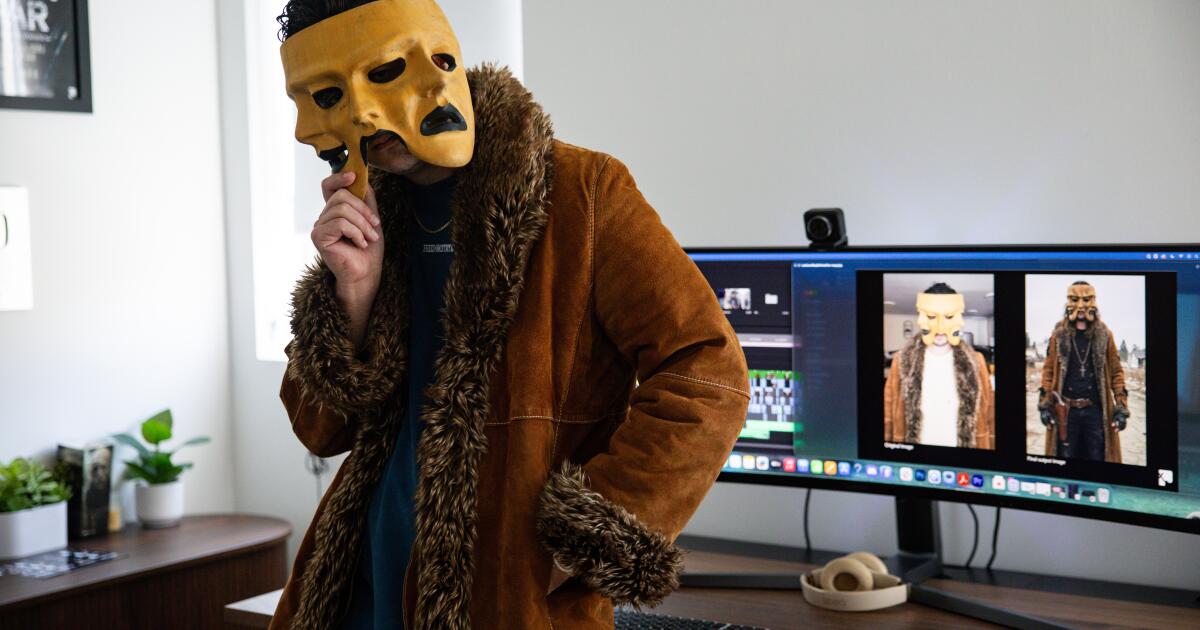
To create one of his characters, “the last lost boy,” Cardoza took self-portraits wearing a three-faced mask and a tattered brown jacket. He used those reference images for the AI character and transforms them into a stylized person, with a personality, backstory and visual details. He fed those images back to Seedance to get consistent characters — repeating the process for each member of the cast.
“I can’t go get Brad Pitt because he costs like $5, 10, 20 million to be in my film,” Cardoza said. “I can probably get a synthetic actor that will act just as good as Brad Pitt in the future. That’s crazy to me.”
Cardoza has copyrighted his script and characters, and aims to eventually attract major studio interest to turn his intellectual property into a film which comes with a built-in fan base.
Such plans are likely to face resistance from the performers union SAG-AFTRA, which has decried the use of synthetic actors such as Tilly Norwood.
“The rise of Seedance comes down to [its] focus on pleasing filmmakers and making things that look filmic,” said Stephan Vladimir Bugaj, senior vice president of JioStar, a joint venture between Disney and India’s Reliance Industries.
ByteDance introduced timeline-based prompting so filmmakers can actually pick specific moments and tweak them, and improved the understanding of camera direction, physics, lighting and fluidity of action. All of this, Bugaj said, “unlocked a kind of spectacle filmmaking that the other models are not delivering quite as well.”
The company’s tool has been in such high demand, Zada said, that Seedance has been quoting some major Hollywood studios $2 million for unrestricted special access.
While acknowledging Seedance’s popularity and its U.S. expansion, Amit Jain, chief executive of Luma, said its ceiling in Hollywood is severely limited. Traditional studios might adopt Chinese models for some preproduction tasks such as concepting, but the geopolitical and intellectual property risks for commercial generations are too prohibitive.
“Can you imagine Disney using the ByteDance model for the next ‘Snow White’? No way,” Jain said. “This is not even a technical argument, really. That’s the reality.”
Luma has been making inroads into Hollywood selling its software but has separately funded a production service company to teach filmmakers to make hybrid AI films using its tools.
Despite conservative production budgets, AI spending by media companies is projected to grow from $2.6 billion to $12.5 billion from 2024 to 2029, according to a State of Generative AI Media report.

Kavan Cardoza flips through pages of his fine-art photography book.
(Kayla Bartkowski/Los Angeles Times)
Bugaj warned that the quality and competitive price of Chinese models should be a “wake-up call” for American players fighting for market share.
“We’re not loyal,” said Zada, the filmmaker. “Whatever is the best, we’re going to use it.”
-

 New York2 hours ago
How a Museum Security Guard and Artist Lives on $51,000 in Parkchester
-

 Los Angeles, Ca2 hours ago
Heat advisory issued as Southern California temps near triple digits this week
-

 Detroit, MI2 hours ago
Detroit Battery Safety Provider Reaches to the Skies with Med Hawk
-

 San Francisco, CA2 hours ago
A Locals-Approved Modern Guide to Fisherman’s Wharf: Seafood, Beer Gardens + Iconic Bay Views
-

 Dallas, TX2 hours ago
New glitzy Houston steakhouse Juliet opens next to Delilah this summer
-

 Miami, FL2 hours ago
Allapattah man faces charges over armed robbery after crash in Miami’s Liberty City
-

 Boston, MA2 hours ago
Somehow, This is a Fitting, Confusing End to Jaylen Brown’s Boston Celtics Career
-

 Denver, CO2 hours ago
Denver Broncos 2026 schedule

