Business
Commentary: AI isn’t ready to be your doctor yet — but will it ever be?


As almost everybody knows, the AI gold rush is upon us. And in few fields is it happening as fast and furiously as in healthcare.
That points to an important corollary: Beware.
Artificial intelligence technology has helped radiologists identify anomalies in images that human users have missed. It has some evident benefits in relieving doctors of the back-office routines that consume hours better spent treating patients, such as filing insurance claims and scheduling appointments.
Eventually, a lot of this stuff is going to be great, but we’re not there yet.
— Eric Topol, Scripps Research
But it has also been accused of providing erroneous information to surgeons during operations that placed their patients at grave risk of injury, and fomenting panic among users who take its offhand responses as serious diagnoses.
The commercial direct-to-consumer applications being promoted by AI firms, such as OpenAI’s ChatGPT Health and Anthropic’s Claude for Healthcare — both of which were introduced in January — raise special concerns among medical professionals. That’s because they’ve been pitched to users who may not appreciate their tendency to output erroneous information errors and offer inappropriate advice.
“Eventually, a lot of this stuff is going to be great, but we’re not there yet,” says Eric Topol, a cardiologist associated with Scripps Research Institute in La Jolla.
“The fact that they’re putting these out without enough anchoring in safety and quality and consistency concerns me,” Topol says. “They need much tighter testing. The problem I have is that these efforts are largely stemming from commercial interests — there’s furious competition to be the first to come out with an app for patients, even if it’s not quite ready yet.”
That was the experience reported by Washington Post technology columnist Geoffrey A. Fowler, who provided ChatGPT with 10 years of health data compiled by his Apple Watch — and received a warning about his cardiac health so dire that it sent him to his cardiologist, who told him he was in the bloom of health.
Fowler also sought out Topol, who reviewed the data and found the Chatbot’s warning to be “baseless.” Anthropic’s chatbot also provided Fowler with a health grade that Topol deemed dubious.
“Claude is designed to help users understand and organize their health information, framing responses as general health information rather than medical advice,” an Anthropic spokesman told me by email. “It can provide clinical context—for example, explaining how a lab value compares to diagnostic thresholds—while clearly stating that formal diagnosis requires professional evaluation.”
OpenAI didn’t respond to my questions about the safety and reliability of its consumer app.
Topol, who has written extensively about advanced technology in medicine, is nothing like an AI skeptic. He calls himself an AI optimist, citing numerous studies showing that artificial intelligence can help doctors treat patients more effectively and even to improve their bedside manners.
But he cautions that “healthcare can’t tolerate significant errors. We have to minimize the errors, the hallucinations, the confabulations, the BS and the sycophancy” that AI technology commonly displays.
In medicine, as in many other fields, AI looks to have been oversold as a labor-saving technology. According to a study of AI-equipped stethoscopes provided to about 100 British medical groups published earlier this month in the Lancet, the British medical journal, the high-tech stethoscopes effectively identified some (but not all) indications of heart failure better than conventional stethoscopes. But 40% of the groups abandoned the new devices during the 12-month period of the study.
The main complaint was the “additional workflow burden” experienced by the users — an indication that whatever the virtues of the new technology, they didn’t outweigh the time and effort needed to use them.
Other studies have found that AI can augment physicians’ skills — when the doctors have learned to trust their AI tools and when they’re used in relatively uncomplicated, even generic, conditions.
The most notable benefits have been found in radiology; according to a Dutch study published last year, radiologists using AI to help interpret breast X-rays did as well in finding cancers as two radiologists working together. That suggested that judicious use of AI could free up time for one of the two radiologists. But in this case as in others, the AI helper didn’t do consistently well.
“AI misses some breast cancers that are recalled by human assessment,” a study author said, “but detects a similar number of breast cancers otherwise missed by the interpreting radiologists.”
AI’s incursion into healthcare even has become something of a cultural touchstone: In HBO’s up-to-the-minute emergency room series “The Pitt,” beleaguered ER doctors discover that an AI app pushed on them as a time-saving charting tool has “hallucinated” a history of appendicitis for a patient, endangering the patient’s treatment.
“Generative AI is not perfect,” the app’s sponsor responds. “We still need to proofread every chart it creates” — thus acknowledging, accurately, that AI can increase, not relieve, users’ workloads.
A future in which robots perform surgical operations or make accurate diagnoses remains the stuff of science fiction. In medicine, as elsewhere, AI technology has been shown to be useful to take over automatable tasks from humans, but not in situations requiring human ingenuity or creativity — or precision. And attempts to use AI-related algorithms to make healthcare judgments have been challenged in court.
In a class-action lawsuit filed in Minnesota federal court in 2023, five Medicare patients and survivors of three others allege that UnitedHealth Group, the nation’s largest medical insurer, relied on an AI algorithm to deny coverage for their care, “overriding their treating physicians’ determinations as to medically necessary care based on an AI model” with a 90% error rate.
The case is pending. In its defense, UnitedHealth has asserted that decisions on whether to approve or deny coverage remain entirely in the hands of physicians and other clinical professionals the company employs, and their decisions on coverage and care comply with Medicare standards.
The AI algorithm cited by the plaintiffs, UnitedHealth says, is not used “to deny care to members or to make adverse medical necessity coverage determinations,” but rather to help physicians and patients “anticipate and plan for future care needs.” The company didn’t address the plaintiffs’ assertion about the algorithm’s error rate.
“We shouldn’t be complacent about accepting errors” from AI tools, Topol told me. But it’s proper to wonder whether that message has been absorbed by promoters of AI health applications.
Disclaimers warning that AI responses “are not professionally vetted or a substitute for medical advice” have all but disappeared from AI platforms, according to a survey by researchers at Stanford and UC Berkeley.
The issue becomes more urgent as the language of chatbots becomes more sophisticated and fluent, inspiring unwarranted confidence in their conclusions, the researchers cautioned. “Users may misinterpret AI-generated content as expert guidance,” they wrote, “potentially resulting in delayed treatment, inappropriate self-care, or misplaced trust in non-validated information.”
Typically, state laws require that medical diagnoses and clinical decisions proceed from physical examinations by licensed doctors and after a full workup of a patient’s medical and family history. They don’t necessarily rule out doctors’ use of AI to help them develop diagnoses or treatment plans, but the doctors must remain in control.
The Food and Drug Administration exempts medical devices from government licensing if they’re “intended generally for patient education, and … not intended for use in the diagnosis of disease or other conditions. That may cover AI bots if they’re not issuing diagnoses.
But that may not help users who have willingly uploaded their medical histories and test results to AI bots, unaware of concerns, including whether their information will be kept private or used against them in insurance decisions. Gaps in their uploaded data my affect the advice they receive from bots. And because the bots know nothing except the content they’ve been fed, their healthcare outputs may reflect cultural biases in the basic data, such as ethnic disparities in disease incidence and treatment.
“If there’s a mistake with all your data, you could get into a pretty severe anxiety attack,” Topol says. “Patients should verify, not just trust” what they’ve heard from a bot.
Topol warns that the negative effect of misleading AI information may not only fall on patients, but on the AI field itself. “The public doesn’t really differentiate between individual bots,” he told me. “All we need are some horror stories” about misdiagnoses or dangerous advice, “and that whole area is tarred.”
In his view, that would limit the promise of technologies that could improve the effectiveness of medical practice in many ways. The remedy is for AI applications to be subjected to the same clinical standards applied to “a drug, a device, a diagnostic. We can’t lower the threshold because it’s something new, or different, with some broad appeal.”


The race to bring air travel to the sky is heating up as Santa Cruz-based Joby Aviation and Toyota launch a joint venture to commercially produce air taxis.
The companies said in a news release Tuesday that they will work together on productivity, quality and costs and move toward mass production of Joby’s electric vertical takeoff aircraft. Joby and Toyota were first linked when Toyota made a nearly $400-million investment in the company in 2020. It has since increased its backing of the company to $900 million.
“It’s really meaningful for us to take on this challenge together with Joby, a partner that shares the same vision,” Toyota Chair Akio Toyoda said. “We believe this strengthened relationship is an important step forward in realizing the future mobility society.”
Joby‘s all-electric vertical takeoff vehicles are designed to hold four passengers and a pilot and can travel at up to 200 mph. The vehicle uses six tilting propellers to achieve vertical takeoff before switching to forward flight.
In February, Joby announced a partnership with Uber to start service in the United Arab Emirates this year, bringing on-demand air taxi rides to the country. It plans to expand to the U.S. after the completion of its final stage of Federal Aviation Administration testing.
Prior to its full FAA certification, Joby is hoping to launch early flight operations later this year as part of a White House program that will bring flights to several states, including New York, Texas and Arizona. Flights in California will not begin until after obtaining FAA certification.
Joby has been in a fierce battle to be the first with taxis in the sky with its Northern California competitor Archer Aviation. The two companies are involved in overlapping lawsuits, with Joby alleging corporate espionage against Archer, and Archer filing a suit alleging dubious ties to China that sparked an investigation into Joby by the U.S. International Trade Commission.
“Toyota has been by Joby’s side for nearly a decade, providing invaluable guidance and support as we built the foundation for manufacturing our aircraft,” JoeBen Bevirt, Joby’s chief executive and founder, said in the news release. “Together, we share a vision of making aerial mobility an everyday reality, and we look forward to delivering on that promise together.”
Joby Aviation’s shares, which have fallen more than 30% this year, climbed 3% on Tuesday to $8.92.
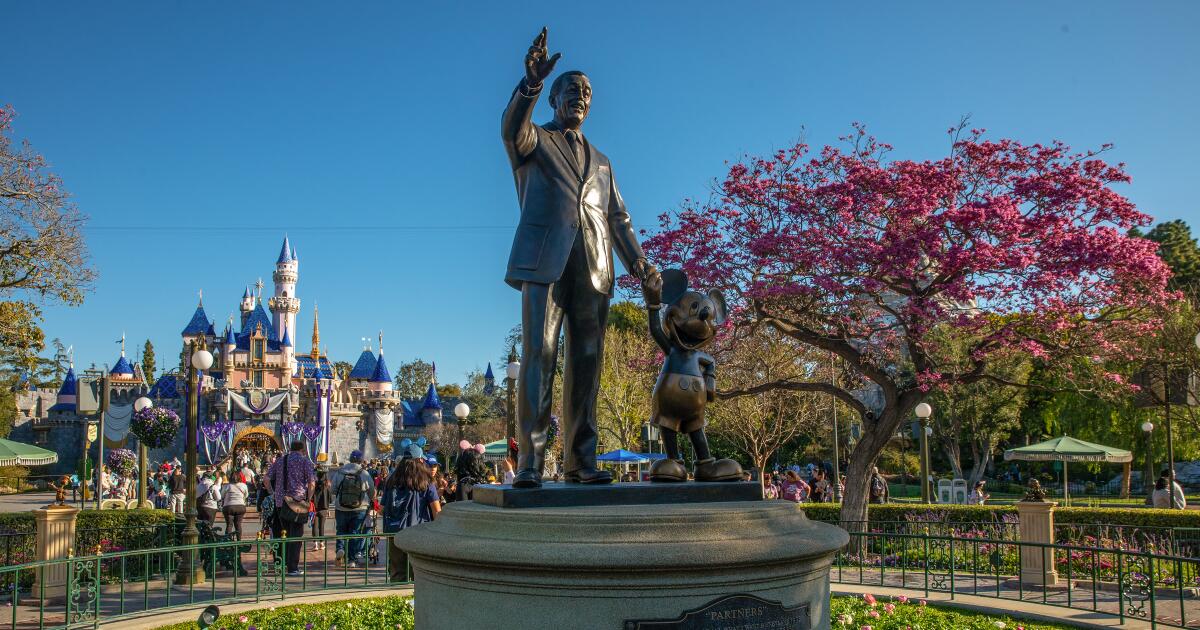
Disneyland Resort in Anaheim will offer $59 tickets for select evening admission to either theme park as part of a new promotion.
The one-day, one-park evening ticket offer will allow attendees to enter Disney California Adventure at 5 p.m. or Disneyland at 7 p.m. Park reservations are still required, as has been the case since the COVID-19 pandemic.
The offer only applies for admission from July 12 through Aug. 5 on Sundays to Wednesdays.
Disneyland Resort is commemorating its 70th anniversary through Aug. 9, and has introduced new shows and additions to rides as part of the occasion.
Walt Disney Co.’s theme parks and experiences business are a crucial boost to its finances, making up about 56% of the company’s operating income last fiscal year.
During the Burbank-based company’s most recent earnings call in May, Disney executives said attendance at its U.S.-based parks was down 1% compared with the prior year, a shift they attributed to “continued softness” in international visitations. However, the company said at the time that it was starting to move past those issues.
Disney’s experiences division reported $9.5 billion in revenue in that fiscal second quarter, up 7% compared with the same period a year ago, something executives said was due to higher guest spending domestically and more capacity on its cruise line.

An aging downtown office complex will be converted into apartments as part of an ambitious plan by local real estate companies to create 4,000 affordable housing units in Los Angeles.
The first project will be a $200-million makeover of the L.A. World Trade Center, a sprawling white elephant of an office complex on Figueroa Street built in the 1970s that will be turned into 512 apartments in one of the largest affordable housing conversions to date downtown.
Future projects being planned in the central city for delivery over the next five years will include other office-to-apartment conversions and new housing built from the ground up.
The 10-story World Trade Center, right, at Figueroa and Fourth streets in downtown Los Angeles, was built in the mid-1970s.
(Myung J. Chun / Los Angeles Times)
Behind the building campaign unveiled Monday are two of the region’s largest real estate companies, Jamison and Kennedy Wilson. Jamison is the city’s most prolific converter of offices to market-rate apartments and currently has a major makeover of a downtown office skyscraper underway for tenants who can pay top rents.
Kennedy Wilson, a real estate investment company based in Beverly Hills, owns Vintage Housing, which builds and operates affordable housing using tax credits and other state and federal financing to help fund it.
Vintage Housing and Jamison’s new affordable housing division, Arden Residential, will take on the campaign to build the housing where qualified tenants will pay rents below market rates.
Rents in the World Trade Center — which will be renamed Sky Castle when it opens in early 2028 — are expected to start at $937 for a one-bedroom unit. Some two- and three-bedroom units would rent for $1,100 and $1,300 per month, respectively, developers said.
Sky Castle will have shared amenities found in more expensive modern apartments, the developers said, such as a fitness center, resident lounge and co-working space. It already has six tennis courts on the roof, which may be converted to pickleball courts, Jamison Chief Executive Garrett Lee said.
The goal is to build higher quality affordable housing by using efficient construction methods Jamison has learned through building more than 8,000 market-rate apartments in the past, Lee said. The makeover of the World Trade Center will mark Jamison’s 15th conversion of an office building to housing.

The plan to redevelop the L.A. World Trade Center, bottom left, is one of the largest affordable housing conversions to date downtown.
(Myung J. Chun / Los Angeles Times)
The 10-story World Trade Center was built in the mid-1970s to fanfare saying it would be home to international companies. In 1976, The Times described the center as a place to prepare for an overseas trip where visitors could get passports and visas, as well as exchange dollars for francs, marks, rubles and other currency. There was a language school and branches of U.S., Swiss and Japanese banks.
By the mid-1980s, the 400,000-square-foot office complex covering a city block at Figueroa and Fourth streets had lost its international flavor and was falling out of favor with corporate tenants who were moving into glossy new skyscrapers on Bunker Hill and in other locations.
The building has been cleared of remaining office tenants to allow work to begin in August, Lee said.
Kennedy Wilson is a nationwide operator of market-rate apartments that has also moved into building affordable housing in the last decade, said Nicholas Bridges, global head of capital markets at the company.
Building affordable, workforce housing “in almost all cases requires public subsidies,” Bridges said, and Kennedy Wilson has developed expertise in assembling “a cocktail of public financing sources” that includes low-income housing tax credits and tax-exempt bonds.
In the past, many housing developers have shied away from building affordable housing because assembling the subsidies needed to make construction profitable is challenging.

An artist’s rendering shows what the L.A. World Trade Center could look like after being redeveloped into affordable housing. The new complex is to be called Sky Castle.
(Ian Camarillo)
“It’s complicated,” Bridges said, “and not for the faint of heart.”
Eligible tenants must earn between 30% and 80% of the median income in the area where the housing is built.
Jamison and Kennedy Wilson will develop about 15 affordable housing projects between downtown and the 405 Freeway, Bridges said, many of them in aging office buildings such as the World Trade Center that are already owned by Jamison and are close to public transit.
Substantial potential for affordable housing lies in L.A.’s underused office buildings, he said.
“In this post-COVID world, the way people are utilizing office buildings, particularly older office buildings, has just fundamentally changed,” he said.
It makes sense for developers of conventional multifamily housing to move to building affordable housing, Lee said, because the government supports it through subsidies, zoning reform and the fast-tracking of construction permits. The city of Los Angeles also recently streamlined its adaptive reuse rules to make it easier to convert office buildings to housing.
“There are a lot of incentives pushing us in this direction,” Lee said.
-

 Kentucky2 minutes ago
Former Northern Kentucky school bus driver sentenced in child pornography case
-

 Louisiana5 minutes ago
Audit finds barriers hinder Louisiana WIC enrollment – American Press
-

 Maine10 minutes ago
How to safely enjoy the water in Maine as temperatures rise
-

 Maryland17 minutes ago
Rep. Glenn Ivey, Community Members Discuss Gun Violence Solutions
-

 Michigan20 minutes ago
Thousands without power in mid-Michigan
-

 Massachusetts25 minutes ago
Mass. Legislature reaches compromise on $63.4B state budget. Here’s what’s in it
-

 Minnesota32 minutes ago
Minnesota Wild Signs Goaltender Calvin Pickard to a One-Year Contract | Minnesota Wild
-
Mississippi35 minutes ago
New autopsy of a baby killed by police in Mississippi deepens outrage


