Business
Column: Trump says Harris stole his idea for exempting tips from tax, but her version beats his

Every four years, the just-toss-an-idea-out-there phase of the presidential race precedes the serious campaigning that starts after Labor Day.
The flavor of the moment is the idea of exempting tips from federal taxes. Donald Trump proposed it during an appearance in June in Las Vegas (home to a lot of restaurant and hotel workers who depend on tips).
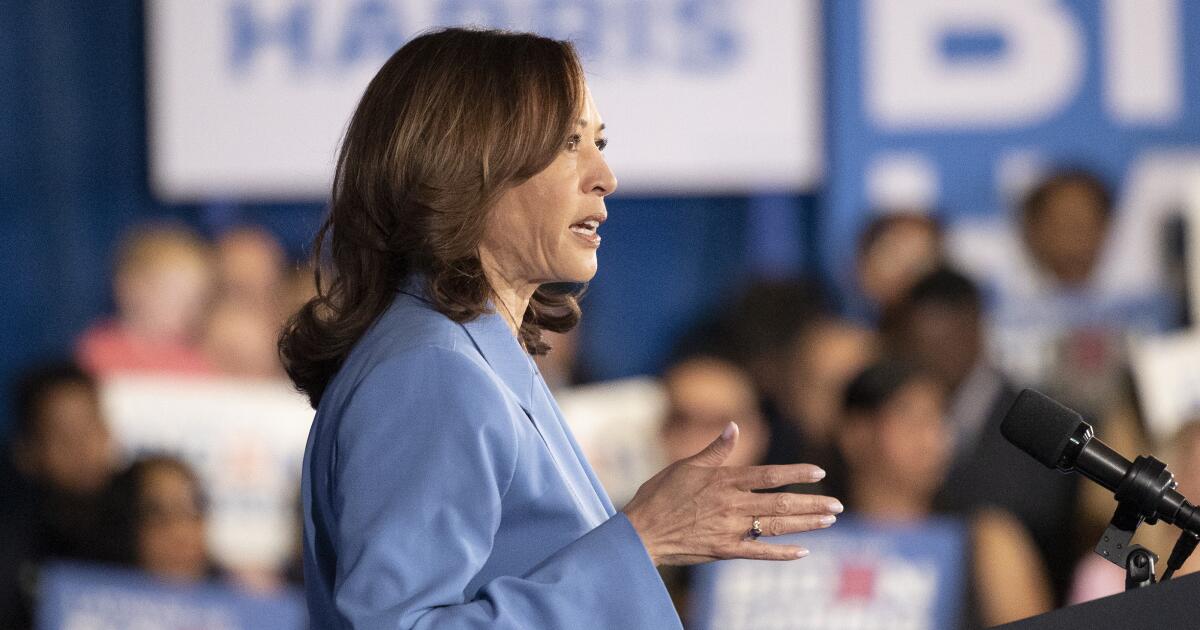
Kamala Harris offered her version a few days ago during a rally of her own, also in Las Vegas. That prompted Trump to whine on social media that she had poached his idea.
A meaningful share of tipped workers already pay zero federal income tax.
— Ernie Tedeschi, Yale Budget Lab
Are you tired of this yet?
Hang on, because there’s more to say, starting with the fact that a tax exemption for tips on its own won’t do much good for the many low-income workers who count tips as an important part of their income.
Second, this is hardly a new idea — it has been kicking around the political world since at least the 1980s. California exempted tips from state tax (with some conditions) in 2015.
A tax exemption for tips is a crowd-pleaser, but doesn’t stand up to scrutiny. Trump’s version, and a bill introduced by Sen. Ted Cruz (R-Texas) and Rep. Byron Donalds (R-Fla.) to put meat on its bones, are half-baked.
Harris paired hers with a proposal to raise the federal minimum wage, which is a much better policy.
If all this jockeying is the two parties vying to be more family-friendly, the crown goes to the Democrats, hands down.
Let’s place the issue under a microscope.
Since Trump hasn’t given any details, we have to use the Cruz/Donalds No Tax on Tips Act as a signpost for the GOP approach. The measure exempts tips from federal income tax, but not from the payroll tax that funds Social Security and part of Medicare. It applies only to households that pay federal income taxes — it’s not refundable, meaning that it doesn’t provide any benefit to households whose income is so low they don’t owe federal taxes.
That leaves out all but “a small sliver” of American workers, according to economist Ernie Tedeschi of the Yale Budget Lab. He counts the number of workers in traditional tipped occupations, including wait staff, barbers and hairdressers, at about 4 million, or just 2.5% of all workers.
“A meaningful share of tipped workers already pay zero federal income tax,” Tedeschi notes.
U.S. census data drive home his point: More than a third of tipped workers earned so little in 2022 that they owed no federal income tax. In other words, they’d receive zero benefit from the Republican act.
Another flaw of the bill is its lack of guardrails to ensure that only low-income tipped workers receive its benefits. Nowhere in the three-page measure are tips defined, nor is there a phase-out of the tax break based on income. This raises the possibility that higher-income households could game the system by defining some of their earnings as tips and pocketing the deduction.
Nothing would “prevent high-income professionals such as hedge fund managers from shifting their compensation to a tax-free tipping model,” observes Brendan Duke of the liberal Center for American Progress.
That mention of “hedge fund managers” shows that the folks at CAP know how their audience would react to another giveaway to plutocrats, but it’s hard to deny that the wealthy are masters of exploiting any tax break that could conceivably save them money.
The biggest problem with the Republican approach is that it operates in a vacuum, as if exempting tips from income tax is all that needs to be done to vest the GOP with pro-family cred. It’s not. Far more gains would be achieved by extending enhancements to the Earned Income Tax Credit and the Child Tax Credit that were enacted as part of the American Rescue Plan of 2021.
The EITC and Child Tax Credit enhancements expired at the end of 2021. Efforts by the Biden White House and its Democratic allies on Capitol Hill to extend them failed, due mostly to Republican opposition. Under the Rescue Plan, the child tax credit was increased to an annual $3,000 per child ($3,600 for children under age 6), from $2,000 per child. The measure raised the maximum age of children eligible for the credit to 17 from 16.
Even more important, the credit was made fully refundable, meaning that it went to families regardless of whether or how much they paid in federal income taxes. The American Rescue Plan also eliminated the preexisting program’s work incentives, which reduced the credit for lower-income families. When the enhancements expired, the child credit fell back to $2,000 per child and reduced the refundable portion to $1,700.
As CAP calculates, many of the low-income households that would receive nothing from the No Tax on Tips Act — a single parent with one child, living on $24,000 income mostly from tips, a student working part-time or a married couple earning less than $30,000 — would receive benefits of up to $2,600 from restoration of the American Rescue Plan credits.
The enhanced Child Tax Credit reduced the child poverty rate by about 30%, keeping as many as 3.7 million children out of poverty by the end of 2021. When the enhancements expired in January, the child poverty rate spiked to 17% from 12.1%, plunging 3.7 million children back under the poverty line. The impact was much worse on Black, Latino and Asian children than on white ones.
In other words, if the Republicans wished to be pro-family really, not just rhetorically, they would have clamored to extend the credits.
Trump’s running mate, JD Vance, whose mouth writes checks his campaign can’t cash, says he’s in favor of the child tax credit and even wants to raise it as high as $5,000 per child. Couple of problems here: First, he surely knows that his Republican colleagues in Congress would never support such a large grant to families, and second, when a more modest increase came up to the Senate floor two weeks ago, Vance didn’t even show up to vote.
How about Harris’ proposal?
What she said in Las Vegas was this: “We will continue our fight for working families of America, including to raise the minimum wage and eliminate taxes on tips for service and hospitality workers.” Nestled within that statement are two very important distinctions from the Trump or Republican proposal.
First is a raise in the federal minimum wage, which has been frozen at $7.25 an hour since 2009. Had the minimum kept pace with inflation, it would be $10.79 today. In seven states, the federal wage applies — five that have not enacted a minimum wage of their own (Alabama, Louisiana, Mississippi, South Carolina and Tennessee) and two (Georgia and Wyoming) where the state minimum is lower than $7.25, meaning that the federal wage is the law.
Harris also specified service and hospitality workers, which obviously means she would exclude professionals gaming the law. Whether she would do so by phasing out the benefit by income or specifically identifying eligible occupations isn’t clear.
Despite her careful phrasing, conservative commentators and not a few actual journalistic organizations fell into the trap of treating Harris’ proposal as a copycat of Trump’s.
The right-wing pundit Mary Katherine Ham, whose determination to tell it like it is was hampered by her lack of knowledge, tweeted that if Harris is “just gonna copy and paste Trump’s site, she doesn’t need another week or two to debut it.”
Obviously, if Ham spent two minutes examining the proposals, she wouldn’t have made this claim. But her error matched those of, for example, CBS News, which reported in headline syntax that Harris was “echoing Trump proposal.”
The distinction was also lost on the Wall Street Journal, which accused Harris of “borrowing a Trump idea.” Never mind that the idea wasn’t Trump’s in the first place. The Times, I’m sorry to say, picked up an Associated Press account that described Harris as “echoing a pledge that her opponent, Republican Donald Trump, has made, and marking a rare instance of political overlap from both sides.”
Budget deficit hawks have also weighed in. The Committee for a Responsible Federal Budget, a watchdog group that is an offspring of the late hedge fund billionaire Pete Peterson, wrung its hands over the potential cost of Harris’ plan, based on a conjecture that she would raise the minimum wage to $15 an hour.
The committee estimated that, combined with an income tax exemption, her plan would cost the federal government as much as $200 billion over 10 years. Is that a lot?
The Congressional Budget Office projects that annual federal budgets will total about $19.6 trillion over the next 10 years, making the cost of the minimum wage and tip exemption come to about 1% of federal outlays during that time.
You make the call. Two of the most expensive tax breaks in federal law are the exemptions for contributions and earnings for pension and individual retirement accounts, and the preferential tax rates on dividends and capital gains. Both disproportionately benefit the wealthy. Combined, they come to $680 billion a year; the minimum wage increase and tip exemption would cost an average $20 billion a year.
Some people might think that an important goal of the federal government should be providing for the most vulnerable members of society. The current system, especially after a massive tax break was enacted by the Republicans and signed by Trump in 2017, is heavily skewed toward comforting the wealthy.
If the parties and their candidates want to play the pro-family card, one can’t really blame them for seizing on a policy that sounds great on TV. Only one of the parties has gone beyond a tax exemption on tips and has favored truly comprehensive pro-family policies. Can you see which one?


Johnny Beig may have played in a semi professional cricket league in Australia, but this summer he’s a big fan of soccer in the United States.
It’s not just because he’s rooting for the World Cup team, though.
FIFA emblems are featured on jerseys that were created by the Dioz Group and distributed for all employees at the 16 FIFA World Cup venues this summer.
(Genaro Molina / Los Angeles Times)
Last year, Beig’s Beverly Hills-based company, Dioz Group, won a $2.5 million contract with On Location, FIFA’s hospitality partner, to design, manufacture and distribute uniforms for all employees working at FIFA World Cup venues this summer.
These include the people welcoming attendees into stadiums, VIP lounge chefs, waiters and the flagbearers during the opening ceremony.
After a multi-step application process, including presentations of its planning and strategy, Dioz says it produced more than 50,000 clothing garments including suits, jackets, shirts and hats and delivered them to the 16 World Cup venues around the U.S., Canada and Mexico in June.
Thanks in part to the World Cup contract, the company’s revenue has reached $15 million so far this year, compared with $20 million last year, Beig said. He declined to disclose the company’s net income but said the business was profitable.
“We are working with larger names that we would have never imagined we would,” he said. “The FIFA World Cup is the pinnacle. Working with the largest sporting event in the world is what we’re very proud of. I don’t think it gets any bigger than that.”

Volunteers line up to prepare to display the Canadian flag before a World Cup round of 32 knock-out match between Canada and South Africa at SoFi Stadium on Sunday.
(Kelvin Kuo / Los Angeles Times)
Dioz is among the many small businesses across Los Angeles that are getting a boost from the global sporting event, said Kevin Klowden, a senior fellow at the Milken Institute.
The influx of hundreds of thousands of fans into the city has been a boon to hotels, transportation services and restaurants, in addition to those in the special events and logistics economy, Klowden said, calling the event the “equivalent of multiple Super Bowls.”
“The number of contracts that are there, it’s a big deal,” he said. “Given the fact that L.A.’s filming is only slowly recovering, having something like the World Cup is definitely a boost.”
Dioz was co-founded by Johnny, 44, and his brother Tony in 2006. The brothers were born in India and raised in Australia, where Johnny enjoyed a brief career as a semi professional cricket player.
He realized his future wasn’t as a professional athlete, but he wanted to stay connected to the sports world, so he began making uniforms for his cricket team in 2006.
He then got a referral to make uniforms for multiple teams in the area before starting an apparel company.
“I wanted to stick with something I was passionate about, which is sports,” he said.

Volunteers unravel the center field display before a World Cup round of 32 knock-out match between Canada and South Africa at SoFi Stadium on Sunday.
(Ronaldo Bolanos / Los Angeles Times)
In 2012, Beig moved to Los Angeles and established Dioz‘s Los Angeles headquarters to tap into the U.S. market. During the pandemic, the company started supplying medical apparel to hospitals and schools, and the business took off, with revenue doubling in 2020, Beig said.
Dioz now has over 150 employees, including 15 in L.A., and manufactures its apparel at factories in China, India, Bangladesh, Turkey and the Philippines. Tony runs an office in Dubai.
Before the World Cup, Dioz provided employee uniforms for events including Super Bowl LIX and Copa America, which may have given it a leg up on the FIFA contact.
Now, with a World Cup contract on their resume, Beig said he’s setting his sights on even bigger events.
“This gives us an edge over the next FIFA events worldwide as well, where we can showcase our skills and we can handle it,” Beig said. “So it gives us a good opportunity to work with sporting events like the UEFA Championship and Premier League.”
As companies get new business from the World Cup, Klowden said it’s important that they leverage their new position to continue that growth.
Companies that benefited from the World Cup might be in a position to bid on even bigger contracts, especially with the Olympics coming up in 2028, Klowden said.
“The really important part in any of these deals is that if a company ran something like this, then they are able to build off of that success,” Klowden said. “Let’s say you’re a company that did a big uniform order or a big food order, and the World Cup goes, and you invested in new manufacturing capacity, or you invested in new clothing machines, or whatever you do; suddenly you don’t have that market anymore, then you’ve just wasted all that money ramping up.”

Surcharges that California homeowners have been hit with statewide by insurers defraying the costs of Los Angeles County’s wildfires were ruled legal in a decision released late Tuesday.
L.A. County Superior Court Judge Tiana Murillo turned down a petition by advocacy group Consumer Watchdog to halt the charges, which insurers began levying last year after the state’s insurer of last resort couldn’t pay all its January 2025 fire claims.
The California FAIR Plan, financially backed and operated by the state’s licensed home insurers, needed a $1-billion bailout from the insurers after it was hit with some $4 billion in claims.
Under a deal Insurance Commissioner Ricardo Lara worked out with the FAIR Plan in 2024, the insurers could seek state approval to surcharge their residential policyholders for up to half of any assessment totaling $1 billion in case the plan needed a bailout in an “extreme worst case scenario” — as it turned out it did.
A total of 105 insurers, including State Farm General — California’s largest home insurer — Farmers and Mercury sought and received approval for the surcharges.
Because the FAIR Plan assessed its member insurers based on their share of the state’s home insurance market, the policyholder surcharges were in the same ballpark. The median fee for homeowners was $28, according to the department of insurance.
The fee can be more or less according to the size of a homeowner’s premium and is split into monthly payments that insurers can spread over one or two years. Condo owners and renters on average were surcharged less.
In a court filing, Consumer Watchdog said $420 million in surcharges were approved.
In its April 2025 lawsuit filed against Lara, the Los Angeles group made a series of arguments in seeking to overturn the residential surcharges, which it deemed an industry bailout. It did not sue over related commercial surcharges.
Consumer Watchdog contended in its lawsuit that the surcharges violated Proposition 103 — the 1988 measure that governs insurer rate hikes — because the proposition does not allow for them.
It also claimed Lara did not follow regulatory protocol in promulgating the new policy.
The group further alleged that the FAIR Plan’s governing statutes do not give Lara the authority to permit the surcharges — and that the statutes require insurers to share in the plan’s profits and losses, and not shift losses to policyholders.
Murillo, and another judge who previously heard the case, turned down all of the consumer group’s arguments in separate rulings, the last of which Murillo issued Tuesday night.
Lara celebrated his legal victory over Consumer Watchdog, which has accused Lara of having close ties to insurers and sought to oust him from office. His terms ends in January.
“This victory sends a loud and clear message: The era of allowing special interests to derail consumer choice is over. We have the momentum, we have the authority, and we will continue to fight until every Californian has access to the coverage they deserve,” Lara said in a statement.
Attorney Will Pletcher, litigation director of Consumer Watchdog, said the group disagreed with the decision and would “consider all options to move this forward.”
“It’s important to try to protect California consumers from these surcharges that we think are in pretty clear conflict with both Proposition 103 and the FAIR Plan,” he said.
Hilary McLean, a spokesperson for the plan, said in a statement it did not have any position on the ruling, given the plan “does not have a role in determining how insurers manage costs associated with assessment.”
Denni Ritter, vice president of state government relations for the American Property Casualty Insurance Assn., a major industry trade group, said the decision rejected “the reckless lawsuit brought by the self-interested group Consumer Watchdog…”
“This ruling preserves a vital tool to protect the stability of the California insurance market. Blocking cost recovery would have undermined the state’s last-resort coverage option,” she said in a statement.
The 2024 policy was issued in response to the rapid growth of the plan due to a series of wildfires over the last decade that prompted multiple insurers to retreat from the state’s home insurance market.
The plan had 264,000 homeowners on its rolls in September 2022, a figure that rose to 452,0000 in the months before the fires — and its residential policyholders have since increased to 663,000 as of March.
The FAIR Plan offers policies that typically cost more than those issued by regular insurers while offering less coverage.
A Times analysis last year found that in the Palisades and Eaton fire zones, the plan’s rolls nearly doubled to 28,440 from 2020 to 2024.
That concentration of policyholders led to the plan’s large losses during the Jan. 7 wildfires, which damaged or destroyed more than 18,000 structures, killing at least 31 people.
It’s been estimated that the insured losses for the wildfires could ultimately total as much as $40 billion, exceeding any past wildfires worldwide. Ritter said that so far insurers have paid $23.7 billion in claims.
The 2025 wildfires were not the only time the FAIR Plan has needed a bailout, though it is the first time its member insurers surcharged policyholders.
In 1993, it assessed carriers after fires in Altadena and Malibu, and in 1994 it did so after the Northridge earthquake. The assessments totaled $260 million.
The plan received approval this year from the insurance department for a 29% rate increase for its homeowner dwelling policy that will take effect in October.

An electric Tesla Semi truck crashed into two vehicles in Dayton, Nev., over the weekend, killing two people and raising questions about the truck’s safety features.
The Lyon County Sheriff’s Office responded to a major collision around 7 a.m. on Sunday at the intersection of Highway 50 and Traditions Parkway about 40 miles east of Reno, the office said.
The office confirmed a semi-truck was involved in the accident, and footage of the scene shows it was a Tesla Semi.
It is the first known crash involving a Tesla Semi, an electric Class 8 truck that Tesla is building in Nevada and plans to ramp up production of. As interest in Tesla’s electric passenger vehicles wanes, the company is betting on the truck to give it a needed boost.
The trucks do not have the Full Self-Driving mode available in Tesla cars, but Tesla’s website says they come standard “with active safety features that pair with advanced motor and brake controls to deliver traction and stability in all conditions.”
According to the Lyon County Sheriff’s Office, preliminary statements obtained at the scene suggest the truck driver may have fallen asleep behind the wheel.
The crash is under investigation by the Nevada State Police Highway Patrol, which said additional information may be released next week.
The Record-Courier identified the victims as Sergio and Jennifer Villanueva, a couple who got married in 2022.
Tesla has not clarified if its semitruck has an automatic emergency braking system. Federal regulators are currently weighing a mandate for emergency braking systems in vehicles more than 10,000 pounds.
-

 Texas2 minutes ago
Tesla driver charged with manslaughter over crash into Texas home
-

 Utah7 minutes ago
3 Trade Scenarios for the Utah Jazz to Find a New Center
-

 Vermont14 minutes ago
4 Burlington beaches closed due to algae blooms
-

 Washington17 minutes ago
Indie Films Opening July 3: ‘Young Washington’ Marches Into Theaters
-

 Virginia17 minutes ago
Discarded cigarette butts spark $1.3M house fire in Virginia
-

 Wisconsin29 minutes ago
Southeastern Wisconsin severe weather; cleanup underway
-

 West Virginia32 minutes ago
America250 fireworks, events happening this weekend in North Central West Virginia
-

 Wyoming37 minutes ago
14 Wyoming Cowboys make Athlon All-Mountain West preseason team

