Business
Column: On Harvard, plagiarism, and the racist right-wing attack on university education

You may have heard during the last few days about the resignation by the president of a smallish university in New England.
Pundits, politicians and alumni are currently locked in a debate over whether Claudine Gay’s decision to step down after only a months-long tenure as president of Harvard was due to accusations that she was a serial plagiarist or her maladroit performance last month at a congressional hearing about a surge of antisemitism on American college campuses.
A few things about this: That some of Gay’s academic writings crossed the line into plagiarism is indisputable. That she, along with the presidents of the University of Pennsylvania and MIT, failed to knock the “gotcha” questions about antisemitism back down the throats of the cynical, preening Republican interrogators at the hearing is also indisputable.
The biggest story about higher education over the last decade has been increased politicization, not wokeness.
— Don Moynihan, Georgetown University
What’s important is that neither of those facts has anything to do with what was really behind the campaign to force Gay out of her job. To put it simply, the press has completely missed the real story. To be precise, the debate about her resignation has ignored the noxious context, which is a concerted attack on American higher education — indeed, all education — by a right-wing cabal.
Gay, whatever her faults, is clear-eyed about this context. In an op-ed published Wednesday, she warned that her case “was merely a single skirmish in a broader war to unravel public faith in pillars of American society.”
Such campaigns, she added, “often start with attacks on education and expertise, because these are the tools that best equip communities to see through propaganda. … Trusted institutions of all types — from public health agencies to news organizations — will continue to fall victim to coordinated attempts to undermine their legitimacy and ruin their leaders’ credibility. For the opportunists driving cynicism about our institutions, no single victory or toppled leader exhausts their zeal.”
What’s most shocking about the failure of the press to recognize what’s happening is that the leaders of the cabal are completely open about their goals and their methods. Here, for instance, is a manifesto by the odious Christopher F. Rufo, the leader of the braying mob that chased after Gay:
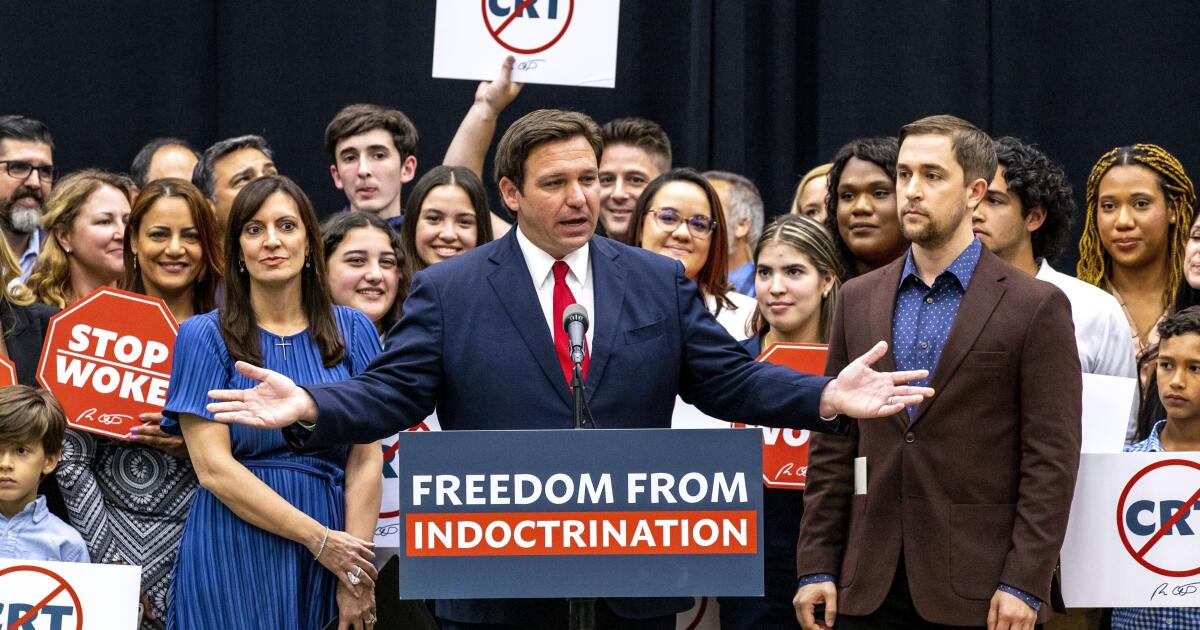
“We launched the Claudine Gay plagiarism story from the Right,” he stated on X-formerly-Twitter on Dec. 19. “The next step is to smuggle it into the media apparatus of the Left, legitimizing the narrative to center-left actors who have the power to topple her. Then squeeze.” This is a replication of his campaigns to turn “critical race theory” (CRT) and “diversity, equity and inclusion” programs (DEI) into dog whistles for the reactionary Republican voting bloc.
The problem is that all the focus is on Harvard, for at least a couple of reasons: It’s the most prestigious university in the country and lots of journalists at agenda-setting news organizations such as the New York Times are alumni, and thus believe that culture and society revolve around the place (or similar Ivy League institutions).
“The obsessive culture war coverage of the Ivies hurts other institutions,” observes Don Moynihan, a public policy professor at Georgetown University. Those elite private schools have the money and connections to survive whatever partisan politics throws at them.
Not so the public institutions that educate the vast majority of Americans. (Harvard’s enrollment, including its graduate and professional schools, is about 30,000; at Florida’s three main campuses, which are under intense partisan threat from Gov. Ron DeSantis, it’s a combined 185,000.)
“The biggest story about higher education over the last decade has been increased politicization, not wokeness,” Moynihan writes. “The biggest threats to speech are coming from people who write the laws and set the budgets, not from students. … University trustees in public institutions are increasingly political appointees determined to impose right wing values.”
He’s right. Yet coverage of the crisis in public schools pales in comparison to the obsessive reportage about Harvard and the Ivies.
The model for eviscerating the independence of public university systems was set by Republican Gov. Scott Walker of Wisconsin. By the end of his two terms in 2019, reported Karin Fischer of the Chronicle of Higher Education in 2022, “Walker had slashed college budgets, stripped tenure protections and university autonomy, and proposed gutting the Wisconsin Idea, enshrined in state law, that stresses higher education’s importance to the state and society.”
According to Barrett J. Taylor, the author of “Wrecked: Deinstitutionalization and Partial Defenses in State Higher Education Policy,” a book about the Wisconsin experience, “Walker went after higher ed to rally his base: ‘Universities were too liberal! Professors had too good of a deal!’ It was something to oppose. And higher ed is still a useful political tool.”
Other state universities were targeted by partisan activists. The University of North Carolina was bedeviled by conservatives on its Board of Governors claiming to find ideological bias campuswide. The board’s real agenda was to shut down progressive activities, which it did by closing a poverty law center at the main campus at Chapel Hill led by “a vocal critic of conservatives,” according to Inside Higher Ed, as well as an environmental science program and a center on social change at satellite campuses.
In December, Kevin Guskiewicz left his job as chancellor of UNC Chapel Hill to become president of Michigan State University. The mostly Republican board replaced him with Lee Roberts, a Republican functionary who had no experience running a major university.
At Texas A&M, conservatives influential within the university system interfered with the hiring of a distinguished journalist, Kathleen McElroy, to head its journalism school.
Over a period of weeks, the terms of her employment were reduced to a one-year non-tenured appointment from a tenured chair. The reason, McElroy was told by the university’s dean of arts and sciences, was that “you’re a Black woman who worked at The New York Times.”
The fiasco led to the resignation of A&M President Katherine Banks after a faculty meeting in which she defended the fiasco clumsily. McElroy chose to stay at the University of Texas and obtained a $1-million settlement from A&M over the altered offer.
Florida remains ground zero of the reactionary attack on public higher education. DeSantis has installed Ben Sasse, a former Republican senator from Nebraska, as president of the flagship University of Florida (enrollment: 60, 795); never mind that Sasse had zero experience running a major university.
The highlight (or lowlight) of DeSantis’ campaign against Florida universities involves New College of Florida, a Sarasota institution that possessed a well-deserved reputation as one of the nation’s outstanding havens for talented, independent-minded students. DeSantis fired its board of trustees and replaced it with a clutch of right-wing stooges including Rufo.
They promptly fired the college’s president and replaced her with Richard Corcoran, a former GOP state legislator, while nearly doubling his salary to $700,000, plus more than $200,000 in perks.
Corcoran moved to turn New College into a fourth-tier institution of zero distinction. He recruited 70 baseball players even though the campus has no playing fields. Existing students fled, and the average SAT and ACT scores and high-school grade point averages of the incoming class have plummeted.
That brings us back to Rufo and his campaign against Claudine Gay. Does any person past the age of playing with their toes really believe that he cares one whit about plagiarism and antisemitism, the ostensible rationales for her departure? Does anyone believe his purpose is to heighten the integrity of prose in academia, or ensure that university campuses remain refuges for pro-Israel policy?
Of course he doesn’t — at least not beyond using these issues to conceal his real goal, which is to make university administrators and faculty terrified of being caught allowing progressive thoughts into the classroom.
Here he was on Twitter, on March 15, 2021, at the height of his fabricated campaign against “critical race theory,” which became conveniently truncated as “CRT,” the better to put it over on rubes without explaining what it is:
“We have successfully frozen their brand — ‘critical race theory’ — into the public conversation and are steadily driving up negative perceptions. We will eventually turn it toxic, as we put all of the various cultural insanities under that brand category.”
“Brand category,” “negative perceptions.” … This is the language of advertising, not serious political discussion.
Having achieved his purpose by demonizing CRT, Rufo and his sycophants turned to DEI. Right-wing politicos unwilling or unable to even feign interest in making public policy scurried to get in front of this parade.
GOP legislators in Wisconsin held hostage $800 million in funding for the state university and blocked all staff pay raises unless the university cut back DEI programs. The university agreed. Oklahoma’s Republican governor, Kevin Stitt, signed an order defunding DEI departments in all state agencies, including the state’s 50 public university campuses.
Did anyone stop to inquire what it means to reverse DEI? The antonyms of diversity, equity and inclusion are uniformity, inequality and exclusion. In context, this translates into white supremacy. For who is on the outside looking in when the rules promote uniformity, inequality and exclusion? In our society, it’s everyone but whites — especially white males.
Of course, once you’ve reduced these principles to “DEI,” no one has to stop and think about meaning. But it’s no secret to those on the firing line. The assault on DEI programs, observed a report on Florida’s anti-DEI campaign by the American Assn. of University Professors, is “emblematic of how civil rights discourses get co-opted by the far right to promote misogynistic (and/or racist) agendas.”
Gay’s sloppiness in citing others’ words in her academic oeuvre was a dormant bomb, awaiting someone looking for a flaw in her record to light the fuse. That doesn’t mean that it fails to qualify as plagiarism; it does, according to Harvard’s own written standards.
Nor does it mean that her offenses would have necessarily prompted her resignation, if not for the miasma of ideological controversy stirred up by Rufo and his detestable henchwoman, Rep. Elise Stefanik (R-N.Y.).
It was Stefanik who set the rhetorical trap that Gay stupidly walked into at that Capitol Hill hearing, along with Penn President Liz Magill (who has also resigned, more directly as a result of a campus controversy over antisemitism) and MIT President Sally Kornbluth (who still has her job).
The sad truth is that plagiarism standards are dynamic, with punishment dependent on the prestige of the accused and the willingness of an institution to stand by them. As Timothy Noah of the New Republic has pointed out, Harvard faculty member Doris Kearns Goodwin committed arguably more egregious examples of plagiarism in 2002 and emerged with her employment and reputation intact, with Harvard’s help.
Rufo and Stefanik are taking victory laps over Gay’s resignation. Stefanik, who never lets an opportunity slip by to display crass vulgarity, tweeted “Two Down,” referring to Gay and Magill. Perhaps his incident will open people’s eyes to the dishonesty of their campaign and the hollowness of their triumph. Wouldn’t that be justice?


Ethics experts sounded the alarm Wednesday after new financial disclosure reports revealed that President Trump’s income ballooned to $2.2 billion in 2025, with $1.4 billion coming from various new cryptocurrency-related businesses.
“It’s bribery. It’s graft. It’s exploitation of public power for private financial gain,” said Kathleen Clark, a law professor at Washington University and an expert in government ethics. “Trump has — with the acquiescence of a somnolent, GOP-controlled Congress and the active assistance of John Roberts’ Supreme Court — transformed the presidency into a massive corruption racket.”
Trump reported income of over $600 million in 2024. But after he entered the White House in 2025, he reported that his income had soared to more than $2.2 billion.
The 2025 annual disclosure report filed with the Office of Government Ethics shows that Trump ramped up his real estate business in countries across the globe, particularly in the Middle East, at a time when his government was negotiating over vital issues of military aid and economic tariffs. The president also expanded his dealings in the relatively new realm of cryptocurrency.
According to the 927-page report, Trump made $635 million in royalties from Celebration Coins and more than $500 million from his World Liberty Financial crypto firm. He drew in millions from a raft of Trump-branded merchandise including God Bless the USA Bibles and sneakers depicting him with his hand raised in a fist. He also brought in $10.4 million from a property in the United Arab Emirates and $9 million from a property in Saudi Arabia.
Noah Bookbinder, an ethics expert and former president of Citizens for Responsibility and Ethics, a nonprofit watchdog group in Washington, described Trump’s business dealings while in the White House as “entirely unprecedented, certainly in modern history, but I think by most ways of measuring, in all of American history.”
“This is corruption,” Bookbinder said. “You have a president who has been quite transparently using the presidency in ways that benefit his business interests and intertwining the presidency and business interests.”
But the president and the White House brushed aside ethics concerns about the money Trump is making.
Trump told reporters Wednesday that he made a lot of money before he came to the White House, he had “big institutions” run his money, and that he had benefited, like every other American, as the stock market went up.
“We’re all profiting,” he said. “I’m profiting because I have a lot of money and a lot of cash.”
In a statement, White House spokesperson Anna Kelly said: “Neither the President nor his family has ever engaged — or will ever engage — in conflicts of interest. … All actions by President Trump and his administration are taken in the best interest of the American people.”
Although the report does not show exactly how much Trump is earning — it provides details of revenue, rather than profit — the scale of the president’s cryptocurrency dealings elevated ethics watchdogs’ long-standing concerns.
Jordan Libowitz, a vice president at Citizens for Responsibility and Ethics, said the most concerning detail of the new report is the hundreds of millions of dollars coming in from various crypto ventures partnered with companies that the American public knows little about.
“At a time when his own administration itself is setting regulation for these types of companies,” Libowitz said, “there’s just this massive opportunity for corruption when foreign governments and foreign nationals can pour tens of millions of dollars into the president’s pocket.”
As a real estate mogul, Trump has long invested in hotels, condominiums and golf courses. But cryptocurrency, Libowitz said, offers vastly more potential for corruption.
“There’s only so many hotel rooms you can book, so many rounds of golf, but there’s no limit with crypto,” Libowitz said. “You can just buy his meme coin and he gets a cut, so you kind of take out the middleman, but also the cap or the amount of money you can funnel to the president.”
Libowitz said it was also problematic for Trump to expand his real estate empire in foreign countries, particularly in the Middle East.
“Now it seems that almost all his new developments are in foreign countries, and that opens up, if you’re building this giant resort, you’re going to need help from the local government, whether it’s tax breaks or utility issues, or building a road, or speeding up permits,” Libowitz said. “These are ways that foreign governments can do favors for the American president.”
In the half a century before Trump was elected, ethics experts say, presidents from Nixon to Obama publicly released their tax returns, sold properties or put the proceeds in a blind trust managed by someone they did not know.
“They weren’t doing it because they legally had to, but because they thought it was the right thing to do,” Libowitz said.
Ever since Trump was first elected in 2016 and opted to not sell his businesses or put them in blind trusts, ethics experts have urged Congress to impose more aggressive financial oversight over money in politics.
“Congress needs to update the law, and basically, mandate blind trusts and sale of assets and disclosure of tax returns,” Libowitz said.
Noting that the Constitution’s Emoluments Clause explicitly states that the president cannot accept things of value from foreign or domestic governments, ethics experts say Trump is flouting the law and Congress has chosen to not enforce it.
Richard Painter, a law professor at the University of Minnesota and former White House ethics lawyer under President George W. Bush, said Congress needed to close loopholes that exempt presidents from federal conflict of interest laws as well as enforce the Foreign Emoluments Clause.
“Nobody holding a position of trust with the United States government can accept emoluments, profits and benefits from foreign governments, and that is flatly prohibited under the United States Constitution,” Painter said. “Now, if the United Arab Emirates put money into Liberty Financial, as I understand they did … and then Trump makes money off Liberty Financial, that’s a Foreign Emoluments Clause problem.”
Congress, he said, should empower an independent prosecutor to investigate such conflicts.
“The problem with the Foreign Emoluments Clause is how do we enforce it?” Painter said. “The founders and head of the Congress enforced it by impeaching anybody who took a bunch of foreign government money, but I guess that system’s not working. That’s a serious problem.”

The race to bring air travel to the sky is heating up as Santa Cruz-based Joby Aviation and Toyota launch a joint venture to commercially produce air taxis.
The companies said in a news release Tuesday that they will work together on productivity, quality and costs and move toward mass production of Joby’s electric vertical takeoff aircraft. Joby and Toyota were first linked when Toyota made a nearly $400-million investment in the company in 2020. It has since increased its backing of the company to $900 million.
“It’s really meaningful for us to take on this challenge together with Joby, a partner that shares the same vision,” Toyota Chair Akio Toyoda said. “We believe this strengthened relationship is an important step forward in realizing the future mobility society.”
Joby‘s all-electric vertical takeoff vehicles are designed to hold four passengers and a pilot and can travel at up to 200 mph. The vehicle uses six tilting propellers to achieve vertical takeoff before switching to forward flight.
In February, Joby announced a partnership with Uber to start service in the United Arab Emirates this year, bringing on-demand air taxi rides to the country. It plans to expand to the U.S. after the completion of its final stage of Federal Aviation Administration testing.
Prior to its full FAA certification, Joby is hoping to launch early flight operations later this year as part of a White House program that will bring flights to several states, including New York, Texas and Arizona. Flights in California will not begin until after obtaining FAA certification.
Joby has been in a fierce battle to be the first with taxis in the sky with its Northern California competitor Archer Aviation. The two companies are involved in overlapping lawsuits, with Joby alleging corporate espionage against Archer, and Archer filing a suit alleging dubious ties to China that sparked an investigation into Joby by the U.S. International Trade Commission.
“Toyota has been by Joby’s side for nearly a decade, providing invaluable guidance and support as we built the foundation for manufacturing our aircraft,” JoeBen Bevirt, Joby’s chief executive and founder, said in the news release. “Together, we share a vision of making aerial mobility an everyday reality, and we look forward to delivering on that promise together.”
Joby Aviation’s shares, which have fallen more than 30% this year, climbed 3% on Tuesday to $8.92.

Disneyland Resort in Anaheim will offer $59 tickets for select evening admission to either theme park as part of a new promotion.
The one-day, one-park evening ticket offer will allow attendees to enter Disney California Adventure at 5 p.m. or Disneyland at 7 p.m. Park reservations are still required, as has been the case since the COVID-19 pandemic.
The offer only applies for admission from July 12 through Aug. 5 on Sundays to Wednesdays.
Disneyland Resort is commemorating its 70th anniversary through Aug. 9, and has introduced new shows and additions to rides as part of the occasion.
Walt Disney Co.’s theme parks and experiences business are a crucial boost to its finances, making up about 56% of the company’s operating income last fiscal year.
During the Burbank-based company’s most recent earnings call in May, Disney executives said attendance at its U.S.-based parks was down 1% compared with the prior year, a shift they attributed to “continued softness” in international visitations. However, the company said at the time that it was starting to move past those issues.
Disney’s experiences division reported $9.5 billion in revenue in that fiscal second quarter, up 7% compared with the same period a year ago, something executives said was due to higher guest spending domestically and more capacity on its cruise line.
-

 Cleveland, OH1 minute ago
Thousands of FirstEnergy customers without power in Northeast Ohio
-

 Austin, TX6 minutes ago
Personal watercrafts banned on Lake Austin for July 4th
-

 Alabama13 minutes ago
Watch the former Argosy casino riverboat sink off the Alabama coast
-
 Alaska16 minutes ago
Fostering 48 parakeets: Alaska’s senior boom strains bird rescue groups
-
 Arizona21 minutes ago
Records: Toddler found alive in hospital morgue after being pronounced dead by Arizona doctor
-

 Arkansas28 minutes ago
Get to know: Arkansas QB commitment Cason Myers | Arkansas Democrat Gazette
-

 California31 minutes ago
California gets Bruce Lee Day in a first for US state’s Chinese Americans
-

 Colorado36 minutes ago
Colorado governor fires two clemency board members who spoke out about Tina Peters’ commutation | CNN Politics

