Business
Column: It's the season for scams, so here's a piece of advice: Never do business with strangers


The text arrived midday, saying a delivery to me was on hold. To fix the problem, all I had to do was click on a web link and enter my ZIP Code.
“Have a great day from the USPS team!” the text said.
The awkwardly worded message (with bad punctuation and an international phone number) was clearly not from the Postal Service. And if I can hazard a wild guess, I don’t think the senders really wanted me to have a great day.
They wanted to rip me off and, so, a word to the wise this holiday season:
Watch your wallet.
California is about to be hit by an aging population wave, and Steve Lopez is riding it. His column focuses on the blessings and burdens of advancing age — and how some folks are challenging the stigma associated with older adults.
Fraud is a year-round, multibillion-dollar international enterprise. But for thieves, the season of joy is a wide-open window of opportunity, as AARP warned Nov. 18:
“With scammers looking to take advantage of consumers from all angles, new AARP survey research reveals that people need to be vigilant this holiday season as they buy gifts, book their travel arrangements, and donate to charities.”
Many of the scams are run by sophisticated international syndicates, said Kathy Stokes, director of fraud prevention at AARP’s Fraud Watch Network. Those crooks are working every channel, fishing for victims by email, phone calls, texts, fliers and regular mail.
Unwitting people are forking over money via gift cards, cryptocurrency, credit cards, cash and wire transfers. Losses often are virtually impossible to recover because the money is on foreign soil before the victims know they’ve been robbed.
Stokes said that in one common ripoff, thieves are going after people who own timeshares they’re trying to dump.
“There’s all this paperwork that makes it look legitimate, like you’re paying to get out of the timeshare,” Stokes said. But the crooks are pocketing thousands of dollars while the target is still stuck with the timeshare.
Last week, in a national conference on scams targeting older adults, Deborah Royster of the federal Consumer Financial Protection Bureau warned that consumers are being wiped out in a flash.
“Retirement savings and other resources that people have earned over a lifetime, and depend on,” Royster said, “can be gone in an instant.”
In that same conference, Virginia lawyer Julie M. Strandlie said her 85-year-old mother lost $80,000 between Thanksgiving and Christmas five years ago in a common scam that began with “flashing graphics and pounding voices” on her computer screen, warning of a virus.
“There’s a number to call for help, but it’s not the real Microsoft,” Strandlie said.
Her mother fell for the ruse, giving the criminals remote access to unlock her frozen computer. She was then duped into believing they had deposited money into her account, and she needed to pay it back in cash and gift cards from Best Buy and Target.

As LAPD Lead Officer Carlos Diaz, left, looks on, LAPD Det. Albert Smith leaves his card with Marta Barillas after a presentation about financial scams and physical abuse against seniors at St. Barnabas Senior Services in Los Angeles in June 2023.
(Genaro Molina / Los Angeles Times)
Steve McFarland, president and CEO of the Better Business Bureau region that runs from Palo Alto to Long Beach, said his office is getting 1,100 consumer complaints of all types each and every day.
He wasn’t kidding and repeated the number.
McFarland and other sources say a greater percentage of millennials report fraud than do older adults, but the latter group suffers greater losses. And across the age spectrum, McFarland said, gift card scams are hot right now.
Bar codes on those cards can be tampered with or photographed by someone before they’re sold, McFarland said. The buyer of the card goes to a checkout stand and puts, let’s say, $100 on the card to be redeemed at Target, Burger King or any number of establishments.
But when the recipient goes to redeem it, the funds are gone. It happened last year to L.A. County Supervisor Janice Hahn, who bought a $100 VISA gift card for a nephew who found that it wasn’t worth a nickel. Hahn later warned of the scam, along with McFarland, on L.A.’s Eyewitness News.
“It’s called gift card draining and these scammers have found several slick ways to victimize unsuspecting shoppers,” Hahn said.
In addition to outright scams, this is a time of year when solicitations for charitable donations can fill your mailbox.
“A lot of charities are trying to close out strong, and criminals know that and are vying for the same dollars,” Stokes said.
If it’s not an established organization that’s known for its good work, Stokes advised going to the Better Business Bureau’s give.org website, where you can type in the name of the charity to find out whether it’s legit. You can also find out what percentage of donations go to the cause versus overhead costs.
Your best policy, unfortunately, is to be suspicious of everything. I recently got a letter with my mortgage lender’s name in the window and opened it to find a warning that this was my “FINAL NOTICE” to avoid a monthly payment increase.
It looked hinky, and on the back page, in fine print, I learned that the mail was from a lender unaffiliated with my mortgage company.
If you see “final notice,” “urgent” or “benefit disbursement enclosed,” don’t even bother opening the envelope.
A friend shared a tall stack of mail that keeps coming for his mother, who died months ago, and as I sifted through it I found one attempt after another to separate her from her money. “Copy of Final Check Enclosed,” said one, and in the cellophane window was what looked like a check for $437.18 that said “Pay to the order of …”
But it wasn’t a check, of course. It was a solicitation from a lobbying firm claiming it will fight to preserve Social Security funding (and by the way, she had a lot of mail from organizations claiming they were out to do the same).
The fake check was described as an example of what she stood to lose if she didn’t immediately support the cause by pulling out her credit card and making an “urgent donation” to keep Social Security solvent.
And then there were solicitations from organizations representing a Noah’s Ark of endangered animals. Look, I’m an animal lover, but how does one begin to sort through all the pleas?
Save the pigs. The horses. The bees. The lions. The donkeys.
“Sunday, a baby donkey was ripped from his mother and brutalized,” said one envelope.
Lots of appeals for dogs, too. One included the photo of a dog with amazing verbal skills, judging by the quote attributed to the canine: “I wish for no one else to be hurt the way humans have hurt me.”
I feel for the dog, but if he can actually speak, let’s get him an agent and send him out on tour so the pup can raise a fortune for his cause.
Of course, there are plenty of good charities out there that are worthy of your generosity, but be careful.
With solicitations. With email. With texts. With phone calls.
All of it.
Banks should be doing more to prevent repeated, questionable, out-of-the-ordinary withdrawals and wire transfers. The gift card industry ought to be able to rein in rampant fraud with smarter security measures.
And people of all ages need to be more discerning, refuse to provide personal information such as Social Security numbers, and get some advice from a trusted friend or loved one before signing any checks or doing business with strangers.
Last year I wrote about two retired L.A. residents, a former teacher and a former banker, who were swindled out of roughly $80,000 apiece in internet scams. Earlier this year I wrote about a Redwood City woman who was taken for $1.8 million, and an Alhambra woman, Alice Lin, who lost $720,000 in an “investment” scheme introduced to her by a man she met on a chat app.
I reached out to Lin, who had some good advice on all forms of communication from sources you don’t know or trust.
“Do not respond,” Lin said. “Don’t touch it.”
steve.lopez@latimes.com


The luxury shopping center in Pacific Palisades will reopen next month after more than $100 million in renovations forced by the January 2025 wildfire that devastated the Los Angeles neighborhood.
Palisades Village will reopen Aug. 15, owner Rick Caruso announced Wednesday. The outdoor center survived the blaze that destroyed homes and other businesses but needed refurbishment to eliminate contaminants that the fire could have spread.
Crews are putting finishing touches on mall buildings after tearing them down to the studs, treating the wood and rebuilding the walls, Caruso said.
“Everybody’s working, and stores are moving their products in,” he said. “It’s a really cool feeling that people have really locked arms and are working together.”
An electrician installs lighting for a restaurant at Rick Caruso’s Palisades Village on Thursday. The shopping center is scheduled to reopen mid-August.
(Myung J. Chun / Los Angeles Times)
Pacific Palisades resident Allison Polhill, who is rebuilding the home of 30 years that her family lost in the blaze, said she is “thrilled” at the prospect of returning to the mall she used to frequent. Its comeback is a boost for the community, she said.
“Every single step that we make to reopen our commercial corridors is going to bring more people back into the Palisades,” said Polhill, who expects to move back into her home at the end of August.
A total of 6,822 structures were destroyed in the Palisades fire, including more than 5,500 residences and 100 commercial businesses, according to the California Department of Forestry and Fire Protection.
Caruso previously attributed the mall’s survival to the hard work of private firefighters and the fire-resistant materials used in the mall’s construction.
The $200-million shopping and dining center opened in 2018 with a movie theater and a roster of upmarket tenants, including Erewhon, which may be the only grocer in the heart of the fire-ravaged neighborhood when it opens.
Caruso’s company was able to fill the mall with tenants despite the long shutdown.
Palisades Village is 99% leased, with the majority of tenants returning, said Jackie Levy, chief financial and revenue officer. Nearly one-third of the shops and restaurants are new to the property.
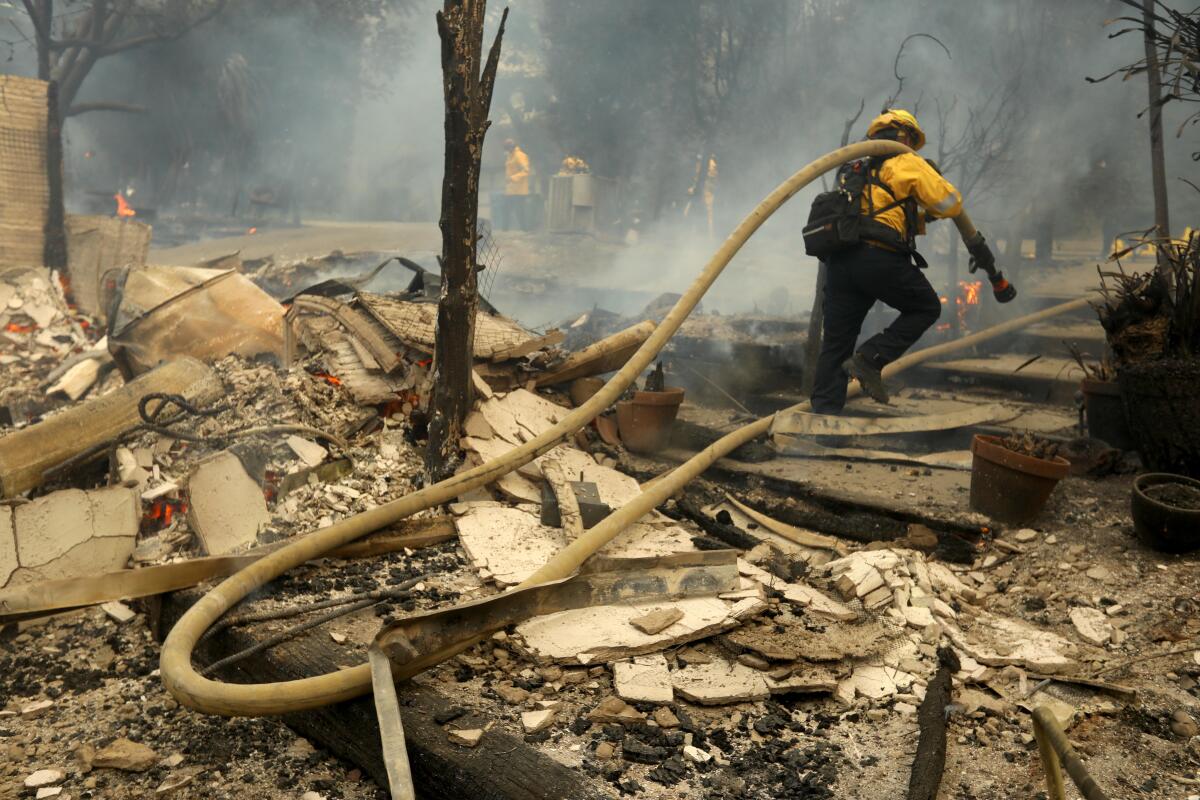
A firefighter carries a hose back to his rig while walking through a destroyed home from the Palisades fire in Pacific Palisades on Jan. 7, 2025.
(Genaro Molina / Los Angeles Times)
Last year, Pacific Palisades-based fashion designer Elyse Walker said she would reopen her eponymous store in Palisades Village after losing her 25-year flagship location on Antioch Street to the inferno.
Other neighborhood shops destroyed in the fire that are reopening at the mall include K Bakery and Loomey’s Toys, which caters to children up to age 12 and used to be across the street from Palisades Elementary Charter School.
“It’s been a journey and I’m excited because I wasn’t sure that there was going to be a place to come back to,” said toy store owner Amanda Rastegar. “Hopefully we can bring some of that magic back.”
Rastegar’s home in the Palisades survived but was damaged by the fire. The family returned about eight weeks ago. Her last memory of the fire was a burning supermarket.
“I just couldn’t wrap my brain around what was happening,” she said. “By the time I left, Gelson’s was on fire.”
Among the returning tenants is Angelini Ristorante & Bar. Well-known Los Angeles chef Gino Angelini said he will be in the kitchen next month for a return of the Italian restaurant.
“We won’t do a big celebrity open,” he said. “We want to have a very soft opening and see our customers come back.”

Construction takes place at Rick Caruso’s Palisades Village on Thursday. The shopping center is scheduled to reopen mid-August.
(Myung J. Chun / Los Angeles Times)
An elaborate celebration would not feel “correct for me,” Angelini said, because the devastation has been “very sad” for so many.
Other new tenants include local chef Nancy Silverton, who has agreed to move in with a new Italian steakhouse called Spacca Tutto. Women’s activewear retailer LESET will open its first West Coast location.
Caruso said he is optimistic that customers will return to the center, even though many Pacific Palisades residents are still dispersed. One tracking system estimated that about 30% of the Village’s customer base was impacted by the fire, he said.
“That means 70% did not get impacted, so there’s a lot of customers still left out there,” Caruso said. Historically, the center drew customers from as far away as Beverly Hills and Calabasas, as well as Malibu, Brentwood and Santa Monica.
He also hopes many will be inspired to visit the revived mall.
“I believe in the goodness of people and I believe that people are going to want to support the Palisades,” he said. “They’re going to want to be there and support the businesses that have had the courage and the heart to reopen.”

Walmart is rapidly expanding its network of electric vehicle chargers designed for customers to use while they shop.
The network could help fill gaps in EV infrastructure in states with greater need for chargers. Walmart, which has more than 5,000 locations in the U.S. and hundreds in California, says more than 90% of Americans live within 10 miles of one of its stores.
The chargers also offer an incentive for customers to choose Walmart — Walmart Plus members will receive a 10% discount off an average price of $0.46 per kilowatt-hour of energy at the company’s chargers.
Walmart chargers are already available at more than 75 locations in 17 states, with Texas boasting the most charging stations, followed by Florida and Arizona.
Matthew Nelson, Walmart’s director of energy policy, said last week on LinkedIn that the network will soon reach 29 states, including California.
“We are delivering on the promise of affordable, reliable and convenient charging,” Nelson said in his post.
According to Walmart’s website, six charging stations are coming to California soon, though the company did not offer a specific timeline.
The chargers will be installed at stores in Antelope, Brea, Fresno, Stockton, Suisun City and Vallejo.
Most charging sites in California will include eight to 16 fast-charging stalls, said Walmart spokesperson Kelsey Bohl.
The company first announced plans in April 2023 to install its own EV chargers at Walmart and Sam’s Club stores, with a goal of installing thousands of chargers by 2030. Partnering with ABB E-Mobility and Alpitronic, it added 25 new charging sites this past May and six more in June.
“Walmart is building a leading retail-integrated EV fast-charging network, focused on delivering an affordable, reliable and convenient charging experience where customers already shop,” Bohl said in an emailed statement. “Customers can charge while they shop, access stations through the Walmart app they already use, and benefit from affordable pricing.”
The charging stations already available include 612 individual charging stalls using 400-kilowatt chargers. Each stall has a dual charging cord with both Combined Charging System and North American Charging Standard connectors. The standard connectors, designed by Tesla, are smaller and lighter than the combined systems.
The primary way to pay for the chargers is through the Walmart app, but the company is also experimenting with built-in credit card readers to allow those without the app to use the stations.
Customers can check charger availability on the Walmart app. The company said the chargers will be available 24 hours a day.

Robotaxis could be turning into robocops.
A self-driving Waymo reported two teens to San Mateo, Calif., police on Monday after they were found drinking alcohol and shooting toy guns in the back of the vehicle.
According to a social media post from the San Mateo Police Department, officers detained two 15-year-olds after the Waymo they were riding in contacted the department and stopped in a parking lot until law enforcement arrived.
“Parents do you know where your teens are?” the San Mateo Police Department wrote on Facebook following the incident. “Waymo does!”
Officers removed both teens from the vehicle and determined they were using toy guns to shoot Orbeez out the windows. Orbeez are small, water-absorbing beads sold at toy stores.
“Toy guns, water guns, and BB guns all pose real dangers, especially to an untrained eye,” the Police Department said. “The simple handling of them can cause fear in [passersby].” “
A video posted on Facebook shows at least five officers and a police dog responding to the scene and approaching the Waymo with their weapons raised.
Waymo did not immediately respond to a request for comment.
Waymo vehicles have internal cameras and microphones that may be used in an emergency or to “promote safety and security,” according to Waymo’s online support page.
The cameras are also used to ensure the vehicles are clean and to help find lost items, according to the support page.
The company said it does not use facial recognition or other biometric identification technologies to identify individuals.
“In more urgent circumstances, support may access live video during a trip,” the Waymo page said.
The San Mateo Police Department’s Facebook post has garnered nearly 60 comments, with one user accusing Waymo of “snitching.”
“At least they got a designated driver?!” one user commented.
-

 Minnesota3 minutes ago
Man seriously injured in north Minneapolis shooting; no arrests
-

 Mississippi5 minutes ago
Ben Crump seeks independent autopsy in Nolan Wells death
-

 Missouri10 minutes ago
Missouri politicians champion unity, diversity on America’s 250th
-

 Montana18 minutes ago
Montana signs onto data center energy cost protection pledge
-

 Nebraska21 minutes ago
Gov. Jim Pillen calls for budget cuts, hiring freeze in new memo
-

 Nevada26 minutes ago
UNR tests whether cow manure can help restore Nevada landscapes after wildfires
-

 New Hampshire33 minutes ago
New Hampshire’s boutique Centennial Hotel sold to Lord Hotels
-

 New Jersey36 minutes ago
7 On Your Side helps man recover his stolen iPhone from safe pickup site

