Business
Column: California's transgender sanctuary law survives a challenge as judge ridicules plaintiff's claims

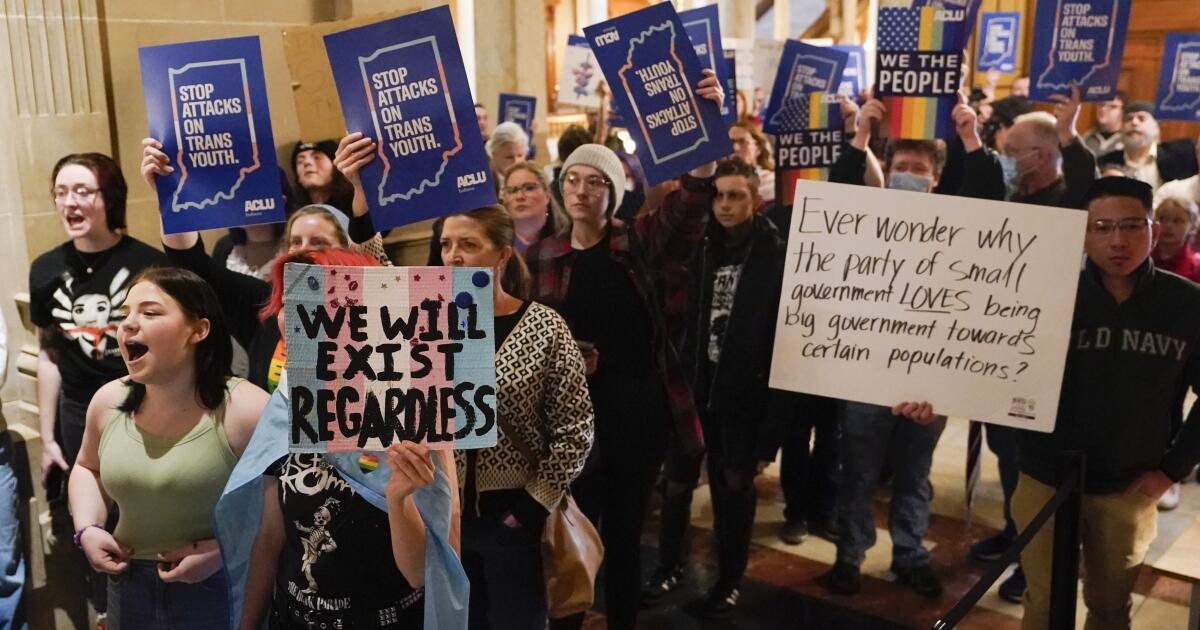
In 2022, when legislation outlawing gender-affirming medical treatments erupted in mostly red-state legislatures across the land, California enacted a law creating a sanctuary for those whose treatments were blocked by the lawmakers.
SB 107, which was signed into law by Gov. Gavin Newsom that September, provided a safe harbor for people from those states who sought the treatment in California, where it’s legal.
The law prohibited the release of medical information about a patient if it was sought from a state that made the treatments illegal, and forbade the arrest or extradition of medical providers in California if the request came from authorities in states that had criminalized the treatments.
Our Watch firmly believes that transgenderism is a cultural issue that it must deal with in accordance with God’s design for every child, as outlined in the Bible.
— Our Watch vs. Bonta
Unsurprisingly, SB 107 became the target of right-wing, anti-LGBTQ+ activists in California. On Tuesday, federal Judge Dale A. Drozd of Sacramento dismissed an effort to declare the law unconstitutional.
It was the third attempt by the plaintiff, a nonprofit affiliated with a conservative Christian church in Temecula that says its mission is to “restore Christian-Judeo values in government and education,” to win Drozd’s approval for its lawsuit. This time, Drozd, plainly fed up with the plaintiff’s serial inability to make its case, forbade it to try again because any further filing would be, as he wrote, “futile under the circumstances.”
Whether Drozd’s ruling will hold up under any appeal or whether the law itself can survive any other lawsuits to overturn it is impossible to say. But the lawsuit filed last year by the nonprofit Our Watch with Tim Thompson (he’s the pastor of the Temecula church) is nevertheless instructive. Our Watch was represented in court by lawyers affiliated with Advocates for Faith and Freedom, a Murrieta organization that lists “parental rights” and “the rights of children, both born and unborn,” among its concerns.
The lawsuit opens a window on the lengths to which zealots and fanatics will go to interfere with the activities of others because they conflict with their own narrow ideologies. There’s a polite name for them: “busybodies.”
The case also underscores how our personal rights are perched on a judicial knife edge in today’s America. There’s ample reason to believe that if such a case were to land in front of a Trump-appointed judge — U.S. Judge Matthew Kaczmaryk of Amarillo, Texas, for instance — the law would have been invalidated in a heartbeat. Appeal would have been taken to the Trump-infested 5th Circuit Court of Appeals, and perhaps ultimately to the Supreme Court, where its fate might be sealed.
After all, that’s been the arc of Kaczmaryk’s ruling invalidating the Food and Drug Administration’s approval of the abortion drug mifepristone. In that case, Kaczmaryk and the 5th Circuit judges bought into the plaintiffs’ fanciful assertions that, as doctors, the prospect of medication abortions caused them “mental and emotional stress”; appeals judge James C. Ho rationalized upholding Kaczmaryk’s mifepristone ban by commenting, “Doctors delight in working with their unborn patients — and experience an aesthetic injury when they are aborted.”
That didn’t happen here because Drozd, an Obama appointee, can recognize a factitious claim for standing when it swims into his ken.
I’ve written before that transgender individuals have become the prime targets for discriminatory legislation in part because socially acceptable targets for hate-mongering and prejudice have become harder for conservative culture warriors to find.
As I observed in 2018, open racism is out (though it made a strong comeback in the Trump era and in the hands of commentators such as Tucker Carlson). In an increasingly pluralistic society, legislators who denigrated ethnic or religious minorities or those with mental illnesses or disabilities found themselves on the outs.
Gay and lesbian Americans have moved into the cultural and social mainstream. Many conservative families have found themselves embracing gay and lesbian siblings, children and parents as worthy of familial love and respect. Same-sex marriage has become embedded in the entertainment mainstream, portrayed on popular TV programs without apology.
Moreover, gay and lesbian people acquired a voice in the highest echelons of political power; gay-bashing no longer works for a political candidate as it has in the past, except perhaps in the most benighted corners of American society.
That leaves gender transition, which is easily caricatured and demonized by unscrupulous politicians aiming to rally their base against a wholly imaginary crisis. By early 2022, according to Human Rights Watch, 130 bills had been introduced in state legislatures. Many barred transgender youths from playing on sports teams or using bathrooms other than those designated for their birth gender.
As of this year, 23 states have banned or restricted gender-affirming treatments for youths; some carry prison terms for violations or restrict insurance coverage. In Florida parents who allow such treatments for their children can lose custody; in Texas, they can be investigated for child abuse. Florida, Ohio and Missouri have implemented restrictions even on gender transition treatments for adults. A Florida rule barring Medicaid coverage for gender treatments was blocked by a federal judge, whose ruling is currently under appeal.
This is the environment that prompted California to enact its sanctuary law. Its law resembled the state’s effort to become a sanctuary for women seeking abortions that their home states had rendered illegal in the wake of the Supreme Court’s overturning of Roe vs. Wade in 2022.
The plaintiff in this case left no question that its action was grounded in fundamentalist anti-transgender bias. “Our Watch firmly believes that transgenderism is a cultural issue that it must deal with in accordance with God’s design for every child, as outlined in the Bible,” the lawsuit says.
As so often occurs, the plaintiff’s case against the California law is a melange of misdirection and misrepresentations.
Our Watch positioned its lawsuit as an effort to protect the right “of parents to raise their children” without governmental interference. It depicted SB 107 as a law that “allows minors to obtain gender transition procedures like harmful puberty blockers, cross-sex hormones, and irreversible surgeries without parental consent, while denying parents access to their child’s medical information.”
This is a flatly inaccurate characterization of the law. It also turns the law’s goal on its head.
The truth is, as Atty. Gen. Rob Bonta observed in his response to the lawsuit, California law gives parents the right to access their children’s medical records. “Nothing in SB 107 changes that,” he noted. Further, he wrote, all those procedures listed in the lawsuit “generally require parental consent in California” — another regulation unaffected by SB 107.
The whole purpose of the California law, Bonta wrote, was to give parents of children seeking gender-affirming care refuge from out-of-state laws that interfered with their right to obtain medically indicated care for their children — not to allow such care over parents’ objections.
The lawsuit painted a picture of physicians willy-nilly imposing radical, irreversible gender-affirming treatments on innocent adolescents whose “gender dysphoria” (the medical term for gender uncertainties) might be transient and resolve themselves over time or with counseling.
That’s a caricature of the standard of care for gender dysphoria as it’s implemented by physicians following established protocols. The truth is that “prior to the onset of puberty, kids typically receive non-medical care,” explained Boston University psychologist Melissa K. Holt during a roundtable discussion of care for youths in 2022.
Care for prepubescent children, Holt said, “is focused around social transitioning,” such as choosing a new name and adopting different dress, “and providing mental health and structural support, like schools using a child’s preferred gender pronouns and allowing them to use the bathroom that aligns with their gender identity…. There are no 4-year-olds going through irreversible medical procedures.”
Drugs such as puberty blockers and hormone treatments are typically administered only as children move into adolescence, are viewed as safe, and are expected to be used only after discussions with medical providers. Medical protocols discourage gender reassignment surgery before the age of 18. But professionals in the field say that outlawing such treatments or even counseling for younger children can produce long-standing psychological problems.
Much of the lawsuit’s argument was self-refuting. “Parents, not the government, are best suited to decide” on their child’s medical treatment, the lawsuit says. Exactly; so how do SB 107’s opponents explain state laws that allow the government to impose its judgment over the parents? The lawsuit is silent on that question.
In dismissing the case, Drozd didn’t address those issues, because he found that the lawsuit had a more fundamental shortcoming: The plaintiff didn’t have standing to bring the case at all.
“Standing” is a concept derived from the U.S. Constitution, which holds, roughly, that litigants in federal court must show that they’re directly harmed by a government action and that their lawsuit will remedy the injury. Our Watch couldn’t meet that requirement, Drozd ruled.
Our Watch claimed that it was “directly harmed” by SB 107 because the law prompted it to “divert our attention to transgender issues” rather than “tackling major cultural issues that violate Christian-Judeo values, including the sexual indoctrination of children, … critical race theory, and abortion.” (Not to be churlish, but some people might be relieved that SB 107 narrowed the organization’s involvement in such overheated culture wars.)
Our Watch “plans to expend money on conferences to connect key stakeholders who are also fighting against the devastating effects of SB 107,” the lawsuit stated.
It wasn’t hard for the judge to see through this argument. Plaintiffs can’t “manufacture standing” through their own choices, he ruled: Our Watch’s “decision to place more focus and correspondingly commit more of its resources to ‘transgender issues’ … was a voluntary decision — not a forced one.”
The culture wars over gender issues are sure to continue because they rely on public ignorance and prejudice — always the preferred weaponry of demagogues. The lawsuit to overturn California’s sanctuary law had, at its core, nothing to do with protecting children. If it did, its promoters wouldn’t have had to gin up a cause of action where none existed.
share


Netflix on Thursday reported higher revenues and profit in the second quarter as it sought to assure investors about its growth prospects.
The streaming giant reported revenue of $12.6 billion in the second quarter, up 13% from a year ago. Net income during the period rose 9% to $3.4 billion.
Netflix said it expects revenue to grow 12% in the third quarter, but lowered its 2026 revenue forecast to $51 billion from $51.4 billion.
The results were roughly in line with what analysts had predicted and were driven by recent price increase and growth in advertising revenue. The latter is expected to reach $3 billion this year, the company said.
In a presentation with analysts, Netflix executives touted global expansion plans.
“We’re entertaining an audience approaching a billion people with still lots of room to grow into our addressable market on every measure,” said Spencer Neumann, Netflix’s chief financial officer, in the earnings presentation. “We believe we’ve got lots and lots of runway for solid growth ahead of us.”
Those comments appeared intended to assuage investors who’ve grown concerned that people could be spending less time on the streaming service as rivals like YouTube gain market share.
Netflix’s share of TV viewing time in the U.S. has steadily declined in recent months as rivals have gained market share, according to Nielsen data.
The streamer represented 7.8% of all TV viewing in the U.S. in April — the lowest percentage since May 2025. It was 7.5% in April 2025, Nielsen said.
By comparison, YouTube has seen its share of the streaming audience grow. YouTube’s TV viewing share in April rose to 13.4%, up from 12.4% a year earlier, Nielsen said.
Some investors fear that if viewership is down, subscribers could cancel the service, which would negatively affect the platform’s growing advertising business. It could also undercut Netflix’s ability to raise prices in the U.S. and other countries.
Those worries have caused Netflix’s stock price to plummet 41% in the last year. The stock closed on Thursday at $74.35 a share, up 1%. In after hours trading, the stock fell 8%.
“The engagement elephant continues to rear its head and investors are on edge that an earlier price hike in a seasonally tough period and lighter content slate could have driven more churn than usual,” wrote Morgan Stanley Research analysts in a research note.
On Thursday, Netflix said in a letter to shareholders it has a sophisticated understanding of its consumers and “we know not all hours are equal” and that engagement on its platform is “healthy.”
“The entertainment industry remains dynamic and competitive,” Netflix told shareholders. “We aim to stay ahead by executing against our three areas of focus: delivering more entertainment value, leveraging technology to improve every aspect of our service, and improving monetization.”
The Los Gatos-based company said it plans to allocate more than 5% of its content spend on live programming this year. Live content has been a key driver for subscriptions, accounting for six of the top 10 new member sign-up days over the last five years, the company said.
In the first half of 2026, Netflix said members watched more than 97 billion hours, up 2% from a year ago. Among the most popular shows: the crime thriller “I Will Find You,” which had 87 million views; and the romantic comedy film “Voicemails for Isabelle,” which garnered 71 million views.
Netflix has been adding new types of content to its platform, including video podcasts to help increase engagement with subscribers during the day.
As part of the diversification efforts, the platform has expanded its portfolio of live programming over the years, including adding NFL games and streaming Major League Baseball’s opening day game.
In 2022, Netflix had also faced investor pressure when it reported declining subscribers for the first time in more than a decade. That pushed the company to delve into other areas including advertising, gaming and cracking down on password sharing.

SpaceX stock dropped below its initial public offering price for the first time on Wednesday, signaling dwindling hype around the Elon Musk company.
Shares dipped below their IPO price of $135 on Wednesday morning for the first time since listing, a humbling loss for the stock, which had skyrocketed more than 50% in its first days of trading last month.
The shares regained some ground later in the day, closing at $135.27.
The initial offering gave the company a market cap of $2.2 trillion, making it one of the world’s most valuable public companies. For a short period, the IPO also made owner Elon Musk the world’s first trillionaire, though his net worth now is about $800 billion.
On July 7, the company was added to the Nasdaq-100 after a rule change allowed companies to join 15 days after their IPOs.
SpaceX raised a total of $86 billion after underwriters exercised their right to sell additional shares, on top of the $75 billion initially raised. It was the largest IPO in history.
SpaceX, based near Austin, Texas, is the leading launch services company in the world, with its Falcon 9 rocket accounting for the vast majority of satellites launched last year.
It is also the leading satellite-based broadband provider with its Starlink service. The extraordinary interest in the IPO was driven by Musk’s plans to make the company an AI leader — including plans to launch orbiting satellite data centers powered by the sun that crunch AI data.
The company’s headquarters moved from Hawthorne to Texas in 2024, but it retains large operations in the South Bay city and blasts off regularly from Vandenberg Space Force Base in Santa Barbara County.
Since the IPO, SpaceX has used its newfound wealth to expand in the AI space.
It announced last month that it was acquiring the AI coding startup Cursor for $60 billion, with the deal expected to close in the third quarter. The San Francisco company, founded in 2022, enables engineers to instruct software in English to run coding tasks autonomously.
Musk also merged his xAI artificial intelligence company into SpaceX earlier this year. The combined entity recently announced it was leasing computing power to rivals Anthropic and Google at two terrestrial data centers it has constructed.
Since the IPO, investors have expressed concerns about the company’s spending plans and debt load.
Even with the volatility of the last month, there’s still more uncertainty to come.
The stock could fall further as locked-up shares held by current and former employees are released.
At least 20% of the shares will be released after second-quarter results are disclosed sometime in the coming months, with all the lockups expiring in December.
But Space X isn’t the only megacap stock to experience ups and downs early on.
Shares of Meta, then named Facebook, fell significantly below the IPO price of $38 before recovering. After its May 2012 launch, shares plummeted by nearly 50% and hit a record low of $19.69 in August 2012.
The company took more than 14 months to rebound, finally surpassing its $38 IPO price in July 2013.

In the latest lawsuit against Paramount Skydance, a corporate shareholder has alleged corruption at the highest levels of the company, which is battling to complete its $111-billion takeover of rival Warner Bros. Discovery to create a new media behemoth.
Controlling shareholders Larry Ellison and his son David have presided over a firm that allegedly made “illegal promises and payments to secure regulatory approval,” for the Ellison family’s Paramount purchase last summer, according to the shareholder lawsuit filed this week in Delaware court.
Larry Ellison allegedly discussed with President Trump how Paramount’s pending Warner Bros. acquisition would result in a shake-up at CNN, states the lawsuit filed by Paramount shareholder Paul Robbins.
“The Ellisons [won] the bidding war for Warner Bros. by promising sweeping changes at CNN and other personal benefits to President Trump,” according to the 59-page complaint.
The case was brought on Robbins’ behalf by the nonprofit Public Integrity Project and the advocacy group Freedom of the Press Foundation, which has been critical of the Trump administration‘s policies toward the media.
The complaint noted that Netflix withdrew from the bidding in February — the same day Co-Chief Executive Ted Sarandos met at the White House with then-Atty. Gen. Pam Bondi and another top official.
The lawsuit suggests Netflix dropped out after recognizing the challenges of dealing with the Trump administration and that Trump always wanted to see the prize go to Paramount because of his close ties to the Ellison family, who have ushered in more favorable news coverage of Trump and the departure of late-night comedian Stephen Colbert.
Robbins does not appear to have firsthand accounts supporting his claims, which are based on public documents and media reports about dealings between the Ellisons and Trump. He has owned Paramount stock since 2021, but the lawsuit does not say how many shares he owns.
He could not be reached for comment.
Paramount, in a statement, pushed back against his claims, saying the “lawsuit recycles allegations that have already been reported and already addressed.”
“As we’ve said consistently: No commitments from either David or Larry Ellison have been made to any government body, state AG or federal agency regarding the future of CNN or any other news property, other than the goal to deliver truth-based journalism,” Paramount said.
It’s the third lawsuit lobbed at Paramount this week. On Monday, California Atty. Gen. Rob Bonta led a coalition of 12 Democratic state attorneys general that filed a federal antitrust lawsuit seeking to block the Paramount-Warner merger due to concerns about consolidation in movie distribution and cable channels.
The Writers Guild of America added another antitrust lawsuit against Paramount on Tuesday, alleging the massive merger would result in fewer jobs and lower pay for writers.
Many in Hollywood are opposed to the deal due to fears that another studio consolidation would bring more layoffs, programming cutbacks and a fragile business environment due to the heavy debt burden — nearly $80 billion — that Paramount would have to take on to buy Warner Bros.
The shareholder lawsuit noted that Paramount participated in a raucous event with UFC fighters on the White House lawn in June to celebrate Trump’s 80th birthday and the nation’s 250th anniversary. Paramount has UFC broadcast rights.
The event came two days after Trump’s Justice Department wrapped its regulatory review of Paramount’s Warner Bros. proposal, giving the merger a key green light.
Justice Department investigators reportedly did not have a chance to express potential antitrust concerns when high-level Justice Department officials closed the inquiry — a major win for Paramount and the Ellisons, the lawsuit states.
“There have been some line attorneys in the DOJ that have reviewed this [merger] and have some concerns,” New York Atty. Gen. Letitia James said Tuesday during a virtual town hall with opponents of the merger. “Their analysis of this particular case was ignored by the front office, if you will, at 1600 Pennsylvania Ave. [the White House] That’s the front office.”
Ellison’s Skydance Media emerged with its deal to buy Paramount two years ago. Previous controlling shareholder Shari Redstone was desperate for an exit and Trump was mounting his White House comeback by battling then-President Biden, then Vice President Kamala Harris.
Trump declined an invitation to appear on CBS’ “60 Minutes,” then under Redstone control. He became infuriated by an October 2024 interview with Harris on “60 Minutes.”
Trump filed a $10-billion lawsuit against CBS (he later upped it to $20 billion). After Trump won the election, he had considerable sway over Paramount because it needed his administration’s approval for the sale to the Ellisons.
Paramount agreed to pay Trump $16 million to end his “60 Minutes” lawsuit, allowing the sale to go forward. The Ellisons acquired Paramount in August, then set their sights on Warner Bros. Discovery, which owns CNN.
“The Ellisons proceeded to remake CBS in the President’s image, bought properties he enjoyed, and even hosted events to honor him,” the lawsuit said. “This helped the Ellisons, but it appears to have hurt Paramount and its media outlets.”
On Wednesday, Paramount said Ellison and other high-level executives had dealings with administration officials but “throughout … the review of the proposed acquisition of Paramount, Skydance has fully complied with all applicable laws, including our nation’s anti-bribery laws.”
In late April, David Ellison hosted an elaborate dinner in Washington to honor the “Trump White House,” according to invitations to the event, “even though President Trump continually insulted journalists at CBS and elsewhere,” the lawsuit said.
On Wednesday, during a confirmation hearing on Capitol Hill, Sen. Cory Booker (D-N.J.) blasted acting Atty. Gen. Todd Blanche for his attendance at the dinner while his agency was reviewing the Paramount deal.
Also on Wednesday, the nonprofit news site ProPublica reported Federal Communications Commission Chairman Brendan Carr has accepted $63,000 in free tickets from CBS in recent years — while Paramount mergers were pending.
Times staff writer Ben Wieder contributed to this report.
-

 West Virginia2 minutes ago
West Virginia to conduct comprehensive review of all bridges as state targets repairs
-

 Wyoming8 minutes ago
NWSR issues Flood Watch advisory for portions of Central, Northwest Wyoming
-

 Crypto14 minutes ago
DeFi’s Newest Threat: How Malicious Liquidity Pools Are Trick-Quoting Ethereum and Polygon Users
-

 Finance20 minutes ago
Gold Purchases Accelerate as Dollar Confidence Wanes
-

 Fitness26 minutes ago
Strength training over decades linked to longer life – Harvard Health
-

 Movie Reviews38 minutes ago
Movie Review: “The Odyssey” by Nolan
-
World50 minutes ago
US strikes bridges and collapses a tower at a key port as its Iran campaign expands
-
 Lifestyle2 hours ago
An eco-journalist takes on a Big Tech in this modern twist on the heist novel


