Business
Column: Anatomy of a smear — Fauci faces the House GOP's clown show about COVID

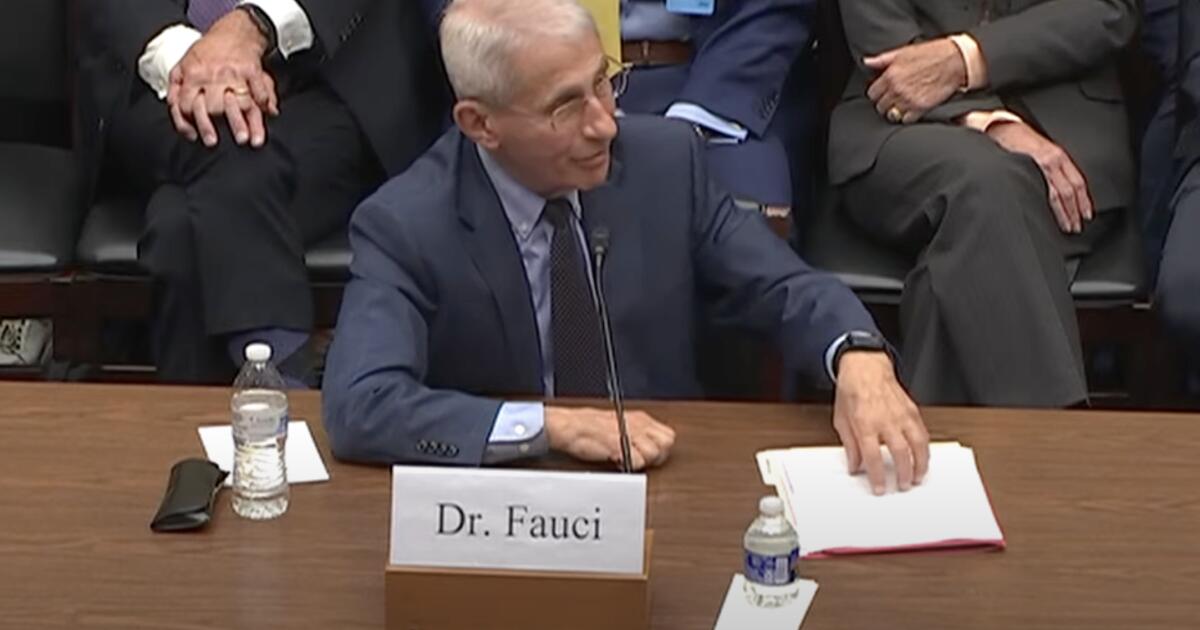
Here’s what we know about Dr. Anthony S. Fauci: As a staff member at the National Institutes of Health for 54 years and director of its National Institute for Allergy and Infectious Diseases for 38 years, Fauci was a key figure in the development of therapies for HIV and ensuring that funding was available for the search for a cure.
Under his leadership, NIAID invested billions of dollars in research that resulted in the development of mRNA technology, which in turn resulted in the development of COVID-19 vaccines in record time, saving millions of lives.
Under Fauci, NIAID also sponsored research into treatments for pandemic flu and the Ebola and Zika viruses. When COVID struck, he was tapped as a top advisor to then-President Trump — one of seven presidents he has advised during his career, from Reagan through Biden.
There have been credible death threats leading to the arrests of two individuals, and ‘credible death threats’ means someone who clearly was on his way to kill me.
— Anthony S. Fauci
He’s revered in the communities of immunologists and virologists; even after Trump sidelined him because he was speaking truths about COVID that Trump didn’t like, he was a prominent spokesman for a scientific approach to the pandemic.
Here’s how he was depicted by Republicans during a hearing Monday of the GOP-dominated Select Subcommittee on the Coronavirus: as the mastermind of “dogmatic” policies that resulted in school closings and business failures, of forced vaccinations, of “one of the most invasive regimes of domestic policy the U.S. has ever seen.”
As the financial sugar daddy of research overseas that created COVID. As the sponsor of policies that are “fundamentally un-American.” As a liar and hypocrite.
None of those accusations, which were aired Monday by subcommittee Chairman Brad Wenstrup (R-Ohio) and other Republican members, has the slightest relationship with truth.
They’re all elements of a campaign among Republicans and right-wingers aimed at painting Fauci, 83, who retired from NIAID in December 2022, as “a comic-book supervillain,” in the words of Rep. Jamie Raskin (D-Md.).
Why are they doing this? One answer must be that conspiracists always need a target to attack in order to attract followers.
At the core of this campaign is the Republican conviction that COVID escaped from a Chinese laboratory.
Since there is absolutely no evidence for this theory that anyone has yet produced, Plan B has been to smear anyone in the firing line. Unfortunately for Fauci, he’s the designated “it.”
As I’ve reported many times, according to reputable scientists who have studied the origin of COVID, scientific evidence suggests that it’s overwhelmingly more likely that COVID reached humans the same way most viruses do, as spillovers from wildlife — in this case, via a thriving trade in China in animals susceptible to the virus.
Let’s look at the particular rabbit holes into which the subcommittee has burrowed to smear Fauci, as set forth during the 3½ hour congressional hearing Monday and in a 15-hour interrogation of Fauci by the subcommittee in January, a transcript of which was released over the weekend along with a memo that misrepresented and cherry-picked his answers.
The committee members are fixated on the notion that Fauci “suppressed” discussion of the possibility of a lab leak. Why would he do that? Rep. Ronny Jackson (R-Texas) proposed an answer.
“It’s obvious to everyone,” he said, “that you and your organization, NIH, had a lot to lose if the American people were to discover that COVID-19 most likely leaked from a lab in Wuhan, China, and that you … actually funded this research.”
The problem there is that, first, Fauci has to this day stated that he is open-minded about the origin of the pandemic.
More to the point, documentary evidence in the subcommittee’s possession shows that in the early days of the pandemic — January and February 2020, when scientists saw features of the SARS-CoV-2 virus causing COVID that they didn’t recognize as coming from nature — he urged them by email to report their concerns, if validated, to “the appropriate authorities,” meaning the FBI in the U.S. and MI-5 in Britain.
“It is inconceivable,” Fauci said in his opening statement to the subcommittee, “that anyone who reads this e-mail could conclude that I was trying to ‘cover up’ the possibility of a laboratory leak. “I was advocating for a prompt and thorough examination of the data and a totally transparent process.”
As it happened, further scientific scrutiny convinced the scientists that “any type of laboratory-based scenario” was not “plausible,” as they reported in Nature in March 2020. Their conclusion has held up over time.
The subcommittee Republicans tried hard to contradict the notion that the lab leak hypothesis is a “conspiracy theory.” Fauci played along, up to a point. He acknowledged that speculation about a lab leak is not in itself a conspiracy theory, but that doesn’t go for the elaborations that many of its adherents have made of it.
“What is a conspiracy theory is the kind of distortions of that particular subject, like, it was a lab leak and I was parachuted into the CIA like Jason Bourne and told the CIA that they should really not be talking about a lab leak,” he said. “That’s a conspiracy.” He was referring to a ludicrous accusation published in September, with great fanfare but no factual support whatsoever, by none other than Wenstrup.
The members spent an inordinate amount of time Monday on the question of whether Fauci’s institute funded so-called Gain of Function experiments in China, so a brief primer on this issue is in order.
“Gain of Function” has become something of a shibboleth for lab-leak adherents, the way “critical race theory” and ESG have become dog whistles for activists trying to undermine, respectively, the public educational system and environmental and social concerns for investors — in this case, giving the term a uniquely sinister connotation.
Generically, however, it refers to laboratory work that augments natural qualities of a microbe to facilitate experimental scrutiny or achieve a necessary goal, such as allowing microbes to produce a flu vaccine or bacteria to produce artificial insulin.
From 2014 to 2017, the U.S. suspended gain-of-function experiments to develop a standard identifying research that might produce “potential pandemic pathogens.” The lab-leak camp asserts that NIAID funded experiments that gave a virus in the Chinese lab the features necessary to make it infectious for humans.
The work that NIAID funded in China was analyzed according to that standard, and it was determined by NIH not to fall into that category, as Fauci has testified before. The subcommittee peppered Fauci with questions aimed at eliciting an admission that the NIAID-funded work qualified under the broad, pre-2017 definition, but he made clear — and is supported by the public record — that the work did not fall into that category.
Much of the hearing was devoted to trivialities. The Republicans blamed Fauci for imposing a regulation on Americans specifying that effective social distancing required a six-foot space between individuals. The GOP members maintain that no scientific research validates a six-foot standard, and cited a 2020 peer-reviewed paper as confirmation.
This assertion is self-refuting, however; the paper actually says that under some circumstances, six feet may not be enough. When Fauci was asked about the issue in January, he explained that coughing, sneezing, wind and other conditions could play into the efficacy of social distancing at any distance. At that point his questioner, GOP counsel Mitch Benzine, acknowledged, “I didn’t think that through, I guess.” But the Republicans masticated the issue endlessly Monday nonetheless.
In any case, Fauci never had the authority to impose public health mandates — whether for masks, social distancing, vaccination or anything else. These were a product of state and local policy decisions. To the extent they relied on government recommendations, those came from the Centers for Disease Control and Prevention, a government body with which Fauci had no official connection.
The fundamental theme of Monday’s hearing was that Fauci should be blamed, even pilloried, for doing the best anyone could in dealing with a virus that no one had seen before, with means of transmission that were not understood for months or more and therapies that took more than a year to figure out.
It’s Fauci’s burden that ignorant and irresponsible politicians and their followers have chosen to turn their gunsights on him, for reasons that remain unclear.
“There have been everything from harassments by emails, texts, letters, of myself, my wife, my three daughters,” he said. “There have been credible death threats leading to the arrests of two individuals, and ‘credible death threats’ means someone who clearly was on his way to kill me. It’s required my having protective services essentially all the time.”
Is this how we wish to treat our most devoted public servants — by smearing them to the point that promising scientists choose not to place themselves in the firing line by entering the public health field?
At the close of the hearing, Wenstrup said his panel’s “goal is to take a hard look at the facts.” But there were few “facts” elicited Monday, just disinformation and character assassination.
Was that really the goal? There are no signs that the Republicans learned a thing from their 3½ -hour inquisition. In January, during Fauci’s interrogation, Rep. Michael Cloud (R-Texas) tweeted, “While many lost their loved ones, their businesses, and livelihoods, Dr. Fauci made millions and enjoyed the media spotlight. It was his most successful year.”
Monday, I asked Cloud if he still believed that. He replied, “I 100% stand by this tweet. Dr. Fauci received more money and glowing media coverage than he had ever received in his life, and if you can’t pick up that he both enjoyed it (and fed into it), then that is on you.”
Let’s give Fauci the last word on that. In January, he lamented that in 2020 he “became the villain number one of the extremists in the population,” which made it “one of the worst years of my life.” Shown the tweet, he remarked, “A congressman tweeted that?” When he was told, “Yeah.”
He replied, simply, “Jesus.”



Business
After Warner Bros. merger, changes are coming to the historic Paramount lot. Here’s what to expect

With Paramount Skydance’s acquisition of Warner Bros. expected to saddle the combined company with $79 billion in debt, Paramount executives are looking to do away with redundant assets including real estate — and there is a lot of that.
Chief in the public’s imagination are their historic studios in Burbank and Hollywood, where legendary films and television show have been made for generations and continue to operate year-round.
“Both of these studios are in the core [30-mile zone,] the inner circle of where Hollywood talent wants to be,” entertainment property broker Nicole Mihalka of CBRE said. “It’s very prime real estate.”
When Sony and Apollo were bidding for Paramount in early 2024, their plan was to sell the Paramount property, but there is no indication that Paramount would part with its namesake lot.
For now, Paramount’s plan is to keep both studios operating with each studio releasing about 15 films a year, but the goal is to eventually consolidate most of the studio operations around the Warner Bros. lot in Burbank in order to to eliminate redundancies with the Paramount lot on Melrose Avenue, people close to Chief Executive David Ellison said.
A view of the Warner Bros. Studios water tower Feb. 23, 2026, in Burbank.
(Eric Thayer / Los Angeles Times)
Paramount would not look to raze its celebrated studio lot — the oldest operating film studio in Los Angeles — because of various restrictions on historic buildings there. Paramount also has a relatively new post-production facility on site and will likely need to the studio space.
Instead, the plan would be to lease out space for film productions, including those from combined Paramount-HBO streaming operations. Ellison also is considering plans to develop other parts of the 65-acre site for possible retail use, as well as renting space for commercial offices.
The studios’ combined property holdings are vast, and real estate data provider CoStar estimates they have about 12 million square feet of overlapping uses, including their studio campuses, offices and long-term leases in such film centers as Burbank, Hollywood and New York.
Century-old Paramount Pictures Studios is awash in Hollywood history — think Gloria Swanson as Norma Desmond desperately trying to enter its famous gate in “Sunset Boulevard,” and other classics such as “The Godfather,” “Titanic” and “Breakfast at Tiffany’s.”
The lot, however, is a congested warren of stages, offices, trailers and support facilities such as woodworking mills that date to the early 20th century. The layout is byzantine in part because Paramount bought the former rival RKO studio lot from Desilu Productions to create the lot known today.
Warner Bros. occupies 11 million square feet and owns 14 properties totaling 9.5 million square feet, largely in the United States and United Kingdom, CoStar said. About 3 million square feet of that commercial property is in the Los Angeles area.
The firm’s portfolio also includes the sprawling Warner Bros. Studios Leavesden complex in the U.K. and Turner Broadcasting System headquarters in Atlanta.
Paramount Skydance occupies 8 million square feet and owns 14 properties totaling 2.1 million square feet, according to CoStar. In addition to its Hollywood campus, Paramount’s holdings include prominent buildings in New York such as the Ed Sullivan Theater and CBS Broadcast Center.
Warner Bros. operates a 3-million-square-foot lot in Burbank with more than 30 soundstages — along with space for building sets and backlot areas — where famous movies including “Casablanca” and television shows such as “Friends” were filmed. Paramount’s 1.2-million-square-foot Melrose campus anchors a broader network of owned and leased production space, CoStar said.
Paramount’s lot is already cleared for more development. More than a decade ago, Paramount secured city approval to add 1.4 million square feet to its headquarters and some adjacent properties owned by the company.
The redevelopment plan, valued at $700 million in 2016, underwent years of environmental review and public outreach with neighbors and local business owners.
The plan would allow for construction of up to 1.9 million square feet of new stage, production office, support, office, and retail uses, and the removal of up to 537,600 square feet of existing stage, production office, support, office, and retail uses, for a net increase of nearly 1.4 million square feet.
The proposal preserves elements of the past by focusing future development on specific portions of the lot along Melrose and limited areas in the production core, architecture firm Rios said.
The Warner Bros. and Paramount lots “are two of the most prime pieces of real estate in the country,” Mihalka said. “These are legacy assets with a lot of potential to be [tourist] attractions in addition to working studios.”
Hollywood is still reeling from previous mergers, in addition to a sharp pullback in film and television production locally as filmmakers chase tax credits offered overseas and in other states, including New York and New Jersey.
Last year, lawmakers boosted the annual amount allocated to the state’s film and TV tax credit program and expanded the criteria for eligible projects in an attempt to lure production back to California. So far, more than 100 film and TV projects have been awarded tax credits under the revamped program.
The benefits have been slow to materialize, but Mihalka predicts that the tax credits and desirability of working close to home will lead to more studio use in the Los Angeles area, including at Warner Bros. and Paramount.
“These are such prime locations that we’ll see show runners and talent push back on having shows located out of state and insist on being here,” she said. “I think you’re going to see more positive movement here.”
Times staff writer Meg James contributed to this report.

Welcome to the age of AI hacking, in which the right prompts make amateurs into master hackers.
A group of cybercriminals recently used off-the-shelf artificial intelligence chatbots to steal data on nearly 200 million taxpayers. The bots provided the code and ready-to-execute plans to bypass firewalls.
Although they were explicitly programmed to refuse to help hackers, the bots were duped into abetting the cybercrime.
According to a recent report from Israeli cybersecurity firm Gambit Security, hackers last month used Claude, the chatbot from Anthropic, to steal 150 gigabytes of data from Mexican government agencies.
Claude initially refused to cooperate with the hacking attempts and even denied requests to cover the hackers’ digital tracks, the experts who discovered the breach said. The group pummelled the bot with more than 1,000 prompts to bypass the safeguards and convince Claude they were allowed to test the system for vulnerabilities.
AI companies have been trying to create unbreakable chains on their AI models to restrain them from helping do things such as generating child sexual content or aiding in sourcing and creating weapons. They hire entire teams to try to break their own chatbots before someone else does.
But in this case, hackers continuously prompted Claude in creative ways and were able to “jailbreak” the chatbot to assist them. When they encountered problems with Claude, the hackers used OpenAI’s ChatGPT for data analysis and to learn which credentials were required to move through the system undetected.
The group used AI to find and exploit vulnerabilities, bypass defences, create backdoors and analyze data along the way to gain control of the systems before they stole 195 million identities from nine Mexican government systems, including tax records, vehicle registration as well as birth and property details.
AI “doesn’t sleep,” Curtis Simpson, chief executive of Gambit Security, said in a blog post. “It collapses the cost of sophistication to near zero.”
“No amount of prevention investment would have made this attack impossible,” he said.
Anthropic did not respond to a request for comment. It told Bloomberg that it had banned the accounts involved and disrupted their activity after an investigation.
OpenAI said it is aware of the attack campaign carried out using Anthropic’s models against the Mexican government agencies.
“We also identified other attempts by the adversary to use our models for activities that violate our usage policies; our models refused to comply with these attempts,” an OpenAI spokesperson said in a statement. “We have banned the accounts used by this adversary and value the outreach from Gambit Security.”
Instances of generative AI-assisted hacking are on the rise, and the threat of cyberattacks from bots acting on their own is no longer science fiction. With AI doing their bidding, novices can cause damage in moments, while experienced hackers can launch many more sophisticated attacks with much less effort.
Earlier this year, Amazon discovered that a low-skilled hacker used commercially available AI to breach 600 firewalls. Another took control of thousands of DJI robot vacuums with help from Claude, and was able to access live video feed, audio and floor plans of strangers.
“The kinds of things we’re seeing today are only the early signs of the kinds of things that AIs will be able to do in a few years,” said Nikola Jurkovic, an expert working on reducing risks from advanced AI. “So we need to urgently prepare.”
Late last year, Anthropic warned that society has reached an “inflection point” in AI use in cybersecurity after disrupting what the company said was a Chinese state-sponsored espionage campaign that used Claude to infiltrate 30 global targets, including financial institutions and government agencies.
Generative AI also has been used to extort companies, create realistic online profiles by North Korean operatives to secure jobs in U.S. Fortune 500 companies, run romance scams and operate a network of Russian propaganda accounts.
Over the last few years, AI models have gone from being able to manage tasks lasting only a few seconds to today’s AI agents working autonomously for many hours. AI’s capability to complete long tasks is doubling every seven months.
“We just don’t actually know what is the upper limit of AI’s capability, because no one’s made benchmarks that are difficult enough so the AI can’t do them,” said Jurkovic, who works at METR, a nonprofit that measures AI system capabilities to cause catastrophic harm to society.
So far, the most common use of AI for hacking has been social engineering. Large language models are used to write convincing emails to dupe people out of their money, causing an eight-fold increase in complaints from older Americans as they lost $4.9 billion in online fraud in 2025.
“The messages used to elicit a click from the target can now be generated on a per-user basis more efficiently and with fewer tell-tale signs of phishing,” such as grammatical and spelling errors, said Cliff Neuman, an associate professor of computer science at USC.
AI companies have been responding using AI to detect attacks, audit code and patch vulnerabilities.
“Ultimately, the big imbalance stems from the need of the good-actors to be secure all the time, and of the bad-actors to be right only once,” Neuman said.
The stakes around AI are rising as it infiltrates every aspect of the economy. Many are concerned that there is insufficient understanding of how to ensure it cannot be misused by bad actors or nudged to go rogue.
Even those at the top of the industry have warned users about the potential misuse of AI.
Dario Amodei, the CEO of Anthropic, has long advocated that the AI systems being built are unpredictable and difficult to control. These AIs have shown behaviors as varied as deception and blackmail, to scheming and cheating by hacking software.
Still, major AI companies — OpenAI, Anthropic, xAI, and Google — signed contracts with the U.S. government to use their AIs in military operations.
This last week, the Pentagon directed federal agencies to phase out Claude after the company refused to back down on its demand that it wouldn’t allow its AI to be used for mass domestic surveillance and fully autonomous weapons.
“The AI systems of today are nowhere near reliable enough to make fully autonomous weapons,” Amodei told CBS News.

The iPic dine-in movie theater chain has filed for Chapter 11 bankruptcy protection and intends to pursue a sale of its assets, citing the difficult post-pandemic theatrical market.
The Boca Raton, Fla.-based company has 13 locations across the U.S., including in Pasadena and Westwood, according to a Feb. 25 filing in U.S. Bankruptcy Court in the Southern District of Florida, West Palm Beach division.
As part of the bankruptcy process, the Pasadena and Westwood theaters will be permanently closed, according to WARN Act notices filed with the state of California’s Employment Development Department.
The company came to its conclusion after “exploring a range of possible alternatives,” iPic Chief Executive Patrick Quinn said in a statement.
“We are committed to continuing our business operations with minimal impact throughout the process and will endeavor to serve our customers with the high standard of care they have come to expect from us,” he said.
The company will keep its current management to maintain day-to-day operations while it goes through the bankruptcy process, iPic said in the statement. The last day of employment for workers in its Pasadena and Westwood locations is April 28, according to a state WARN Act notice. The chain has 1,300 full- and part-time employees, with 193 workers in California.
The theatrical business, including the exhibition industry, still has not recovered from the pandemic’s effect on consumer behavior. Last year, overall box office revenue in the U.S. and Canada totaled about $8.8 billion, up just 1.6% compared with 2024. Even more troubling is that industry revenue in 2025 was down 22.1% compared with pre-pandemic 2019’s totals.
IPic noted those trends in its bankruptcy filing, describing the changes in consumer behavior as “lasting” and blaming the rise of streaming for “fundamentally” altering the movie theater business.
“These industry shifts have directly reduced box office revenues and related ancillary revenues, including food and beverage sales,” the company stated in its bankruptcy filing.
IPic also attributed its decision to rising rents and labor costs.
The company estimated it owed about $141,000 in taxes and about $2.7 million in total unsecured claims. The company’s assets were valued at about $155.3 million, the majority of which coming from theater equipment and furniture. Its liabilities totaled $113.9 million.
The chain had previously filed for bankruptcy protection in 2019.

How to Watch 2026 Indianapolis SX, Talladega GNCC, and MXGP of Argentina Live on TV – Racer X

Plum Borough parents charged with supplying alcohol for underage drinking party

Augusta homeowners prep for golf week rentals

Storm Team4 Forecast: Foggy Friday morning with scattered showers

Woman, 28, arrested for murder after 2 young girls found in suitcases on Cleveland’s east side

Florida High School Football Rankings: Top 25 teams – Oct. 21

Cleary's 21 help Le Moyne down Central Connecticut State 69-64 in OT

How old is Bo Nix? What to know about Oregon quarterback ahead of 2024 NFL Draft

99th annual Pony Swim held in Virginia

Indiana Members Credit Union announced as new anchor tenant at Bottleworks District

DOJ continues Biden autopen probe despite former president unlikely to face charges
Fact check: Did French border guards mock influencers returning from Dubai amid Iran war?

Iran’s fight for survival / The widening war / Trump’s nebulous goals : Sources & Methods

Map: 4.9-Magnitude Earthquake Shakes Louisiana

Paxton vows he’s ‘staying in this race’ even if Trump backs Cornyn in Texas GOP clash
-

 World1 week ago
Exclusive: DeepSeek withholds latest AI model from US chipmakers including Nvidia, sources say
-

 Wisconsin4 days ago
Setting sail on iceboats across a frozen lake in Wisconsin
-

 Massachusetts1 week ago
Mother and daughter injured in Taunton house explosion
-

 Massachusetts3 days ago
Massachusetts man awaits word from family in Iran after attacks
-

 Maryland5 days ago
AM showers Sunday in Maryland
-

 Florida5 days ago
Florida man rescued after being stuck in shoulder-deep mud for days
-

 Denver, CO1 week ago
10 acres charred, 5 injured in Thornton grass fire, evacuation orders lifted
-

 Oregon7 days ago
2026 OSAA Oregon Wrestling State Championship Results And Brackets – FloWrestling