Lifestyle
Michaela Jaé Rodriguez’s Necklace Gives her Peace


Sometimes, when the mood strikes or the outfit is right, Michaela Jaé Rodriguez’s mother will offer to loan her a very special diamond-encrusted peace sign necklace.
Rodriguez, who stars in the new Broadway revival of “The Rocky Horror Show,” wore the necklace when she found out she was nominated for an Emmy in 2021 for her role in “Pose.” (Rodriguez was the first openly trans woman to be nominated for a lead acting category; in 2022, she became the first trans actress to win a Golden Globe.)
In an interview that has been edited and condensed, Rodriguez dives deeper into the hand-me-down-and-around peace sign and talks about her loved ones who have imbued it with their magic.
Tell me about your necklace.
It’s this peace sign that my mother lends to me. She always wants her pieces back, but she lets me wear them a good amount.
I’m not married yet, but you know that tradition of something old, something new? That’s what I feel when I get it. It just feels like she’s handing over, crazy enough, a legacy and a lineage. The people that gave it to her were people that were really monumental in her life. My Aunt Nita, she was this rambunctious, spirited energy. God bless her, she passed away from cancer, but she still kept her juice. And my uncle, I had such a close relationship with him. He was a Capricorn, which makes it all the better because we’re Capricorns together.
What kind of events might prompt your mom to loan you the necklace?
When I’m going out for a show, or when I’m going for a big event, or when we’re traveling. She usually gives it to me for monumental moments in my life.
Is the necklace always with you, even if you’re not wearing it?
I don’t leave it alone. Usually it’s with me, and I’m always just checking it. Touch, for me, is a big thing. It’s a very spiritual and magical thing for me. Feeling it makes me know that there is some strength there. But if it’s gone, I feel like there’s kind of a separation. The only way I feel better is if it’s in my mom’s hands or if it’s in her possession again, honestly, because I know that it’s in a safe space and that energy is being harnessed in the right way.
Are there other people it’s connected to in your life?
I think my grandmother, more than anything, because my grandmother passed away in Covid, and my mom always wore it in that time. My Aunt Kim because she had it in the time when we were doing “Pose,” and my Aunt Kim passed away. My Aunt Debbie, too, who passed away from cancer.
Those are the people who are imbued in it, latched onto it, or a piece of their spirit.
Do you think about passing the peace sign necklace down someday?
Well, one, I feel like it would have to be a coming-of-age gift. I’d have to watch them grow and say, “You’ve gotten your stripes of growth, you’ve done a great job, and this is a really important piece to a lot of us.” If I had a daughter or a son, I’d probably give it to one of them, and more likely my daughter because, you know: mama, daughter, little baby girl. Or one of my nieces, and I have one in my mind already. I would probably give it to her, and I would just let her know that this is a piece of jewelry that has been handed down by very powerful women, and women who have instilled a lot of strength in me.



There’s a sense of quiet mystery in tarot. That’s why during my reading last week, it was more peculiar than disruptive when a dancer hopped on a table to lay at a 90-degree angle and jet her feet in the air.
Despite said activity, the tone was contemplative, and moments later, as I was being asked to describe the colors and mood of a Ten of Swords card, I was tapped on the shoulder. After a gesture to follow, I was handed a lantern.
The way I swayed the light would now dictate the performer’s movements. We may not have been dancing, but it was close. Melancholic and intimate, the performer (Haylee Nichele) silently guided me to become comfortable in my discomfort, to sit with the evening’s themes of longing, loss, confusion and impending grief.
Sam Alper’s Bill, foreground, and Haylee Nichele’s Constance in Koryn Wicks’ “You Must Be Here for the Reading,” an immersive tarot show.
(Daniel Kleen)
“You Must Be Here for the Reading,” running through June 20 at North Hollywood’s After Hours Theatre, is part theatrical and dance performance, part tarot reading and part cocktail hour. It’s also personal, led by two actors who encourage the attendees to open up, to complete poems and to generally tune into their vulnerability.
The 60-minute show, partly scripted and partly improvised, comes from the mind of Koryn Wicks. Trained in dance and choreography, Wicks’ day job is in themed entertainment while her personal projects explore the immersive space. They’re theatrical works that experiment with audience interaction. “You Must Be Here for the Reading” is no different.
The setup: Collectively, our group of eight has arrived at a tarot reading, only the famed reader we are there to work with, Constance, performed by Nichele on the night I saw, never arrives for her assigned role. We know her fate, but her partner, Sam Alper’s Bill, who nervously attempts to carry on with the performance in her absence, does not.
From there, “You Must be Here for the Reading” becomes a show heavy on audience participation. There are scripted, story-specific beats, but the cards pulled — and the tales they tell — is, of course, randomized.

Sam Alper as Bill, an unsuspecting tarot card reader in Koryn Wicks’ “You Must Be Here for the Reading.”
(Daniel Kleen)
“I knew that I wanted the audience to be the primary drivers of the tarot reading,” Wicks says. “I knew that I wanted the host to not be a tarot reader and there to be some sort of event that made it so the audience would have to take the reins and read the tarot.”
In turn, “You Must Be Here for the Reading” works for both those who are novices to the space as well as those who are more experienced. During the pre-show, guests can explore tarot books and uncover slips of paper hidden in them that prompt us to answer questions or complete poems — the latter will figure into the performance. A worksheet given to us asks us to interpret some core tenets, as well as to enter the reading with a question we would like to explore.
The show then focuses on how each attendee’s desires, concerns or lived experiences shape the perception of the reading.
“What’s drawn me to tarot is the way it’s built on symbolism and the way that symbolism is embedded in the collective unconscious,” Wicks says. “I think it’s really fascinating that we have this artifact that has this ability to give us insight into a lot of shared experiences. When I’ve read different books about tarot, or had my cards read by different people, there is an openness to interpenetration.
“The assignment I gave myself for this piece,” Wicks continues, “was to create an experience in which you had a group of people coming together and going through the process of defining the symbolism and meaning of the cards in real time.”
And yet the show also pulls from Wicks’ background in dance. While Constance never shows for the reading, her presence is still felt, often hovering or circling around the table with movements designed to interpret the tone of the reading. She’s a ghostly presence, the gracefulness heightening the somber emotions of the night. Though she and Bill never interact directly, much of the dance seeks to explore their unseen bond. At times, Constance may call on various audience members to act as a dance partner.
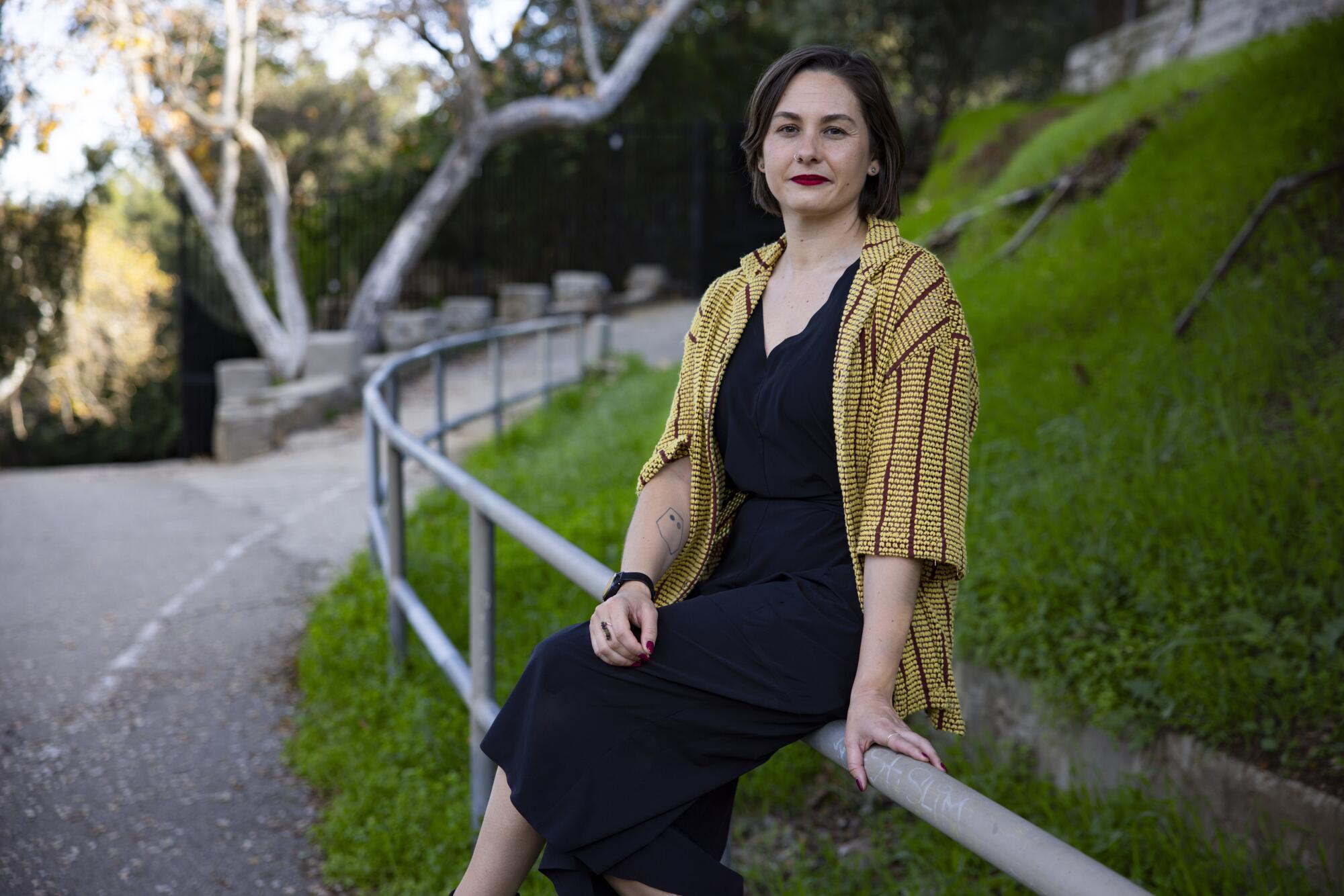
Koryn Wicks, creator of “You Must Be Here for the Reading,” an immersive tarot performance in which audiences are tasked with deciphering their own cards while a melancholic story unfolds around them.
(Kayla Bartkowski / Los Angeles Times)
“I really believe that one of the most beautiful things art does for us is remind us that we are not alone,” Wicks says.
Immersive art allows for a sense of participation, which Wicks hopes will increase one’s appreciation of dance.
“Dance is an embodied art form,” Wicks says. “There is science that shows that some of the enjoyment from watching dance comes from imagining yourself moving. In North America, a lot of people haven’t had an experience or education with dance, especially not concert dance. Then we ask them to sit in a dark auditorium in a small chair and not move to enjoy it. I found through my research, both practical and academic, there is something to inviting audiences to participate in dance that allows them to derive meaning from it.”
‘You Must Be Here for the Reading’
While there isn’t enough time in the show for everyone to have a one-on-one experience with the dancer, watching an audience and cast member attempt to get in sync with each other underlines the night’s themes of connecting. Ultimately, that’s the space where the show resides. “You Must Be Here for the Reading” uses tarot as a means to bring some structure to our often disconnected lives.
“It stands in contradiction to our current historical moment,” Wicks says of the show. “It’s very anti-AI. It’s asking people to sit with books and to find little seeds and not necessarily pursue solutions or puzzles. It’s asking us to connect, sometimes with strangers.”
I kept my question that I brought to the reading secret, but I found the show provided a hopeful answer. Not because the cards offered a solution. Instead, they provided a community.

Sunday Puzzle
NPR
hide caption
toggle caption
NPR

On-air challenge
Every answer is the six-letter name of a world capital, in which I’ve changed the first and last letters. You name the capitals.
Ex. VASSAL –> NASSAU (capital of the Bahamas)
1. CONDOR
2. ROSCOE
3. PUBLIC
4. SAVANT
5. ZANILY
6. DRAG UP
7. ETHENE
8. TARSAL
9. TUSCAN
10. NONACT
11. I AGREE
12. [7 letters:] CALLING
Last week’s challenge
Rearrange the letters of NECESSARY MISPRINT to spell a familiar phrase.
Answer: Sic semper tyrannis.
Winner:
Judy Alexander of South Burlington, Vermont.
This week’s challenge
This week’s challenge comes from listener Michael Pickard. Name something in 10 letters that’s found in a kitchen. Drop its sixth letter to name something on a keyboard. Then drop the new word’s fifth letter to name something no one wants to get. What words are these?
If you know the answer to the challenge, submit it here by Thursday, June 18 at 3 p.m. ET. Listeners whose answers are selected win a chance to play the on-air puzzle. Important: include a phone number where we can reach you.

A wish is a deeply personal thing, often fleeting and silent. But sometimes, a wish is a collective endeavor, a bold and communal call for action.
Yoko Ono’s “Wish Tree” installation is both. The piece — which Ono has staged more than 250 times in 35-plus countries — draws on a Japanese tradition at Buddhist temples that invites visitors to scribble their hopes and dreams onto paper tags and tie them to the branches of a tree. The wishes are left dangling amid the tree leaves, like budding fruit.
Ono’s very first “Wish Tree” — a baby grapefruit tree planted in a wooden box — was shown in 1996 at Santa Monica’s Shoshana Wayne Gallery in Bergamot Station. It was part of Ono’s solo show there. After the exhibition closed, the gallery planted the tree on its property. It was so meaningful to Wayne that when her gallery left Bergamot Station in 2018 (it’s now located in West Adams), she re-planted the iconic tree in her own backyard — in Pacific Palisades. It tragically burned in last year’s wildfire.
Visitors secure their wishes on century-old olive trees at the Broad museum’s East West Bank Plaza.
(Kayla Bartkowski / Los Angeles Times)
Now, 30 years after its initial debut, a grove of “Wish Trees” is in bloom at the Broad museum. And they appear to be much needed right now, given the voracious response from the public. The installation, “Wish Trees for Los Angeles,” is part of Ono’s solo exhibition at the Broad, “Music of the Mind.” Outside, on the museum’s East West Bank Plaza, 10 century-old olive trees are brimming with paper wishes from the public. Together, the bounty of wishes reflect our collective mood in L.A., offering a prismatic snapshot of our hopes, frustrations, anxieties, dreams and desires at this moment in time.
“Ono’s work is ever-relevant and it connects with people where they are, regardless of the context. But of course, right now, we need a place to put hope and think about making the world better,” said Broad curator and exhibitions manager Sarah Loyer. “We’re in a really difficult, dark place globally, nationally, and all of the ways we’ve experienced that as a city with the effects of climate change, the fires and ICE. It feels really important that we have space for hope and reflection.”
On a recent morning, hundreds of sun-dappled wishes shimmied in the tree leaves in at least 10 languages: English, Spanish, Japanese, Korean, German, Italian, Chinese, Persian, French and Turkish among them. They’d all been penned that day. Nearby on a table were paper tags, pens and instructions, which included asking a friend “to do the same. Keep wishing.”
Some wishes called for world peace or the end to war. Others spoke to financial hardships, like the desire to buy a home or keep a job. Many wished for strength to combat physical or mental illness. A slew of wishes echoed the universal yearnings for health, wealth and true love.
“Wishing for a free Iran,” one tag read in Persian.
“PEACE,” echoed another.
“I wish for things to make sense,” read another.
One particularly moving wish hung by a small bunch of flowers tucked into a tree trunk nook: “Wishing to find the strength to let go of the weight of the pain my mother brings me in the final years of her life on this earth.”

Sadie Whitman, 25, left, and Jaisa Pinnock, 25, from New York ready their wishes.
(Kayla Bartkowski / Los Angeles Times)

Yoko Ono’s original “Wish Tree” in 1996 at Shoshana Wayne Gallery, long before it burned in the Palisades Fire.
(Shoshana Wayne Gallery)
A Broad visitor experience team member, whose first name is Ash, was especially touched by a wish written in Spanish.
“It was a child wishing that their parents’ visa would be approved,” she said. “Being Latina and living in L.A. right now, that hit so close to home. I have a lot of experience wishing for the safety of the people in my community.”
There was levity as well: “I wish for a new game in Poki,” one tag read; “I wish for you to have a wish come true,” read another.
When words fell short, visitors to the installation drew pictures: a house surrounded by hearts; a smiling cat; a bowl full of wishes.
The need for a communal outlet for hope was not lost on the Broad. It accelerated the opening of the wider exhibition in order to bring it to Angelenos at a time when, the museum felt, people especially needed it.
The response to the “Wish Trees” was immediate. Even before the exhibition was open to the public, as the museum was readying for a private press preview, passersby on Grand Avenue grabbed paper tags from the outdoor installation’s instructions table and began filling the olive trees with their desires, the Broad said. The museum had designated one central tree to be the official “Wish Tree” and it had built an elevated platform around the trunk base, so visitors could reach the branches more easily. The public filled that tree on day one — and then spread their wishes to the surrounding trees, all of which are now part of the artwork.
Broad staffers now “harvest” the wishes from the trees every day, cutting them down and saving the “trimmings” in a box to make room for new paper tags (it draws about 500 to 800 wishes a day). When the exhibition is over, it plans to mail the wishes to Ono’s studio in New York, which has so far amassed more than 2 million wishes internationally.
Visitors interacted with the artwork in myriad ways.

Yoko Ono’s “Wish Trees” have amassed 2 million wishes globally; each day staffers need to “harvest” 500 to 800 wishes from the trees to make room for new paper tags.
(Kayla Bartkowski / Los Angeles Times)
Two young women who appeared to be in their early 20s posed for selfies under a “Wish Tree,” mouths pursed. As they walked away, one of their tags fell to the ground: “I want to be famous,” it read.
Behind them, Lauren Lloyd, 33, visiting from Nashville, sat earnestly scribbling on her wish tag, which was filled from edge to edge with neat script.
“I think that when you’re surrounded by so much opportunity to see negativity, having an opportunity to see the positive, joyful, wishful thinking people have is very powerful — especially seeing it physically and not just scrolling [online],” she said.
Newlyweds Tito Avalos, 26, and Andrea Avalos, 24, who were visiting from El Salvador, tied their wishes to a tree together, their wrists entwined and fingers clasped. A street performer crooned, in the background: “I can’t help falling in love with you…”
“I think it’s really powerful — it’s a little bit romantic,” Tito said, adding that he’d wished “for a life of more travels and to visit a lot of countries.”
Andrea said that she’d wished for “a happy life together.”
“And more travels too!” Tito chimed in.
The most spirited response of the day came from 12-year-old Jailene Pimentel, between bites of a Subway sandwich. She lives in the West Adams area and was on a school trip to the Broad from Jane B. Eisner Middle School.
“I think it’s nice that people are so hopeful,” she said, adding that the positivity had surprised her.
Why? “Because of everything going on, like ICE, Trump. But people still wish for the best.”
As the wind kicked up, the wishes rustled, as if in conversation.
“To have a child.”
“To go to camp.”
“Prosperity.”


The wish tags hanging on the “Wish Tree” feature various hopes and dreams that are written in a number of different languages.
Seeing the accumulation of other people’s innermost desires in the trees — and given that the wishes are uncovered — lends the work an openness and accessibility that can be therapeutic, Loyer said.
“You can come away with a sense of healing, community and connection to a wider public or a sense of urgency to take more action,” she said. “It’s about spreading that message of peace.”
-

 Politics4 minutes ago
Trump announces peace deal with Iran, declares Strait of Hormuz will reopen: ‘Let the oil flow!’
-

 Health7 minutes ago
One muscle protein may hold the key to staying stronger as you age, study finds
-

 Sports12 minutes ago
2026 World Cup Odds: Germany Heavily Favored to Win Group E After 7-1 Win
-

 Technology19 minutes ago
FBI says Russian hackers hijacked old Wi-Fi routers
-
 Business22 minutes ago
Steven Spielberg’s ‘Disclosure Day’ takes the box office crown
-
 Entertainment27 minutes ago
Seth Rogen says he hasn’t spoken to James Franco and doesn’t plan to work with him
-
Lifestyle34 minutes ago
One of L.A.’s most personal theater experiences is disguised as a tarot reading
-
 Politics37 minutes ago
U.S. and Iran reach agreement to end war, Trump says

