Lifestyle
Yoko Ono’s popular “Wish Trees” at the Broad offers hope to Angelenos in unsettling times


A wish is a deeply personal thing, often fleeting and silent. But sometimes, a wish is a collective endeavor, a bold and communal call for action.
Yoko Ono’s “Wish Tree” installation is both. The piece — which Ono has staged more than 250 times in 35-plus countries — draws on a Japanese tradition at Buddhist temples that invites visitors to scribble their hopes and dreams onto paper tags and tie them to the branches of a tree. The wishes are left dangling amid the tree leaves, like budding fruit.
Ono’s very first “Wish Tree” — a baby grapefruit tree planted in a wooden box — was shown in 1996 at Santa Monica’s Shoshana Wayne Gallery in Bergamot Station. It was part of Ono’s solo show there. After the exhibition closed, the gallery planted the tree on its property. It was so meaningful to Wayne that when her gallery left Bergamot Station in 2018 (it’s now located in West Adams), she re-planted the iconic tree in her own backyard — in Pacific Palisades. It tragically burned in last year’s wildfire.
Visitors secure their wishes on century-old olive trees at the Broad museum’s East West Bank Plaza.
(Kayla Bartkowski / Los Angeles Times)
Now, 30 years after its initial debut, a grove of “Wish Trees” is in bloom at the Broad museum. And they appear to be much needed right now, given the voracious response from the public. The installation, “Wish Trees for Los Angeles,” is part of Ono’s solo exhibition at the Broad, “Music of the Mind.” Outside, on the museum’s East West Bank Plaza, 10 century-old olive trees are brimming with paper wishes from the public. Together, the bounty of wishes reflect our collective mood in L.A., offering a prismatic snapshot of our hopes, frustrations, anxieties, dreams and desires at this moment in time.
“Ono’s work is ever-relevant and it connects with people where they are, regardless of the context. But of course, right now, we need a place to put hope and think about making the world better,” said Broad curator and exhibitions manager Sarah Loyer. “We’re in a really difficult, dark place globally, nationally, and all of the ways we’ve experienced that as a city with the effects of climate change, the fires and ICE. It feels really important that we have space for hope and reflection.”
On a recent morning, hundreds of sun-dappled wishes shimmied in the tree leaves in at least 10 languages: English, Spanish, Japanese, Korean, German, Italian, Chinese, Persian, French and Turkish among them. They’d all been penned that day. Nearby on a table were paper tags, pens and instructions, which included asking a friend “to do the same. Keep wishing.”
Some wishes called for world peace or the end to war. Others spoke to financial hardships, like the desire to buy a home or keep a job. Many wished for strength to combat physical or mental illness. A slew of wishes echoed the universal yearnings for health, wealth and true love.
“Wishing for a free Iran,” one tag read in Persian.
“PEACE,” echoed another.
“I wish for things to make sense,” read another.
One particularly moving wish hung by a small bunch of flowers tucked into a tree trunk nook: “Wishing to find the strength to let go of the weight of the pain my mother brings me in the final years of her life on this earth.”

Sadie Whitman, 25, left, and Jaisa Pinnock, 25, from New York ready their wishes.
(Kayla Bartkowski / Los Angeles Times)

Yoko Ono’s original “Wish Tree” in 1996 at Shoshana Wayne Gallery, long before it burned in the Palisades Fire.
(Shoshana Wayne Gallery)
A Broad visitor experience team member, whose first name is Ash, was especially touched by a wish written in Spanish.
“It was a child wishing that their parents’ visa would be approved,” she said. “Being Latina and living in L.A. right now, that hit so close to home. I have a lot of experience wishing for the safety of the people in my community.”
There was levity as well: “I wish for a new game in Poki,” one tag read; “I wish for you to have a wish come true,” read another.
When words fell short, visitors to the installation drew pictures: a house surrounded by hearts; a smiling cat; a bowl full of wishes.
The need for a communal outlet for hope was not lost on the Broad. It accelerated the opening of the wider exhibition in order to bring it to Angelenos at a time when, the museum felt, people especially needed it.
The response to the “Wish Trees” was immediate. Even before the exhibition was open to the public, as the museum was readying for a private press preview, passersby on Grand Avenue grabbed paper tags from the outdoor installation’s instructions table and began filling the olive trees with their desires, the Broad said. The museum had designated one central tree to be the official “Wish Tree” and it had built an elevated platform around the trunk base, so visitors could reach the branches more easily. The public filled that tree on day one — and then spread their wishes to the surrounding trees, all of which are now part of the artwork.
Broad staffers now “harvest” the wishes from the trees every day, cutting them down and saving the “trimmings” in a box to make room for new paper tags (it draws about 500 to 800 wishes a day). When the exhibition is over, it plans to mail the wishes to Ono’s studio in New York, which has so far amassed more than 2 million wishes internationally.
Visitors interacted with the artwork in myriad ways.

Yoko Ono’s “Wish Trees” have amassed 2 million wishes globally; each day staffers need to “harvest” 500 to 800 wishes from the trees to make room for new paper tags.
(Kayla Bartkowski / Los Angeles Times)
Two young women who appeared to be in their early 20s posed for selfies under a “Wish Tree,” mouths pursed. As they walked away, one of their tags fell to the ground: “I want to be famous,” it read.
Behind them, Lauren Lloyd, 33, visiting from Nashville, sat earnestly scribbling on her wish tag, which was filled from edge to edge with neat script.
“I think that when you’re surrounded by so much opportunity to see negativity, having an opportunity to see the positive, joyful, wishful thinking people have is very powerful — especially seeing it physically and not just scrolling [online],” she said.
Newlyweds Tito Avalos, 26, and Andrea Avalos, 24, who were visiting from El Salvador, tied their wishes to a tree together, their wrists entwined and fingers clasped. A street performer crooned, in the background: “I can’t help falling in love with you…”
“I think it’s really powerful — it’s a little bit romantic,” Tito said, adding that he’d wished “for a life of more travels and to visit a lot of countries.”
Andrea said that she’d wished for “a happy life together.”
“And more travels too!” Tito chimed in.
The most spirited response of the day came from 12-year-old Jailene Pimentel, between bites of a Subway sandwich. She lives in the West Adams area and was on a school trip to the Broad from Jane B. Eisner Middle School.
“I think it’s nice that people are so hopeful,” she said, adding that the positivity had surprised her.
Why? “Because of everything going on, like ICE, Trump. But people still wish for the best.”
As the wind kicked up, the wishes rustled, as if in conversation.
“To have a child.”
“To go to camp.”
“Prosperity.”


The wish tags hanging on the “Wish Tree” feature various hopes and dreams that are written in a number of different languages.
Seeing the accumulation of other people’s innermost desires in the trees — and given that the wishes are uncovered — lends the work an openness and accessibility that can be therapeutic, Loyer said.
“You can come away with a sense of healing, community and connection to a wider public or a sense of urgency to take more action,” she said. “It’s about spreading that message of peace.”

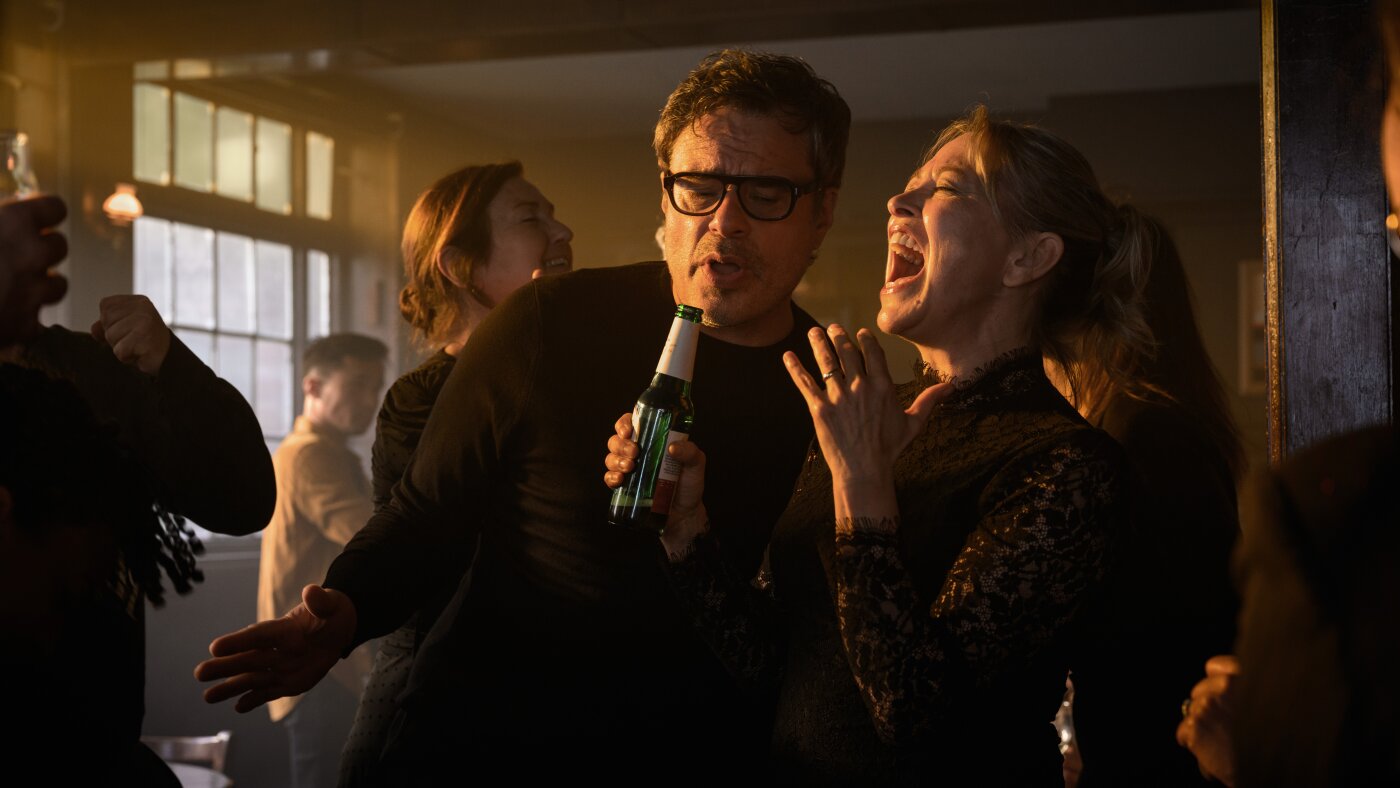
In Alice and Steve, Jemaine Clement and Nicola Walker play long-time friends who turn on each other after he gets involved with her 26-year-old daughter.
Lara Cornell/Disney+
hide caption
toggle caption
Lara Cornell/Disney+
I grew up watching episodic shows on network TV, nearly all of them formulaic but some indelibly great. Then, like everyone else, I moved into the days of what my colleague David Bianculli dubbed Platinum TV, where series like The Sopranos and The Wire and Fleabag aspired to something higher. What both these eras had in common was that their shows were carefully crafted — they had an internal logic, and a tone, that held them together.
In recent years, though, there’s been a proliferation of shows that, possibly obeying some algorithm, care less for coherence than sensation. They lurch among tones, from cuteness to sentimentality to meanness, stirring in random plot twists along the way. Bouncing all over the emotional map, these shows depend on compelling actors and a few memorable scenes to make us overlook their loose construction.
A great example is Alice and Steve, an entertaining but sometimes exasperating six-part British comedy on Hulu about two 50-something best friends who turn on each other after he gets involved with her 26-year-old daughter.


While the premise is juicy, it’s also a tad yucky, and I mainly tuned in because its title characters are played by performers Jemaine Clement from Flight of the Conchords and Nicola Walker, whom I’ve raved up on this show more than once.
The series starts poorly with Steve and Alice going on a cutesy bender after a friend’s funeral. Now, I always hate drunk scenes, which are an invitation to overact. As Clement and Walker bray their lines, we learn that Steve’s a divorced celebrity hair stylist who can’t find a girlfriend while Alice is a clothes designer with a doting younger husband, nicely played by Joel Fry, a sweetie-pie of a teenage son — that’s Tyrese Eaton-Dyce — and, of course, that 26-year-old daughter, Izzy, who has inherited her mother’s willfulness. Played by Yali Topol Margalith, Izzy kickstarts the plot by flirting with Steve. Predictably, he succumbs.

Almost immediately, they think they’re in love. While the weak-willed Steve wants to hide their romance — he knows it’s inappropriate — Izzy just blurts out the facts to her mom. Alice flips. And from hereon out in this series where the women are as alpha as the men are hangdog, Alice drives the action. Betrayed and violently angry, she’ll do whatever it takes to break them up — no matter who gets hurt. Her antics unleash Steve’s own malice. We’re in Beef territory.
At its core, Alice and Steve hinges on the way that platonic friendships are often richer and more powerful than romantic ones. It’s a fascinating subject, which may be why I found the script by Sophie Goodhart so frustrating. I wanted her to dig deeper. While the show’s got some very funny bits — Alice’s sharp-tongued mother is a blast — it’s often annoyingly lax.

If Steve really does the hair of Charli XCX, how come he’s a clueless older guy whose pop culture references are Willie Nelson and Woody Allen? If Izzy truly adores her mother as she claims, why does she keep rubbing her relationship with Steve in her mom’s face? Halfway through, one character nukes the other’s career, but this life-shattering event has no real weight: It’s barely even mentioned for the rest of the series.
That said, Alice and Steve is worth seeing for scenes like the one in which Steve spinelessly sells Izzy out or the lacerating discussion between Alice and her husband when he fully grasps that he adores a woman who views him as a reliable but dull concierge, not a man she likes hanging with. Most touching of all may be the lovely sequence when Alice, wise for once, smooths a romantic crisis between her son and his would-be girlfriend, a pair who are the show’s emblem of hope. For once, we understand why people love her.

While most viewers will find Steve more likable than Alice — the show takes pains not to make him appear predatory or creepy — the role doesn’t give Clement a whole lot to do except play variations on shambolic dread and discomfort. The show gets its galvanizing zing from Walker, a beloved star in England with amazing, luminous eyes. Her Alice is the kind of complicated, volcanic heroine that you don’t see in movies and rarely see on TV, one who shows her apocalyptic rage freely and in many different forms.
At least once in every episode, something would lead me to say, “Man, is this show a mess.” But that wasn’t a deal breaker. I kept watching. After all, life is messy, too.


How to enter your Sporty Spice era.
Getty Images/quantic69/Olga Kurbatova/Anastasiia Zvonary/Photo Illustration by NPR
hide caption
toggle caption
Getty Images/quantic69/Olga Kurbatova/Anastasiia Zvonary/Photo Illustration by NPR
Reality dating and professional sports are not as different as you’d think.
Brittany is in her Sporty Spice era – she watched the NBA playoffs, she’s following World Cup games, and she’s watching the New York Liberty play their WNBA season. These games are daily – and so is the reality dating show Love Island. And she noticed that the two formats are not very different at all. Defector.com staff writer and co-owner Kelsey McKinney came to the same conclusion – so the two of them discuss why these games of athleticism and love can bring us together… and why they get valued differently in our culture.
For more episodes on sports and reality TV, check out:
Get rich or die trying: how sports betting is changing our love of the game
Is this the end of reality TV?
The ugly truth of America’s expensive homes
Support Public Media. Join NPR Plus.
Follow Brittany on Instagram: @bmluse
This episode was produced by Liam McBain. It was edited by Neena Pathak. Our Supervising Producer is Cher Vincent. Our Executive Producer is Barton Girdwood. Our VP of Programming is Yolanda Sangweni.

-

 San Francisco, CA3 minutes ago
Terrified passengers film Waymo autonomous vehicle driving into live fireworks in San Francisco
-

 Dallas, TX6 minutes ago
WATCH: USA vs. Belgium watch party at FIFA Fan Festival Dallas
-

 Miami, FL11 minutes ago
Tim Hardaway Jr. returns home as Miami Heat sign veteran guard:
-

 Boston, MA18 minutes ago
‘Enough is enough’: Weekend violence in Boston sparks calls for change, from more police to community investment – The Boston Globe
-

 Denver, CO18 minutes ago
Kalshi Promo Code DENVER: Trade $10, Get $10 World Cup Bonus for USA-Belgium – Denver Stiffs
-

 Seattle, WA26 minutes ago
Fans take over Seattle for USA-Belgium World Cup match
-

 San Diego, CA27 minutes ago
Elite California city set for mass illegal street vendor expansion as judge issues stunning verdict
-

 Milwaukee, WI33 minutes ago
Milwaukee police officers injured in separate holiday weekend incidents

