Science
44% of Americans breathe dangerously polluted air. In California, it’s 82%

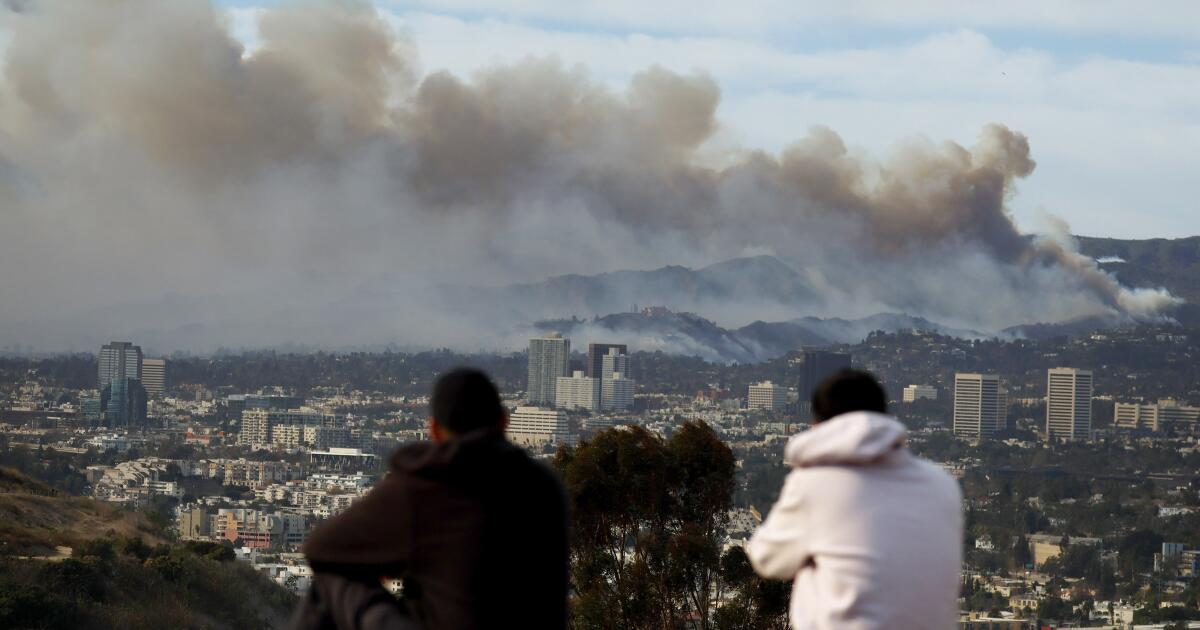
Greater Los Angeles remained the most ozone-polluted metro area in the nation, according to the American Lung Assn.’s 2026 State of the Air report, which found that Southern California continues to face some of the country’s dirtiest air.
The report, released on Wednesday, ranked Los Angeles-Long Beach as the worst U.S. metro area for ozone pollution, with an average of 159.2 unhealthy ozone days a year. The region also ranked seventh worst nationally for annual particle pollution and seventh worst for short-term particle pollution.
The American Lung Assn., or ALA, assigns grades based on the number of unhealthy air days and the severity of pollution levels, using federal air quality standards. Los Angeles County received failing grades across all three categories measured in the report: ozone, short-term particle pollution and annual particle pollution.
Riverside and San Bernardino counties also failed all three measures.
Orange County received an F for ozone, a failing grade for annual particle pollution and a C for short-term particle pollution.
Ground-level ozone, often called “smog,” is a corrosive gas that forms when pollution from vehicles and other sources reacts in heat and sunlight. It can irritate the lungs and trigger serious breathing problems.
Short-term and annual particle pollution refer to fine particulate matter, known as PM2.5. These microscopic particles come from sources such as vehicle exhaust, industrial emissions and wildfires. Because they are small enough to enter the bloodstream, they are linked to asthma attacks, heart disease, strokes and lung cancer, according to Will Barrett, assistant vice president for Nationwide Clean Air Policy at the ALA.
The report did find some signs of progress. Los Angeles posted its lowest annual particle pollution level in the history of the report, even though the region still ranked among the nation’s worst overall.
On the other hand, ozone pollution in Los Angeles worsened from last year’s report, keeping the metro area in the top spot nationally for smog. The report says Los Angeles has ranked worst for ozone in 26 of the 27 years the ALA has issued the study.
Speaking to the press Tuesday, Barrett said the region’s pollution comes largely from transportation sources “primarily burning gasoline and diesel,” along with refineries and other local emissions sources. He said those pressures are compounded by climate and coastal conditions that push pollution inland, especially into the Inland Empire, where unhealthy ozone days are even more severe.
Nationally, the report found that in the U.S., 152.3 million people, or 44% of the population, live in places that received a failing grade for at least one measure of ozone or particle pollution. That includes 33.5 million children, or 46% of people under 18. In California, the ALA said 82% of residents live in counties affected by unhealthy air.
Of the 15 U.S. counties with the most bad smog days last year, eight were in California.
When it came to bad PM2.5 pollution days, California had seven of the 15 worst counties.

And of the 15 counties with the worst year-round PM2.5 pollution, nine were in California.

In the report, the ALA said recent federal actions could undermine California’s efforts to improve air quality. Those include missed deadlines for stronger particle pollution standards, rollbacks of clean-vehicle and fuel-economy rules, exemptions from toxic air pollution regulations, and a Congressional Review Act challenge targeting three of California’s clean-vehicle standards.
“This [Environmental Protection Agency] is making significant rollbacks to life-saving clean air rules,” Diana Van Vleet, the report’s lead author and the ALA’s director of nationwide clean air advocacy, said during Tuesday’s press call. “Federal actions have weakened, delayed and repealed many pollution limits.”
She referenced the EPA’s February revocation of a longstanding scientific conclusion that man-made climate change threatens the health of Americans.
“The recent actions by the federal government to interfere with California’s state rights to protect residents’ health are a major challenge to the ongoing success of our local air districts and state Air Board,” said Barrett. He added that state estimates show federal actions weakening California’s clean-air authority could lead to more than 14,000 deaths, thousands of emergency room visits and hospitalizations, and $145 billion in cumulative health impacts through 2050.
Children are especially vulnerable to polluted air because their lungs are still developing, they breathe more air relative to their body size, and they often spend more time outdoors, the report said.
“In my daily work life, I treat children with asthma that is often made worse because of the heavy doses of pollution they breathe,” said Afif El-Hasan, physician-in-charge at Kaiser Permanente San Juan Capistrano Medical Offices.
El-Hasan added that air pollution “also inhibits lung development in children, which can lead to reduced lung capacity as adults. This is not reversible. Once it happens, it’s done.”
Southern California’s air pollution burden has long been shaped by a mix of traffic, freight movement, industry, geography and climate.
The county rankings show the concentration of that burden. San Bernardino County ranked as the most ozone-polluted county in the nation, with 159.2 weighted average unhealthy ozone days, followed by Riverside County at 126.7 and Los Angeles County at 119.0.
The report also highlighted cleaner-air successes elsewhere in California. Sacramento recorded its lowest annual particle pollution levels and fewest unhealthy ozone days in the report’s history.
Four California cities also ranked among the nation’s cleanest in at least one category: Salinas and Chico for having zero high-ozone days, and Santa Barbara and San Luis Obispo for recording zero days of unhealthy particle pollution.
The ALA urged state lawmakers to keep funding programs aimed at cutting emissions from the biggest sources. “The Lung Association is calling for the California Legislature to invest in zero-emission truck programs,” Barrett said, as well as for funding for cleaner agricultural equipment and consumer cars.
The health and environmental arguments for these political positions have been argued to death, but Barrett says that the economic consequences of dirty air are often overlooked. “What is often missing is this impact of the cost of air pollution on family budgets, on kids missing school, their parents staying home from work, on and on and on,” he said. “Air pollution is a costly societal problem that needs to be addressed.”


new video loaded: NASA Announces Artemis III Crew
transcript
transcript
NASA Announces Artemis III Crew
NASA announced the crew of Artemis III mission, which will fly to low-Earth orbit to test rendezvous and docking maneuvers with one or two lunar landers.
-
“I am excited to welcome you as the next crew in the Artemis journey to successfully return to the moon — this time to stay.” “I’m honored by the role that I’ve been given. I’m also very humbled by the task in front of us. But first and foremost, I’m grateful.” “So with that, the Artemis II crew, comrade, hands you the baton. You got the controls.” “As you know, we had a significant anomaly at our Launch Complex 36A on May 28. We’ve redoubled our efforts and are moving forward.”
By Alisa Shodiyev Kaff
June 9, 2026
Science
Santa Monica Mountains’ last steelhead trout survived the Palisades fire — and even had babies

Scientists feared the Santa Monica Mountains’ last remaining steelhead trout were dead, smothered by debris flows unleashed by the Palisades fire.
But the endangered fish surprised them: A team of biologists recently spotted 30 of the rare trout — and 21 babies — in Topanga Creek.
“There was a lot of happy dancing in the creek,” said Rosi Dagit, principal conservation biologist for the Resource Conservation District of the Santa Monica Mountains, which works with public and private landowners to conserve natural resources.
That’s because the steelhead here are endangered, at both the state and federal levels. Once, they swam in most streams of the Santa Monicas, but their numbers plummeted amid overfishing and coastal development. Increasingly frequent wildfire has further stressed their habitat. Topanga Creek, a biodiversity hot spot, is home to their last known population in the mountains that stretch from the Hollywood Hills to Point Mugu in Ventura County.
The trout that were spotted, including this one, are part of a distinct Southern California population that’s listed as endangered at the state and federal levels.
(RCDSMM Stream Team)
The California Department of Fish and Wildlife spearheaded a complex mission to rescue trout threatened by the Palisades fire that sparked in January 2025.
Time was of the essence. The fire hadn’t yet been fully contained. But rain was on the way, which would sweep massive amounts of sediment from the denuded hillsides into the water. Fish are often killed this way.
Crews stunned the fish with electricity, scooped them up in buckets, trucked them to a hatchery and ultimately moved them to Arroyo Hondo Creek in Santa Barbara County.
Within days, Topanga Creek was choked with mud. Some assumed the fish left behind were goners.
But in March, the conservation district’s team found four. The following month, when water conditions were clearer, they saw more.
“These fish continue to amaze me,” said Kyle Evans, environmental program manager for the state Department of Fish and Wildlife, who had seen the damage to the creek. “I had seen populations get wiped out in similar situations. So when I heard, I was thrilled.”
Evans surmises the fish that survived were in an area of the creek where less charred material and sediment were swept in.
“These fish likely hunkered down, were hiding under some rocks or places to try to get away from the main concentration of flow,” he said. “And luckily they weren’t buried.”
The ones that were spotted were fairly small, around 6 to 14 inches. Rainbow trout and steelhead trout are the same species, but with different lifestyles. If the fish remain in freshwater, they’ll be considered rainbows. However, they can migrate to the ocean and become steelhead, where they typically grow larger before returning to their natal waters to spawn.
Topanga Creek hasn’t fully recovered from the damage it sustained, but scientists say it’s looking better. Surveys last year were “so depressing,” Dagit said, with very few animals, and stretches that were essentially transformed into flat roads from all the sediment buildup. Some of the riparian canopy burned right down to the creek.
Then came 32 inches of rain over the last nine months, scouring out and moving sediment, creating deeper pools. Dagit said they recently found newt egg masses for the first time in years, as well as a few adult newts and many frogs. Plants that provide cover are starting to recover.
She provided photos comparing certain pools last year and this year, some dramatically transformed. In September 2025, the Shrine Pool could have been an overgrown hiking trail. This April, it was filled with shallow water.

The Shrine Pool in September 2025, left, and the same location in April 2026, right, with RCDSMM’s Isaac Yelchin donning a wetsuit.
(RCDSMM Stream Team)
Topanga Creek is home to another endangered fish, the small but hardy northern tidewater goby, often described as cute. Not long before the trout operation, Dagit led a rescue of hundreds of these fish too. Many were repatriated to the lagoon at the mouth of the creek in a moving ceremony last June.
There’s still the matter of what to do with the trout that were moved to Santa Barbara County last year. Evans would like to bring them home to the Santa Monicas at some point, but isn’t sure if it will happen. On one hand, they could bolster the small, genetically isolated surviving population. On the other, they might inadvertently bring in a disease or bacteria. There is some time to decide. Evans estimates the creek still needs to recover for two to three more years.
For now, the fish are functioning fine in their adopted creek. Experts worried the trauma wrought by the move would disrupt their spawning process, but they had babies that spring. This year, they spawned again.

The Pacifica Municipal Pier was shut down and taped off Thursday after city workers noticed cracks running through the landmark structure and concrete chunks falling into the ocean.
It’s just one of many coastal California structures that have recently crumbled under pressure from a rising and relentless ocean.
Officials from the small, beach city south of San Francisco said the pier was closed due to “cracking, separation, and displacement of the concrete walkway and structural elements.”
It will stay closed while structural engineers asses its safety.
Photos taken by city employees show a wide crack that runs from top to bottom and across the structure as well. Other photos show a large horizontal crack under the foundation of a small restaurant on the pier, the Chit Chat Cafe.
The cafe was also shut down.
This is not the first time the 53-year-old pier has shown signs of stress. In 2021, part of it was shut down after handrails along the edge collapsed. And in 2023, after a series of storms pummeled the Central California coast, damaging parts of the pier, the structure was partially closed for more than year.
Those same storms caused extensive damage in Aptos and Capitola, 70 miles south, where piers and waterfront infrastructure were swept away or damaged.
In 2024, a 150- to 180- foot section of the Santa Cruz wharf was ripped off by powerful waves.
At least 10 of the state’s dozens of coastal public piers were closed for part or all of 2024 due to structural damage sustained in winter storms since 2022. At least five others have longer-term upgrades planned to address structural issues.
“These things are costly to maintain,” said Zach Plopper, senior environmental director at Surfrider. “They are a part of our California coastal culture in many ways, but we’re going to need to reckon with, one, the state that they’re in, and two, the continuous and worsening threats they’re going to experience,”
He said most of the piers were constructed in the early 1900s, and they weren’t built to withstand decades of rough seas, storms and rising sea level.
“With this incoming El Niño, which is forecasted to be significant, and this marine heat wave we’re in the midst of, we’re kind of in uncharted waters as far as what this winter could bring in terms of storms and swells to the California coast, and we’re likely going to see a lot more damage,” he said. “Not just piers, but roads and other coastal infrastructure up and down the state.”
There was no storm in Pacifica earlier this week, so no single event could be blamed for the destruction.
However, a 2025 report from an outside engineering firm, GHD, found that several sections of the pier were in “poor” or “serious” condition, and they recommended closure before anticipated storms or events that could “subject the piles to high winds, swells and large waves.”
The firm found several areas of the pier where concrete was missing and rebar was exposed and corroding.
“The pier has continued to experience high winds and large waves in a harsh marine environment,” the engineers wrote in the report, noting that continuous exposure to seawater or marine spray was “detrimental” to the structure.
A 2023 city report estimated it would cost $19 million to repair.
That same year, a state law was enacted to require local governments along the California coast to plan for sea level rise in the coming decades.
Sea level has risen some 8 inches, on average, along the coast in the past 150 years, Plopper said, and researchers anticipate another foot in the next 25 years.
“We’re going to see profound shifts on our coastline, none that we have ever experienced before, and building static structures on the coast just doesn’t work all that well,” he said. “We’re going to have to make some really hard decisions.”
-

 Miami, FL3 minutes ago
Home intruder shot and killed in Miami Gardens
-

 Boston, MA10 minutes ago
Rays hold on to beat Tolle, Red Sox 4-3
-

 Denver, CO13 minutes ago
The steep price the Denver Nuggets must pay to get off Zeke Nnaji’s contract
-

 Seattle, WA18 minutes ago
Baltimore Orioles fall to Seattle Mariners 6-5 for their fourth loss in a row
-

 San Diego, CA25 minutes ago
San Diego City Council OKs compromise spending plan, capping a contentious budget season
-

 Milwaukee, WI28 minutes ago
Milwaukee apartment theft; woman says puppy, sister’s ashes stolen
-

 Atlanta, GA33 minutes ago
Atlanta mayor to address MARTA readiness as agency unveils safety changes for World Cup
-

 Minneapolis, MN40 minutes ago
Minneapolis Cafe Cuts Prices to Zero in Protest—and Profits Rise

