Entertainment
Inside Ye’s first comeback show at SoFi Stadium


On the first night of Passover, Ye — the superstar rapper, the artist formerly known as Kanye West, the man who once threatened in a tweet to go “death con 3 On JEWISH PEOPLE” — performed for what looked like a full house at Inglewood’s SoFi Stadium.
The first of a pair of Ye concerts this week at the gigantic NFL palace, Wednesday’s show came two months after the 48-year-old musician apologized for his past antisemitic comments, attributing his behavior to injuries he sustained in a 2002 car crash.
More to the point, perhaps, the gig came on the heels of last week’s release of “Bully,” Ye’s first solo LP since 2022’s “Donda 2,” which the trade journal Hits predicts will enter the album chart at No. 2, right behind the latest from BTS.
In other words, Ye’s trying to get a comeback going — and, to judge by the very warm reception he got at SoFi, he might prove successful.
Wednesday’s concert — Ye’s first full live performance in Los Angeles since a 2021 gig at the L.A. Memorial Coliseum — lasted about two hours and featured guest appearances by Don Toliver and Ye’s 12-year-old daughter, North.
The rapper performed atop an enormous dome set up on the stadium’s floor; for much of the night, a spinning globe was projected onto the dome so that Ye looked to be — well, on top of the world is how he might’ve put it.
Early in the set, Ye asked his technical crew to “make the earth move slower,” which somebody made happen.
Accompanied by what sounded like prerecorded backing tracks, Ye opened with a handful of songs from “Bully,” which seeks a middle ground between the soulful, sample-heavy sound of his early work and the gloomier, synthed-up vibe of more recent records like “Donda” and his and Ty Dolla Sign’s “Vultures 1” and “Vultures 2.”
After an extended version of the new album’s “All the Love,” he reached back for an assortment of oldies, including all-timers like “Father, Stretch My Hands, Pt. 1,” “Mercy,” “Black Skinhead” and “Can’t Tell Me Nothing,” which he stopped and restarted after telling the crew to mute the music during the song’s line about getting his money right so that he could hear the crowd join in.
He also did his and Jay-Z’s collaborative 2011 hit — the one whose title contains the N-word — which made you think about how he and his old frenemy are both mounting comebacks at the same time, Jay-Z as a kind of retiree’s victory lap and Ye in hopes of moving past a mess of his own making.
Other classics Ye performed included “Bound 2” and “Heartless,” to name two of his most emotionally potent songs, though thick smoke in the stadium made it hard to feel a sense of connection with him as he moved back and forth atop the dome.
Ye brought out Don Toliver to perform “Moon” and Toliver’s “E85,” then cycled again through the “Bully” tracks he’d done earlier. North West came out to perform “Talking” and “Piercing on My Hand,” after which Ye did his and Ty Dolla Sign’s “Everybody,” which prominently samples the Backstreet Boys’ “Everybody (Backstreet’s Back).”
Then he finished with a sprint through some of his most beloved hits: “All Falls Down” into “Jesus Walks” into “Through the Wire” into “Good Life,” which he restarted several times because he said the lights were “corny.”
“Is this like an ‘SNL’ skit or something?” he asked when nobody made the changes he was looking for.
Ye ended the show with “All of the Lights,” which got a huge pryo display, and “Runaway,” his epic 2010 warning to anyone foolish enough to consider falling in love with him.
“Run away fast as you can,” he sang, and the crowd roared right along.


Not to shock anyone, but it’s important to disclose that I’ve never seen an episode of “The Mandalorian” (or any “Star Wars” show). But the breakout star of the series, “Baby Yoda,” aka “The Child,” aka Grogu, has become a ubiquitous pop cultural sensation, so it’s nearly impossible to go in completely cold to the big screen adaptation of the series, “Star Wars: The Mandalorian and Grogu.” Still, I can report that it’s possible to go in colder than most and still maintain your footing, to alleviate any concerns of fellow casual “Star Wars” fans.
That’s because “Mandalorian and Grogu” director and co-writer Jon Favreau, and co-writers Dave Filoni and Noah Kloor, traffic in easily digestible tropes, archetypes and genre references. The story is like an old-fashioned film serial blown up to blockbuster proportions, set in a world that has dominated pop culture for almost 50 years. The remnants of a crumbling empire, a bounty hunter with a heart of gold, a cute green guy who wields the Force — what’s not to get?
How Mando (Pedro Pascal under the helmet) and Grogu linked up has been covered in the series, so if you’re a die-hard fan, there’s not a lot of repeat or recap. Essentially, what you need to know is that the story is set in the period between the original “Star Wars” trilogy (ending with “Return of the Jedi”) and the sequel trilogy (starting with “The Force Awakens”). The Galactic Empire has fallen, replaced with the New Republic. While former Imperial warlords drift about, trying to amass power, the New Republic sends out the Mandalorian to haul them back to headquarters to snitch on their comrades. Reparations and justice for corrupt and evil fascists — we simply love to see it.
Favreau’s film plays like another installment in the Mando and Grogu adventures: We meet up with them mid-raid, which results in a dead target, and doesn’t please his boss, Colonel Ward (Sigourney Weaver). Still, she sends them on to their next assignment, doing some dirty work for the criminal gangster organization the Hutts. Jabba’s son Rotta (Jeremy Allen White) is missing, and his aunt and uncle would like him back. While Mando hates to work for the Hutts, they’ve promised intel on a very promising, and very elusive, Imperial leader.
When they find Rotta (weirdly buff for a Hutt) in the fighting pits of the urban enclave Shakari — thanks to information from a food vendor voiced by Martin Scorsese — Mando is surprised to find that Rotta’s not inclined to return to his family. White’s actorly presence comes through in his vocal performance, lending the beleaguered fighter a sense of depressed world-weariness and poignant ennui.
But this plot point kicks off a narrative whirlpool in which “The Mandalorian and Grogu” finds itself trapped — Mando is knocked out cold, wakes up in an unfamiliar spot, and then has to fight a bunch of CGI beasties. This happens at least three times in the film, and it gets repetitive. The nods to Ray Harryhausen monster movies are appreciated, but it quickly loses its novelty.
The film takes its cues from those old timey epics, as well as from Westerns and samurai movies — anything with a lone fighter who lives by a code and has a desire to fiercely protect his loved ones. There’s an element of the classic Western “Shane” as Mando fights to protect his diminutive sidekick, and Pascal delivers his quips (“Fighting’s not a sport, it’s a last resort,” etc.) with John Wayne-style panache.
But with his helmet hiding his face (to take it off is shameful), and most of the characters computer-generated, our emotional touchpoint throughout remains a puppet — Grogu. With his huge eyes, baby coos and little shuffle, he’s been engineered to elicit cute aggression from audiences and everyone he encounters, including Rotta, and various creatures who help him along the way, resulting in a wave of deus ex machina story beats where someone swoops in to save the day. Over and over, Mando finds himself in a jam but we never think he’s in any real danger, because would this kiddie-skewing “Star Wars” actually force Grogu to grapple with grief?
Ludwig Göransson’s expressive score does much of the emotional heavy lifting too. He peppers in an electronic techno theme among the sweeping orchestral stuff for a feel that’s both ‘80s retro and distinctly modern; when the film pauses for Grogu’s moment of heroism it’s quietly atmospheric and curious. The score is the single best element of filmmaking on display, because the cinematography is a desaturated CGI mish-mosh.
Grogu’s cuteness may be a powerful force, but it’s not enough to sustain this big-screen leap, especially in a blockbuster this bloated, and frankly, dull. If it feels like a serial, maybe it should have stayed a series.
‘Star Wars: The Mandalorian and Grogu’
2 stars out of 4
Running time: 2 hours 12 minutes
Rated PG-13 for sci-fi violence and action.
Where to watch: In theaters Friday, May 22.
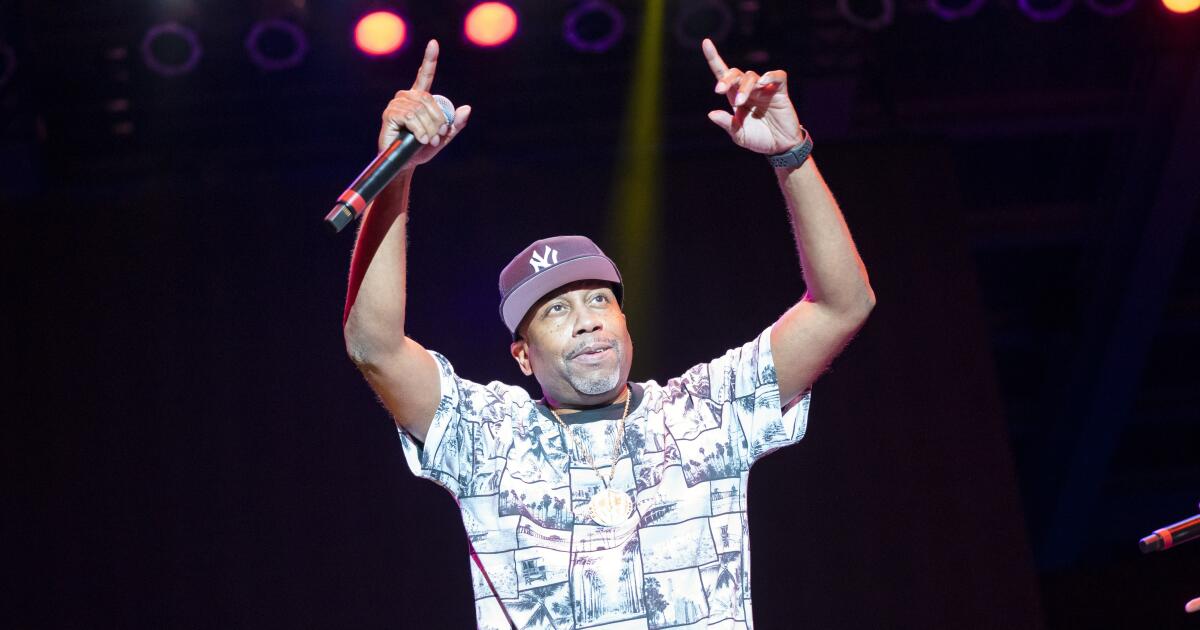
Rapper Rob Base, one-half of the hip-hop duo Rob Base & DJ E-Z Rock, died on Friday after a battle with cancer. He was 59.
“Rob’s music, energy, and legacy helped shape a generation and brought joy to millions around the world. Beyond the stage, he was a loving father, family man, friend and creative force whose impact will never be forgotten,” a statement on Base’s Instagram read.
The statement also expressed gratitude to Base, who was surrounded by family as he died, for “the music, the memories and the moments that became the soundtrack to our lives.”
Rob Base was born Robert Ginyard in May 1967. He was best known for his collaborations with DJ E-Z Rock. The two were lifelong friends, meeting in fifth grade while living in Harlem. Their song “It Takes Two” was released in 1988 by Profile Records. The song became a breakout single for the duo and peaked at No. 3 on the Billboard U.S. dance club songs chart, with The Times calling “It Takes Two” “the rage of the rap underground.”
The duo followed up the hit with the release of the singles “Joy and Pain” and “Get On the Dance Floor.” Base released his solo album, “The Incredible Base,” in 1989.
Base was an ardent supporter of the rap genre, explaining to The Times in 1989 the nuance of the music.
“People outside rap don’t understand it. There’s all sorts of subtle things — key things — happening over and above the beat in rap songs. The fans want new stuff all the time,” Base said.
Base had two children, De’Jené Ginyard and Robert Ginyard Jr. His wife, April, died in 2013.
Movie Reviews
‘The Birthday Party’ Review: Hafsia Herzi, Benoît Magimel and Monica Bellucci in Léa Mysius’ Gripping if Uneven Home-Invasion Thriller

Lean, mean and frequently terrifying, The Birthday Party (Histoires de la nuit) is a home-invasion thriller in the vein of films like Funny Games and Speak No Evil, even if it stops well short of the sadistic shocks of either of them. Adapted from a French bestseller by Laurent Mauvignier, writer-director Léa Mysius’ third feature shares its remote setting and appetite for darkness with her 2022 fantasy drama The Five Devils, though it’s more cohesive than that scattershot genre-bender. A pileup of movie-ish improbabilities in the climactic act notwithsanding, the new film is a taut nail-biter with a strong cast.
The family put through the wringer of one long hellish night are the Bergognes — hard-working Thomas (Bastien Bouillon), who runs the small dairy farm where they live in rural Western France; his wife Nora (Hafsia Herzi), who gets a 40th birthday surprise when she’s named head of town-planning at her office job; and their smart preteen daughter, Ida (Tawba El Gharchi).
The Birthday Party
The Bottom Line Highly watchable, though needs a new third act.
Venue: Cannes Film Festival (Competition)
Cast: Hafsia Herzi, Benoît Magimel, Bastien Bouillon, Monica Bellucci, Tawba El Gharchi, Paul Hamy, Alane Delhaye, Servane Ducorps, Tatia Tsuladze
Director: Léa Mysius
Screenwriter: Léa Mysius, based on the novel Histoires de la Nuit, by Laurent Mauvignier
1 hour 54 minutes
They have one sole neighbor, Cristina (Monica Bellucci), a well-heeled Italian artist who lives and works in a distressed-chic studio that looks to be a converted barn, where Ida regularly stops by on the way home from school to paint.
One key bit of foreshadowing happens early on when Nora freaks out over a video Ida posted online of the family dancing. Despite her daughter’s protestations about losing her 60,000 views, Nora demands that she take the video down, making it clear she does not want to be seen on socials.
Another significant plot signal is the arrival while the family are out of a shifty-looking dude, later identified as Flo (Paul Hamy), who claims to Cristina that he’s come to look at the farmhouse for sale. Cristina knows of no plans for the Bergognes to sell, and her eagerness to get rid of him seems a sharp intuition.
Flo doesn’t stay gone for long, returning first with a seemingly dim-bulb younger brother Bègue (Alane Delhaye), who spent two years in a psych ward, followed by eldest sibling Franck (Benoît Magimel), who clearly calls the shots. When Ida shows up at Cristina’s after school, the place appears empty; even the painter’s dog is gone. But the brothers are merely keeping her hidden to prevent her from warning Thomas when he gets back.
As much as the percolating dread and looming threat of violence, Mysius’ script digs into the psychological violation of intruders who have extensive intimate knowledge of the family. They know that Thomas bought the family farm at a time when the sector is struggling, and that financially, he’s in the hole. Franck and co. let him get inside the farmhouse and start stringing up decorations for Nora’s birthday party before making their presence felt.
Nora has a flat tire on the way home from work, which slows her arrival. When she does finally get back, Franck greets her with familiarity, calling her Leïla, and she assures him he has the wrong person. But Franck won’t be persuaded, making things increasingly spiky as the night progresses, and hinting at a past that makes Thomas wonder how well he knows his wife.
Mysius keeps this chilling negotiation phase humming, and all the characters are well-drawn. But the director really makes the material her own through her investment in the women, who are not just trembling in fear but quietly strategizing, trying to identify any weak points in Franck and his brothers that they can use.
Some of the best scenes involve Bègue, left alone in the studio to keep an eye on Cristina. He tries to act tough, but she finds his soft underbelly of vulnerability and coos sympathetically over the demeaning treatment he receives from his brothers. Bellucci is in good form as Cristina appears to be plotting a move but is smart enough not to rush it. She talks to Bègue about her art and it seems obvious that he’s unaccustomed to being spoken to like an intelligent adult. A glass of wine and a shared joint make their scenes seem almost like a mellow hang. Up to a point.
Next door, meanwhile, Nora is increasingly needled about the parts of her past kept secret from her family. When she’s forced to acknowledge her history with Franck, marital tensions and trust issues combine with the unpredictable nature of volatile strangers clearly not averse to brutal violence.
Through all this, Ida is encouraged to stay in the living room and watch cartoons on TV, but the kid is alert to everything that’s going on, even if she doesn’t fully understand it.
In addition to the women, the trio of thugs bring a punchy dynamic — Magimel has fully entered his Brando phase, his imposing physical presence as unsettling as his menacing words; the magnetic Hamy is a livewire bundle of cocky charm and danger; and Delhaye is almost touching as Bègue, whose lack of self-assurance makes him a poor fit for the criminal life, something he probably knows already.
The standout performance, however, is from Herzi — so memorable in Abdellatif Kechiche’s The Secret of the Grain and in Cannes last year with her latest work as director, the exquisite queer coming-of-age drama, The Little Sister. She’s a major talent who seems due for wider recognition on both sides of the camera.
Given how efficiently the movie crackles through the set-up and into the uncomfortable midsection in which anything could happen, it’s a shame Mysius fumbles the big finish. Too often, you are jarred out of the movie by nagging inattention to verisimilitude, like a character bleeding out from a gunshot wound, who puts his pain on hold to tend to matters of the heart. The unlikely skill with a rifle of another character seems like something out of the hoariest Western, a cliché that would be picked apart in any screenwriting for dummies class.
The track record of European genre movies being remade in America is all over the place, but this is one case in which some smart retooling of the wobbly third act could yield a viable property.
-

 South Dakota4 minutes ago
May proclaimed Archaeology & Historic Preservation Month
-

 Tennessee10 minutes ago
What Tee Martin said about joining Lane Kiffin’s staff, son’s transfer to LSU
-

 Texas16 minutes ago
2026 NCAA softball tournament: Bracket, schedule for the Women’s College World Series, scores
-

 Utah22 minutes ago
Utah father now accused of abusing 2 teen girls
-

 Vermont28 minutes ago
Police search for missing Pownal, Vt., teen
-

 Washington40 minutes ago
Washington State Ferries makes room for pets, paws with new policy launching this summer
-

 Wisconsin46 minutes ago
12 Offbeat Wisconsin Towns To Visit In 2026
-

 West Virginia52 minutes ago
How to watch Kansas baseball play West Virginia in Big 12 tournament

