News
Appeals court rejects HUD homelessness overhaul saying it would be “disastrous”


Tents are lined up on Skid Row Thursday, July 25, 2024, in Los Angeles.
Jae C. Hong/AP
hide caption
toggle caption
Jae C. Hong/AP
A federal appeals court late Wednesday rejected the Trump administration’s push to impose new conditions on homelessness funding, saying implementing them “would be immediately destabilizing and disastrous.” The ruling upheld a lower court’s preliminary injunction, the latest rebuke to a major shift that advocates warn would push 170,000 people in federally subsidized housing back into homelessness. That would include many who are disabled, elderly and veterans.

The Department of Housing and Urban Development wants to slash money for permanent housing and shift it to transitional programs that require sobriety, mental health treatment and other conditions. HUD Secretary Scott Turner has said this would nudge people toward self-sufficiency. The agency did not say whether it would appeal the ruling, but said in a statement that it “remains committed to reforming the misguided ‘Housing First’ approach that for years funded the self-serving homeless industrial complex, rewarded activists, and ignored solutions.”
The change in how to spend nearly $4 billion dollars a year would upend two decades of bipartisan federal policy, an approach the appeals court ruling said “has proven effective.”

The mere threat of losing funding as this case plays out has already had “serious real-world harm,” the ruling noted. Citing evidence from plaintiffs, it said multiple local homeless services providers had stopped accepting new clients, and “stopped referring new clients to certain permanent housing programs … because of the planned [funding] cuts.”
A coalition of non-profit homelessness advocacy groups, local governments and mostly Democratic-led states brought the legal challenge, arguing the last-minute overhaul announced last fall was unlawful.
“We are relieved,” the coalition said in a statement, and “remain dedicated to protecting proven solutions to homelessness.”


“Good morning, good morning, good morning. How are you?” This is Harlaine Dominique. She’s a travel nurse and mother to 16-month-old J.J. “I know this is your worst part. It’s all clean.” During the Covid-19 pandemic, Harlaine worked on the front line treating patients. Tens of thousands of Haitians like her work in health care. “It hurts deeply to know that just six years ago, I was a hero. Now I am considered a burden to this country.” Harlaine has temporary protected status, or TPS. It allows her to live and work legally in the U.S. Now, she and more than 300,000 Haitians could face deportation if the Supreme Court allows the program to end. The Trump administration and Republicans in Congress have criticized TPS for allowing migrants to stay in the country for years. “TPS is a program that was always meant to be temporary.” “It was temporary. It’s right in the name.” “It was meant to be temporary.” Harlaine is J.J.’s primary caregiver, though his father, an American citizen, is fighting for custody of him. Without TPS, Harlaine could be deported and separated from her son. “I can only imagine what that would do to my son. For him to lose his mom — he’s my everything. He depends on me. He needs me.” “I was probably 11. I was so skinny. I want to be skinny again.” Harlaine came to the U.S. in 1995, when she was 7 years old, and overstayed her visa. In 2010, she and her mother, Roz, were granted deportation protection after a magnitude-7.0 earthquake struck Haiti, killing over 200,000 people. Since then, Harlaine has earned her degree, become a travel nurse and a mother. Her family’s status had been renewed several times due to the ongoing political instability and gang violence in Haiti. But TPS offers no pathway to permanent residency or citizenship. “TPS has allowed me to live the American dream that we all pray for — knowing that can all be stripped away from me keeps me up at night.” Harlaine’s mother, Roz, needs a kidney transplant. This year, Roz lost her access to Medicare after the Trump administration restricted access for TPS holders. With less than two months before the Supreme Court decides the fate of TPS holders, it’s unclear if their family will be able to stay together. “We’ve built a life here. We have our family. We’ve helped build this economy, this country. Stripping us of it is inhumane.”

A banner of President Donald Trump hangs over Iranian Americans and their supporters as they march from the U.S. Capitol to the World War II Memorial during a rally Saturday, May 16, 2026, in Washington.
Rod Lamkey/AP
hide caption
toggle caption
Rod Lamkey/AP
President Donald Trump has staked much of his political identity on his prowess as a dealmaker who is capable of bending adversaries to his will.
But Iran, until now, has proved resistant to that approach. Since the United States and Israel launched military strikes on Iran in late February,

a 38-day military campaign has given way to a fragile ceasefire, a mutual blockade centered on the Strait of Hormuz, and a cycle of stalled negotiations punctuated by Trump’s repeated threats to resume large-scale attacks.For more than six weeks now, the two countries have been locked in a standoff that has rattled global energy markets, regional stability, and Trump’s domestic political standing.
It has left governments, militaries, corporations and communities around the world asking: ‘what will Trump do next?’
On Monday, Trump announced he had called off a planned military strike at the request of Gulf Arab allies. He then said that “serious negotiations are now taking place,” adding that multiple regional partners — the United Arab Emirates, Qatar and Saudi Arabia — had told him they believed “a deal will be made, which will be very acceptable to the United States of America.”
But even as he announced the pause, Trump told his military commanders to remain on standby for “a full, large-scale assault of Iran, on a moment’s notice, in the event that an acceptable Deal is not reached.” That marked the latest spin in what has become a recurring cycle for Trump during this conflict: a deadline, a threat, a pullback, another threat.
Three of Trump’s core stated war aims — Iran abandoning its nuclear program, halting ballistic missile development, and ending support for Iran’s proxy forces in Gaza, Iraq, Lebanon, and Yemen — remain unmet.
Iran’s response to this latest pause from the White House was hardly conciliatory.
“Our armed forces’ fingers are on the trigger, while diplomacy is also continuing,” Mohsen Rezaei, a military adviser to Iran’s supreme leader, said on state television.
Iran’s leverage over the Strait
Central to the impasse is the Strait of Hormuz, through which roughly one-fifth of the world’s oil and natural gas moved before the conflict began. Iran’s effective closure of the waterway, even as the U.S. continues to enforce its own blockade on Iranian ports, has sent energy prices higher worldwide and created a direct problem for American consumers.

An analysis of average national gas prices by AAA shows they have increased more than 50% since the start of the conflict. An AP-NORC poll conducted this past week showed that only a third of Americans currently approve of Trump’s handling of the economy.
Trump’s decision to utilize maximum economic and military pressure worked against Venezuela and placed severe strain on Cuba. But Iran presents a different challenge because of its ability to threaten one of the world’s most critical energy chokepoints.
Another challenge is that both sides believe that playing the waiting game will ultimately work in their favor. Vali Nasr, a scholar of Iranian politics at Johns Hopkins University’s School of Advanced International Studies, told NPR’s Morning Edition that the current leadership in Tehran has drawn a sharp distinction between Trump’s military threats, which Iranian officials consider sincere, and his invitations to conduct diplomacy, which they do not.
“Iran does not take him seriously when he says he wants to negotiate,” Nasr said, adding that Iranian officials have read U.S. diplomatic signals as a strategy designed to buy time and sow internal confusion rather than reach a genuine agreement. On several occasions, the U.S. and Israel have launched attacks against Iran amid negotiations.
No clear endgame
On the question of whether the conflict could settle into a prolonged frozen standoff, Nasr said he was skeptical that the current impasse will hold.
“The Strait of Hormuz cannot remain closed indefinitely, and the U.S. cannot maintain this blockade indefinitely,” he said, citing the toll on the broader global economy as well as the limits of America’s naval capabilities. “I don’t think we’re talking months — maybe a month.”
Despite its battlefield losses, Iran has managed to keep its governing operations mostly intact and its grip on the Strait largely in place. But questions remain over Iran’s long-term nuclear ambitions that the country’s leaders have long insisted are civilian in nature. Trump has at times threatened to destroy them. But the government in Tehran is insistent on its right to develop peaceful nuclear energy.

The White House, for its part, maintains that its current posture has been successful.
“President Trump holds all the cards and wisely keeps all options on the table,” White House spokesperson Olivia Wales repeatedly insisted to reporters this week.
At her home in Stanton on Thursday, Leticia Rinker, 71, kept thinking she was smelling gas.
She repeatedly checked the burners on her stove. She threw away an old pan, thinking maybe she had burned some grease on it while cooking chicken that day.
Then, her head started hurting.
The smell was still in the air Friday morning when she went for a walk, she said.
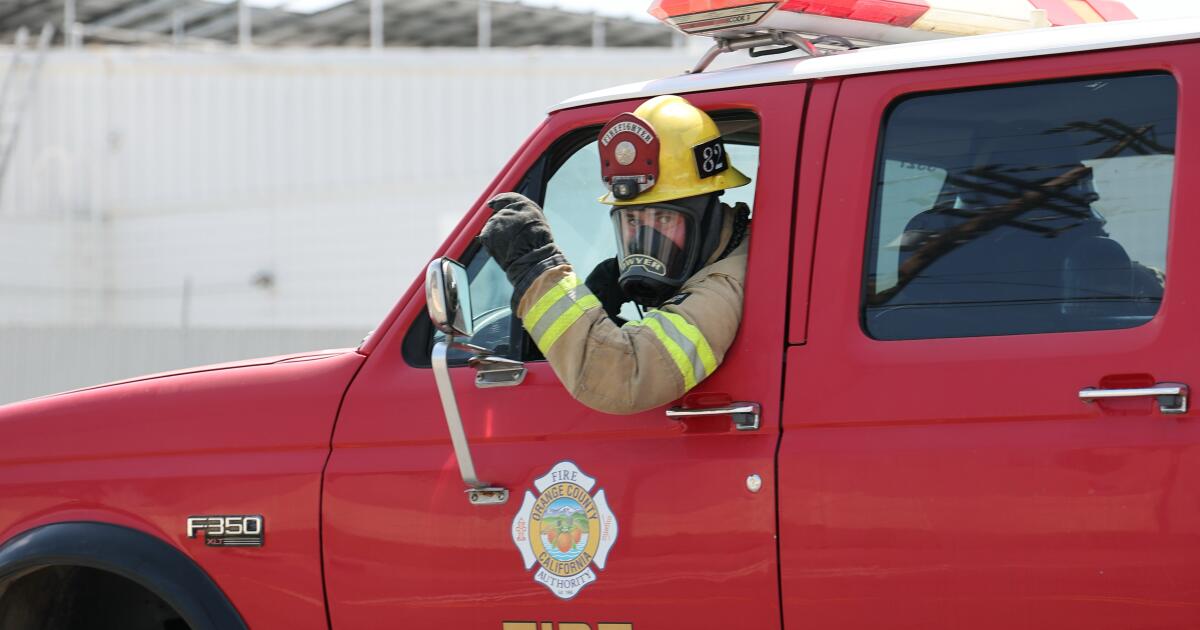
“Now I know why I smelled it and why I got the headache,” Rinker said Friday night after evacuating her home while emergency crews frantically worked to stop a damaged chemical tank at GKN Aerospace in Garden Grove from exploding.
Rinker, who is retired, had a long career in the automotive industry. “I know smells,” she added.
Rinker was staying at the evacuation center at the Garden Grove Sports & Recreation Center, with her two pugs, Lulu and Daisy, and her daughter’s two cats, Cedric and Elvis.
She was walking Friday morning at around 11 a.m. when a neighbor called and told her she needed to get the pets and go.
Her daughter and son-in-law, who live with her, were on a trip out of state, so she spent most of the day in her car at the evacuation center with the pets. The evacuees, she said, were remarkably calm, and relief workers fed them “some delicious spaghetti.”
“Everybody’s very relaxed, just chilling, sitting down,” she said. “A lot of people have their dogs. It’s OK, you know? It’s not a chaos thing.”
Still, she said, she had no idea when she could go home and was upset she had not grabbed food for the pets because she did not think she would be gone so long.
“I’m just hanging out in my car,” she said from the evacuation site. “I see no sense in going anywhere and wasting my gas, as high as it is.”
Rinker said she had friends and neighbors who refused to leave.
Rinker has lived in Stanton, near the aerospace manufacturer, for three decades and said she had never experienced anything like this.
“All I need is for my house to explode,” she said sarcastically.
Then, with a sigh: “I’m trying not to think about it. I love my house.”
-

 South Dakota4 minutes ago
May proclaimed Archaeology & Historic Preservation Month
-

 Tennessee10 minutes ago
What Tee Martin said about joining Lane Kiffin’s staff, son’s transfer to LSU
-

 Texas16 minutes ago
2026 NCAA softball tournament: Bracket, schedule for the Women’s College World Series, scores
-

 Utah22 minutes ago
Utah father now accused of abusing 2 teen girls
-

 Vermont28 minutes ago
Police search for missing Pownal, Vt., teen
-

 Washington40 minutes ago
Washington State Ferries makes room for pets, paws with new policy launching this summer
-

 Wisconsin46 minutes ago
12 Offbeat Wisconsin Towns To Visit In 2026
-

 West Virginia52 minutes ago
How to watch Kansas baseball play West Virginia in Big 12 tournament

