Midwest
When anti-ICE clashes trigger federal intervention: Experts explain the constitutional breaking point

NEWYou can now listen to Fox News articles!
Anti-ICE protesters have surrounded federal agents, Democratic leaders have denounced enforcement operations and tensions in Minneapolis have boiled over, but experts say none of it crosses the line into a constitutional breakdown or would justify the use of federal emergency powers by President Donald Trump.
Legal analysts say the unrest, while volatile, does not inhibit the federal government’s constitutional authority to enforce immigration law. That threshold would only be crossed if state officials themselves moved to block or materially obstruct federal agents, raising supremacy clause concerns.
Ilya Somin, a George Mason University law professor, told Fox News Digital that agitators hindering federal agents’ work, even aggressively, does not rise to that level.
“There is no general principle of law which says that anything that makes the work of federal agents more difficult in any way somehow violates the Constitution,” Somin said.
FEDS SHIFT TO TARGETED IMMIGRATION ENFORCEMENT IN MINNEAPOLIS UNDER HOMAN
Protesters clash with law enforcement after a federal agent shot and killed a man Jan. 24, the second federal-involved shooting in the city during the month, deepening tensions over enforcement operations in Minneapolis. (Arthur Maiorella/Anadolu via Getty Images)
Protesters have taken to the streets of Minneapolis in recent weeks to confront immigration officers during Operation Metro Surge, a federal enforcement effort that has deployed thousands of ICE and Customs and Border Protection agents to Minnesota.
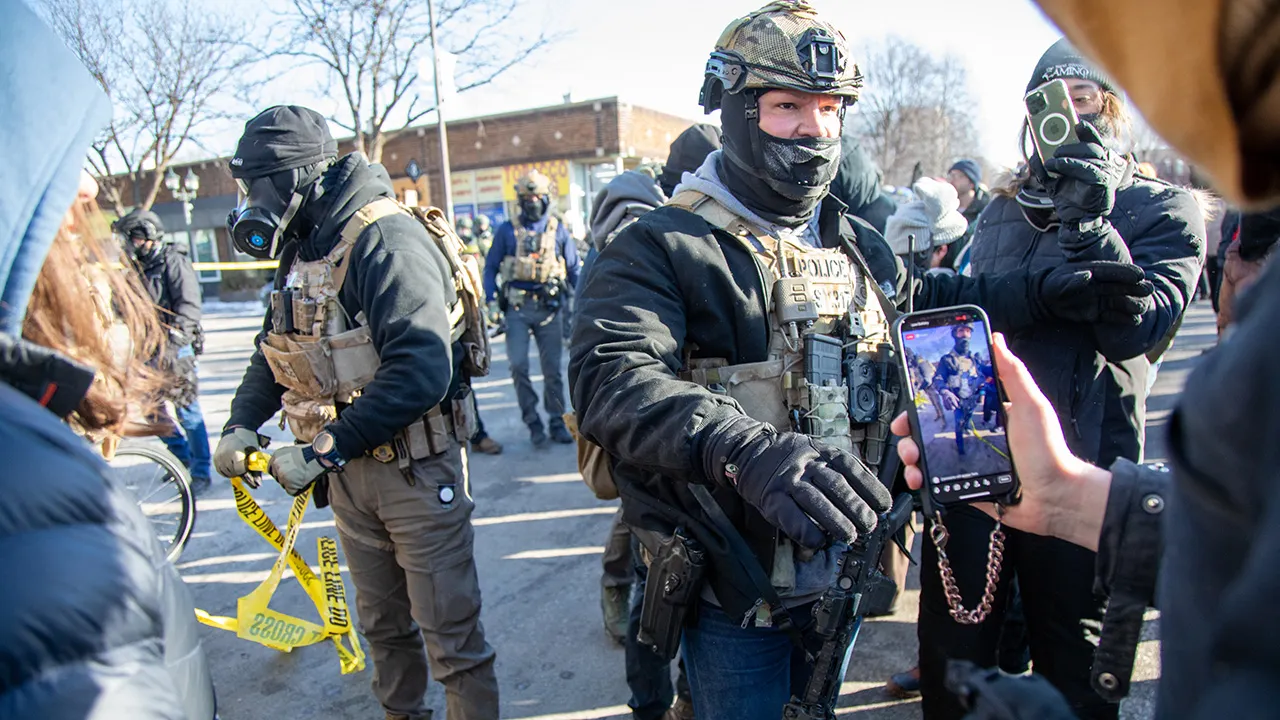
During enforcement actions, protesters have at times surrounded ICE agents with shouting, whistles, filming and unruly crowds, creating a tense mix of peaceful demonstrators and coordinated agitators that has occasionally escalated into blockades or violence.
The dynamics at play have centered on two legal principles. On one hand, the anti-commandeering doctrine prevents the federal government from forcing state and local officials to enforce federal law. On the other, obstruction of federal law enforcement is unlawful and could violate the supremacy clause, which says federal law trumps state law when the two are in conflict.
If the state were to pass laws that obstruct federal law enforcement from performing its job duties, that would trigger supremacy clause concerns, Somin said, but he noted that such conditions are not present in Minnesota.
Operation Metro Surge began in December, sending 3,000 immigration agents to Minneapolis and St. Paul. The effort has led to thousands of arrests, but it has spurred resistance from residents and resulted in two high-profile deaths of U.S. citizens at the hands of immigration agents, which fueled further public outrage. The FBI is now investigating those incidents.
Minnesota Gov. Tim Walz met with Trump border czar Tom Homan as the administration reshuffled federal immigration leadership in the state. (Chip Somodevilla/Getty Images)
Democratic state leaders, meanwhile, have widely criticized the operation and drawn blame from Republicans for exacerbating tension with their rhetoric. At one point, Democratic Minnesota Gov. Tim Walz compared ICE’s presence to the Civil War.
“I mean, is this a Fort Sumter?” Walz told The Atlantic. “It’s a physical assault. It’s an armed force that’s assaulting, that’s killing my constituents, my citizens.”
Asked whether the resistant nature of Minnesota’s Democratic leaders could amount to “nullification,” Somin rejected the idea.
“Nullification is when the state officials themselves resist the enforcement of federal law. If they merely fail to help the feds against private parties, that is something that’s protected by the anti-commandeering principles of the Tenth Amendment,” Somin said.
That hands-off approach has extended beyond rhetoric. Walz has welcomed a reduction in federal personnel but urged a faster drawdown, while Minneapolis Mayor Jacob Frey has said the city would not assist with immigration enforcement.
“We were never going to agree, and we have not agreed, to enforce federal immigration law. Why? It’s not our job,” Frey said in a New York Times interview.
As state and local leaders have declined to intervene, opposition to the ICE operation has increasingly taken shape on the ground. Activists have mobilized to confront and monitor federal immigration agents, activity that legal experts distinguish from unlawful, state-led obstruction.
Central to that resistance is Defend the 612, a network of private citizens that has coordinated what activists describe as “ICE watching,” using encrypted messaging apps to track enforcement activity and share information about agents’ movements, according to reporting by the conservative City Journal.
In addition to street confrontations, activists have staged protests at sensitive locations, including a disruption of a church service in St. Paul, where the pastor is also an ICE field director. Several participants, including former CNN anchor Don Lemon, were arrested and charged under a federal statute typically used to protect abortion clinics and pregnancy counseling centers.
TRUMP’S IMMIGRATION VICTORY IN A MINNESOTA COURT IS A WIN FOR ALL LAW-ABIDING CITIZENS
Don Lemon has told Fox News Digital he stands by his reporting. (Don Lemon/YouTube)
Federal authorities have moved to arrest individuals accused of directly impeding immigration enforcement. Attorney General Pam Bondi announced charges against 16 agitators accused of obstructing agents and assaulting officers, while the Justice Department also charged a Minneapolis man, a self-described Antifa member, with cyberstalking after he allegedly called for attacks on ICE and doxxed a pro-ICE individual.
Even so, legal experts stress that, so far, all the anti-ICE activity falls short of a collapse of federal authority. Hans von Spakovsky, a senior legal fellow at Advancing American Freedom, said existing laws already prohibit “mob” violence and obstruction, adding that Minnesota leaders’ approach has been “irresponsible” but not illegal.
The DOJ in January subpoenaed Walz, Frey and three others for information on whether they conspired to interfere with ICE’s work. A DOJ spokesman did not respond to a request for comment on the status of that probe.
Should unrest intensify, the Trump administration has floated the Insurrection Act, a rarely used provision that allows the president to respond to unlawful obstructions of federal authority. The president has said that while it remains an option, it is not currently necessary.
Trump’s border czar, Tom Homan, who is leading immigration operations in Minneapolis, likewise downplayed the impact of anti-ICE agitators.
“You’re not going to stop ICE. You’re not going to stop Border Patrol,” Homan said. “These roadblocks they’re putting up? It’s a joke. It’s not going to work, and it’s only going to get you arrested.”
Ilan Wurman, a University of Minnesota law professor, said in a podcast that while Trump “probably” could invoke the Insurrection Act, by constitutional standards a president should only call upon the military to enforce federal law as a “last resort.”
Fox News contributor Jonathan Turley spelled out when the Insurrection Act could be appropriate, noting it was deferential to the president.
“The establishment of roadblocks and direct interference with the enforcement of federal laws can support such an invocation,” Turley said. “During the Civil Rights period, opposition to and obstruction of civil rights laws justified the use of military force.”
Still, Turley and others emphasize that the Minnesota protests, as intense and at times chaotic as they have been, do not yet meet the criteria for such drastic federal action.
“The promise of some Democratic leaders to arrest and prosecute ICE agents is likely to fail. Roadblocks to bar federal agents would also constitute obstruction and, if supported by the state, would violate the constitutional authority of the federal government,” Turley said.
Read the full article from Here



In Lincoln, Ill., another pillar just fell. The New York Times’ Julie Bosman reports that the state plans to close Logan Correctional Center, a women’s prison that employs more than 500 people, stripping the Route 66 town of about 13,000 of one of its last major, stable job sources. State officials say the nearly century-old complex is too deteriorated to fix and will be replaced by a new, modern facility in Crest Hill, outside Chicago. Capitol News Illinois reports the Illinois Department of Corrections estimates it’ll take five years to build the new prison.
In Lincoln, where factories, a glass plant, and even a 157-year-old college have already called it quits, that decision feels like one more hit—and one that favors the Chicago area over downstate. Residents and local leaders, who spent years lobbying to keep the prison, now worry about a fresh wave of departures as families follow jobs elsewhere, further straining schools and small businesses already on the edge. For a look at what the loss of a single prison means for one Midwestern town—which takes particular pride in the fact it was uniquely named for Abraham Lincoln before he became president—read the full piece.
Indiana
Indiana Republicans nominate Max Engling for secretary of state at GOP Convention in Fort Wayne

FORT WAYNE, Ind. (WANE) — Republican delegates selected Max Engling as their nominee for Indiana Secretary of State on Saturday, defeating incumbent Diego Morales at the Indiana GOP State Convention in Fort Wayne.
Roughly 1,800 Republican delegates gathered at the Grand Wayne Convention Center to choose the party’s nominee. Engling, a Hamilton County resident and former senior advisor to U.S. Sen. Jim Banks, will now advance to the Nov. 3 general election.
He will face Democratic nominee Beau Bayh and Libertarian nominee Lauri Shillings. Former Indianapolis Mayor Greg Ballard is also expected to appear on the ballot as an independent candidate after his campaign announced Saturday it had collected more than 52,500 signatures, exceeding the number needed to qualify.
Following his victory, Engling said he was grateful to the delegates and fellow candidates.
“I’m very thankful, very blessed to move forward into the general election,” Engling said. “I’m thankful to the delegates. I’m thankful to the other candidates that ran great races.”
Engling said the campaign will focus heavily on election administration and Republican priorities heading into November.
“We’re going to win when we get there in November,” he said. “The goal is to have common sense solutions where we tighten our security around our elections. I’ve already said it — we’re here to close the primaries, make sure that only citizens are voting in our elections, and to stop the business fraud that we’ve seen in these shell trucking companies that have popped up around the state.”
He said those efforts would begin immediately if elected.
“Priority on day one, we’re going to work with the statehouse to close the primaries,” Engling said. “We already have legislation in the statehouse right now, and we’re pressing on that immediately.”
Engling also addressed the broader political environment, including the possibility of independent candidates on the ballot.
“So, Indiana wants common-sense voting laws,” he said. “They don’t want to move over to a third party; they want to vote for the conservative, Republican option. We’re excited for that.”
He added that Republicans must remain unified heading into the general election.
“Two rounds of voting, understood,” Engling said. “We know that Republicans need to move forward together. That is my mission. So, we are moving forward as a team.”
Engling said the campaign will stay focused on voter turnout and message discipline.
“We’re going to run our race with who we’ve already put forward,” he said. “We’re not looking at what the other folks are doing. We’re going to be energized on our side and say, ‘How do we make sure that our voters are coming out?’ We’re moving forward as a Republican team.”
He closed by emphasizing unity after a competitive convention.
“We are one Republican team,” Engling said. “We know that. We’re going to move forward as a unified team.”
Indiana State Treasurer Daniel Elliott also spoke during the convention, thanking delegates and reflecting on Republican performance heading into November.
“Well, I’m grateful for the Republican Party and their trust in me,” Elliott said. “I worked really hard these last four years to show that we can get good work done. And I think it paid off.”
Elliott said the focus now shifts to the general election.
“November, that is where it really counts, because November is when we’re going to the people of Indiana to say, ‘Here’s what we’ve done,’” he said. “We have good leadership, good Republican leadership. We have good results, our state is one of the top business states in the country. I raised $1.24 billion in two years, which is double what was done in the previous decade. We’ve got a good winning message, so I’m ready for November, and we really want to get everyone’s vote.”
He encouraged voter participation across the state.
“I appreciate your support, I appreciate your support to get here, and now, we need y’all to get out,” Elliott said. “We need to get out, all of us, and vote. This is a sacred responsibility, and it really means something. We need everyone, especially Republicans, to get out and vote.”
Elliott also noted internal confidence within the party following a contested convention process.
“I’ve been very fortunate that the party supports me,” he said. “The reason we didn’t have any opponents is because we’ve worked really hard and people have seen the good work and what we’ve put forth, and they say, ‘Yes, that is who we need.’”
The convention marks only the third time in the last century that the Indiana Republican Party has held its state convention outside Indianapolis.
“This has surpassed the perfection of the 2014 convention,” Allen County Republican Party Chairman Steve Shine said. “I’ve heard nothing but accolades about how great our city is from people who haven’t been here in the last 12 years.”
Shine said the competitive Secretary of State race helped drive enthusiasm among convention attendees.
“There were four great candidates that worked very hard to secure the votes of the delegates,” Shine said. “Today, the winner showed that they were the one with the most perseverance and were able to convince the delegates that they were the right person to face the Democrats in the fall.”
The Secretary of State contest became increasingly contentious in recent weeks after Indiana Attorney General Todd Rokita and Banks withdrew their support for Morales, citing concerns about his ability to win in November.
Rokita said he believes Republicans will unite behind Engling despite the contentious nomination battle.
“Oh, it’s going to play out fine,” Rokita said. “We do this a lot better than Democrats, let me tell you that.”
Following Engling’s victory, Rokita predicted Republicans would rally behind the nominee despite the hard-fought contest.
“Republicans, because we’re all individuals at heart, it’s in our DNA to have these discussions and then unify together,” Rokita said. “I’ve been the candidate in four conventions. Most of them contested.”
Rokita, a former Indiana Secretary of State himself, said he expects the party to come together ahead of the general election. The attorney general said he expects the party to rally around Engling ahead of November.
“Our party has always coalesced around me and against the Democrat in the fall,” Rokita said. “I expect the same thing now.”
Indiana voters will decide the state’s next Secretary of State during the Nov. 3 general election, when Engling faces Bayh, Shillings and potentially Ballard on the statewide ballot.

Coming off a great campaign, the Iowa State Cyclones will be a different-looking team on the hardwood next year. Unfortunately, a lot of key players for the team last season will no longer be around.
After a successful trip to the Sweet 16, the Cyclones will be entering next season with a mostly new group. Due to players like Joshua Jefferson, Nate Heise, and Tamin Lipsey all graduating, the team was always going to have a different look.
While it appears likely that both Lipsey and Jefferson are going to be drafted into the NBA, it goes to show the level of talent that Iowa State is losing. These two players were arguably the two best on the team last year, and replacing that level of production will not be an easy task.
Since both of those players were seniors, the program knew that they would be playing elsewhere. However, the decision by Milan Momcilovic, who was their third star to enter the NBA Draft and transfer portal, likely wasn’t something the team expected before his breakout campaign.
However, due to his success last year, Momcilovic testing the waters of the NBA and entering the portal made a lot of sense for the talented sharpshooter. Eventually, he made the decision to join the Kentucky Wildcats, and losing him will be a big blow for the Cyclones.
Iowa State Will Miss Star Potential of Milan
Even though the Cyclones were able to bring in a lot of good players in the transfer portal, figuring out who the star of the team is going to be next year might be a bit tricky. If Milan were to have returned following one of the best shooting years in the history of college basketball, it would have undoubtedly been him as the featured player of the team.
Now, since Momcilovic is gone, Iowa State is going to need some of their returning players and their new additions to step up. While having quality depth is important, the Cyclones were a team that had arguably three of the top 50 players in college basketball last season.
With their three best players gone, it will be interesting to see who steps up and becomes the top players for Iowa State. Of the transfers, it could be JaQuan Johnson who looks to step up into that role. He is coming off a really strong year with Bradley and very well could be the top-scoring option for the team.
 Add us as a preferred source on Google
Follow
-

 Florida1 minute ago
Juneteenth in Fort Myers: See photos of the celebration
-
Georgia6 minutes ago
Georgia Lottery Powerball, Cash 3 results for June 20, 2026
-

 Hawaii13 minutes ago
Waianae encampment deadline extended amid pushback from lawmaker, community
-

 Idaho16 minutes ago
One dead, four injured in US 26 crash near Ririe – East Idaho News
-

 Illinois21 minutes ago
Illinois Prison Closure Deepens Small Town’s Fears
-

 Indiana28 minutes ago
Indiana Republicans nominate Max Engling for secretary of state at GOP Convention in Fort Wayne
-

 Iowa31 minutes ago
Why Iowa State Basketball Will Miss Star Potential of Milan Momcilovic
-

 Kansas36 minutes ago
Salvador Perez attended the Ecaudor-Curaçao match at Arrowhead. So did other royals — from the Netherlands

