News
Video: NASA Delays Artemis II Rocket Launch Until at Least March


new video loaded: NASA Delays Artemis II Rocket Launch Until at Least March
transcript
transcript
NASA Delays Artemis II Rocket Launch Until at Least March
NASA delayed the Artemis II mission on Tuesday after detecting hydrogen leaks. The mission was scheduled to circle the moon with four astronauts.
-
As we began that pressurization, we did see that the leak within the cavity came up pretty quick. We did a cutoff, which is a normal safing activity for us.

By Jackeline Luna
February 3, 2026



This year’s cohort of Israeli and Palestinian entrepreneurs taking part in 50:50 Startups is smaller than usual, because the war prevented many from travelling. 50:50 co-founder Amir Grinsteen (third from right) founded the program seven years ago, believing that building businesses together would also build lasting bridges, that could advance the cause of peace.
Dena Yadin
hide caption
toggle caption
Dena Yadin
BOSTON – Salah Hussein was 11 years old when he was woken up in the middle of the night by Israeli soldiers in his family home in Nablus in the West Bank. It left him traumatized and terrified for years.
It was “triggering” to see any Israeli in uniform, he says. “For me, all of them were a threat.”
But decades later, Hussein, now a 33-year-old entrepreneur, has willingly and purposefully tied his fortune to his co-founder, who is an Israeli Jew.
Hussein is one of about 35 entrepreneurs taking part in a start-up accelerator program called 50:50 Startups, where mixed teams of Palestinians, Israeli Arabs and Israeli Jews spend six months in a kind of business bootcamp, going to workshops, lectures and connecting with mentors. The program culminates with a session in Boston, where the entrepreneurs pitch their ideas to potential investors.
The cross-the-divide collaboration brings an extra layer of challenge to what is already a heavy lift. By most estimates, about 90% of startups fail. But Hussein is fiercely determined, not only because of pragmatic considerations, like the need for resources and access to capital for his business, but also the more lofty ideals.

Salah Hussein, a Palestinian from Nablus, is excited about investors’ interest in his venture that uses AI and cameras to detect and prevent greenhouse pests.
Tovia Smith/NPR
hide caption
toggle caption
Tovia Smith/NPR
“If we are not the ones looking for change, who will be? We are the right people at the right place, at the right time. We have to move on,” he says. “I don’t want my kids to be living in a world full of hatred.”
Yana Shaulov is the Jewish Israeli on Hussein’s team. A 37-year-old molecular biologist, she joined 50:50 hoping to launch an idea of her own, but ended up joining Hussain’s team instead. Having grown up in a mixed neighborhood of Haifa, she says, she’s used to coexistence.
“It’s not always easy, you can feel the tension sometimes, but [Israelis and Palestinians] are both here to stay, and we have to live together at the end of the day,” Shaulov says. She concedes that the small collaborations at 50:50 are just “a small start,” but believes what they’re doing will be “contagious.”
“It’s already worth it just to show other people that it’s possible,” she says.
The team also includes two others: a Palestinian from the West Bank and a Christian woman who is an Israeli citizen. Their company, Qanara Tech, is developing AI cameras to detect and prevent insects in greenhouses growing food. Other teams include one with a patent pending to build a better heart monitor, and another that uses egg shells and plant seeds as the filter in a water purification system.
Sometimes, even when the ideas are viable, the partnership is not. Hussein says he had a previous venture that fell apart shortly after Hamas’s deadly attack on Israel on October 7th, 2023, and the war that ensued. The tension was just too much, both within the team and especially from hardliners back home. The scorn and backlash can be so intense, Hussain says, it’s hard to keep it from getting in your own head.
“Sometimes even thinking about what I’m doing right now fills me with some negative [voices], like, ‘Salah, you’re a normalizer. Be careful!’, he says. But then the “other voice” in his head chimes in, “Keep going, Keep moving! All these tiny effects can lead to change.”
Israelis participating in the program, like 27-year old Aviv Meir, say they feel it, too.
“It’s hard to put yourself in the enemy’s shoes,” she says with a sigh. “You need to have so much strength to feel safe, and to understand that understanding their side will not demolish your side. It’s sometimes making you crazy.”
Meir has been involved in bridge-building initiatives since she was a teenager. She’s the type you’d expect to sign up for a program like this. But 50:50 is also drawing in participants not already inclined toward dialogue.
The hard conversations
Salah Elsadi, a Palestinian who lived in Gaza for 15 years, says he wasn’t even aware of the peace-building aspect of 50:50 when he applied to the program. He was interested in building his business, not bridges. But he has learned to lean in when he has to. For example, at a recent 50:50 event in Boston that was open to the public, a French Israeli woman, Sarah Blum, drew Elsadi into conversation. A short while in, she told him that about 10 years ago, a Palestinian man from Jerusalem attacked her with a knife.
“He wanted to kill me,” she said.
Elsadi was visibly taken aback, but continued listening as Blum shared that some of the first people who called to check in on her were close friends who were Palestinian, and how important it is to continue dialogue even in the most difficult moments.
Then, in what seemed to be a bid to ease the moment, she asked Elsadi how his family in Gaza was doing. But it did little to diffuse the tension.
“Not good,” he answered. “They’re struggling to find water or food. My youngest brother has chronic disease and can’t get medicine.”
Blum said she could understand.
“I have close family friends who were in Kfar Aza on October 7th who are traumatized from the massacre, and some who lost loved ones [who were] taken hostage and killed in Gaza, and [did not have] access to medicine when they were in captivity,” she said.
It’s the kind of conversation that could have easily spiraled out, but Blum and Elsadi managed to take in each other’s pain. The encounter ended with a hug, and both said afterward that it just reinforced their conviction that focus must shift from past grievances to future possibilities.
“We need to start a new thing, not just to remember the last things which remind us that ‘Oh, I need to take revenge,” Elsadi says. “We cannot continue war, war, war, war. How long do we want it to continue?”
Program leaders take pains to say that 50:50 is not a political organization. That’s what allows it to create an environment where each side can see the other as people, not enemies.
In one stark example, a Palestinian man who grew up in a refugee camp near Hebron was sharing how he felt humiliated and harangued by IDF soldiers at checkpoints. Then he found out one of the Israelis he had come to know in the program was actually one of the soldiers stationed near his home. It was striking, he says, to hear that former Israeli soldier share how terrified he and others were of Palestinians.
“They feel [the Palestinians] will attack them, or maybe shoot them, so they always stand by, [with] nerves tense,” the Palestinian man said. “At the end of the day [the soldier is] a human being. He’s someone like me who just wants to get back home safe and have dinner with [his] family.”
But that kind of talk doesn’t go over well back home, this Palestinian man says, which is why he asked that his name not be used in this report.
“People say it’s like betraying, especially in this situation, [where] everything is on fire,” he said. “I don’t want to be a target to [be] hurt or something.”
Building trust organically
The 50:50 Startups program was co-founded by Israeli-American Amir Grinstein in 2019, and the program later partnered with Tel Aviv University and Northeastern University in Boston, where he’s a marketing professor. The idea is that short of marriage, creating a business together may be the most profound way to bond two people together; it’s a partnership based on equality, a shared goal and a mutual trust and reliance on each other’s support.
“Its very intimate, it’s very intense, it’s up and down like a roller coaster, and it’s long term,” Grinstein says. “They have to try hard to work together. They’ll fail together or they’ll succeed together.”
As a start-up itself, 50:50 has had to pivot and iterate through challenges Grinstein could never have imagined: COVID, October 7th, and several wars. Each has made it difficult or impossible for the entrepreneurs to travel to Boston for the capstone session at Northeastern. This year, because of the ongoing war in the region, more than half the entrepreneurs could only attend by Zoom.

Israeli and Palestinian entrepreneurs in the 50:50 Startups program attend a workshop at Harvard Business School about data analysis.
Salah Hussein
hide caption
toggle caption
Salah Hussein
“You are still under missiles with this war raging outside, and we hope it will be over soon,” Grinstein says at the start of a recent class. He then pivots to the day’s lesson, which happens to be about negotiation and rebuilding trust when things become tense or adversarial, an especially apt lesson for these entrepreneurs.
But that’s as close as 50:50 gets to any specific instruction on cross-the-divide collaboration. Unlike other coexistence programs, there are no dialog workshops or trust-building exercises. Grinstein says that just happens organically.
“The elephant is obviously in the room, so we’re not ignoring it,” Grinstein says. “But what I want is to see the Israelis and Palestinians develop friendships that transcend the business, and then naturally you will have coffee with your partners and you might be in a better position – after you build trust, after you work together — to have conversations that are tough and challenging.”
Still a relatively small program, 50:50 has taken on some 320 participants since it began. But Grinstein says the relationships they forge have significant ripple effects on friends, and family, as well as on the Northeastern undergraduates who are part of his class, and work as interns for the start-ups.
Senior Alexa Garcia, says just watching the entrepreneurs working together, laughing and teasing each other, was a lightbulb moment for her.
“Sometimes it’s so easy to forget that they’re on such different sides of a conflict because they seem like such good friends, like the banter is crazy,” she says. “A lot of times it’s just completely out of my mind that they are on two different sides of conflict.”
Garcia and two other students who stopped to talk after class say they each started the semester with a clear leaning toward either the Israelis or Palestinians. But that changed, they say, as they got to know the entrepreneurs personally and came to understand the hardships suffered by both sides, like when team meetings were delayed because a Palestinian was stuck at a checkpoint, or an Israeli had to run to a bomb shelter.
All three say their views have now shifted toward the middle.
“Both sides have been through so much, both have done right, both have done wrong,” says Garcia. “The more I learn, there’s no side for me.”
A ‘hippie heart’ and a ‘capitalist brain’
The 50:50 session in Boston ends with a Shark Tank-style chance for the teams to pitch their ventures to potential investors and hope an investor will bite, or at least offer some useful feedback.
For their part, investors grill the entrepreneurs about not only their ideas, but also their partnerships; they’re investing in a team as much as a product. And while some see the collaborations as inherently risky, others see them as an asset – at least potentially.
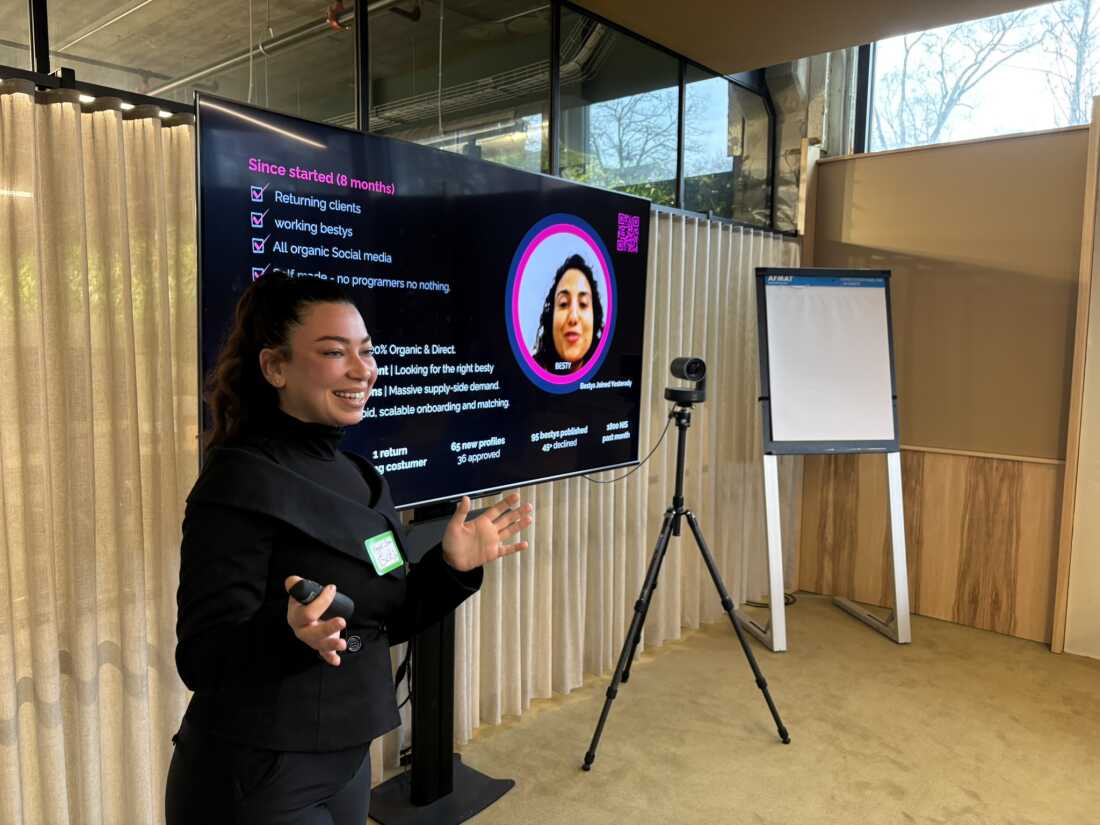
Hagar Shmaia, from Israel, was one of about a dozen Israeli and Palestinian entrepreneurs who pitched their ideas to a room of investors, as part of the 50:50 Startups program. Shmaia has designed an online platform called “Besty” that allows women to find a wide range of support on-demand
Tovia Smith/NPR
hide caption
toggle caption
Tovia Smith/NPR
“I always say I have a hippie heart and a capitalist brain,” says Brian Abrams, founder of B Ventures, one of the investors who listened to the pitches. “My hippie heart loves this kind of collaboration. My capitalist brain insists it makes business sense.”
In a best-case scenario, Abrams says, the Israeli-Palestinian partnerships could create a “halo-effect” around a brand, helping a start-up to build momentum.
“The collaboration builds the brand, attracts other people, helps them get bigger, and at best that becomes a virtuous cycle,” Abrams says.
Ultimately, the case could be made that startups run by these unlikely co-founders could actually be safer investments, says Tomer Cohen, Co-Founder and Director of Tech2Peace, a bridge-building program similar to 50:50 for younger participants.
“If the entrepreneurs have managed to come together in spite of the political reality, it actually says a lot about them as individuals, that they will be more resilient and can overcome most of the challenges that [entrepreneurs] face in early-stage ventures,” he says.
So far, Grinsteen says, 50:50 ventures are beating the odds. It’s still early for many, but of the roughly 55 start-ups, about a half are still in the game.

Vice President JD Vance made an unannounced visit to the Supreme Court last week to attend a private dinner in a wood-paneled conference room with Chief Justice John G. Roberts Jr. and dozens of the chief justice’s former law clerks.
Accompanying his wife Usha, who clerked for the chief justice nearly a decade ago, Mr. Vance’s visit was a social call, people familiar with the dinner said. But Mr. Vance’s friendly pop-by illustrated the awkward dance that has been underway between the Trump administration and the nation’s highest court, as the administration has at times appeared to woo the justices even as President Trump has repeatedly bullied and insulted them.
With the court preparing to issue major rulings in the coming weeks that will determine the fate of key aspects of the president’s agenda, Mr. Trump has vacillated between combative and conciliatory in his treatment of the justices.
He has seemed ever aware and at times resentful of the critical role the justices play in determining the lawfulness of his policies, with the court representing perhaps the one force in American government truly able to thwart his agenda. At the heart of the tension: a president who appears to believe that justices, especially those he appointed, should be loyalists rather than independent actors in a separate, equal branch of government.
Abigail Jackson, a White House spokeswoman, said in a statement that the American people have “always valued President Trump’s ability to freely speak his mind and share his thoughts directly with them” — including about the court.
The chief justice did not respond to a request for comment. A spokeswoman for Mr. Vance declined to comment.
Mr. Trump was furious with the court after it invalidated his sweeping tariffs in February. He called a news conference to vent, criticizing individual justices as “fools and lap dogs” and saying his two nominees who voted against him were “an embarrassment to their families.”
While past presidents have voiced disagreement and frustration with Supreme Court rulings, that kind of language and personal animosity has been unheard-of from a president.
Standing silently by his side was the solicitor general, D. John Sauer. Mr. Trump’s former personal lawyer represents the administration at the Supreme Court in a role that has traditionally been so trusted by the court that it is nicknamed the “10th justice.”
Despite Mr. Trump’s anger, the administration has abided by the court’s ruling in the tariffs decision. The U.S. government this month started to refund some of the roughly $160 billion collected from those tariffs, plus interest.
Days after the news conference, Mr. Trump toned things down at his State of the Union address, when he could have blasted the chief justice and other members of the court to their faces as they sat in their robes in the front of the House chamber. Instead, in his remarks, Mr. Trump merely declared the ruling to be “very disappointing.” Otherwise, he was cordial to the four justices who attended, shaking their hands and exchanging pleasantries as he made his way to the rostrum.
But in recent weeks, the president has returned to hammering the court, including in repeated social media posts, as he has been appearing to brace for another major loss when the court rules on his effort to end the guarantee of birthright citizenship. The decision is expected by late June or early July.
“It would be a disgrace if the Supreme Court of the United States allows that to happen,” Mr. Trump said during an event in the Oval Office on Thursday. “It’s all up to a couple of people, and I hope they do what’s right.”
Mr. Trump turned up the pressure in early April when he became the first sitting president to attend an oral argument at the court for the birthright citizenship case. He spent about an hour listening to the arguments before abruptly getting up and walking out while the session was still underway. Critics said it was a show of power designed to intimidate the justices.
The president subsequently complained in a social media post that the Supreme Court had “not even recognized or acknowledged” his presence.
At the same time, the president hosted all six of the justices nominated by Republican presidents to the White House last month for a state dinner honoring King Charles III of Britain and Queen Camilla. The dinner was held the night before the court heard a case about Mr. Trump’s immigration policies.
None of the three liberal justices attended, and neither the White House nor the court have said whether they were invited.
On Friday, two justices who the president has praised were in the East Room of the White House. Justice Clarence Thomas swore in Kevin Warsh as the next chairman of the Federal Reserve. Justice Brett M. Kavanaugh also attended.
Three of the justices who took part in the state dinner — Neil M. Gorsuch, Amy Coney Barrett and Justice Kavanaugh — were picked by Mr. Trump during his first term, drawing them Mr. Trump’s particular attention and, at times, his ire. In a recent post, as he criticized Justices Gorsuch and Barrett for voting against his tariffs, he insisted they should have been “loyal to the person that appointed them.”
The justices seem to have struggled with whether or how forcefully to respond. They have not specifically addressed Mr. Trump’s personal insults and have not responded to requests for comment about his statements when asked. But they have at times politely pushed back in public appearances.
In recent interviews to promote his new children’s book, Justice Gorsuch has rejected assertions that the justices should be loyal to the president.
“My loyalty is to the Constitution, the laws of the United States,” he said in an interview with CBS News. “That’s the oath I took. It’s really just that simple.”
The chief justice too has gently denounced the personal attacks — but indirectly. During an appearance at Rice University in March, he said harsh rhetoric aimed at justices is “dangerous.”
“It’s got to stop,” he added, without specifying whose rhetoric he was describing or naming Mr. Trump.
In an interview with a federal judge last year, the chief justice defended the independence of the judiciary, saying its role is “to obviously decide cases but in the course of that to check the excesses of Congress or the executive.”
Colleen Sinzdak, a former law clerk to Chief Justice Roberts who argues frequently in front the court, said the justices seem to be trying to stay above the political fray. By ignoring some of the attacks, the justices send the message that they see themselves as part of an institution rather than political actors scrumming with elected officials.
“It’s not supposed to be about you personally,” she said. “They are trying to embody that in how they are going about their business, and to the extent possible to do the things they would normally do — like going to state dinners.”
Likewise, Richard Lazarus, a law professor at Harvard who has written frequently about the court, said the justices appeared to be trying to treat Mr. Trump like any other party in a case when they seated him in the public gallery for the arguments in the birthright citizenship case, rather than in a special seat reserved for presidents that is used for courtroom ceremonies.
Still, he said the president’s personal attacks on individual justices were “out of bounds,” representing a unique assault that went beyond the traditional push and pull between the branches of government.
“It does damage to the court as an institution,” he said, and it “generates threats to the individual justices and their families when the president attacks them in this way.”
Professor Lazarus said he believed the justices should have declined to attend Mr. Trump’s state dinner last month, given that it appears only those nominated by Republican presidents had been invited.
“It’s wrong, irresponsible and undermines the integrity of the court, which all the justices tell us they believe in,” he said.
Ms. Jackson, the White House spokeswoman, said the president understands the dangers of political violence after three assassination attempts in less than two years.
“Any implication that sharing these opinions is akin to making threats is deeply unserious and should be dismissed by anyone with half a brain,” she said in a statement, adding that the administration “cares deeply for the safety of all members of the Judicial Branch.”
For his part, Mr. Vance, a graduate of Yale Law School, has not been shy about expressing his frustration with the courts and his wife’s former boss. In an interview with New York Times opinion columnist Ross Douthat last year, Mr. Vance said the chief justice was “profoundly wrong” to suggest that one of the roles for the court is to check the excesses of the executive branch. Courts, he said, should be “extremely deferential” to the president’s political judgments.
At the court last Saturday night, around 100 guests gathered for the reunion of law clerks, starting with cocktails in a courtyard, followed by dinner in one of the formal conference rooms on the same floor as the courtroom.
Mr. Vance and his wife were not given special seating at the chief justice’s table, said people familiar with the event who were granted anonymity to talk about the private dinner. And when Chief Justice Roberts gave brief remarks to welcome guests, he did not offer any special greeting to Mr. Vance.
For the night, the vice president was just a plus one.
Zolan Kanno-Youngs and Tyler Pager contributed reporting to this story.

It has become much harder to forget since the effective closure of the Strait of Hormuz.
Hundreds rather than the usual thousands of vessels have passed through the strait since March 5.
“This really feels like a global crisis, a little similar to what happened with Covid-19,” says Rystad’s Abramov. Gasoline and diesel prices have surged, and jet fuel and fertiliser are already in short supply; food prices are expected to rise, while the next phase of the crisis is likely to lead to fuel rationing and industrial shutdowns, experts have said.
Policymakers are debating when recession may set in. “The word on everyone’s lips is stagflation,” a senior European industrialist says. “The longer this goes on, the more I worry about it.”
As the disruption has stretched on for months, companies have been forced to find radical workarounds. Some are trying to transport goods via land — either through existing oil pipelines or using trucks.
Danish logistics group DSV, market leader in the Middle East, is moving cargo through Saudi Arabia and Turkey. “When everything is flowing, you don’t consider your job vital. But if you can’t get cargo in, the people there can’t eat,” says Jens Lund, the company’s head.
Lorries, however, can replace only a small share of the capacity provided by large container and cargo ships, while border crossings and challenging terrain can further slow their transit.
Battle for control
Western countries have traditionally worried about routes in the Middle East, fearing that any regional conflict could limit access to the Red Sea, Suez or the Bosphorus.
But Trump has placed the Panama Canal at the heart of his vision of hemispheric defence – accusing China of trying to control the waterway, and threatening to take control of it himself. A Hong Kong-based conglomerate previously ran two ports on the canal, until Panama annulled its contracts earlier this year. China has called the US president’s claims groundless and said it wants to keep the canal neutral.
Nonetheless Trump’s moves may encourage Beijing to “rekindle building a Nicaragua Canal”, says Jensen, referring to a concession granted to a Chinese businessman in 2013 to develop a new rival waterway – though little came of it.
Following Trump’s threats and the cancellation of the port contracts, China has increased inspections of Panamanian-flagged vessels, leading to reports of ships reflagging, he adds. China’s foreign ministry said in March that its inspections were in accordance with laws and regulations.
A Chinese academic in Beijing, who asked not to be identified, says Panama’s move on the ports “would not be forgotten in Beijing, which would improve its projection of hard power to ensure that this did not happen again in other important strategic chokepoints”.
“Right now, the cost is very limited [for countries like Panama], but I think in the future, this is not going to be tolerated,” he says.
-

 Health2 minutes ago
Filtered water at specific ages could add months to your lifespan decades later, new study finds
-

 Sports8 minutes ago
Raiders’ No 1 pick Fernando Mendoza surprises Cal’s MBA commencement by walking the stage for undergrad degree
-

 Technology14 minutes ago
Humanoid robots work nonstop in package test
-
 Business20 minutes ago
Defying Trump, California continues to bet big on offshore wind
-
 Entertainment26 minutes ago
Star Wars strikes back with $102 million projected for ‘The Mandalorian and Grogu’
-
 Lifestyle32 minutes ago
Sniff and find connection? These hip fragrance gatherings tantalize L.A.’s ‘smellers’
-
 Politics38 minutes ago
L.A. voters will cast ballots in eight City Council districts, two with open seats
-
 Sports50 minutes ago
LAFC coach Marc Dos Santos hopes to restore attacking identity after World Cup

