Politics
Trump’s playbook falters in crisis response to Minneapolis shooting

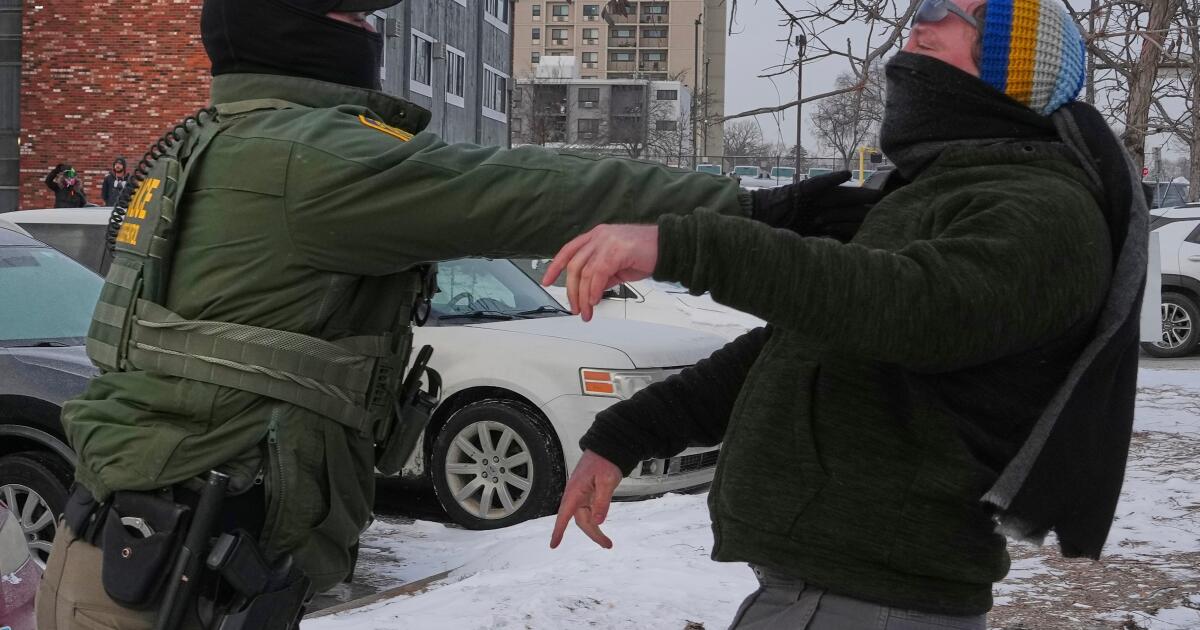
The Trump administration has blamed the death of an American citizen at the hands of immigration agents in Minnesota on the victim within hours of their killing for the second time this month, calling the late Alex Jeffrey Pretti an “assassin” and “domestic terrorist” without opening an independent investigation.
The crisis response from President Trump’s top Homeland Security officials followed a familiar playbook from an administration eager to project grit and resolve, particularly on immigration, in the face of inconvenient facts. Despite their efforts, damage from the incident continued to reverberate Sunday, creating political jeopardy for the president.
Videos that emerged of Pretti’s killing enraged the public. Government lines justifying the use of lethal force prompted blowback among staunch Republican supporters and conservative groups. Negotiations in Congress to thwart another shutdown were upended over Immigration and Customs Enforcement funding. And a Trump-appointed judge blocked the administration from attempting to destroy evidence in the case, lending weight to fears of a cover-up.
It is new terrain for Trump, whose handling of immigration had been a rare bright spot in polling of his job performance throughout his first year back in office. Now, for the first time, surveys show a plurality of Americans disapprove of the administration’s enforcement tactics, with one in three Republicans expressing concern they have grown too harsh.
Pretti, 37, an intensive care nurse at a hospital for veterans in Minneapolis, was shot 10 times at close range by two ICE agents. Multiple videos of the incident appear to show Pretti attempting to aid a fellow civilian who had been pushed by an ICE officer, before he himself was wrestled to the ground by agents.
He had been carrying a firearm that Minneapolis police said was lawfully purchased and registered. The videos that circulated on social media do not indicate that he had brandished, or was attempting to reach for, his weapon, despite Homeland Security Secretary Kristi Noem accusing Pretti of attending the protest with the aim of committing violence.
Bill Essayli, the assistant U.S. attorney in Los Angeles, warned that approaching law enforcement while armed created “a high likelihood they will be legally justified in shooting you.” But the administration’s decision to blame Pretti’s death on his decision to bear arms drew harsh rebuke from 2nd Amendment advocates across the Republican Party.
“Responsible public voices should be awaiting a full investigation, not making generalizations and demonizing law-abiding citizens,” the National Rifle Assn. said in a statement.
Erick Erickson, a prominent conservative commentator, accused Noem and Greg Bovino, Trump’s head of the U.S. Border Patrol, of making matters “far worse by being unrestrained in how they proceed.”
“The President is a great marketer and PR guy,” Erickson wrote on X. “While those around him may not realize it, I’m pretty sure he understands another dead American with his team rushing to undermine second amendment arguments and define the dead guy with a lot of facts still unknown is a bad look.”
The general counsel at the Department of Homeland Security during Trump’s first term said he was “enraged and embarrassed” by the agency’s “lawlessness, fascism, and cruelty,” and called for the president’s impeachment and removal.
“People have had enough,” Brian O’Hara, Minneapolis’ police chief, told CBS News’ “Face the Nation.” “The Minneapolis Police Department went the entire year, last year, recovering about 900 guns from the street, arresting hundreds and hundreds of violent offenders, and we didn’t shoot anyone. And now this is the second American citizen that’s been killed, it’s the third shooting within three weeks.”
Earlier this month, Renee Nicole Good, also 37 and a mother of three, was shot to death by an ICE agent while driving her car, shortly after dropping her son off at school. Just as in Pretti’s case, Noem and other senior administration officials justified the incident within hours of her death by impugning the victim’s motives without producing substantive evidence.
The aggressive response comes as the administration has faced accusations of misrepresenting other facts to the public.
After the president confused Greenland with the separate island nation of Iceland four times in a speech last week in Switzerland, Trump’s press secretary, Karoline Leavitt, flatly denied he had made the mix-up.
And on the same trip, Trump dismissed the role of NATO’s allies in the war in Afghanistan, where partner nations lost more than 1,000 soldiers over the course of the war, falsely claiming they “stayed a little back, a little off the front lines.” The remark has infuriated some of Washington’s closest allies.
Only when Noem was questioned by a conservative reporter on Fox News about the circumstances of Pretti’s death did she suggest error may have been at fault.
“This happened in seconds,” Noem said, asked whether Pretti had been shot and killed after being disarmed of a weapon he hadn’t brandished in the first place. “They clearly feared for their lives and took action to defend themselves.”


A man who was already known to the U.S. Secret Service approached the White House complex on Saturday evening, took a gun out of a bag and opened fire before being shot and fatally wounded by Secret Service police officers.
A bystander was also struck by gunfire, the Secret Service said in a statement, though it did not give details on the nature or severity of the injuries. It was unclear who fired the shot that struck the bystander.
The gunman, who was identified by two officials with knowledge of the investigation as Nasire Best, 21, was taken to a nearby hospital, where he was pronounced dead. No officers were injured, the Secret Service said.
In a social media post early Sunday, President Trump thanked the Secret Service and law enforcement officers involved in the shooting, and described the gunman as having “a violent history” and a “possible obsession” with the White House.
The shooting took place a little after 6 p.m. near 17th Street and Pennsylvania Avenue, at the northwestern corner of the White House grounds.
Mr. Trump, who was in the building at the time, had made it known on Friday that he would be spending the long holiday weekend at the White House.
In his social media post, Mr. Trump also appeared to renew his push for a proposed ballroom and security expansion at the White House, saying the episode underscored the need for “the most safe and secure space of its kind ever built in Washington.”
Within the last month, two people have been arrested after opening fire in the vicinity of top U.S. officials.
On April 25, a man from California who was armed with a shotgun, handgun and several knives charged past a security checkpoint at the White House Correspondents’ Association dinner, where Mr. Trump was due to speak, before being subdued by Secret Service agents.
On May 4, a man from Texas was wounded during an exchange of gunfire with Secret Service officers near the Washington Monument, accused of making vulgar statements about the White House afterward, as he was being taken to a hospital in an ambulance.
Mr. Best had been arrested last July for walking into a restricted area on the White House grounds, ignoring signs and commands to stop. At that time, according to an affidavit filed in D.C. Superior Court, Mr. Best had already been known to Secret Service personnel “for walking around the White House complex inquiring how to gain access at various entry posts.”
He had briefly been involuntarily held that June for blocking a vehicle entry on the east side of the White House, the affidavit said. At the time of that arrest, on a misdemeanor charge of unlawful entry, he had no pending warrants. He told officers at the scene that “he was Jesus Christ and that he wanted to get arrested.”
Court records show that a judge issued a “stay away order” the day of his arrest, apparently barring him from the area around the White House. After he did not show up for a hearing in August, a bench warrant was issued.
On Saturday evening, the flurry of gunfire prompted a brief White House lockdown, and rattled the reporters who were gathered on the North Lawn.
Selina Wang, a senior White House correspondent for ABC News, posted a video on social media of her recording a report when what sounds like gunfire can be heard in the background.
She was about three seconds into the recording when the noises are heard, and she dropped to the floor for cover.
“I was in the middle of taping on my iPhone for a social video from the White House North Lawn when we heard the shots,” she wrote on X. “It sounded like dozens of gunshots. We were told to sprint to the press briefing room where we are holding now.”
Allison Robbert, a photographer for The New York Times, said that about 20 to 30 gunshots were heard from the north lawn of the White House.
“Journalists heard it from outside the press room and were ushered inside by Secret Service,” she said in a text message.
Christopher Mele and Mark Walker contributed reporting.
Politics
Retiring senator warns if Trump continues to do ‘stupid things’ it will kill GOP in November

NEWYou can now listen to Fox News articles!
A Senate Republican warned that President Donald Trump’s decisions were “killing our chances” for the GOP holding onto power in the Senate.
It’s another chapter in the ongoing breakdown of the relationship between Sen. Thom Tillis, R-N.C., and Trump that started last year during Republicans’ push to pass the president’s “big, beautiful bill.”
The latest episode on Friday came after Trump accused Tillis of being a “nitpicker” on Truth Social.
“When I told him that I would not, under any circumstances, endorse him for another run, too much work and drama (he couldn’t have won, anyway!), he immediately quit the race and publicly announced that he was going to ‘retire,’” Trump said.
President Donald Trump accused Sen. Thom Tillis, R-N.C., of being a “nitpicker” on Truth Social. (Andrew Harnik/Getty Images; Chip Somodevilla/Getty Images)
TRUMP DOUBLES DOWN ON $1.8 BILLION ‘SLUSH FUND’ THAT KILLED HIS AGENDA, SPURRED REPUBLICAN REBELLION
“I said, ‘Wow, great news, that was easy!’ The media said how brave he was to take me on, but he wasn’t brave, he was just the opposite – HE WAS A QUITTER,” he continued. “Now he can have all the fun he wants for a few months, with some of his RINO friends, screwing the Republican Party.”
Tillis has not shied away from being critical of the Trump administration since announcing his decision not to run for office again, and he has typically aimed his barbs at the president’s top advisors.
He did so again by blaming Trump’s nearly $1.8 billion “anti-weaponization” fund on U.S. Pardon Attorney Ed Martin, pushing 50-year mortgages and the bipartisan Senate housing package on Housing Director Bill Pulte, the push to acquire private companies with taxpayer dollars on Commerce Secretary Howard Lutnick, and the spate of firings of top generals at the Pentagon — and “not holding Putin accountable for his systematic kidnapping, rape, torture, and murder of Ukrainian civilians,” on War Secretary Pete Hegseth.
SENATE GOP ERUPTS OVER TRUMP DOJ ‘ANTI-WEAPONIZATION’ FUND, PUNTS ICE, BORDER PATROL FUNDING
“If opposing these things makes me a RINO, then I gladly accept that nickname,” Tillis said on X. “We need Republicans to do well in November, but the stupid stuff is killing our chances!”
White House spokeswoman Olivia Wales told Fox News Digital in a statement that Trump is “the unequivocal leader, best messenger, and unmatched motivator for the Republican Party, and he is committed to maintaining Republicans’ majority in Congress to continue delivering wins for the American people.”
REPUBLICANS RECOIL AS TRUMP’S BILLION-DOLLAR DOJ ‘SLUSH FUND’ FOR ALLIES THREATENS ICE, BORDER PATROL PLAN
Acting Attorney General Todd Blanche told Fox News Digital, “The weaponization that happened under the Biden Administration will not happen again, as we restore integrity to our prosecutorial system.” (Chip Somodevilla/Getty Images)
“In just over one year, the President has made our country greater than ever before with the most secure border in American history, the largest middle-class tax cuts ever, and the lowest murder rate since 1900,” Wales said. “President Trump will continue to draw a sharp contrast with his commonsense agenda and the radical Democrats in Congress who allowed millions of illegal aliens to flow through the border, unanimously opposed the Working Families Tax Cuts, and are soft-on-crime.”
Still, many of those decisions have given Republicans across the spectrum of the Senate GOP heartburn, and most recently, the “anti-weaponization” fund derailed Congress’ effort to fund immigration operations across the country for the remainder of Trump’s term.
Tillis was one of several Republicans who blasted the fund created by the Department of Justice (DOJ) shortly after its announcement earlier this week and joined in a dogpile against acting Attorney General Todd Blanche on Wednesday behind closed doors.
CLICK HERE TO DOWNLOAD THE FOX NEWS APP
Like several others, Tillis was concerned that the fund could be used by Jan. 6 rioters convicted of assaulting police officers.
“Imagine that,” Tillis said earlier this week. ”A fund that is set up to compensate people who assaulted Capitol Police officers and other responding agencies, right? People that had pled guilty to physical acts against the president may actually be able to get compensated. How absurd does that sound coming out of my mouth?”

Los Angeles voters will cast ballots in eight City Council district elections next week, including for two open seats where incumbents are leaving because of term limits.
The contests for the seats being vacated by Councilmembers Bob Blumenfield and Curren Price have drawn large fields of candidates, but the biggest spending has been in the Westside’s District 11, where incumbent Traci Park is facing challenger Faizah Malik, a public interest attorney and one of four council candidates backed by the local chapter of Democratic Socialists of America.
Park has raised $1.3 million, according to the latest campaign finance reports filed Friday, while challenger Faizah Malik reported about $520,000 in contributions. In addition, more than $3 million has been spent in the race by so-called independent expenditure committees that spend money to elect or defeat candidates but which are barred from coordinating their activities with the campaigns.

The district includes Venice, Mar Vista, Brentwood and Pacific Palisades, which was devastated by wildfire in January 2025.
Malik said Friday she is confident heading into the primary election, saying most of her donations are under $100 each, and that she hasn’t taken money from corporations.

Los Angeles City Council candidate Faizah Malik attends a canvassing event March 15 in Westchester.
(Eric Thayer / Los Angeles Times)
“This is what it means to be a grassroots candidate, and it is just more evidence that the people of CD11 believe in our vision for a Westside that is affordable for everyday people,” Malik said.
A Park campaign aide said Park’s haul is indicative of the councilmember’s record of getting results.
“But no one is taking anything for granted,” the aide said in a statement. “We’re working until the final vote is cast because this election will determine whether the Westside keeps moving forward or gets pulled backward into the same failed ideological politics Angelenos are exhausted by.”

Los Angeles City Councilmember Traci Park, center, with members of United Firefighters of Los Angeles City on May 12.
(Genaro Molina / Los Angeles Times)
Park has emphasized her advocacy for fire recovery efforts, including pushing for permit fee waivers for residents wanting to rebuild. Malik has said Park has been too focused on single-family homeowners and said she would focus more energy on renters.
They have contrasting views on policing: Malik said she opposes expanding the size of the Los Angeles Police Department and instead supports shifting more resources to the city’s unarmed crisis response program. Park said the Police Department should have about 10,000 sworn officers, up from about 8,700 currently. She voted in favor of a 2023 LAPD contract that gave raises to officers and increased salaries to new hires.
They stand in contrast of each other on the Venice Dell housing development project, which would turn a city lot into 120 housing units for low-income and homeless people. Park opposed the completion and instead wants to turn it into a “mobility hub” and move the housing project to an adjacent lot. Malik, who represented the developer that filed a suit against the city claiming Park and others sought to kill the project, said the project was a motivating factor for her campaign.
District 9
Six candidates are vying to replace Councilman Curren Price, who hit the 12-year limit, in District 9. The district includes the Convention Center, USC and communities along the Harbor Freeway.
The candidates vary on key issues, including policing and housing. Estuardo Mazariegos, co-director of the Alliance of Californians for Community Empowerment Los Angeles, is backed by the Democratic Socialists of America. He has called for reducing the LAPD budget and redirecting funds to other city departments.
Two other candidates — Jorge Hernandez Rosas, an educator, and Jose Ugarte, who previously worked for Price — said they support hiring more police officers. Another hopeful, Elmer Roldan, executive director of Communities in Schools of Los Angeles, said he believes in keeping the LAPD at its current size.
Ugarte, Roldan, Rosas and Martha Sánchez, a therapist, all support enforcing Municipal Code 41.18, which bars homeless encampments near schools and daycare centers. Mazariegos and Jorge Nuño, an entrepreneur, say the code doesn’t solve homelessness and instead just moves people around.
Ugarte has raised the most in contributions of any candidate and has been endorsed by the Los Angeles County Democratic Party in the nonpartisan race.
District 3
Three candidates are competing for an open seat in District 3, where Councilmember Bob Blumenfield has termed out of office. The district encompasses Woodland Hills, Canoga Park, Reseda, Winnetka and Tarzana.
The candidates are Tim Gaspar, who founded an insurance company, Barri Worth Girvan, district director for Los Angeles County Supervisor Lindsey Horvath, and Christopher Robert “C.R.” Celona, a tech entrepreneur.
The three candidates are similarly positioned on public safety, backing Mayor Karen Bass’ long-term goal to increase the LAPD ranks to at least 9,500 officers. All three also support enforcing Municipal Code section 41.18.
Gaspar and Worth Girvan have both scored key endorsements. Gaspar is backed by Blumenfield, billionaire developer Rick Caruso and Councilmembers Monica Rodriguez, Tim McOsker and John Lee and billionaire developer Rick Caruso. Worth Girvan has endorsements from a long list of state Democratic lawmakers, the county Democratic Party, the Sierra Club and labor unions.
Gaspar leads in campaign contributions, followed by Worth Girvan. Celona, who has promised to resuscitate the city’s entertainment industry by fast-tracking film permits and cutting red tape, trails far behind.
District 1
Councilmember Eunisses Hernandez faces four challengers in District 1, which stretches from Highland Park on the northeast to University Park on the southwest. She is backed by the local Democratic Socialists of America, and her challengers claim the district has suffered under under her leadership, pointing to MacArthur Park as emblematic of the homelessness and drug addiction crisis plaguing the city.
Hernandez counters with a list of accomplishments, including helping secure a $6.3-million state grant to house homeless individuals near the Arroyo Seco riverbed and advocating for a citywide network of unarmed crisis response teams.
She faces challenges from Maria Lou Calanche, a former Los Angeles police commissioner and founder of the nonprofit Legacy LA; Nelson Grande, an executive consultant and former president of Avenida Entertainment Group; Raul Claros, founder of California Rising; and Sylvia Robledo, a small-business owner and former council aide.
Hernandez’s campaign has also faced an onslaught of accusations of “dark money” spending. A group called Neighbors First has sent mail pieces critical of Hernandez and other leftist City Council candidates.
District 5
Incumbent Katy Yaroslavsky faces two challengers for her District 5 seat, both of whom oppose her stance on housing and public safety spending. The district includes some of the city’s wealthiest neighborhoods, including Bel-Air, Westwood, Cheviot Hills and Hancock Park.
Challengers Henry Mantel, a tenants’ rights lawyer, and Morgan Oyler, an accountant, say Yaroslavsky hasn’t done enough to increase the district’s housing supply. Yaroslavsky, who holds a wide lead in fundraising, has said she supports increasing housing density near transit centers but cautioned against building more than the city can sustain.
District 13
Councilmember Hugo Soto-Martínez, who is also backed by the Democratic Socialists of America’s L.A. chapter, faces three challengers in District 13, which includes Atwater Village, Glassell Park, Elysian Valley, Echo Park, Silver Lake and East Hollywood.
The list of challengers includes Colter Carlisle, vice president of the East Hollywood Neighborhood Council, Dylan Kendall, who runs Grow Hollywood, and Rich Sarian, vice president of strategic initiatives for downtown’s South Park Social District.
While Soto-Martínez supports expanding the city’s unarmed personnel program, Carlisle and Kendall would like to expand the police force. Sarian has said he supports the unarmed personnel program and wants to examine the LAPD’s current size and resources.
District 15
Incumbent Tim McOsker is facing off against community organizer Jordan River in District 15, which covers Harbor City, Harbor Gateway, San Pedro, Watts and Wilmington. McOsker has decades of experience in the political world, having worked in the mayor’s office, and the city attorney’s office before joining the City Council in 2022. Rivers, who is unemployed, is a member of the Green Party.
District 7
Monica Rodriguez is running unopposed for the District 7 seat in the northeast San Fernando Valley.
Times staff writers David Zahniser, Noah Goldberg and Sandra McDonald contributed to this report.
-

 World7 minutes ago
Box Office: ‘Michael’ Nears $800 Million, ‘Devil Wears Prada 2’ Hits $600 Million Globally
-

 News13 minutes ago
Firefighters Still Working to Cool Garden Grove Chemical Tank
-

 Politics19 minutes ago
Gunman in Shooting Near White House Killed in Exchange of Fire With Secret Service
-

 Business25 minutes ago
At an LA Costco, Skateboarding and Learning About Loss
-

 Science31 minutes ago
RFK Jr.’s Push to Curb Antidepressants Has Shaken Psychiatry
-

 Culture49 minutes ago
Summer’s Best Beach Reads
-
 Lifestyle55 minutes ago
Mind-bending photos by anonymous cousins show the pain and dreams of Afghan women
-

 Technology1 hour ago
The best Memorial Day sales you can shop this weekend

