News
West Virginians question National Guard deployments after attack on 2 of their own

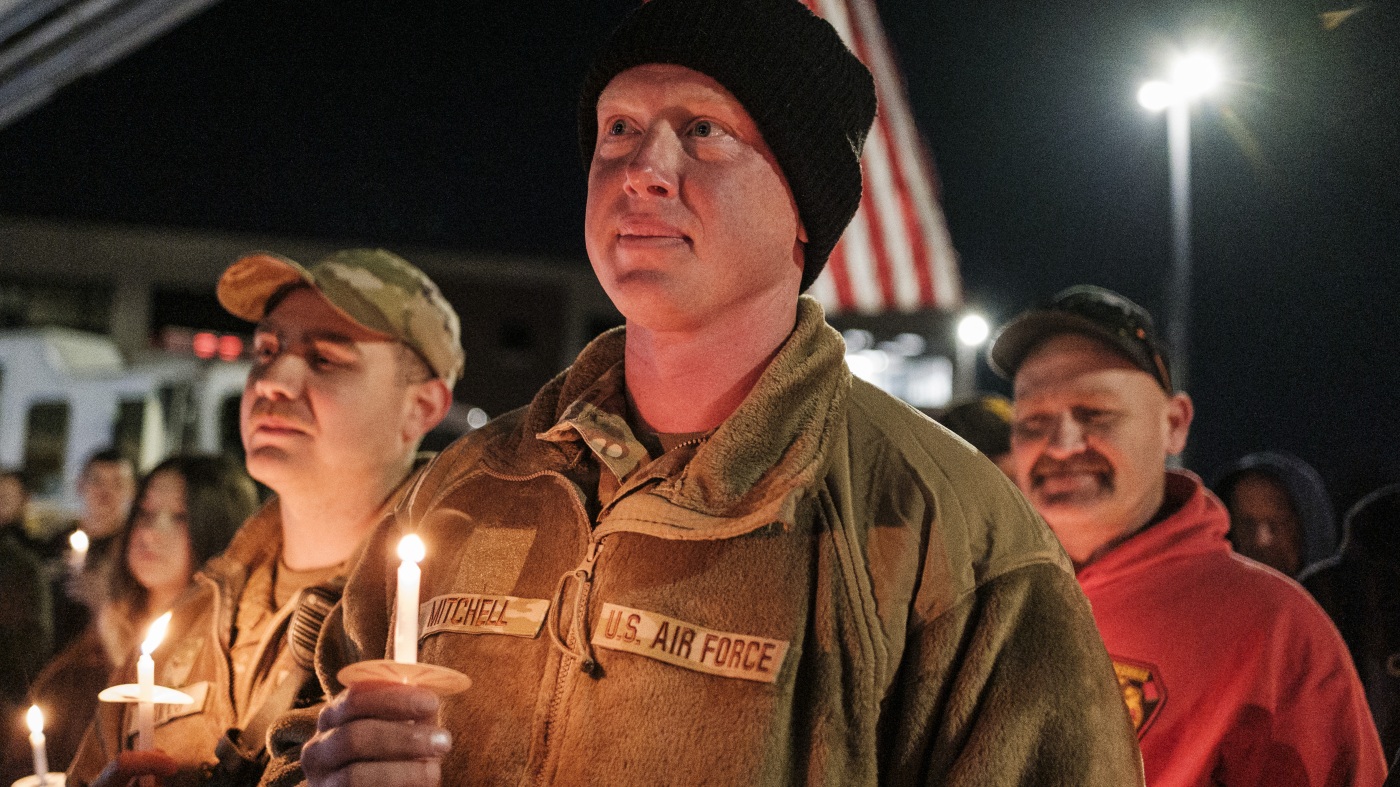
SSgt Jason Mitchell, a member of the West Virginia Air National Guard attends a candlelight vigil for SSgt Andrew Wolfe outside of the Berkley County Sheriff Office on December 3, 2025 in Martinsburg, West Virginia. SSgt Andrew Wolfe was shot on November 26 near The White House in what officials described as a targeted attack by an Afghan refugee who had previously worked with the United States military and C.I.A in Afghanistan. (Michael A. McCoy for NPR)
Michael A. McCoy for NPR
hide caption
toggle caption
Michael A. McCoy for NPR
WEBSTER SPRINGS, WV. — In West Virginia, many of the thousands of bridges spanning mountain valleys and gorges are named for local veterans and on Main Streets in small towns, banners feature hometown soldiers, some of whom fought and died in past conflicts.
It’s a state with one of the country’s highest per-capita populations of veterans. Service in the military — including the various branches of the National Guard — has long been seen not just as a patriotic duty, but as an economic lifeline, particularly in some of the poorer parts of the state.
The death of Army Specialist Sarah Beckstrom in a Washington, D.C. shooting and the wounding of another National Guard soldier — Air Force Staff Sergeant Andrew Wolfe, have brought that reality home once more in their hometowns and across the state.
The two were attacked while patrolling near the White House as part of President Trump’s National Guard deployments to American cities. Trump has said the deployments are necessary to fight crime, but Democratic leaders and federal judges have questioned their legality. In deep red West Virginia too, there appears to be a growing chorus questioning the rationale for sending troops to D.C.

Before moving to nearby Summersville after high school, Beckstrom, 20, grew up in Webster Springs, with its population of just 800 tucked amid mountains and spruce forests. Kenny Kidd has been driving a school bus in the town for years. He remembers all the children and Sarah he says, “was a great kid.”
“She always had a smile on her face. Always willing to help. And she always liked to give me a rough time,” he says laughing.
In this part of the state, job prospects for someone graduating high school are pretty sparse.
“Coal mining is on its way out,” Kidd says. “Other than that, it’s… work at a grocery store or a hardware store. And there’s just not much here.”

Main Street in Webster Springs, W.Va. on Dec. 3, 2025. The small West Virginia town with a population of just 800 offers few job prospects for high school graduates.
Chris Jackson For NPR
hide caption
toggle caption
Chris Jackson For NPR

Flags fly at half-staff for West Virginia National Guard Specialist Sarah Beckstrom at the Webster County Courthouse in Webster Springs, W.Va. on Dec. 3, 2025.
Chris Jackson for NPR
hide caption
toggle caption
Chris Jackson for NPR
Financially, he says, the Guard is a good deal for young adults. The bonuses can help put them through college, the pay from monthly drills and annual training are much-needed money in their pockets. And then there’s the extra pay from deployments, like the one to D.C., where the West Virginia Guard has more soldiers per capita than any other state.
At a prayer vigil for Wolfe in his hometown of Martinsburg, Air Force Staff Sergeant Jason Mitchell says it was the need to pay off college debt that brought him to the National Guard. Mitchell, who is in the same unit as Wolfe — the 167th Airlift Wing — has served 13 years, but didn’t go to D.C. because he was already deployed in the Middle East as part of a regular rotation. He plans to stay for another seven years to get full retirement benefits, including a pension and veteran healthcare.
“My stepdaughter actually just joined and she graduated basic [training] while I was deployed,” he says. “She was kind of in the same boat where she was going to college and was looking for… an opportunity.”

Members of the West Virginia Public Safety community attend a candlelight vigil for SSgt Andrew Wolfe outside of the Berkley County Sheriff Office on December 3.
Michael A. McCoy for NPR
hide caption
toggle caption
Michael A. McCoy for NPR

Members of the West Virginia Public Safety community attend a candlelight vigil for SSgt Andrew Wolfe outside of the Berkley County Sheriff Office on December 3.
Michael A. McCoy for NPR
hide caption
toggle caption
Michael A. McCoy for NPR
At Martinsburg High School, guidance counselor Charity Powers advises seniors. It’s not just one thing that motivates those who choose the Guard, she says. Some want money for college, some want to travel and others see it as a patriotic duty to follow in the footsteps of relatives who’ve served.
“I think in this area, especially for kids who are kind of disadvantaged, which we have a lot of those students, it’s a really good opportunity for them.”
Despite the state’s enthusiasm for the military and the voluntary nature of the D.C. deployment, Republican Gov. Patrick Morrisey has found himself on the defensive about it. Amid reports that troops are being employed in tasks such as trash pickup and landscaping instead of security, as the White House has suggested, West Virginia Democratic lawmakers have sharply criticized Morrisey for signing off on it. Several state newspapers have echoed that sentiment on their opinion pages.
Mike Pushkin, a West Virginia House of Delegates member and chairman of the state’s Democratic Party says Beckstrom and Wolfe “would not be there had it not been for the president calling in the National Guard in this strange form of political theater and it unfortunately put them in harm’s way.”
In a statement to NPR, Gov. Morrisey said: “The State of West Virginia is unwavering in its support for our National Guard. Since our founding, our state has a proud history of military service, answering the call for missions across the globe. The mission in D.C. is a continuation of this legacy of service — and we fully back the Guard members who willingly stepped up to clean up crime in our nation’s capital.”

A pedestrian walks into United Bank as ribbons in honor of Sarah Beckstrom adorn the door on Main Street in Webster Springs, W.Va. on Dec. 3.
Chris Jackson for NPR
hide caption
toggle caption
Chris Jackson for NPR
But in a state that went heavily for Trump in 2016, 2020 and 2024, it’s not difficult to find people who wonder aloud why sending the West Virginia National Guard to Washington makes any sense.

Roseanna Groves, who lives in Webster Springs and is related by marriage to Beckstrom was outraged that the man charged in the attack — an Afghan national who worked with the CIA — had been let into the U.S. at all. She blamed former President Biden, although he was let in under Trump’s administration.

“I think something should be done” about immigrants like him, she says. But she doesn’t understand the decision by Trump and Morrisey to send that Guard to Washington. “I feel it was crazy, I really do,” she says.
It’s a sentiment shared by Kidd, the school bus driver. He’s heard the reports that Beckstrom, Wolfe and others were busy in cleanup instead of “doing their jobs.” It just isn’t worth it, he says.
As for the deployment, “I think it’s turned into a lot more political than anything else,” he says.
Referring to those banners featuring local heroes in towns across West Virginia, “Sarah’s picture … it’ll be next,” he says. “But she’ll be missed.”


The Justice Department sent letters warning election officials in all 50 states and the District of Columbia that they could face criminal prosecution over noncitizen voting, a spokesperson for the Justice Department confirmed Tuesday.
The letters, signed by Assistant Attorney General Harmeet Dhillon, who heads up the department’s Civil Rights Division, give states five days to explain how they will comply with federal voter eligibility laws and how they will maintain “clean voter lists.”
“The Department sent these letters to all 50 states and the District of Columbia, asking for voluntary compliance in a timely manner with their obligations under federal law to ensure only citizens vote in federal elections,” a Justice Department spokesperson said in a statement.
Noncitizen voting in federal elections is extremely rare, but Trump and his administration have falsely portrayed it as a widespread issue.
Michigan Secretary of State Jocelyn Benson, Nevada Secretary of State Francisco Aguilar and Utah Lt. Gov. Deidre Henderson are among those who said they received the letters from the Justice Department.
The letters say state election officers “could be criminally prosecuted for aiding and abetting” noncitizen voting. They further specify that any election officer who knowingly retains noncitizens on a statewide voting registration list or who facilitates noncitizens’ receiving and casting ballots could be subject to criminal liability.
“An intentional act that is aimed at diluting the votes of citizens could also constitute a violation” of federal law, the letters said.
Henderson wrote on social media that the threats constitute “truly bizarre behavior.”
“Got another love letter this morning from the DOJ sprinkled throughout with threats of criminal prosecution,” she wrote. “I’m sure I’m not the only chief election officer of a state who is being targeted for following state and federal laws by resisting DOJ’s demands for private voter data that have thus far been ruled illegal by at least a dozen courts.”
The letters are the latest move in the Justice Department’s campaign to assert more federal control over state elections.
While some states have complied with the administration’s demands that they hand over voter roll data, the Justice Department has sued 30 states and Washington, D.C., for resisting. So far, 11 different federal courts have dismissed the Justice Department’s efforts to seize voter rolls.

Lionel Messi #10 of Argentina celebrates scoring his team’s second goal during their World Cup match against Egypt in Atlanta on Tuesday.
Elsa/Getty Images
hide caption
toggle caption
Elsa/Getty Images
They looked beaten. And out. Argentina, the defending World Cup champion and No. 1-ranked team, was down 2-0 late against Egypt.

Then, in a span of 13 remarkable minutes, Argentina scored not once, not twice, but three times, capping a comeback for the ages and leaving Egypt stunned and shellshocked.
For much of the game in Atlanta, Egypt was in control, hobbling Argentina early. The Egyptian attack began almost immediately with a stunning header goal delivered by Yasser Ibrahim in the 15th minute. After that, Egypt’s defense closed ranks, making it practically impossible for Argentina to equalize.
It was downhill from there for the Argentines: team captain Lionel Messi failed to convert a penalty kick, and in the 67th minute, Egypt got a second goal from Mostafa Ziko (after an earlier Egyptian goal had been disallowed after a video review). It looked like Argentina was finished. On the brink of elimination.
But no one told the Argentine players that.
In the 79th minute, Lionel Messi began doing his thing. He fired a cross near the Egyptian goal, and Cristian Romero headed it in. Messi was not done. Four minutes later, he powered a shot past the Egyptian keeper. It was his eighth goal of this tournament, the most of any player. The score was 2-2.
Then, in stoppage time, yet another Argentina header and another goal, this time from Enzo Fernandez.
“This is the World Cup for you,” said Messi after the game. “It wasn’t easy to come back from two goals down. But as I always say, this group never gives up. We always try to fight until the end.”

French referee François Letexier speaks with Egypt forward Mohamed Salah during the World Cup Round of 16 match between Argentina and Egypt in Atlanta.
Roberto Schmidt/AFP via Getty Images
hide caption
toggle caption
Roberto Schmidt/AFP via Getty Images
Afterward, Egypt coach Hossam Hassan complained about the French referee and the officiating. “I am not convinced. I am not convinced with this outcome. I’m not convinced with the way things unfolded during this match,” said Hassan in a post-match news conference. “We have been treated unfairly today. We have suffered injustice.”
“We would have deserved to earn this win, but we are leaving with honor, with pride, regardless of this defeat,” said Hossan.
African soccer teams have been the stars of this World Cup. Morocco has yet to lose a game. Cape Verde qualified for the first time in its history and stymied Spain, Uruguay and Saudi Arabia. Argentina barely beat them in a nail-biter of a match.
For Egypt, getting this far in the tournament is historic in itself: it’s the first time the team has made it this far. For Argentina, it was a terrifying yet relieving victory: several players, including Messi himself, cried after the game.
Next, they move to the quarterfinals and will play the winner of today’s Switzerland-Colombia match.

Top Senate Democrats are pushing for answers on whether a provision in a controversial settlement agreement between President Trump and his own administration applies to companies co-founded by or affiliated with the Trump family.
As part of a deal struck in May by the Justice Department to resolve a lawsuit brought by Mr. Trump, the Internal Revenue Service is permanently barred from pursuing claims against Mr. Trump, his oldest sons Don Jr. and Eric, and the Trump Organization based on prior tax returns.
In a one-page document signed by Acting Attorney General Todd Blanche and dated May 19, the Justice Department said the defendants in the president’s lawsuit — the IRS and the Treasury Department — are “FOREVER BARRED and PRECLUDED” from “prosecuting or pursuing, any and all claims” arising from tax returns filed before the settlement took effect. Blanche also wrote that the settlement applies to “parties including trusts, parent, sister, or related companies, affiliates, and subsidiaries.”
Now, Senators Elizabeth Warren of Massachusetts, Senate Minority Leader Chuck Schumer of New York, and Ranking Member of the Senate Finance Committee Ron Wyden of Oregon are pushing 11 businesses and organizations with ties to the Trump family to get answers for the “significant questions” the settlement raises relating to the tax audit provision, and whether the companies are included in the deal.
“Under the guise of a so-called legal settlement, the Trump administration has attempted to decree that the President, his family, and their entire business empire — potentially including entities with even the vaguest ‘affiliation’ to the family — are to face zero consequences if they have committed a range of financial crimes or misdeeds — regardless of the severity of the violation,” the senators wrote in letters transmitted to the companies Monday night.
The letters were sent to mining company Kaz Resources, defense firm Powerus, cryptocurrency companies World Liberty Financial and American Bitcoin, robotics startup Foundation Future Industries, investment firm 1789 Capital, private aviation company Tag Air, and prediction markets Polymarket and Kalshi.
All of the companies either were founded by Mr. Trump and his two adult sons, or list members of the Trump family as advisers, board members, or partial owners. Donald Trump Jr. sits on Polymarket’s advisory board and 1789 Capital, where he’s a partner, has invested in Polymarket. Days before Mr. Trump took office for his second term, Kalshi also announced Trump Jr. would be a strategic adviser.
The Democrats, who are in the minority, lack subpoena power, so Mr. Trump, his children and his companies can’t be forced to answer the questions posed by the senators.
According to recent financial disclosures, the president earned more than a billion dollars from cryptocurrency ventures alone last year, including from his meme coin business and World Liberty Financial, his family’s cryptocurrency firm.
Separately, the senators also asked the Trump Organization in a separate letter if it believes it has “immunity from all audits, civil penalties or federal prosecution” for any crimes that could have occurred before the settlement.
Trump Media and Technology Group, which is majority owned by a trust that lists Mr. Trump as the sole beneficiary and operates the Truth Social platform he uses daily, also received a letter from the Democratic senators.
“The public deserves transparency about the scope of this get-out-of-jail free card for Trump-aligned businesses, and about whether you intend to rely on this settlement as a free pass for any possible violations of the law,” the senators continued in their letter, which also seeks any communications that executives at the companies have had with the Justice Department and White House leading up to or after the settlement was signed.
The settlement was announced months after Mr. Trump and two of his sons and the Trump Organization accused the IRS and Treasury Department of unlawfully allowing a government contractor to leak tax returns to media outlets in 2020.
In a statement, a Justice Department spokesperson said “the IRS routinely provides releases as part of resolving taxpayer reviews and audits. This settlement follows that same standard practice.”
The spokesperson did not provide specific information about which companies are covered by the audit provision, or whether the Trump Organization and Trump family are the only entities covered by that addendum.
-
 Lifestyle8 minutes ago
Can you say no to a friend’s wedding? : It’s Been a Minute
-

 Technology16 minutes ago
The robotaxi law that could ban Tesla
-

 World23 minutes ago
US urges donors to abandon UNRWA funding as UN defends agency’s mission
-

 Politics26 minutes ago
EXCLUSIVE: FBI adds alleged COVID fraudster accused of taking $5M from kids’ meal program to Most Wanted list
-

 Health31 minutes ago
One walking habit could signal a healthier brain after 80, scientists say
-

 Sports38 minutes ago
New Jersey pro wrestling promotion bringing the fight to the beach
-

 Technology41 minutes ago
Are airline miles still worth it?
-
 Business46 minutes ago
Walmart’s EV chargers are coming to California with discounts for members

