Midwest
Wisconsin professor slams ‘isolating environment’ for conservatives on campuses

NEWYou can now listen to Fox News articles!
This story is part of Fox News Digital’s investigative series Campus Radicals. Get the full series here.
A professor in Wisconsin who recently went viral for a Facebook post in the wake of Charlie Kirk’s assassination described an “isolating environment” for those on campus who harbor conservative views.
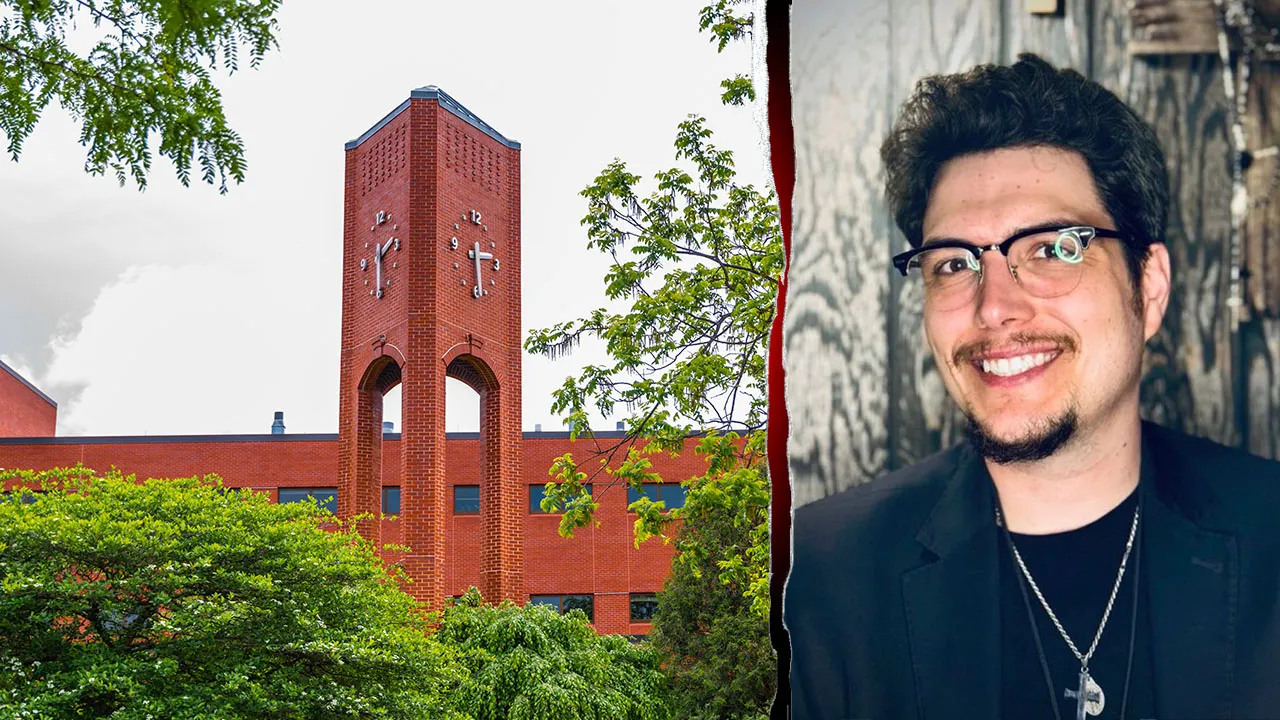
Trevor Tomesh is an assistant professor of computer, information and data science at the University of Wisconsin –River Falls. While he stressed that on his campus, he feels like there is room for dialogue among faculty members who might disagree politically, he recognizes that isn’t the case at every institute of higher learning in the United States.
“I do know, though, that even at somewhere like the University of Wisconsin—River Falls, a lot of professors are not very happy to speak up about their views if their views are contrary to the narrative, essentially,” Tomesh told Fox News Digital, stressing that his views do not represent those of the university where he teaches or the University of Wisconsin system.
Trevor Tomesh is a professor at the University of Wisconsin—River Falls. He spoke to Fox News Digital about being a conservative on a college campus on Thursday, Oct. 23, 2025. (Fox News Digital)
Days after Kirk’s assassination on the campus of Utah Valley University, Tomesh took to Facebook to slam academia for its response to the murder. The post took off, not only on Facebook, but on platforms like X, where screenshots were shared far and wide by conservative influencers.
CHARLIE KIRK DIED FOR FREE SPEECH AND UNIVERSITIES STILL HAVE NOTHING TO SAY
“The fact that Charlie was killed on a college campus for expressing his opinions and ideas — the one place in society that’s sole purpose is to express opinions and ideas — should be a watershed moment for all universities,” he wrote. “Every single member of every single university community — faculty, administrators, staff and students — should be lamenting this as it spells the death of the university.”
Instead, Tomesh wrote, Kirk’s death was met with deafening silence.
“To date, there has been no statement from my university or the University of Wisconsin system,” he said. “Not a single one of my students heard from any of their professors about this. How do I know? I asked them.”
AFTER CHARLIE KIRK’S ASSASSINATION, LEFT-WING PROFESSORS DOUBLE DOWN ON SHREDDING HIS LEGACY
River Falls, WI, USA – June 5, 2022: The University of Wisconsin River Falls (Cheri Alguire/iStock)
He also expressed disgust for professors and students who celebrated Kirk’s assassination, and contrasted the reaction to Kirk’s killing with the reaction to a popular Christian, conservative speaker named Sister Cindy Smock holding an event on campus. The school, he said, offered trauma counselors to students, and “assembled a task force to determine how to handle people like Cindy and the trauma she inflicts on students.”
Despite his many efforts to get the University of Wisconsin system to address Kirk’s death, it did not.
“Once I came out as a conservative and I made my views known on Facebook, and that my post went viral on Facebook, I had a lot of faculty and staff from all over the world, but from my university as well, message me and say basically, hey, ‘I wish that I had the bravery to speak up like you do,’” Tomesh told Fox News Digital. “And so it’s kind of an environment, it’s a cold environment. It’s an isolating environment when you’re conservative on especially a very liberal campus, which I’m not on a particularly liberal campus, but when you’re on a very liberal campus, it can be very isolating.”
‘FEARLESS’ TOUR TAKES CHARLIE KIRK’S FREE SPEECH MISSION TO COLLEGES NATIONWIDE
Tomesh has experience in that realm from a past university position in Canada, where he said he was told by a university department head to believe whatever he wanted, but was also warned that there would be “consequences” for doing so.
Charlie Kirk throws hats to the crowd after arriving at Utah Valley University on September 10, 2025, in Orem, Utah. (Trent Nelson/The Salt Lake Tribune/Getty Images)
“So yeah, I use the word ‘coming out’ because it is something that when you do say, ‘I’m a conservative on a college campus,’ there is a certain expectation that you may wind up encountering friction,” he said. “Either friction from your colleagues or friction from administration, or even you know, backlash from students.”
He described an ugly scene on campus after Kirk’s assassination, when a chalk memorial to the slain conservative leader was “defaced with some very disturbing things, including one of the things that were written on the bullet casing that took Charlie’s life…”
HOW UNIVERSITY INDOCTRINATION TURNED DEADLY, AND WHY ONE SCHOLAR SAYS IT’S ONLY GETTING WORSE
“And it can be very hostile, a very hostile environment,” Tomesh said. “I’ve had lots of parents and lots of students email me saying that they’re afraid to either go to college or to send their children to college because they’re afraid that their students are not going to have a fair shake at it because of their orthodoxy.”
Tomesh denounced popularized rhetoric used in the political discourse that likens conservatives to “Nazis” and “fascists,” which he said is meant to dehumanize people.
He stressed two critical points to address.
People raise placards reading “This is our Turning Point” during a memorial service for slain conservative commentator Charlie Kirk at State Farm Stadium, in Glendale, Arizona, U.S., September 21, 2025. (Brian Snyder/Reuters)
UNIVERSITIES CRACK DOWN ON EMPLOYEE SOCIAL MEDIA POSTS CELEBRATING, DEFENDING KIRK’S DEATH
The first is that Americans, and especially students on college campuses, need to unlearn the idea that speech itself is violence. Secondly, he said Americans need to separate their political ideas from their identities, pointing out that when a political ideology becomes someone’s entire identity, any attack on that ideology becomes an attack on the person.
“And that’s one huge problem, I think, especially with the ideological progressives, is that they have taken an assumed identity, assumed ideas into part of their core identity,” he said. “And that is a very big mistake, because then any attack on an idea inevitably is interpreted as an attack on your personal identity and on you as a person.”
Finally, Tomesh offered a stark warning about the direction of the United States if people cannot learn to tolerate dissenting opinions.
“And if we can’t do those two things, we’re done. We’re toast,” he said. “Western culture is over. And it’s—I’m serious about that. It’s going to be a civil war if we cannot learn those two things.”
The school explained its decision not to make a statement on Kirk’s death in an email to Fox News Digital on Monday.
“UW-River Falls is committed to freedom of expression, viewpoint diversity, and respectful dialogue. We believe strongly in fostering a climate where all students and faculty feel supported and safe in expressing their perspective in a marketplace of ideas. These values are central to our mission and essential to the health of our democracy,” the school told Fox News Digital.
CLICK HERE TO DOWNLOAD THE FOX NEWS APP
“Political violence has no place in our society, and the murder of Charlie Kirk was horrific. Following this tragedy, our student affairs team reached out to student organizations to offer support,” the school continued.
“We understand that questions have been raised about not issuing a formal public response. UW–River Falls adheres to the recently enacted Institutional Statements Policy of the Universities of Wisconsin that took effect last June. This policy is rooted in the principle of institutional neutrality wherein such statements should be limited to matters ‘that directly affect the operations and core mission of the university and should maintain viewpoint neutrality in any reference to any matter.’”
Read the full article from Here



A Metro Detroit church is giving back to the youth. In an age of heightened peer pressures, such as teen takeovers, leaders tell CBS News Detroit that good old-fashioned fun is the way to bring all ages together.
“It’s been a vision of mine and my late husband forever,” said Divine Restoration Ministries Pastor Dr. Tenisia Evans.
Divine Restoration Ministries hosted a Legacy in Action Day on Saturday in the gym of Eastpointe High School in Eastpointe, Michigan. The church says its focus is showing up for communities, especially the future generation.
“So many things going on in the world right now and the youth has been the center of our focus,” said Evans.
Evans says with the help of other church leaders and businesses, including AT&T, they were able to secure food, games and experiences for kids of all ages.
And when it comes to creating an event kids would actually like, Detroit teen Martrail Mullen says they were spot on.
“Kids, we like to move around and still have cardio, and while still having fun at my age, most churches don’t do that,” said Mullen.
Mullen says he has been invited to teen takeovers in the past. While he says he’s never gone to one, he wishes kids would use their time more wisely.
“Kids my age, they are doing a lot of things,” said Mullen.
That’s why Evans says now is the time they open their arms to anyone in need of support.
“We’re here. We’re here for you and we want to pour back and let you know that if you need anything, come to us and we will be here as a resource,” said Evans.
Milwaukee, WI
Carin León, Summerfest’s first regional Mexican music act, draws new visitors to Milwaukee


MILWAUKEE – Summerfest wrapped up its first weekend Saturday with headliner Carin León, who organizers said is the first regional Mexican music artist to hit the stage.
Out-of-town draw
What they’re saying:
The performer drew visitors to the festival from Chicago to Michigan.
FREE DOWNLOAD: Get breaking news alerts in the FOX LOCAL Mobile app for iOS or Android
“I love the experience, it’s really cool,” Gigi Acosta, who traveled from Chicago, said. “We love it, it’s so much fun here.”
Folks flocked into Henry Maier Festival Park to take part in the fun.
“He puts on a great show,” said Karina Rodriguez, who came from Chicago with her family.
“Five hours, to me, is really nothing to come see him,” said Tracey Solis, who along with Filberto Solís, traveled from Michigan.
Tourism in Milwaukee
Big picture view:
It is an impact Summerfest leaders said will have a greater impact on the city.
“We drive over $160 million in tourism to this economy,” Jerrod Woods, senior director of marketing for Summerfest, said. “Carin is another huge aspect of that to help bring all the tourism to the city.”
Woods said León’s performance is an example of the diverse number of artists they want to keep bringing to the festival.
“The amount of people and outpour that you receive, like, ‘thank you for bringing such an incredible artist,’ like Carin León, who represents the Latin community not only here in Milwaukee but around the region,” Woods said.
It’s what brought new visitors, like the Rodriguez family, to Milwaukee.
SIGN UP TODAY: Get daily headlines, breaking news emails from FOX6 News
“We brought my mom because she’s a super fan,” said Karina Rodriguez. “She loves him, and this is our first time at Summerfest.”
Acosta even made a poster hoping to get her favorite artist’s attention.
“I love you Carin León,” she said as she blew a kiss.
What’s next:
Organizers said Saturday’s show is another example of giving people what they want. They told FOX6 News that they are already planning for 2027.
The Source: Information in this story is from FOX6 News interviews with Gigi Acosta, Tracey Solis, Filberto Solís, Karina Rodriguez, Georgina Rodriguez, Casey Rodriguez, and Jerrod Woods.

A child was seriously injured after a car hit them in an alley in Minneapolis on Saturday morning.
Minneapolis police say a child was playing in an alley near 29th Avenue North and Lyndale Avenue North around 11:30 a.m. when a car hit them. The child was brought to the hospital with potentially-life-threatening injuries, police added.
The child’s age was not released by law enforcement.
The driver of the car stayed at the scene and is cooperating with law enforcement, Minneapolis police said.
There have been no arrests at this time.
-
 Lifestyle11 minutes ago
‘Wait Wait’ for June 20, 2026: With Not My Job guest Caro Claire Burke
-

 Technology19 minutes ago
Sony’s Xperia 1 VIII is still a phone for the fans
-

 World26 minutes ago
Trump-backed ‘El Tigre’ looks to crush cartels, end Colombia’s socialist era in pivotal election
-

 Politics29 minutes ago
Obama Center visitors say project symbolic of ‘Black excellence,’ claim scandal-free legacy while Trump ripped
-

 Health34 minutes ago
Poison centers link growing Benadryl abuse among teens to dangerous social media trends
-

 Sports41 minutes ago
Bryce Harper hits for cycle, Kyle Schwarber blasts three homers in Phillies blowout win over Mets
-

 Technology44 minutes ago
Meta offers paid training for AI data center jobs
-
 Business49 minutes ago
‘I got crushed’: AI giants are funding ad wars in races across the country

