Midwest
Wisconsin professor slams ‘isolating environment’ for conservatives on campuses

NEWYou can now listen to Fox News articles!
This story is part of Fox News Digital’s investigative series Campus Radicals. Get the full series here.
A professor in Wisconsin who recently went viral for a Facebook post in the wake of Charlie Kirk’s assassination described an “isolating environment” for those on campus who harbor conservative views.
Trevor Tomesh is an assistant professor of computer, information and data science at the University of Wisconsin –River Falls. While he stressed that on his campus, he feels like there is room for dialogue among faculty members who might disagree politically, he recognizes that isn’t the case at every institute of higher learning in the United States.
“I do know, though, that even at somewhere like the University of Wisconsin—River Falls, a lot of professors are not very happy to speak up about their views if their views are contrary to the narrative, essentially,” Tomesh told Fox News Digital, stressing that his views do not represent those of the university where he teaches or the University of Wisconsin system.
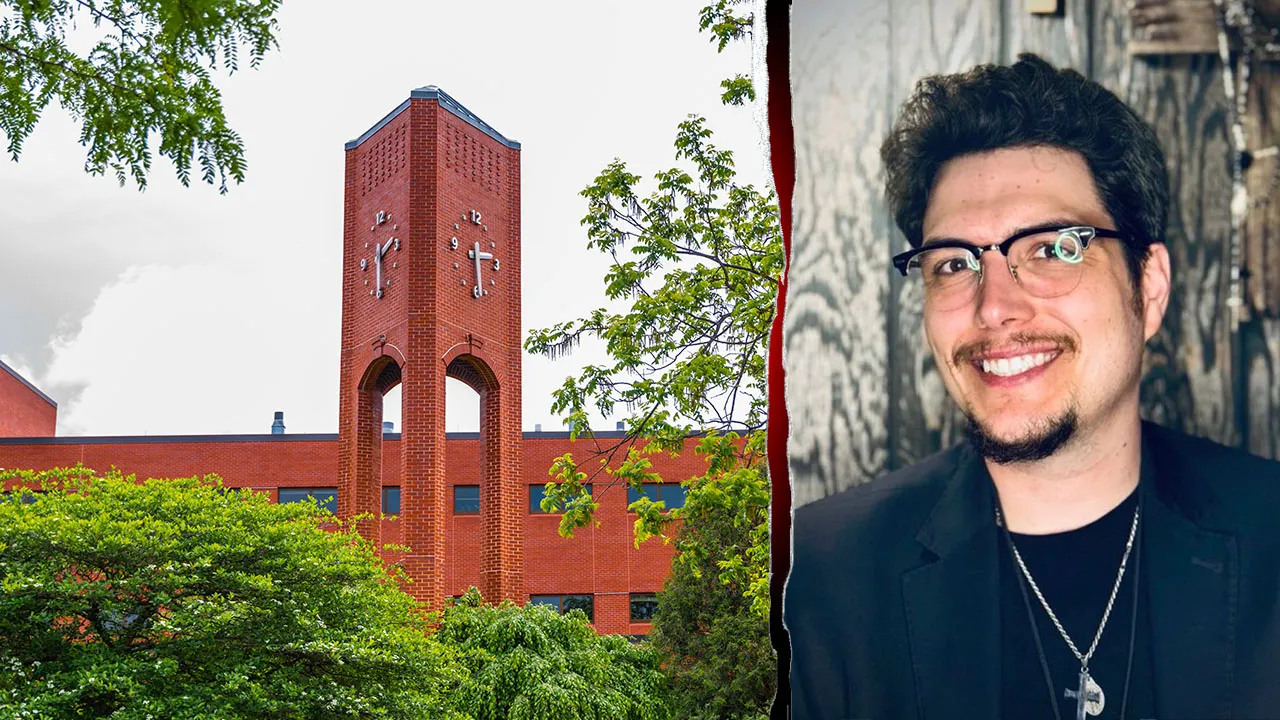
Trevor Tomesh is a professor at the University of Wisconsin—River Falls. He spoke to Fox News Digital about being a conservative on a college campus on Thursday, Oct. 23, 2025. (Fox News Digital)
Days after Kirk’s assassination on the campus of Utah Valley University, Tomesh took to Facebook to slam academia for its response to the murder. The post took off, not only on Facebook, but on platforms like X, where screenshots were shared far and wide by conservative influencers.
CHARLIE KIRK DIED FOR FREE SPEECH AND UNIVERSITIES STILL HAVE NOTHING TO SAY
“The fact that Charlie was killed on a college campus for expressing his opinions and ideas — the one place in society that’s sole purpose is to express opinions and ideas — should be a watershed moment for all universities,” he wrote. “Every single member of every single university community — faculty, administrators, staff and students — should be lamenting this as it spells the death of the university.”
Instead, Tomesh wrote, Kirk’s death was met with deafening silence.
“To date, there has been no statement from my university or the University of Wisconsin system,” he said. “Not a single one of my students heard from any of their professors about this. How do I know? I asked them.”
AFTER CHARLIE KIRK’S ASSASSINATION, LEFT-WING PROFESSORS DOUBLE DOWN ON SHREDDING HIS LEGACY
River Falls, WI, USA – June 5, 2022: The University of Wisconsin River Falls (Cheri Alguire/iStock)
He also expressed disgust for professors and students who celebrated Kirk’s assassination, and contrasted the reaction to Kirk’s killing with the reaction to a popular Christian, conservative speaker named Sister Cindy Smock holding an event on campus. The school, he said, offered trauma counselors to students, and “assembled a task force to determine how to handle people like Cindy and the trauma she inflicts on students.”
Despite his many efforts to get the University of Wisconsin system to address Kirk’s death, it did not.
“Once I came out as a conservative and I made my views known on Facebook, and that my post went viral on Facebook, I had a lot of faculty and staff from all over the world, but from my university as well, message me and say basically, hey, ‘I wish that I had the bravery to speak up like you do,’” Tomesh told Fox News Digital. “And so it’s kind of an environment, it’s a cold environment. It’s an isolating environment when you’re conservative on especially a very liberal campus, which I’m not on a particularly liberal campus, but when you’re on a very liberal campus, it can be very isolating.”
‘FEARLESS’ TOUR TAKES CHARLIE KIRK’S FREE SPEECH MISSION TO COLLEGES NATIONWIDE
Tomesh has experience in that realm from a past university position in Canada, where he said he was told by a university department head to believe whatever he wanted, but was also warned that there would be “consequences” for doing so.
Charlie Kirk throws hats to the crowd after arriving at Utah Valley University on September 10, 2025, in Orem, Utah. (Trent Nelson/The Salt Lake Tribune/Getty Images)
“So yeah, I use the word ‘coming out’ because it is something that when you do say, ‘I’m a conservative on a college campus,’ there is a certain expectation that you may wind up encountering friction,” he said. “Either friction from your colleagues or friction from administration, or even you know, backlash from students.”
He described an ugly scene on campus after Kirk’s assassination, when a chalk memorial to the slain conservative leader was “defaced with some very disturbing things, including one of the things that were written on the bullet casing that took Charlie’s life…”
HOW UNIVERSITY INDOCTRINATION TURNED DEADLY, AND WHY ONE SCHOLAR SAYS IT’S ONLY GETTING WORSE
“And it can be very hostile, a very hostile environment,” Tomesh said. “I’ve had lots of parents and lots of students email me saying that they’re afraid to either go to college or to send their children to college because they’re afraid that their students are not going to have a fair shake at it because of their orthodoxy.”
Tomesh denounced popularized rhetoric used in the political discourse that likens conservatives to “Nazis” and “fascists,” which he said is meant to dehumanize people.
He stressed two critical points to address.
People raise placards reading “This is our Turning Point” during a memorial service for slain conservative commentator Charlie Kirk at State Farm Stadium, in Glendale, Arizona, U.S., September 21, 2025. (Brian Snyder/Reuters)
UNIVERSITIES CRACK DOWN ON EMPLOYEE SOCIAL MEDIA POSTS CELEBRATING, DEFENDING KIRK’S DEATH
The first is that Americans, and especially students on college campuses, need to unlearn the idea that speech itself is violence. Secondly, he said Americans need to separate their political ideas from their identities, pointing out that when a political ideology becomes someone’s entire identity, any attack on that ideology becomes an attack on the person.
“And that’s one huge problem, I think, especially with the ideological progressives, is that they have taken an assumed identity, assumed ideas into part of their core identity,” he said. “And that is a very big mistake, because then any attack on an idea inevitably is interpreted as an attack on your personal identity and on you as a person.”
Finally, Tomesh offered a stark warning about the direction of the United States if people cannot learn to tolerate dissenting opinions.
“And if we can’t do those two things, we’re done. We’re toast,” he said. “Western culture is over. And it’s—I’m serious about that. It’s going to be a civil war if we cannot learn those two things.”
The school explained its decision not to make a statement on Kirk’s death in an email to Fox News Digital on Monday.
“UW-River Falls is committed to freedom of expression, viewpoint diversity, and respectful dialogue. We believe strongly in fostering a climate where all students and faculty feel supported and safe in expressing their perspective in a marketplace of ideas. These values are central to our mission and essential to the health of our democracy,” the school told Fox News Digital.
CLICK HERE TO DOWNLOAD THE FOX NEWS APP
“Political violence has no place in our society, and the murder of Charlie Kirk was horrific. Following this tragedy, our student affairs team reached out to student organizations to offer support,” the school continued.
“We understand that questions have been raised about not issuing a formal public response. UW–River Falls adheres to the recently enacted Institutional Statements Policy of the Universities of Wisconsin that took effect last June. This policy is rooted in the principle of institutional neutrality wherein such statements should be limited to matters ‘that directly affect the operations and core mission of the university and should maintain viewpoint neutrality in any reference to any matter.’”
Read the full article from Here



MILWAUKEE – The National Weather Service has issued a heat advisory for Milwaukee and all of southeastern Wisconsin from noon Tuesday through 8 p.m. Wednesday, with heat index values expected to reach the upper 90s to around 100 degrees.
While the advisory is expected to end Wednesday evening, hot and humid conditions are forecast to continue through the remainder of the week.
Forecast conditions can change, so everyone is encouraged to monitor local forecasts and follow guidance from the National Weather Service.
Milwaukee County cooling sites
What we know:
Cooling sites are available throughout Milwaukee County.
For an updated list of cooling locations, heat safety information, and resources on preventing heat-related illness, visit the City of Milwaukee website or call 211.
FREE DOWNLOAD: Get breaking news alerts in the FOX LOCAL Mobile app for iOS or Android
Staying safe during extreme heat
What you can do:
Stay cool
- Limit outdoor activities, especially during the hottest part of the day.
- Spend time in air-conditioned buildings whenever possible such as libraries, shopping centers, or community centers.
- If you have an air conditioner, make sure it is installed and working properly.
- Wear lightweight, light-colored, loose-fitting clothing.
- Take cool showers or baths, or use cool, wet towels to lower body temperature.
- Fans may provide comfort but should not be relied upon as the primary cooling method during extreme heat.
Stay hydrated
- Drink water regularly, even if you do not feel thirsty.
- Avoid alcohol and excessive caffeine, which can contribute to dehydration.
- Encourage children, older adults, and others at higher risk to drink fluids throughout the day.
Protect yourself and others
- Never leave children, older adults, or pets unattended in vehicles. Temperatures inside a parked vehicle can become deadly within minutes.
- Check on older neighbors, family members, and others who may need assistance staying cool.
- Many public cooling sites are located along Milwaukee County Transit System (MCTS) routes. Visit RideMCTS.com for transit information.
Know the Signs of Heat-Related Illness
Heat exhaustion may include:
- Heavy sweating
- Weakness or fatigue
- Dizziness
- Nausea
- Fainting
Heat stroke is a medical emergency. Symptoms may include:
- High body temperature
- Hot, dry skin or profuse sweating
- Confusion
- Rapid pulse
- Loss of consciousness
Call 911 immediately if someone is experiencing signs of heat stroke.
For additional hot weather safety information, visit the City of Milwaukee website.
The Source: City of Milwaukee Health Department sent FOX6 the information.

INDIANAPOLIS (WISH) — Central Indiana is bracing for a prolonged stretch of intense heat as a strong ridge of high pressure becomes firmly established over the region. High temperatures are expected to climb into the low to mid-90s through Thursday, while heat index values — the combination of heat and humidity — will reach between 100 and 105 degrees each afternoon.
Today Through Thursday: Sustained Heat
A well-entrenched upper-level ridge will maintain hot, dry conditions through Thursday. Daytime heating coupled with suppressed atmospheric mixing will keep dew points elevated, and thus heat indices high, especially during peak afternoon hours between noon and 6 p.m.

Storm chances during this period are expected to remain very low as the stable, dry air mass suppresses convective development.
Late Week: Transition and Storm Chances
The heat will begin to subside by the end of the workweek as the high-pressure ridge weakens and shifts eastward. This opens the door for increased moisture return and the development of scattered showers and thunderstorms, particularly Friday and Saturday afternoons.
Models currently show some variation on the timing and extent of this moisture return, so forecasts may adjust as the weekend approaches.
Residual scattered storms will be possible into Sunday and Monday, but the main story shifts away from oppressive heat to more typical summer storm activity.
7 Day Forecast:

The NBA world is waiting in anticipation to see what 41-year-old LeBron James will do next with his career, and the story just got more interesting.
Over the weekend, Cleveland Cavaliers head coach Kenny Atkinson had a quote that turned heads. “You guys know there’s a little free agency thing going on right now. That could be our real jump, and you know what I’m talking about. That’s exciting too.”
“We’re in the mix for the greatest player of all time”
Cavs Head Coach Kenny Atkinson discusses with @WorldWideWob, @DarthAmin, and Ryan McDonough what it would be like to have LeBron return to Cleveland
Hear our Summer League coverage! ⬇️https://t.co/jnEcXNELrs pic.twitter.com/RLf47TlpM5 — SiriusXM NBA Radio (@SiriusXMNBA) July 12, 2026
The Cavaliers coach also went on to say, “Listen, this is an exciting time for us, right? Like we’re in the mix for, you know, the greatest player of all time… I think you’re nervous, but we understand how it is. He’s obviously earned that right to take his time.”
Major Interest
The Cavaliers knew roster changes needed to happen following their exit from the playoffs in the Eastern Conference Finals. While making the conference finals was an achievement, getting swept embarrassingly by the eventual champion New York Knicks showed one thing: this team still had a clear gap to close if they were to win a championship.
A quote like this from an NBA coach is not typical in the slightest. Atkinson is making his interest in LeBron clear on a national stage, and rightfully so. LeBron brings a skill set the Cavaliers have been missing since his departure: a lengthy forward who can help with spacing while also adding playmaking, postseason experience, and late-game control.
A New Mentality
Aside from roster fit, LeBron can bring something this team has needed for quite some time: a new mentality. The Cavaliers have been labeled as soft, stemming from a quote such as “the lights were brighter than expected” by Jarrett Allen after a series loss to the Knicks in 2023.
“Even for me, the lights were brighter than expected.”
– Jarrett Allen on his playoff struggles
(Via @SpinDavies ) pic.twitter.com/f9ax5rUXkJ
— NBACentral (@TheDunkCentral) April 27, 2023
LeBron, despite his age, still has his championship mentality. This is evident from his playoff series against the Rockets while he was still with the Lakers this past May. LeBron led the Lakers past a younger, arguably more talented team in the Rockets to advance to the second round.
The hope is that this championship mentality can rub off on the Cavs’ younger talent while LeBron wraps up his career in the wine and gold.
It looks like everyone is waiting on what “The King” does next, including his next potential head coach. This is for good reason, as LeBron could be the missing piece needed to take the Cavaliers to the next level, not only because he remains one of the greatest players of all time, but because he could bring a championship mentality to a core that desperately needs it.
Follow
-

 Boston, MA3 minutes ago
GBH Daily: Come sail away
-

 Denver, CO9 minutes ago
New ice cream shop with a ‘waffle theater’ bets big on downtown Denver
-

 Seattle, WA15 minutes ago
Seattle weather: Sunny skies and warmer temperatures Tuesday
-

 Milwaukee, WI27 minutes ago
Milwaukee cooling centers, heat advisory tips; what to know
-

 Atlanta, GA33 minutes ago
Warnock, Dickens talk about new housing legislation
-

 Indianapolis, IN45 minutes ago
Indiana heat index to hit 100 as hot, dry pattern holds | July 14, 2026
-

 Pittsburg, PA51 minutes ago
Another stretch of high temperatures in the 90s hitting the Pittsburgh area this week
-

 Augusta, GA57 minutes ago
Flash flooding impacts multiple areas across Columbia County

