Virginia
30 notes to remember from FSU football’s 34-14 victory against Virginia Tech


The Florida State Seminoles recorded their second ACC victory of the season in the middle of November. On Saturday night, FSU took down Virginia Tech, 34-14.
The Seminoles outscored the Hokies 24-7 in the second half, overcoming a 7-3 deficit in the second quarter to win by 20 points.
READ MORE: FSU football ends home slate on high note with 34-14 win over Virginia Tech
Here are 30 notes surrounding various data-points from the game.
Stats To Remember From FSU’s Win Over Virginia Tech
- Florida State won its 600th game in program history Saturday, beating Virginia Tech 34-14 in the home finale at Doak Campbell Stadium. Among schools with 600 all-time wins, FSU (79 seasons) and Appalachian State (96) are the only schools to play fewer than 100 seasons.
- Head coach Mike Norvell improved to 27-9 in November as a head coach, including a 14-5 mark at home. FSU is now 22-2 under Norvell when allowing fewer than 20 points, with a 5-0 record in 2025.
- The Noles improved to 25-13-1 all-time against the Hokies, with a 15-6 mark at Doak.
- Wide receiver Duce Robinson led Florida State with 6 catches for 134 yards and a 50-yard touchdown. Robinson’s five 120-yard receiving games are tied for the national lead and are the most for a Seminole in a season since 2014 (Rashad Greene, five).
- Robinson’s 947 receiving yards rank 18th in FSU single-season history and are the most for a Nole since 2019.
- Robinson’s touchdown was Florida State’s seventh of the season of at least 50 yards.
- Robinson’s catch was his third of at least 50 yards in 2025, 2nd-most in the ACC behind teammate Micahi Danzy’s four. Robinson leads the ACC with 10 30-yard catches.
- Robinson also broke up a pass on Virginia Tech’s hail mary to end the first half. He previously had an interception on a hail mary vs. Penn State while with Southern Cal in 2024.
- Florida State has had a 100-yard receiver in five consecutive games, the Noles longest streak since 2013-14 (five games).
- Quarterback Tommy Castellanos was 12-for-24 for 189 yards and three total touchdowns – one passing and two rushing. His touchdown pass to Robinson was his eighth pass of 50+ yards, most in the ACC and top-5 nationally.
- Castellanos’ eight rushing touchdowns are tied for the team lead and a new FSU’s singleseason record for rushing touchdowns by a quarterback (Jordan Travis had seven rushing touchdowns each season from 2020-23).
- Castellanos’ three total touchdowns tie his most in a game this season.
- Castellanos will enter the NC State game with 6,006 career passing yards.
- True freshman Mandrell Desir forced a fumble on a 4-yard sack in the third quarter, the first forced fumble of his career. Linebacker Blake Nichelson fell on the ball, his first career fumble recovery and FSU’s second of the season.
- Nichelson added a 3-yard tackle for loss on fourth down in the fourth quarter.
- Desir later teamed up with Omar Graham Jr. for a tackle on 4th down, forcing a turnover on downs. Desir finished with three tackles in the game, while Graham had five tackles and now has 102 for his career.
- Desir leads FSU with 5.0 sacks and 6.0 tackles for loss in 2025. His 5.0 sacks are the most for an FSU true freshman since current New York Giant Brian Burns had 9.5 in 2016; Desir’s 5.0 sacks are the 2nd-most for an FSU true freshman since 2005.
- Safety Ashlynd Barker had five tackles with 1.0 tackles for loss and ranks second on the team with 5.0 TFL for the year.
- Tight end Randy Pittman Jr. rushed for a 1-yard touchdown in the third quarter, his third rushing touchdown of the season. Pittman’s three rushing TDs in a season are the most for a tight end in 2025 and most for an ACC tight end since 2019.
- Pittman’s touchdown followed Nichelson’s fumble recovery; FSU has scored points after 11 of 14 takeaways in 2025, with eight touchdowns.
- Senior cornerback Jerry Wilson’s interception on Virginia Tech’s third play was his 3rd of the season and 8th of his career.
- Wilson’s interception was FSU’s 11th interception of the season and was FSU’s first takeaway on an opening drive since an interception vs. Boston College in 2022.
- Wilson added a 5-yard tackle for loss on 3rd-and-2 on the Hokies’ next drive, his first of the season. Wilson’s TFL forced a Virginia Tech field goal try from 54 yards that was missed short.
- Earl Little Jr. had six tackles and one pass breakup, the second PBU of his career.
- Redshirt senior Stefon Thompson forced a fumble, the fifth of his career and his first since 2023.
- Jaylin Lucas returned consecutive kickoffs for 37 and 39 yards in the second half, FSU’s two longest kickoff returns of the year and Lucas’ longest as a Seminole. Offensively, Lucas added 13 yards on two catches and 10 yards on two runs.
- Kicker Jake Weinberg connected on two field goals to tie a career high. He was 4-for-4 on point-after tries, extending FSU’s streak to 159 straight made PAT.
- Florida State did not punt, the Noles third game without a punt in 2025. Entering the season, FSU did not punt in only four games in school history.
- The three games without a punt are the most in the country this year and match the most in a season since 2007.
- In a pregame ceremony, Florida State recognized 18 seniors: LS Mason Arnold, WR Gavin Blackwell, DB Shyheim Brown, QB Tommy Castellanos, TE Markeston Douglas, OL Gunnar Hansen, LB Elijah Herring, RB Caziah Holmes, DL Darrell Jackson Jr, DL Jaden Jones, OL Richie Leonard IV, OL Adrian Medley, OL Luke Petitbon, OL Micah Pettus, LB Stefon Thompson, WR Squirrel White, RB Roydell Williams and DB Jerry Wilson.
READ MORE: Mike Norvell sickened by FSU football’s loss to Clemson: ‘that comes down to all of us’
Stick with NoleGameday for more FREE coverage of Florida State Football throughout the 2025 season
Follow NoleGameday on and Twitter, Facebook, Instagram, and TikTok
More Florida State News


RICHMOND, Va. — Jerrod Buford first picked up a paintbrush as a kid, never imagining that same creative outlet would carry him through his darkest days in prison.
Buford, who grew up in Williamsburg, was convicted and arrested as a young man and spent almost a decade behind bars. During that time, he struggled deeply.
“Turning to drugs and alcohol to kind of shadow over emotions,” Buford said. “Looking for acceptance, approval. Not just from my parents, but from friends, from, you name it. I mean, I tried to commit suicide, I don’t even know how many times,” Buford said.
WTVR
It was inside prison walls that art became more than a hobby.
“Throughout my prison time, I learned, the freedom that I desired, I’ve always had it. I got, I found it, in a box,” Buford said.
More than three years after his release, Buford continues to advocate for art as a tool for healing. He describes his work as a gift he feels called to share.
“I received a blessing from God that just allowed me to display what he’s given me,” Buford said.
For Buford, creating art is also a way of processing his past.
“That’s what art has done for me. It’s given me the ability to look at parts of my life, all parts of my life, and find the good and the negative, learn from the negative,” Buford said.
He shares his story and artwork with a wide audience through social media, including live sessions on TikTok, and holds art classes with new communities.
The Story Cafe
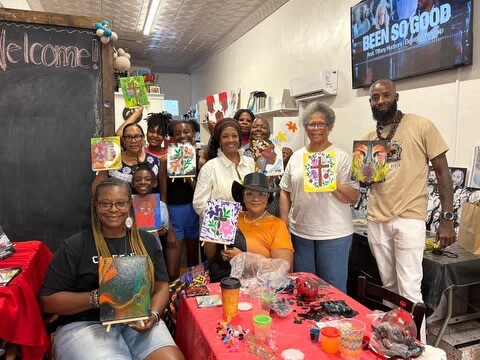
Buford said his mission is to help others find their own path toward healing — whatever form that takes.
“What I strive to do is guide this person to just create, man. Don’t care what people think about your creation, you just need to get it out,” Buford said. “Whether it’s with art, addressing your mental health, getting your life right — just do it.”
CBS 6 is committed to sharing community voices on this important topic. Email your thoughts to the CBS 6 Newsroom.
📲: CONNECT WITH US
Blue Sky | Facebook | Instagram | X | Threads | TikTok | YouTube

This story was initially reported by a journalist and has been converted to this platform with the assistance of AI. Our editorial team verifies all reporting on all platforms for fairness and accuracy. To learn more about how we use AI in our newsroom, click here.

Lovingston, VA (7News) — Good Morning Washington interviews Amanda Beckwith of Virginia Distillery Company- one of the contributing distilleries to the Virginia Spirits Board’s 250th Celebration Trio Pack, a special, exclusive release created to commemorate America’s upcoming 250th anniversary. This limited-edition package features a curated collection of a rum, a gin, and a whiskey, all crafted from scratch by distillers in Virginia to celebrate the rich history and current state of distilling within the Commonwealth.
Beckwith elaborates on VA Distillery Company’s role in the project, noting her focus on Virginia-grown grain to make the bottle of unique whiskey that is included in the Trio Pack. It is also worth noting that the Trio Packs themselves were bottled and produced right here at Virginia Distilling Company!
American single malts are the newest official category of American whiskey, distilled from one grain and from a single distillery. Virginia Distillery Co specializes in this new category of whiskey and crafted their contribution to the Trio Pack with this very specialty. Given the limited remaining availability of the Trio Pack, its historical value and collectible nature, the message it loud and clear encouraging viewers to grab a pack before they are all gone!
BE THE FIRST TO COMMENT
21+ Please drink responsibly, this content is sponsored by Virginia Distillery Company.


Powerball, Mega Millions jackpots: What to know in case you win
Here’s what to know in case you win the Powerball or Mega Millions jackpot.
Just the FAQs, USA TODAY
The Virginia Lottery offers multiple draw games for those aiming to win big.
Here’s a look at June 24, 2026, results for each game:
Powerball
Powerball drawings are held Monday, Wednesday and Saturday at 11 p.m.
13-14-16-21-38, Powerball: 14, Power Play: 2
Check Powerball payouts and previous drawings here.
Saturday, June 27, 2026
Pick 3
DAY drawing at 1:59 p.m. NIGHT drawing at 11 p.m. each day.
Night: 3-1-5, FB: 8
Day: 7-8-8, FB: 4
Check Pick 3 payouts and previous drawings here.
Pick 4
DAY drawing at 1:59 p.m. NIGHT drawing at 11 p.m. each day.
Night: 4-7-2-1, FB: 7
Day: 7-3-4-6, FB: 3
Check Pick 4 payouts and previous drawings here.
Pick 5
DAY drawing at 1:59 p.m. NIGHT drawing at 11 p.m. each day.
Night: 7-5-2-6-9, FB: 0
Day: 6-9-4-0-7, FB: 0
Check Pick 5 payouts and previous drawings here.
Cash Pop
Drawing times: Coffee Break 9 a.m.; Lunch Break 12 p.m.; Rush Hour 5 p.m.; Prime Time 9 p.m.; After Hours 11:59 p.m.
Coffee Break: 12
After Hours: 08
Prime Time: 13
Rush Hour: 01
Lunch Break: 14
Check Cash Pop payouts and previous drawings here.
Cash 5
Drawing every day at 11 p.m.
09-12-15-24-43
Check Cash 5 payouts and previous drawings here.
Bank a Million
Bank a Million draws are held every Wednesday and Saturday at 11 p.m.
18-21-25-33-36-39, Bonus: 13
Check Bank a Million payouts and previous drawings here.
Millionaire for Life
Drawing everyday at 11:15 p.m.
03-04-10-36-37, Bonus: 05
Check Millionaire for Life payouts and previous drawings here.
Feeling lucky? Explore the latest lottery news & results
This results page was generated automatically using information from TinBu and a template written and reviewed by a Center for Community Journalism (CCJ) editor. You can send feedback using this form.
-

 Movie Reviews3 minutes ago
Movie review: Hero of folklore worse off in ‘The Death of Robin Hood’
-

 World15 minutes ago
‘Eddie Cochran: Don’t Forget Me’ Director Kirsty Bell on How Legendary Musician Influenced New Generation of ‘Rock Stars’ Like Yungblud
-
 Lifestyle53 minutes ago
‘Supergirl’ has a solid hero but could use a better villain : Pop Culture Happy Hour
-

 Technology1 hour ago
Of course Meta thinks gambling is the future
-

 World1 hour ago
Death toll from Venezuela earthquakes rises to at least 589, with thousands reported missing
-

 Politics1 hour ago
McCarthy says Trump will use ‘everything he can’ to force Senate action on SAVE America Act
-

 Health1 hour ago
Switching from cigarettes to vapes linked to higher risk of major eye diseases, large study finds
-

 Sports1 hour ago
2026 World Cup Odds: Which Nations are Favored to Reach Semifinals?

