Arizona
What to know about the race to replace the late Arizona House Democrat


Democratic Rep. Gerry Connolly dies after fight against esophageal cancer
Rep. Gerry Connolly, 75, died after a battle with esophageal cancer and was remembered by his family for his advocacy, democracy defense, and service in Congress.
Scripps News
Voters in southern Arizona will have a good sense of who might succeed the late Rep. Raúl Grijalva – one of three septuagenarian Democrats who died while serving in Congress since the start of this year – after July 15.
The Democratic and Republican primaries on Tuesday come two months before the special election on Sept. 23. But, in the deep blue stronghold, whoever comes out on top among the handful of candidates on the left will have the general upper hand.
Adelita Grijalva, the late congressman’s daughter and former member of the Pima County Board of Supervisors, is the leading contender for the Democratic nomination, in what has become a microcosm of an ongoing national debate about the future of the party.
Also in the mix in Arizona is a more moderate former intern for former Rep. Gabby Giffords, as well as a Gen-Z social media savant.
On the Republican side, three candidates face off in hopes they can defeat more than two decades of precedent.
Grijalva, a staunch progressive, champion of environmental issues and congressman of over twenty years, died in March at the age of 77 following a battle with lung cancer.
The special election to fill his seat is one of three that will be held this year to fill House vacancies prompted by the death of a congressmember, all Democrats.
Grijalva’s daughter leads three-way Democratic contest
Adelita Grijalva, 54, is the expected frontrunner leading in the special election’s limited polling.
Taking up her father’s progressive mantle, Grijalva said in a debate on June 10 that his work in office “is the legacy that shaped me.”
Her campaign has garnered a slew of endorsements from prominent groups and figures, in and out of the state, including both Arizona Sens. Mark Kelly and Ruben Gallego, and fellow progressives Sen. Bernie Sanders of Vermont and Rep. Alexandria Ocasio-Cortez of New York.
Her main competitors include former state legislator Daniel Hernandez, 35, who had been working for one week as an intern to Giffords when a gunman opened fire at her Tucson constituent event in 2011. Hernandez, then a 20-year-old college student, has been credited with saving Giffords’ life by rushing toward her when she was shot in the head and staunching the bleeding.
The race in Arizona is a three-way contest between Hernandez, Grijalva and 25-year-old Deja Foxx, a popular social media strategist and activist.
While Grijalva has the political establishment’s backing (and Hernandez has his own endorsements from lawmakers like New York Rep. Ritchie Torres), Foxx has attracted support from some Democratic disruptors seeking a major shift in the party.
David Hogg, activist and former co-vice chair of the Democratic Party, and his political group, Leaders We Deserve, have endorsed Foxx’s grassroots campaign.
Democratic primary winner has the upper hand
Tuesday’s Democratic primary will be a good indication of who will ultimately win the seat and provide insight into voters’ hopes for the party.
Whichever Democrat comes out on top will be in the prime position to win in September, given the 7th district’s historically liberal leaning.
Three Republicans – Daniel Butierez, Jimmy Rodriguez and Jorge Rivas – hope to buck the region’s longstanding tradition of going Democrat. All are businessmen with thin political resumes.
The winner of the July 15 Republican primary faces a steep general election battle, regardless of opponent.
Aid for House Democrats
Congressional Democrats are counting on a Democrat to win in southern Arizona.
The outcome of this special election will help them tighten the margin in the House and put extra pressure on Republicans, who are already working with a narrow majority.
House Speaker Mike Johnson’s intraparty tightrope was evident early in July during the passage of President Donald Trump’s sweeping tax, spending and policy legislation.
In a campaign video on July 4, the day Trump signed the bill into law, Foxx, one of Arizona’s trio of Democratic candidates, said Republicans won “not because Democrats didn’t fight hard enough, but because three Dem congressmen died, while in office, and handed MAGA Republicans the advantage.”
Grijalva’s death came a week after former Rep. Sylvester Turner, D-Texas, died at 70. In May, Virginia’s Rep. Gerry Connolly, 75, was the third Democrat to die in office.
A special election to replace Connolly will be held in northern Virginia on Sept. 9. Texas’ 18th Congressional District, in the Houston area, will select Turner’s successor later on Nov. 4.



A new study has ranked Arizona as one of the worst states to move to for two years in a row, largely due to what it calls a poor quality of life.
The study conducted by Consumer Affairs analyzed the best states to move to in the United States, putting Arizona at the bottom of the list.
Before Arizonans get too defensive about the Grand Canyon State, Consumer Affairs used factors such as affordability, safety, economic strength and education to measure each state, leaving out factors like entertainment, retirement benefits and other considerations that may be important to people living here.
Popular states such as California and New York also landed at the bottom of the list due to their lack of affordability, even though they both have some of the best health care and education in the nation, Consumer Affairs noted.
Here’s why the study says you shouldn’t move to Arizona. Do you agree?
Why you shouldn’t move to Arizona
Arizona ranked No. 10 out of the worst states to move to, scoring especially poorly in quality of life.
Quality of life was measured by the state’s Social Progress Index, average air quality, weather, environmental protection and number of national parks. Due to Arizona’s extreme summers and Phoenix’s consistently poor air quality, it’s easy to see why Arizona ranked No. 44 in quality of life out of 50 states, even though the Grand Canyon is one of the most popular national parks in the nation.
However, Arizona also ranked poorly in other categories, sitting at No. 42 in health care and education, No. 41 in safety and No. 34 in affordability out of 50 states.
There was one category Arizona did impressively well in, ranking No. 5 in economic strength even as one of the youngest states in the country. Still, Arizona’s economic power wasn’t enough to boost its ranking.
Top 10 worst states to move to
Arizona wasn’t alone; some of the biggest states in the country were also considered the worst states to move to in 2026.
- New Mexico
- Louisiana
- California
- Arkansas
- Oklahoma
- Nevada
- Alaska
- Mississippi
- Oregon
- Arizona
Top 10 best states to move to
- Utah
- New Hampshire
- Idaho
- Minnesota
- Massachusetts
- Maine
- North Dakota
- Pennsylvania
- Iowa
- South Dakota
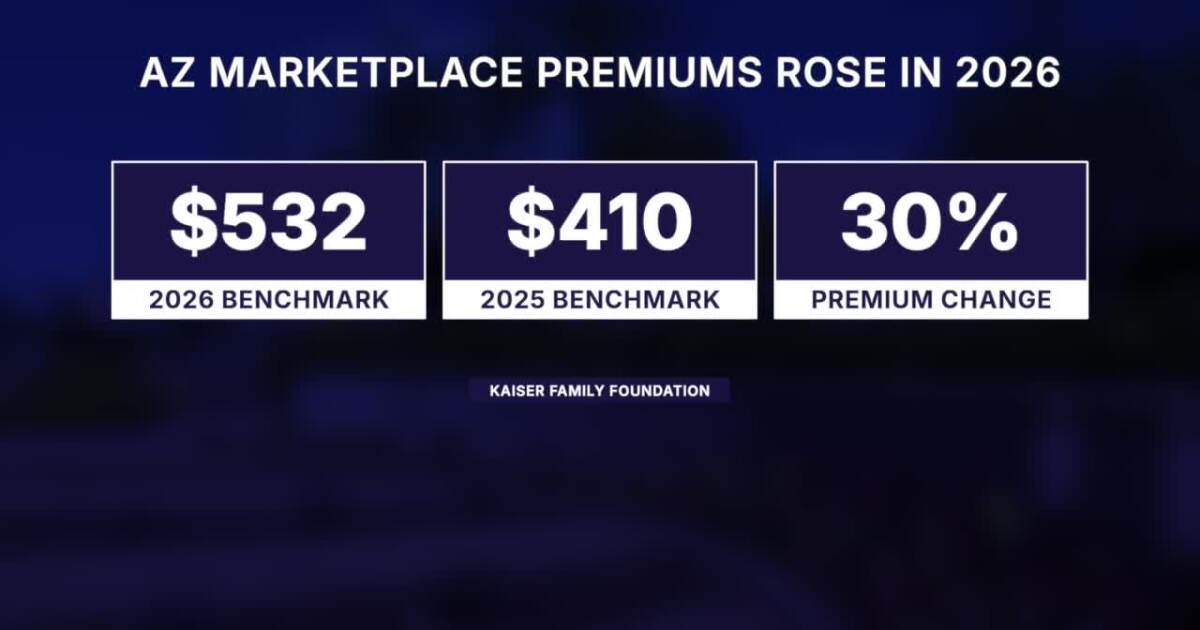
PHOENIX — Arizona’s ACA marketplace enrollment fell from 363,000 to just over 255,000 in a single year — a nearly 30% decline and the third-largest annual drop in the country.
Rising premiums and expired tax credits are driving the trend, with the average benchmark plan premium in Arizona now at $532 — up 30% from 2025.
In the player above, ABC15 Data Analyst Garrett Archer takes a look inside the numbers on how healthcare premiums are impacting health insurance enrollment.
This story was reported on-air by a journalist and has been converted to this platform with the assistance of AI. Our editorial team verifies all reporting on all platforms for fairness and accuracy.
Want more news in your community? Add ABC15 as a preferred source on Google below:

Arizona
Arizona man pleads guilty after illegally living in forest for years among ‘1,000lbs of trash’

A man in Arizona has pleaded guilty to violating federal fire restrictions and unlawfully residing in a national forest, after authorities said he spent years living at a makeshift campsite surrounded by what officials described as “approximately 1,000 pounds of trash”.
Mark Aaron Gatz was arrested on 25 June at his illegal campsite in Arizona’s Tonto national forest, according to court records. A United States Forest Service (USFS) officer wrote in documents submitted to court that Gatz had been operating an “illegal campsite” with a “hot wood burning campfire” despite fire restrictions and that he had told investigators that he had been living in the forest for about eight years.
The officer wrote that a records check found that Gatz had previously received multiple citations and was the subject of six outstanding federal arrest warrants for earlier violations, including for building fires during fire restrictions, constructing on national forest service lands, unsanitary conditions and occupying national forest as a residence.
Gatz “said that he knew about current fire restrictions but had to have fire to eat”, authorities said. The documents show that USFS officers made contact with Gatz multiple times over the last year or so, and issued him warnings as well as a violation notice for having campfires during fire restrictions.
Notes from officers’ previous encounters with Gatz earlier this year, submitted into the court docket, state that authorities observed “trash such as clothing, pans, tools, and plastic cups scattered throughout the campsite along with a structure that was four feet in height build using wood panels”.
During an encounter with Gatz in May, officers reported observing “approximately 1,000 pounds of trash” at the site, which they said included tires, plastic bags, trash bags, aluminum cans and other items. They also wrote that they found that the campfire site had been left unattended by Gatz the previous day while still hot.
In a separate report filed by law enforcement from an encounter in February, one officer wrote that “upon arrival at the camp, I was flabbergasted by the amount of debris in the area”.
Investigators said that during that encounter, the debris consisted of three ladders, six to eight totes “overfilled with debris”, five 55-gallon drums, eight tires, multiple bicycle frames, 5 gallons of motor oil, plywood and other “miscellaneous lumber”, and they wrote that trash was scattered over approximately half an acre of Forest Service land and creating what officers described as public safety concerns.
In a separate report from July 2025, officers said they observed what they described as a “large messy campsite” while patrolling the area due to complaints “from the district office abut one large messy camp”.
“There was roughly half an acre of resources ruined due to so much trash and goods on the ground for an extended period of time,” the officer wrote.
This week, after Gatz pleaded guilty, he was sentenced to time served and three years of probation, according to court records.
A representative for Gatz did not immediately respond to a request for comment.
-
 Sports3 minutes ago
Dodgers scheduled to visit White House in late July to celebrate 2025 World Series win
-

 World13 minutes ago
Former US Olympian pleads not guilty in DC reflecting pool vandalism case
-
 News40 minutes ago
Former Olympian pleads not guilty in reflecting pool vandalism charges
-

 Los Angeles, Ca2 hours ago
Heat advisory, beach hazards in effect as Southern California sizzles
-

 Detroit, MI2 hours ago
Teen on moped hit by car after cruising through stop sign in Detroit
-

 San Francisco, CA2 hours ago
Flight of fancy: San Francisco moves to build private luxury airport terminal
-

 Dallas, TX3 hours ago
Dallas’ digital creator economy is booming. Burnout is too.
-
Miami, FL3 hours ago
I went to 2 famous Miami restaurants, a flashy steakhouse and a Cuban hot spot. Here’s how they compared.


