Northeast
Education Department finds New York agencies ‘violated’ Civil Rights Act with ban on Native American mascots

NEWYou can now listen to Fox News articles!
An investigation by the Department of Education’s Office for Civil Rights (OCR) into two New York state agencies has found that both violated Title VI of the Civil Rights Act over a ban on Native American-inspired mascots and logos – an issue thrust into the national spotlight because of one Long Island school district.
The Department of Education released a press release of its findings on Friday, just a month after first launching the probe into the New York Department of Education and the New York State Board of Regents.
Secretary of Education Linda McMahon testifies before a House Committee on Appropriations subcommittee budget hearing on the US Department of Education on Capitol Hill, Wednesday, May 21, 2025, in Washington. (AP Photo/Rod Lamkey, Jr.)
“The Trump Administration will not stand idly by as state leaders attempt to eliminate the history and culture of Native American tribes,” U.S. Secretary of Education Linda McMahon, who visited Massapequa High School on Friday, said.
“Rather than focus on learning outcomes, the New York Department of Education and Board of Regents has set its sights on erasing Massapequa’s history – while turning a blind eye to other districts’ mascots that are derived from or connected to other racial or ethnic groups. We will stand with the people of Massapequa until commonsense is restored and justice is served, and until New York comes into compliance with federal law.”
The investigation was brought about when the Native American Guardians Association (NAGA) filed a complaint in April after claiming that the state agencies forced Massapequa School District, home of the Chiefs, to retire its mascot.
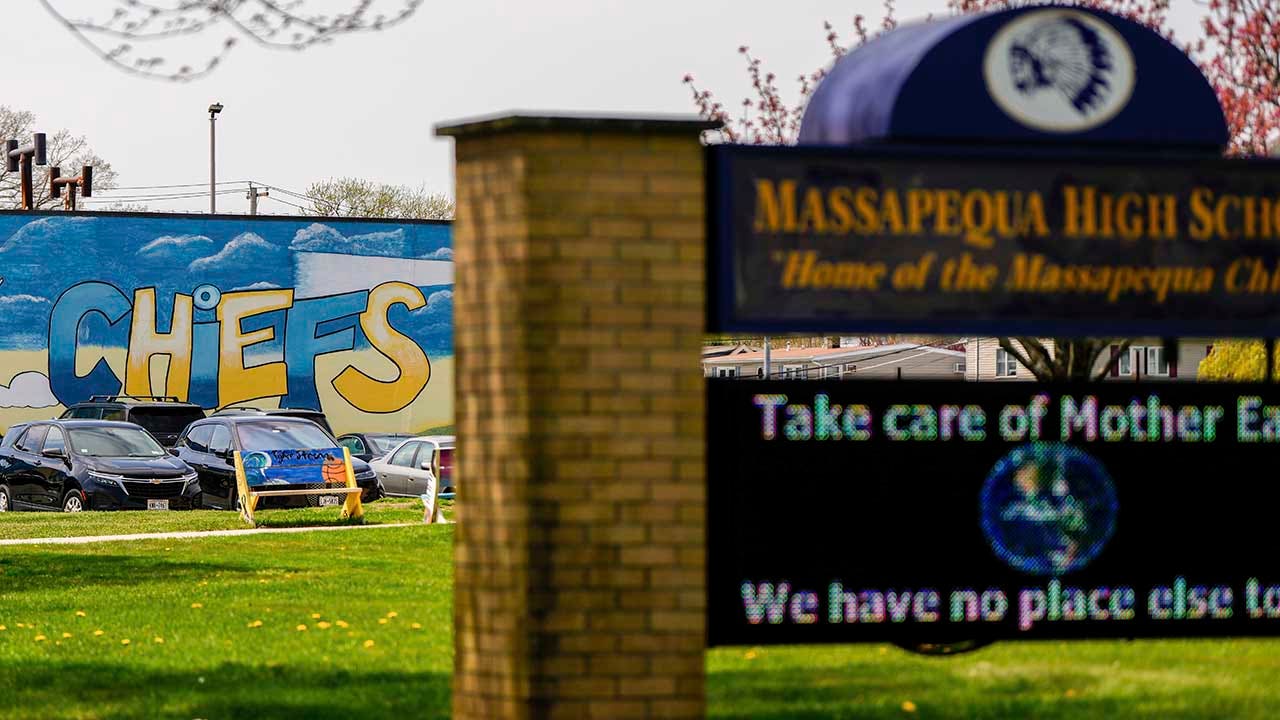
A mural for the Massapequa Chiefs school sports teams, where, according to media reports, the Trump administration has launched an investigation into New York officials threatening to withhold state funding for the town of Massapequa for failure to comply with a state mandate removing Native American names from school logos, is seen painted on a building next to the high school in Massapequa, New York, May 1, 2025. (Reuters/Shannon Stapleton)
“The Native American Guardians Association stands firm in asserting that the preservation of Native themes and imagery in New York public schools is not only a matter of cultural dignity but a fundamental civil right for all students. We call on federal and state leaders to help us defend these dwindling expressions or our presence and contributions,” Vice President of NAGA Frank Blackcloud said in a statement at the time.
TRUMP RIPS ‘RIDICULOUS’ CALLS FOR NEW YORK HIGH SCHOOL TO CHANGE NATIVE AMERICAN MASCOT
“Maintaining a respectable presence in NY State schools is vital to educational equity, historical truth, and the civil rights of all American Indians.”
The Department of Education also found that while Native American-inspired mascots, names and logos were not permitted under the policy, others that “appear to have been derived from other racial or ethnic groups” were, making the policy “discriminatory.”
The district sued the state in September, claiming its First Amendment rights were violated, but a federal judge ruled against it. Rebranding, including changing the name and logo, would cost roughly $1 million, district officials claimed.
A view of the Massapequa High School marquee, in Massapequa, N.Y., Friday, April 25, 2025. (AP Photo/Julia Demaree Nikhinson)
President Donald Trump became aware of the issue last month and encouraged the Department of Education to look into the ban, which he called “an affront to our great Indian population.”
The 2022 mandate requires all public schools to retire Native American mascots and logos or risk the loss of federal funding. Four schools on Long Island have since filed lawsuits.
The Department of Education announced Friday as part of its investigation that proposed resolution to the violations includes rescinding the ban on “Indigenous names, mascots, and logos,” issuing a memorandum to public schools informing them of the changes, and issuing apology letters to Indigenous tribes acknowledging that the actions of the two agencies “silenced the voices of Native Americans and attempted to erase Native American history.”
A marquee outside the Massapequa High School is backdropped by a “Chiefs” mascot mural, in Massapequa, N.Y., Friday, April 25, 2025. (AP Photo/Julia Demaree Nikhinson)
The Department of Education said failure to comply with the resolution plan risks further action by the Department of Justice and the potential loss of federal funding.
Fox News Digital’s Ryan Gaydos and Jackson Thompson contributed to this report.
Follow Fox News Digital’s sports coverage on X, and subscribe to the Fox News Sports Huddle newsletter.
Read the full article from Here


The Cincinnati Reds are in a rain delay for the second consecutive day. Saturday’s rain delay came before the game even started. Sunday’s rain delay occurred in the bottom of the 8th inning.
“The tarp is on the field, and we are in a delay here at PNC,” the Pirates official account posted on X. “We’ll update when we have info.”
Update: The grounds crew is taking the tarp off the field and the game is expected to resume around 5:20 ET.
The Pittsburgh Pirates lead the Reds 5-4 in the 8th.
Let’s take a look at how we got there.
Game Recap
In the second inning, Esmerlyn Valdez hit a ground-rule double off Reds starting pitcher Brady Singer that scored Nick Gonzalez, giving the Pirates an early 1-0 lead.
Later in the inning, former Red Tyler Callihan hit his third home run of the year, giving Pittsburgh a 4-0 lead.
However, in the fourth, the Reds would battle back. After Elly De La Cruz reached on an error and Sal Stewart singled, JJ Bleday added a single of his own that would score both, making it a 4-2 Pittsburgh advantage.
The Reds continued to rally in the fifth. After Noelvi Marte walked, Tyler Stephenson stayed hot with an RBI double to left field, getting the Reds back within a run.
Edwin Arroyo followed with an RBI single of his own that tied the game at 4.
The Pirates got a run back in the bottom half of the fifth when Ryan O’Hearn hit his 12th home run of the season. That would be it for Singer, who gave up five runs on nine hits in 4 1/3 innings. He struck out six and did not walk a batter.
The Pirates had a big opportunity to break the game wide open in the seventh when Zach McCambley walked the bases loaded. Reds manager Terry Francona brought in Brock Burke, who was miraculously able to get out of the jam with a pop-up and an inning-ending double play.
The Reds had a big chance to tie the game in the 8th when they had runners on first and second with nobody out. However, Nathaniel Lowe popped out, Spencer Steer flew out, and Noelvi Marte grounded out to end the threat.
Pierce Johnson was set to come in the game for the Reds when the game entered a rain delay.
We will provide an update as we know more.
Sign Up For Our DAILY Newsletter for More Free Coverage of the Cincinnati Reds Delivered to YOU Directly
Follow me on X at @RedsDaily4 for more.
Make sure you bookmark Cincinnati Reds Talk for the latest news, exclusive interviews, and daily coverage of the Cincinnati Reds! Follow Cincinnati Reds OnSI on Twitter/X: @RedsTalkSI. Like Our Cincinnati Reds On SI Facebook Page. Follow Cincinnati Reds On SI on Instagram.
 Add us as a preferred source on Google
Follow

WALLINGFORD, Conn. (WFSB) – The Connecticut Department of Transportation is marking two years since the death of Andrew DiDomenico, a DOT worker killed in a work zone crash on June 28, 2024, in Wallingford.
DiDomenico, 26, of Meriden, was struck and killed while working along the shoulder of the Wharton Brook Connector of Interstate 91.
Denise Lucibello, 55, of East Haven, was driving under the influence when her vehicle left the roadway and struck him, according to the state’s attorney’s office.
Lucibello was sentenced to 10 years in prison, execution suspended after five years served, followed by five years of probation. She pleaded guilty to second-degree manslaughter and operating a motor vehicle under the influence.
“The defendant chose to drive under the influence and because of that choice, a young life full of promise was senselessly taken,” State’s Attorney John P. Doyle Jr. said.
DiDomenico’s family started the Andrew DiDomenico Memorial Foundation to honor his legacy and provide scholarships and donations in his name.
CT DOT continues to remind drivers to keep others in mind on the road and themselves.
“Roadside workers put themselves at risk every time they step onto a job site, and it’s on all of us to keep them safe. Drive sober, put the phone away, and slow down and move over in work zones. Lives depend on it.”
Copyright 2026 WFSB. All rights reserved.

Purchase this image
FREEPORT — Flo Edwards and Alexus Bond have been shucking oysters under a tent and serving them to mollusk enthusiasts from all over the country for three days.
Their bounty is helping the 5th annual Maine Oyster Festival reach a new record for oyster sales, which is predicted to be well over last year’s 40,000.
The event started in 2021, when a group of oyster farmers approached Visit Freeport to ask about a statewide oyster festival, lead planner Margaret Hoffman said.
“They really desired to have a festival in Maine that was free and open to the public, low cost, broke down barriers, because people think oysters are this kind of exclusive thing that you can only eat in fancy restaurants,” Hoffman said. The farmers also wanted an event that welcomed farmers from anywhere in Maine.
Dozens of restaurants, artists and marine specialists take over the parking lot behind the iconic L.L. Bean flagship store in Freeport. At any given time during the three-day event, 20 of these tents represented oyster farms.

Purchase this image
“The best office I’ve ever worked in is out on the water during the daytime,” Edwards — whose main gig is dentistry — said. She and Bond, a logistician, started their business, Indigo Oyster Co., three years ago.
Indigo is a two-woman job, the lifelong friends said. They had spent years bonding over their shared love of oysters until one day they asked each other: “Should we try this?” Then, they started their farm in Yarmouth.
“Usually women who look like us are in the factories where they’re just shucking or canning, like not taking part in the ownership,” Bond said.
They chose the name “Indigo” because it honors Bond’s Asian heritage and Edwards’s African heritage. Taking the leap to launch a life on the water meant an opportunity to highlight women and people of color — two underrepresented populations in oyster farming, Bond said.
This was their first year at the festival, and it went well. Some visitors even saved their last oyster ticket to return to the booth, labelling Indigo oysters as their favorite of the weekend.
Hoffman said turnout this year has been great thanks to the weather and the offerings, with some farms selling out on the second day of the festival. She met one woman who said she had driven from Arizona just for the event.

Purchase this image
Freeport welcomed farmers and educators from as far south as Eliot, and as far north as Brooksville, all eager to teach visitors about the world of oyster farming.
Most oyster farmers in Maine use a top culture method, where oysters are harvested in a cage at the surface of the water. Top culture harvesting is relatively fast, and produces small oysters, said John Clapp, the owner of Mimi’s Oysters.
“We’re really focused on dive harvesting and working on our bottom sites,” Clapp said. They are one of a few farms in the state that uses both top and bottom culture.
All of Mimi’s oysters spend an entire season on the surface, but the largest get planted directly on the bottom where they grow for another two years. Bottom culture makes for a bigger oyster and a more complex flavor palate, Clapp said.
“Despite the extra time that it takes to get there, we feel that the, you know, the more time you spend with the oyster, the better product that you’re getting in the end,” he said.
Clapp and his team came to the festival with 4,000 oysters. After selling 2,400 on Saturday, the crew was confident they’d sell out of their remaining 1,600 Sunday.
Between sampling dozens of oysters, browsing the goods for sale and listening to live music, visitors had the opportunity to watch the festival’s culminating event on Sunday; an oyster shucking competition.

Purchase this image
No two oysters are the same, and no one knows that better than the professional shuckers who competed this year.
Spectators gathered as Kelly Punch, Firat Kocan and defending champion Chad Michael Egeland carefully slid their shucking knives between each oyster shell. Any leftover grit or cracks in the shell resulted in a penalty.
Egeland finished first, followed by Kocan and Punch. After a few minutes of inspection, judges wrote down final scores on the lid of a paper takeout box, crowning Egeland winner for the second year in a row.
The oysters were slightly dry and gave the competitors some trouble this year, Egeland — who is also the raw bar sous chef at Portland’s Scales — said. But, he couldn’t be happier with his win.
-

 Pittsburg, PA1 minute ago
Cincinnati Reds vs. Pittsburgh Pirates Game Delayed on Sunday
-

 Augusta, GA8 minutes ago
CSRA Death Cafe holds gathering at Augusta church
-
 Washington, D.C11 minutes ago
Trump lashes out at Washington, DC, mayoral nominee
-

 Cleveland, OH16 minutes ago
1 dead, 1 hospitalized after early morning crash: Cleveland EMS
-

 Austin, TX23 minutes ago
Big changes to the drought in recent weeks
-

 Alabama26 minutes ago
Alabama football 2027 commit shuts down recruitment
-
 Alaska31 minutes ago
Mat-Su Initial Attack Responding to Fire in Flat Lake
-

 Arizona38 minutes ago
NFL power rankings: Arizona Cardinals are in lowest tier

