West
Catholic bishops vow to resist blue state law intruding on 'sacred' trust: 'Obey God rather than men'

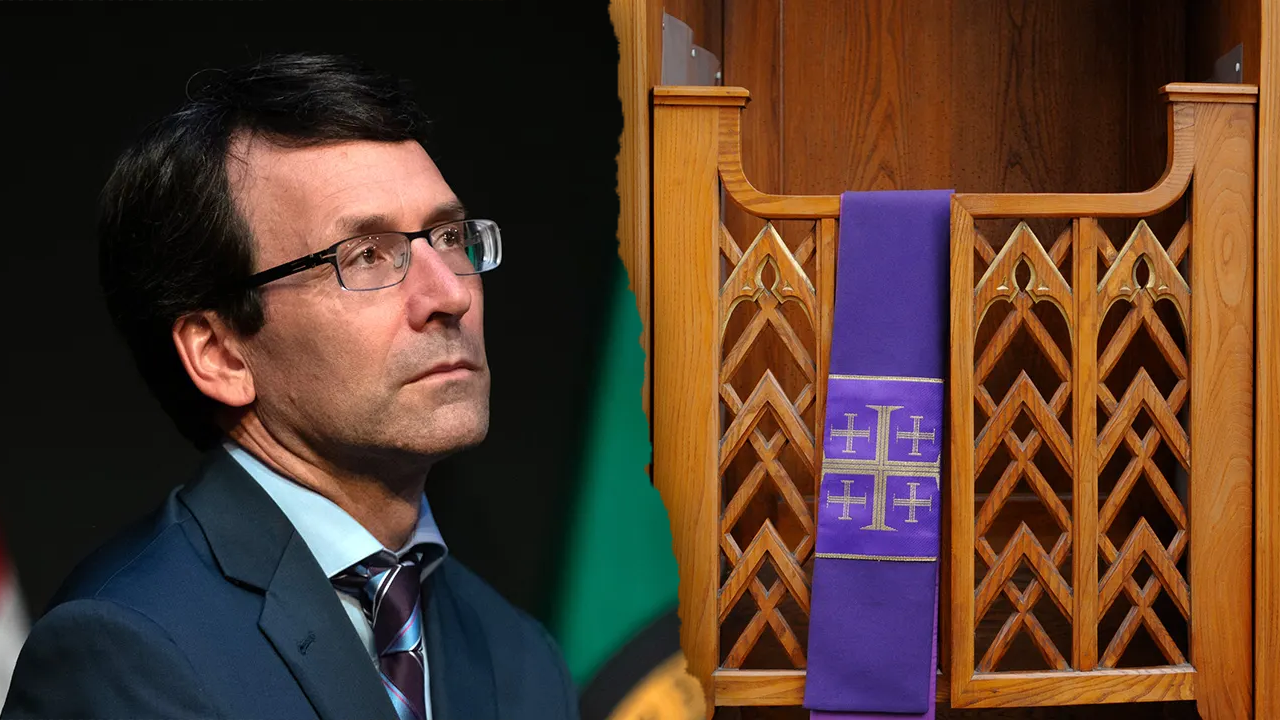
The Catholic bishops of Washington state are resisting a new law signed by Democratic Governor Bob Ferguson that they say would violate the seal of confession, which would result in excommunication for any priest who complies.
Spokane, Washington, Bishop Thomas Daly released a statement in response to the law in which he said that he and his priests “are committed to keeping the seal of confession – even to the point of going to jail.”
The new law, signed last week by Democratic Gov. Bob Ferguson, who is Catholic, added “members of the clergy” to a list of professionals who are required to report information that relates to child abuse or neglect to law enforcement, and the measure does not provide an exception for information offered at a confessional. The law is set to go into effect on July 26.
A central tenet of the Catholic sacrament of confession is that priests are bound by an absolute seal of confidentiality, an obligation that requires them to keep anything learned in confession a secret. Violating this tenet results in what is called “excommunication,” which cuts a person off from the church and eternal life, according to Catholic teaching.
DOJ INVESTIGATING ‘ANTI-CATHOLIC’ WASHINGTON STATE LAW REQUIRING CLERGY TO REPORT CHILD ABUSE
The Catholic bishops of Washington state are resisting a new law signed by Democratic Governor Bob Ferguson that they say would violate the seal of confession, which would result in excommunication for any priest who complies. (Chona Kasinger/Bloomberg via Getty Images and iStock)
While Daly said that his diocese has a zero-tolerance policy regarding child sexual abuse and that the church would “do everything within our power to keep your children safe,” he said the “Sacrament of Penance is sacred and will remain that way in the Diocese of Spokane.”
Seattle Archbishop Paul Etienne framed the issue as a question of whether the clergy is “answerable to God or state.”
He quoted a scripture passage that reads, “We must obey God rather than men.”
“This is our stance now in the face of this new law. Catholic clergy may not violate the seal of confession – or they will be excommunicated from the Church,” said Etienne, adding: “All Catholics must know and be assured that their confessions remain sacred, secure, confidential and protected by the law of the Church.”
CHOOSING AN AMERICAN POPE ‘CANNOT BE AN ACCIDENT,’ SAYS PAUL MAURO
Democrat Bob Ferguon won the 2024 Washington state governor’s race, defeating Republican challenger Dave Reichert. (Getty Images)
Etienne said that the law cuts to the heart of the First Amendment’s ban on the state either establishing or prohibiting the free exercise of a religion.
“Once the state asserts the right to dictate religious practices and coerce information obtained within this sacrament – privileged communication – where is the line drawn between Church and state? What else may the state now demand the right to know? Which other religious practices will it try to legislate?” asked the archbishop.
On Monday, the U.S. Department of Justice’s Civil Rights Division opened an investigation into the law for possible violations of the First Amendment’s religious protections.
A statement by the division said that the new law “singles out ‘members of the clergy’ as the only ‘supervisors’ who may not rely on applicable legal privileges, including religious confessions, as a defense to mandatory reporting.”
BROOKLYN BISHOP BRENNAN ON WHAT POPE LEO XIV MEANS FOR THE CHURCH
Archbishop Paul Etienne is the leading Catholic cleric for the city of Seattle. (Reuters/Chris Helgren)
“The law appears to single out clergy as not entitled to assert applicable privileges, as compared to other reporting professionals,” said Assistant Attorney General Harmeet Dhillon of the Justice Department’s Civil Rights Division.
“We take this matter very seriously and look forward to Washington State’s cooperation with our investigation,” said Dhillon.
Bishop Joseph Tyson of Yakima, Washington, posted on Facebook that he was grateful for the Justice Department’s investigation, saying that the bishops’ attempts to meet with the governor about the law had gone unanswered.
“I realize that many may disagree but in a way that parallels attorney client privilege, the seal of confession allows the penitent to come to grips with moral accountability and culpability,” said Tyson. “We want to hope and pray that the heart of an offender would be so moved by the mercy of God and the guidance of the skilled clergy that it would necessarily lead to an encounter beyond the sacramental seal with law enforcement.”
Ferguson did not respond to Fox News Digital’s request for comment.
Fox News Digital’s Landon Mion contributed to this article.
Read the full article from Here


SAN FRANCISCO (KGO) — A recent Civil Grand Jury report has identified wildfire risks in San Francisco’s Glen Canyon, warning that vegetation management is needed to reduce the potential for a fire in an area not typically associated with wildfire danger.
The report focuses on the canyon’s large population of Blue Gum eucalyptus trees, an invasive species originally imported from Australia.
Historical photographs show Glen Canyon was largely treeless in the late 1800s, when the land was used primarily as a dairy farm.
The eucalyptus trees were planted after investors believed the fast-growing species could be harvested for timber.
“And these people were so stupid, they didn’t realize they were going to build railroad ties and use the wood for building, and it’s worthless. It warps, it splits. it has no commercial value,” said Rick Carell, a member of the Civil Grand Jury.
While the timber venture failed, the trees remained.
Today, their flammability is a concern for fire safety officials and grand jury members.
MORE: 600 goats graze Poplar Beach in Halfmoon Bay to reduce wildfire risk
“The leaves have a lot of oil in them, and so actually, if it’s very hot, and it’s been very, very dry, they actually explode, because it’s highly flammable. And so, you can see here, look at all the debris right next to this road. So somebody throws a cigarette out into there, and you have a potential fire,” Carell said.
Carell said assessments of the trees have raised additional concerns.
“They evaluated something like 427 eucalyptus trees and 80% of them, back in 2012, were in bad shape,” he said.
Although CAL FIRE has repeatedly rated San Francisco’s wildfire risk as low because of the city’s cool, foggy climate, the grand jury report points to the 2025 Pacific Palisades fire in Los Angeles as an example of how fires can occur in urban areas where vegetation management is inadequate.
The report notes that Glen Canyon has only two fire hydrants, one near the Glen Park Recreation Center and another near a day camp building.
However, San Francisco’s Emergency Firefighting Water System provides additional resources through reservoirs, high-pressure hydrants and underground cisterns.
One nearby cistern at Chenery and Surrey streets can supply 75,000 gallons of water. Based on a fire engine’s typical pumping rate of 1,500 gallons per minute, that amount of water would be exhausted in about 50 minutes. Additional cisterns are located in surrounding neighborhoods.
MORE: CAL FIRE urging Bay Area residents to create defensible space as wildfire season begins
Despite the concerns, the report concluded that removing all eucalyptus trees is not a practical solution because of the canyon’s steep terrain. Large-scale removal could increase the risk of landslides. Instead, the report recommends managing vegetation by clearing brush and fallen debris and removing diseased trees.
“To remove any brush that might be a fire hazard, if something could really ignite quickly. We’re going to raise up the branches, the lower branches of the tree because that’s where a lot of the problem is for the spread of the fire, and if there are any dead trees that are really hazardous or branches that may hang over the roadway, that we can take them out as well,” said Rachel Gordon of the San Francisco Department of Public Works.
Public Works officials are expected to coordinate closely with CAL FIRE on vegetation management efforts.
“CAL FIRE guys, they train in the type of environment, and so what they do, they get their chainsaws out, they eliminate. They limb the trees, they bring out the debris and that sort of stuff so this is an ideal training site for them,” Carell said.
The San Francisco Public Utilities Commission, which manages a small portion of the canyon, has already removed trees on its property to prevent them from falling across O’Shaughnessy Avenue, a potential emergency evacuation route.
The agency has also hired habitat experts to remove non-native vegetation and replace it with fire-resistant native species, including coast live oaks.
“That has all these tannins in the foliage that resist fire. You can put a lighter right under that thing in the middle of the hottest day of the year, and it will not burn like these willows. They will not burn, and so that’s what we want to load our parks with instead of having things like the eucalyptus and the pine — which, as we all know, they just burn like a crazy Christmas tree fire,” said Habitat Specialist Josiah Clark.
The majority of the 66-acre canyon is managed by the San Francisco Recreation and Parks Department, which agrees that improved coordination among city agencies is essential to maintaining fire safety in the area.
Copyright © 2026 KGO-TV. All Rights Reserved.

The Regional Transportation District’s BroncosRide buses, running from Park-n-Ride lots around metro Denver to Broncos football games, will be back this fall after a five-year suspension.
RTD directors this week voted 10-5 to reinstate the service.
The agency suspended the service before the Broncos’ 2020-21 season due to bus driver shortages and agency concerns about public transit equity.
Despite RTD’s current budget crisis, the directors decided that the BroncosRide — which will cost $1.6 million, according to information that agency staff provided to directors — will help boost RTD’s lagging overall ridership and increase the appeal of public transit.
If the buses are full, Director Chris Nicholson said, fare revenues estimated at $497,855 will offset the cost.
“At RTD, we make lives better through connections, and there’s nothing better than seeing (Broncos quarterback) Bo Nix connect for a touchdown,” Nicholson said. “Previous boards didn’t see it as a fundamental part of service. We do.”
Before the Broncos’ Aug. 21 preseason home game against the Green Bay Packers, RTD officials plan to announce detailed plans to run about 92 buses from about 18 locations around metro Denver, including stations near Denver International Airport, East High School, the Highlands Ranch Town Center, Interstate 25/Broadway, Broomfield, Longmont, Littleton and Parker.
Get more Colorado news by signing up for our Mile High Roundup email newsletter.
Seattle, WA
FOLLOWUP: Sound Transit Board finalizes $400+ million spending installment for West Seattle light rail

Two weeks ago, we reported on the Sound Transit Board‘s System Expansion Committee recommending approval of actions to allot $406 million toward West Seattle light rail – the first big commitment after the ST3 plan revision that cemented ST commitment to WS. At this afternoon’s meeting of the full board, the actions all got final approval, as did a much-smaller installment of spending on Ballard light-rail planning.
(Here’s the full slide deck as presented at the committee meeting, also including the current WS light-rail cost estimate of around $5 billion.)
On the horizon, according to the most-recent ST email update, is work to advance the plan for the new cross-Duwamish River light-rail bridge, shown in this rendering:
 (Sound Transit rendering)
That work on the south end of Harbor Island (in a parking lot at 1001 Klickitat, according to city docs) will see crews drill a test bridge shaft approximately 10 feet wide and 250 feet deep to better understand ground conditions,” ST says, to obtain “key information needed to finalize the bridge design.”
-
 Lifestyle22 minutes ago
‘The Bear’ is back in the kitchen
-

 Technology34 minutes ago
Android 17’s new foldable gaming mode could make flippy phones more fun
-

 World37 minutes ago
Shark attack survivor wakes from 10-day coma and shares first words with family at her hospital bedside
-

 Politics42 minutes ago
Trump administration pledges $150M in aid, deploys Navy warships after deadly Venezuela earthquakes
-

 Sports52 minutes ago
Second Lady Usha Vance joins celebrity-filled crowd for Team USA’s group-stage finale in LA
-

 Technology57 minutes ago
Debt collection letter for debt you don’t owe? What to do now
-
 Business1 hour ago
Newsom blesses Uber ballot measure truce — but fight over car crash lawsuits continues
-
 Entertainment1 hour ago
La Cruz offers a musical memorial to Pulse shooting victims on Pride Month

