Lifestyle
How one woman is doggedly transforming a trash patch into a fragrant habitat garden


Some people see trash and weeds and walk on by. Others rail against the slobs of the world, or agencies that don’t do their jobs.
And some, like environmental scientist Marie Massa, roll up their sleeves and get to work.
In Massa’s case, that’s meant spending six to nine hours a week since early 2023 working mostly alone to transform a long, trash-filled strip of no-man’s land between Avenue 20 and Interstate 5 in Lincoln Heights into a fragrant, colorful habitat of California native plants.
Tall stems of rosy clarkia, a native wildflower, add to the riot of spring color in the Lincoln Heights California Native Plants Corridor on Avenue 20, south of Broadway.
(Christina House / Los Angeles Times)
She’s named the garden the Lincoln Heights California Native Plants Corridor and features it on her Instagram page, ave20nativeplants, exulting every time she spots a native bee, caterpillar or some other creature visiting the space for food or shelter.
“You see all these horrible things happening in the world,” she said, “the loss of rainforests, of plants and animals and insects. … It’s so much and sometimes I can’t handle all this bad news,” Massa said. “That’s why I feel compelled, because I can make a difference here.”

With little fanfare, Southern Californians are quietly changing urban landscapes for the better with native plants. These are their stories.
Massa is slender and just 5 feet tall in her work boots, with strands of gray lightening her dark hair. Years ago, she helped build the Nature Gardens at the Los Angeles County Natural History Museum. She wrote about wildflower blooms for the Theodore Payne Foundation’s Wild Flower Hotline and volunteered to help renovate UCLA’s extraordinary Mathias Botanical Garden, a project that was completed in 2024.
These days Massa is a stay-at-home mom to Caleb, age 8. Her husband, Joseph Prichard, one-time lead singer for the L.A. punk band One Man Show Live, now runs his own graphic design company, Kilter. Most weekdays, Massa walks her son to and from school, makes her husband’s lunch and tends her own private garden.

Marie Massa purchased 200 feet of hose so she could hook it up to a spigot at the neighboring Alliance Susan & Eric Smidt Technology High School, which has given her permission to use the water to keep her native plant garden project alive.
(Christina House / Los Angeles Times)
But Tuesdays, Wednesdays and Thursdays between 8:30 and 11:30 a.m., Massa becomes a determined eco-warrior. With her garden gloves, buckets, hand tools and a spongy cushion to protect her knees as she weeds, Massa is doggedly transforming a strip of public land roughly 8 feet wide and around 380 feet long — longer than a football field.
She fills bags of trash from around her planting strip and calls 311 to have them hauled away. She drags 200 feet of hose to water her new plantings a few times a month, from a spigot made available by Alliance Susan & Eric Smidt Technology High School next door. She’s spent days digging up garbage buried three feet deep in the garden and even muscled an old oven from the planting area to the curb after someone dumped it during the night.
When graffiti appears on the retaining wall below the freeway, she takes a photo and uploads it to MyLA311 to get it painted over. She’s lobbied for plant donations, potted up excess seedlings for people to carry home and recruited work parties for really big jobs, such as sheet mulching the parkway between the sidewalk and the street to keep weed seeds from blowing into the habitat corridor on the other side of the sidewalk.
The project started slowly in the fall of 2022. As she walked Caleb to school, less than a mile from their Lincoln Heights home, Massa noticed this long strip of neglected land between the freeway’s retaining wall and the sidewalk.

Passerby Eimy Valle, 20, walks amid the abundant spring color of the Lincoln Heights California Native Plants Corridor on Avenue 20.
(Christina House / Los Angeles Times)
“It was full of weedy dried grasses, all kind of brown, and lots of trash,” Massa said. “There were also four planter beds in the parkway [the strip of land between the sidewalk and street] with a few buckwheat and encelias (brittlebush), but every time the L.A. Conservation Corps came to mow the weeds down, they gave a huge horrible buzz cut to the native plants.”
When the buckwheats in the parkway got mowed down, she said, they blew seeds into the wider planting strip on the other side of the sidewalk, and Massa said she noticed some buckwheat seedlings coming up, trying to make space for themselves among the weeds. “I thought, ‘Native plants could do really well here,’ and I started developing this idea that the strip would be cool as a native plant garden.”
That November, she bought some wildflower seeds and sprinkled them along the corridor, to see whether the soil would support their growth. After the heavy rains that winter, she was delighted to find them sprouting in the spring, fighting through the weeds along with buckwheat seedlings.

Clusters of deep blue California bluebells are among the many vibrant flowers blooming at the Lincoln Heights California Native Plants Corridor on Avenue 20.
(Christina House / Los Angeles Times)

Native sticky monkey-flowers come in two colors at the Lincoln Heights California Native Plants Corridor: in red and here, in pale yellow with white edges.
(Christina House / Los Angeles Times)
She wrote a letter to people who lived near the untended land, outlining her idea to create a native plant garden to beautify the area and support pollinators. She invited neighbors to help her and included her email address. “I didn’t get any responses,” she said, “but when I went out to weed, people would come up to me and say, ‘We got your letter and this is a cool idea.’”
In the spring of 2023, as her wildflowers were sprouting, Massa called the office of Los Angeles Council District 1 and told them about her project. She asked them to stop the Conservation Corps from mowing down the emerging plants and requested help from the Conservation Corps to suppress the weeds along the long strip of parkway between the sidewalk and street.
The council agreed, so between May and October of 2023, Massa organized six work sessions to sheet mulch the parkway between the sidewalk and street, laying down cardboard and city-provided mulch with help from members of the L.A. Conservation Corps, Plant Community and Aubudon Society. The goal was to suppress the weeds on the parkway so they didn’t add more seeds to the habitat she was trying to create on the other side of the sidewalk.
“The sheet mulching took a looong time,” she said, “but I wanted the parkway to look nice, with cleaned up planters, so people could park along the street, easily get out of their cars and see the corridor.”
But she still needed plants. She went to her former boss at the Natural History Museum’s Nature Gardens, native plant guru Carol Bornstein, with her design, and Bornstein helped her choose colorful, fragrant and resilient native shrubs, perennials and annuals that could provide habitat for insects, birds and other wildlife.
The response to her plant quest was heartening. The Los Angeles-Santa Monica Mountains Chapter of the California Native Plant Society gave her a $500 grant, and several nonprofit and for-profit nurseries donated plants, including the Audubon Center at Debs Park, Theodore Payne Foundation, Santa Monica Mountains Fund native plant nursery, TreePeople, Descanso Gardens, Plant Material, Hardy Californians, Artemisia Nursery and Growing Works Nursery, which even delivered the large cache of plants from its nursery in Camarillo to Lincoln Heights.
By November she had more than 400 plants, and the help of a friend, Lowell Abellon, who wanted to learn more about native plants. Working about six hours a week, they slowly began adding plants to the 380-foot strip, weeding around each addition as they went. By March they had added about half the plants, but they had to stop before it got too warm.
“If you plant them too late, they don’t have time to get good roots down into the ground [before it gets too hot],” she said. “I tried to be on top of the watering, but during the summer about half of them died, so I had to do a lot of replacement planting in the fall.”
During the summer, Massa mostly worked alone keeping the newly planted sections of the corridor weeded and watered. Because school was out, she brought her young son to help her each week. Sometimes neighbors with children would join them, she said, giving her son someone to play with, but once or twice, she resorted to offering him $5 for his weeding work.
When school resumed in the fall, Massa was ready to start planting again, this time working mostly alone because her friend Abellon had a family emergency that took him out of state. She began in October, planting and weeding the rest of the corridor, including adding 100 plants to replace the ones that died.

The native plant corridor on Avenue 20 has many clumps of showy penstemon, native perennnials that live up to their name with their deep-throated, vibrantly colored flowers in electric purple and pink.
(Christina House / Los Angeles Times)
Now, in the garden’s third spring, the plants are filling out. There are large mounds of California buckwheat, tall spires of sweet hummingbird sage and incandescently purple clusters of showy penstemon. Monkey flowers in orange and red, scarlet bugler, purple and white sages and coffeeberry shrubs are coming into their own. And there’s so much California buckwheat Massa has had to thin out some of the plants and put them in pots for others to take home.
She hopes her work will inspire others to create their own native plant gardens and even tackle a project like hers, beautifying a neglected public space. But she says it’s important that people understand such work is more than a passion; it’s a long-term commitment.
Guerrilla gardeners have great intentions, she said, but it usually takes at least three years for a garden of native plants to get established, and those young plants will need water, whether it’s a nearby water spigot or jerricans of water lugged to the site.
“If you just plant and go, you might as well throw the plants in a trash can, because it’s not going to work,” Massa said. “If you don’t water them, if you don’t weed and pick up trash, people aren’t going to respect the space, especially if you don’t put in the effort to keep it looking good. For a garden to be successful, you have to commit to putting in the work.”
Massa’s son goes to another school these days, but she figures she’ll keep up her three-mornings-a-week schedule at the garden for at least another year, until she’s confident the plants are established enough to thrive on their own. For instance, she wants to make sure the narrow leaf milkweed she planted gets big enough to attract endangered monarch butterflies and provide a place for them to lay their eggs and plenty of food for their caterpillars every year.
“My hope is that this will become a habitat that’s self-sustaining,” she said, “so I can step away and be OK just picking up trash every once in a while.”

Marie Massa is nearly dwarfed by the tallest plants in her Lincoln Heights California Native Plants Corridor.
(Christina House / Los Angeles Times)
Will she start another project somewhere else? Massa rolled her eyes.
“My husband says I can’t take on another project until this one is done, and this one has been a lot of work,” she said, laughing, “buuuut I do actually have my eye on another spot.”
And then suddenly she’s serious, talking about this weedy strip on Main Street, not far from where she’s working now. She’s a little embarrassed, struggling to explain why she would want to tackle another lonely, thankless project, but defiant too, because, clearly, this is a mission.
“People in this neighborhood don’t seem to know about native plants,” she said, “so maybe I can show them their value, the value of having habitat and space around you that’s beautiful. Maybe it could be a way of educating a new audience about the value of appreciating the environment.”
Maybe so. Better watch your back, Johnny Appleseed.



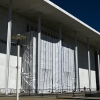
The Kennedy Center on June 28, with its facade signage still covered by a tarp and scaffolding.
Alex Wroblewski/AFP via Getty Images
hide caption
toggle caption
Alex Wroblewski/AFP via Getty Images
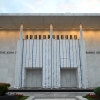
On Wednesday, a federal appeals court denied President Trump’s request to stop the removal of his name from Washington, D.C.’s Kennedy Center. The signage on the building has been covered with tarp and scaffolding since June 13, but in a court filing last month, the center’s current executive director said that Trump’s name has been removed.
In their decision, three judges from the U.S. District Court of Appeals for the District of Columbia Circuit said that the president had failed to prove that the arts center would be “irreparably injured” without Trump’s name attached to it.
NPR requested comment from the Kennedy Center, but did not receive an immediate reply.
This latest round of court decisions is part of the ongoing litigation filed by Rep. Joyce Beatty, D-Ohio, against President Trump and the board of the Kennedy Center. In a statement emailed Wednesday to NPR, Beatty said: “Today’s ruling again affirms that this administration’s efforts to rename the Kennedy Center were unlawful. His name no longer desecrates this sacred memorial, which belongs to the American people. Now it is time for the Trump administration to accept this, comply with the law, and take the tarps down.”
In previous court filings, Trump’s legal team had asserted that removing the president’s name from the arts complex, both on the physical building and in its digital materials, would inflict irreparable harm in both time and money already spent. In the denial, the three judges — Patricia Millett, Robert Wilkins and Gregory Katsas — wrote that since Trump’s name has already been removed, “a stay would not avert those harms.”
Furthermore, Trump had claimed that without his name attached, future fundraising would be threatened “and [will] contribute to the financial decline of the Center.” In response, the appeals judges wrote: “Appellants, however, have failed to support this assertion with any specific facts or evidence. They offer only the conclusory assertions of the Kennedy Center’s Executive Director that were made in a factually unsupported declaration.” The center’s current executive director, Matt Floca, specializes in physical plant management.
The presiding judge in the case, Christopher R. Cooper, has ordered that the center provide him a status report on the center’s operation and programming before the end of this month. As of Wednesday, the center’s calendar lists a small roster of programs, including outdoor free movie screenings, workshops for children, and five free live performances in July on its Millennium Stage. In the past, the Kennedy Center presented over 2,000 arts and education events each year, including free daily Millennium Stage performances.

Lifestyle
A meal with an animated Mona Lisa? Immersive dining goes high tech — but will L.A. eat it up?
My dinner course is served. It is a Campbell’s-inspired soup can, lightly angled so strands of broccoli are peeking out. I lift the can to uncover a slow-braised short rib and mashed potatoes. An American dish to represent an American artist, here Andy Warhol.
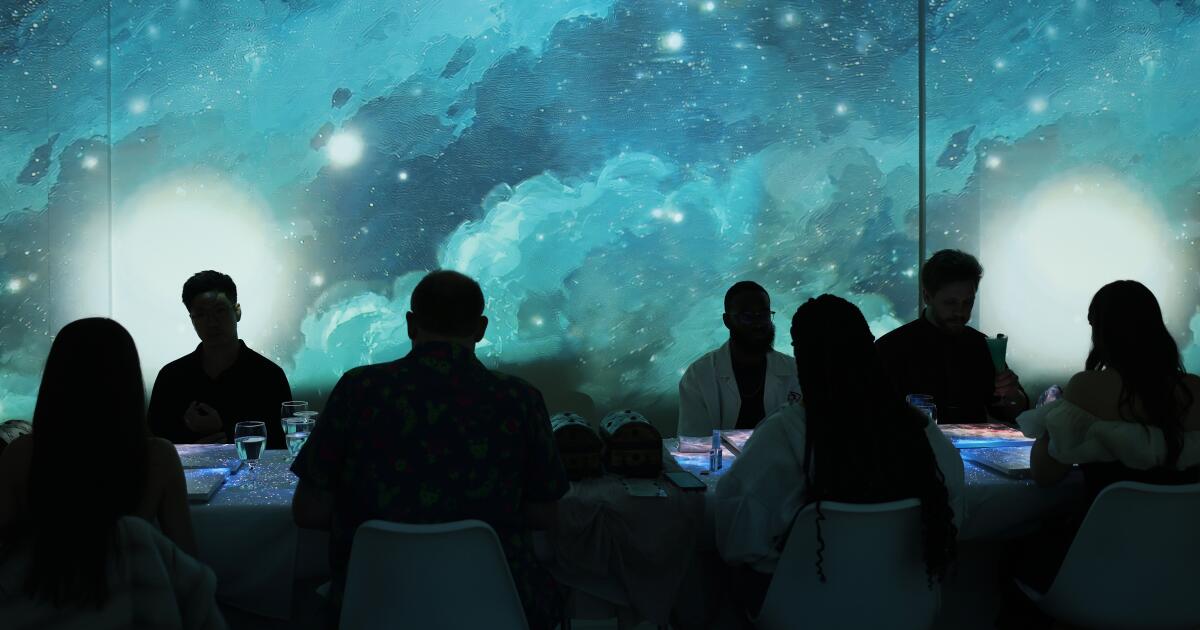
The room is overtaken with projections, scenes of bustling New York traffic paired with bachelor-pad-like guitar riffs. Shown on a wall above a dinner table is a selection of Warhol silkscreens. It’s a Friday night in West Hollywood, and I’m surrounded by a mix of out-of-towners and those celebrating an anniversary. And while this is a special occasion, we’re urged to get a little messy with our food — to use our hands, to paint with a salad, to draw on a cookie.
The main course: A tomato soup can? “7 Paintings” is an immersive event that occasionally hides dishes in artist-inspired presentations.
(Christina House / Los Angeles Times)
Play is the primary side dish at “7 Paintings,” a tech-infused dinner theater that aims to be a crash course in fine art. That selection of veggies paired with multiple mini cups of colorful dressings? Guests are encouraged to mix and match the vinaigrettes into a mess of hues, a nod to abstractionist Jackson Pollock. And yellowfin tuna with dashes of avocado and taro chips? That’s an edible tribute to Banksy, of course. What does raw fish have to do with stenciled street art? It’s bold, heavily angled and has a short shelf life? Maybe? Perhaps don’t overthink it.

Even the paper is edible.
(Christina House / Los Angeles Times)
“Have you ever eaten a painting before?” says Nadine Beshir, the Dubai-based creator of “7 Paintings.” “We try to get people out of their comfort zones and eating paper. I want to bring out the child in them.”
“7 Paintings,” held at Sunset House L.A. through the end of August, is the latest example of immersive dining to arrive in this city. These experiences often involve guest participation and are accentuated with advanced multimedia technology and sometimes theatrical elements.
Worldwide, there have been standouts. For instance, Eatrenalin at Germany’s Europa-Park, a dining room-meets-ride where participants are whisked around the space on trackless “floating chairs,” has just received a coveted Michelin star. Ibiza’s Sublimotion has similar haute ambitions, pairing 12 diners together in a room that will come alive with otherworldly projections and performers. At times, diners will win don virtual reality headgear.
But tech-driven immersive dining experiences have never quite taken off in Los Angeles as a trend. Last year, the Gallery, where fantastical cityscapes and projections surrounded downtown L.A. diners, stood just a couple months before the concept was abandoned.

“7 Paintings” pairs food with art and music. It’s “fun dining, not fine dining,” says its founder.
(Christina House / Los Angeles Times)

Bartender Luca Famulari shakes a cocktail at the immersive dining event.
(Christina House / Los Angeles Times)
“The economics of a restaurant are not the same as the economics of theater and the challenge of combining the two lies in thinking outside the box with respect to pricing and cost structure, such that the customer perceives high value from both the food and the experience,” says the Gallery co-founder Daren Ulmer.
Entrepreneurs keep aiming for that careful balance. “Le Petit Chef and Friends” is currently running at Tangier at downtown’s Hotel Figueroa, an event in which a fully animated film is projected on our plates and tables. Long-running pop-up event Fork N’ Film leans more dinner and movie, pairing dishes directly inspired by what is happening on screen. Upcoming films include “Ratatouille” and “Lilo and Stitch.”
The field comes with challenges. “The costs are very high,” says Joanna Garner, an immersive designer and former creative director with experiential art firm Meow Wolf. Garner has been experimenting herself with communal, immersive dinner events, and her next, the flirtatious “Please Open Your Mouth,” is set for July 11. (No tech there, as Garner is after a more sensual, adult-focused gathering.) Tickets for her event are $150 and a spot in the “7 Paintings” dining room runs $175, priced on par with a number of city’s most acclaimed restaurants.
There is also the reality that all public dining is in some fashion immersive, usually requiring varying combinations of engagement, communication and presentation. And then, are all these added elements distracting?

An animated Mona Lisa sits on the wall as guests enjoy their meals. Throughout the dinner, the painting provides factoids on various artists.
(Christina House / Los Angeles Times)
Throughout “7 Paintings,” for instance, an animated Mona Lisa, situated on the wall next to the main dinner table, will provide brief biographical details of each artist represented.
“Being able to nail the food, and nail the story, those are two very difficult threads to weave,” Garner says. “I do think, ultimately, people come to a dinner table to talk to the people at the table and to have intimate experiences. To have an experience where you’re constantly being taken away from the food, I’m not so sure if that’s what people are looking for.”
Food is framed as a star of “7 Paintings” but tasting it is just one component. At one point, we must uncover a cheese course in a tiny treasure chest, the code for the lock hidden in the projections (don’t stress, it’s not a hard puzzle). Beshir highlights the Pollock-inspired salad course, which is accentuated with a jazz soundtrack, as the thesis of the evening.
1

2

1. A guest uses a silicon brush to apply sauces onto an entree, a nod to abstractionist Jackson Pollock. 2. Projections fill up the dining table during meals.
“This course is really about getting people to free their minds from preconceived ideas,” Beshir says. “Like, you have to eat with a fork and knife, or the salad comes and then the dressing. No, the dressing comes and then the salad, and it’s trying with big brushes to paint the way he did. A lot of people do not understand Abstract Expressionism, and they think it’s people just splashing colors around. But when you understand the link between the rhythm of the music and painting, you live it. We give you time to paint with your salad dressing.”
In L.A., Beshir has partnered with nightlife impresario Kim Kelly, who is plotting a “Sleep No More”-inspired walk-around theatrical show for the Sunset House venue later this year. “7 Paintings,” however, is fully seated, and purposefully a little silly. Beshir and Kelly have been evolving it during its L.A. run, recently adding a stronger painting component by giving guests their own canvas to work on throughout the evening. Each night crowns a winner.
“Everyone comes over to look at their art,” Kelly says. “It just kind of changed the whole thing, to be honest. People are now being creative throughout the entire evening. Instead of just watching and occasionally painting, you’re now painting the whole time.”
As for what, perhaps, soba noodles with edamame and mushrooms have to do with Pablo Picasso, or why Salvador Dali gets an unexpected dessert course of a white chocolate potato souffle, Beshir clarifies the goal of the evening. While the animated Mona Lisa will provide backstories on each painter, this isn’t an educational night. “It’s fun dining, not fine dining,” Beshir says.
And by the end of my night, strangers were socializing, showing off their painted cookie creations, sharing Banksy tidbits and asking for recommendations on various vinaigrette combinations. Ultimately, it’s an evening of discovery, packed with surprises like finding an entire course hidden under a canvas.

Darryl Mayes of Charlotte, N.C., left, and Taylor Smith of North Hollywood, right, uncover their course.
(Christina House / Los Angeles Times)
“We try not to have too much sophistication, like fried ants or something. I’m personally very adventurous in how I eat, but if I want to have this in 100 cities around the world, I cannot be too meticulous.”
And Beshir has big goals.
“I want this be your movie and dinner thing,” Beshir says. “I want people to be waiting for our next show, and to be able to afford to come every couple months.”
And to come home not with leftovers, but perhaps a painting of their own.
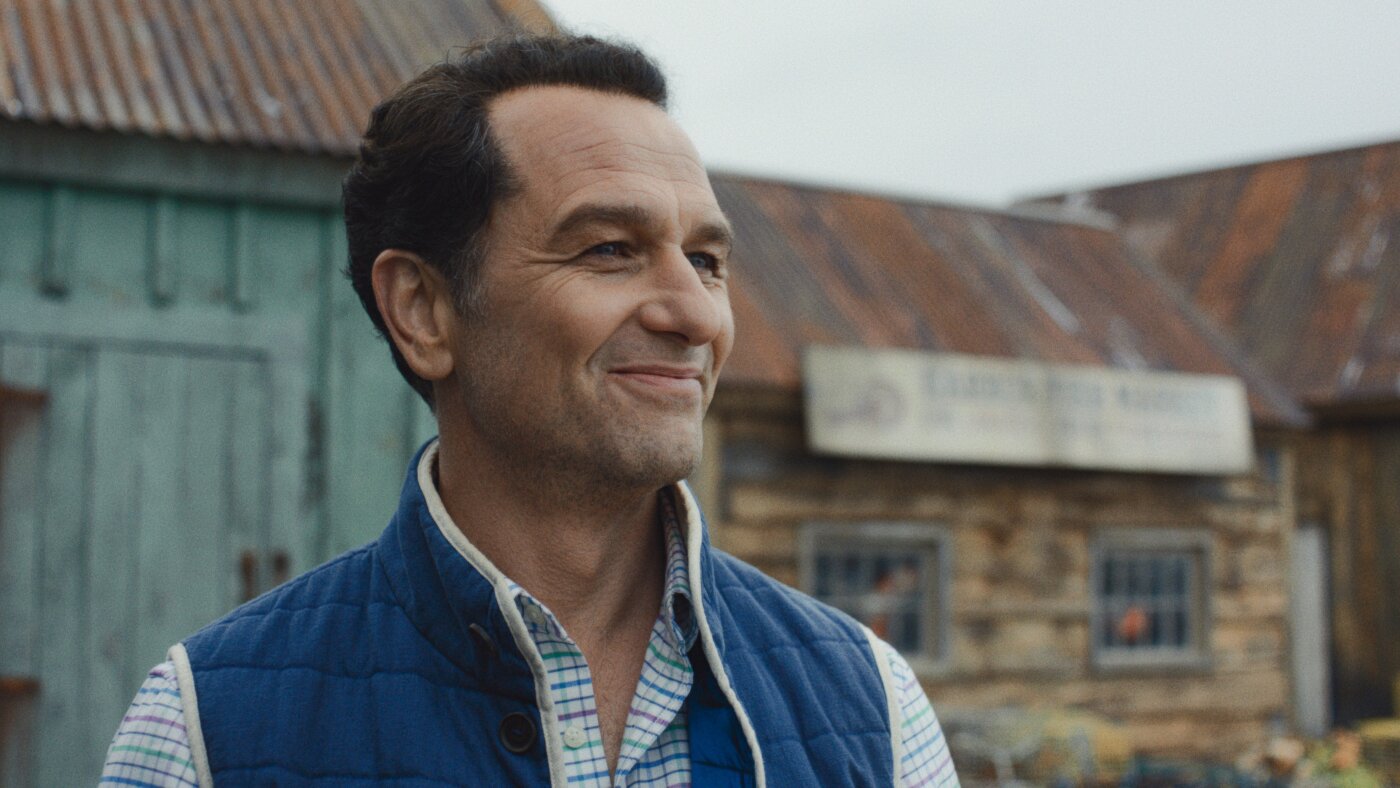
Matthew Rhys was nominated for his role in Widow’s Bay.
Apple TV
hide caption
toggle caption
Apple TV
The 2026 Emmy nominations are here. We’re unpacking the record-breaking nominations for Hacks, plus a big day for Widow’s Bay, The Pitt, and The Bear. We’ll also talk about the snubs and make some early predictions of who will win.
Connect with Pop Culture Happy Hour:
Letterboxd / Facebook
Our weekly newsletter
Support Pop Culture Happy Hour+
-

 Los Angeles, Ca28 minutes ago
Heat advisory, beach hazards in effect as Southern California sizzles
-

 Detroit, MI48 minutes ago
Teen on moped hit by car after cruising through stop sign in Detroit
-

 San Francisco, CA57 minutes ago
Flight of fancy: San Francisco moves to build private luxury airport terminal
-

 Dallas, TX1 hour ago
Dallas’ digital creator economy is booming. Burnout is too.
-
Miami, FL1 hour ago
I went to 2 famous Miami restaurants, a flashy steakhouse and a Cuban hot spot. Here’s how they compared.
-

 Boston, MA1 hour ago
Pedestrian struck and killed in Roxbury – Boston News, Weather, Sports | WHDH 7News
-

 Denver, CO1 hour ago
Santa Fe Drive in Denver closed this weekend for pedestrian bridge construction
-

 Seattle, WA1 hour ago
Police video shows West Seattle Bridge copper wire theft suspect’s arrest

