Lifestyle
I worked out with an AI trainer at L.A.’s 'first full-scale AI-powered gym.' Here's how it went


The genius knows all. It knows my height, my weight, my hydration, my cardio stamina — even, regrettably, my body’s visceral fat percentage. I’m standing on a bioelectrical impedance device — which looks a lot like a scale but with metal handles and metal foot pads — and it’s sending low-grade, painless electrical signals through my hands and feet to measure my muscle, fat and water. The percentages of each are then fed into an AI program.
Welcome to Fred Fitness, which touts itself as L.A.’s “first full-scale AI-powered gym.” You might be wondering: What does that even mean? Mostly that AI-powered software, referred to as Genius, is integrated into every piece of cardio and strength equipment at the gym. Throughout your workout, it functions as an ever-present but imperceptible force, sparking beneath the surface, like a digital mycelium network with an agenda: to help you reach your training goal (whether that’s weight loss, strength building or toning) in the most efficient way possible.
The Santa Monica facility opened in mid-February in an 11,500-square-foot former Patagonia store on 4th Street. Fred Fitness CEO Andre Enzensberger says the gym has about 400 members, who pay $150 a month to be bossed around by an algorithm.
Inside Fred Fitnessm an AI gym in Santa Monica.
(Chiara Alexa / For The Times)
At first glance, Fred Fitness looks like nothing more than a high-end gym in a tony neighborhood. It’s airy and bright, with soaring ceilings, exposed wood rafters and leafy hanging plants. On a recent Wednesday afternoon, it was sparsely populated, with just a few dozen members working out on brand-new, still-gleaming treadmills, bikes and elliptical machines. The strength machines use electric motors to create resistance instead of physical weights, so there’s no clanking. It’s relatively quiet but for the whirring of cardio equipment and a blend of lo-fi and electronic pop music on the sound system. Not exactly “The Matrix.”
But the exercise machines at Fred Fitness are tailored to you. They know members’ names and body analysis data, and they’ve configured personalized workout programs customized to their goals and fitness abilities. They’re also gamified, meaning their screens display a “Pac-Man”-like video game that members “play” by moving the weight during reps and sets. Grab the handles of a seated rowing machine, for example, and pull the weight faster or slower to move your on-screen avatar — a ball — up or down within a maze and “eat” coins as you go. Competitive? The gym keeps track of your scores, if you choose to participate, and displays the information on an app and a wall-mounted monitor to encourage a sense of community.

Fred Fitness an AI gym in Santa Monica.
(Chiara Alexa / For The Times)
“I love it because it’s fun and totally automated,” says Keverton Marinho, a 32-year-old new member. “I just play — I don’t have to think about anything.”
The gamification may be fun, but it’s purposeful too, Enzensberger says.
“It helps members train at the correct speed,” he says. “It regulates time under tension, meaning how fast you push or how slow you release the weight. So your workout is more effective.”

-
Share via
There’s no joining fee at Fred Fitness and the month-to-month membership includes access to certified personal trainers — though not unlimited sessions — who consult with members about their AI-generated training programs. Trainers also wander the gym floor, answering questions and offering corrections when they notice someone’s form is off. That human element is critical, Enzensberger says.
“AI is so big right now, but we’re very proud of the human aspect of our gym — the team — and how we complement the AI precision,” he said.
Before joining, potential members undergo a free full-body assessment from Genius to get a fitness baseline. A “body composition analyzer” breaks down fat and lean muscle mass limb by limb and gives stats about foundational muscle strength, base metabolic rate and hydration levels, among other metrics. That information is then interpreted by the AI. Many gyms offer fitness assessments when you sign up for personal training, and luxury health clubs, such as Equinox and Santa Monica’s Love Life, do in-depth health and fitness testing for new members; but most regular gym memberships don’t include fitness assessments.
After the body composition analysis, which measures your metabolism, a human trainer leads the member-to-be through different exercise circuits on machines that measure their strength, cardio and flexibility. There’s also a series of on-screen questions related to workout goals, exercise experience and preferences.
Genius then assigns the member a “biological age” — different from your chronological age in years. It’s like an overall fitness score, says Fred Fitness general manager Miguel Alvino.
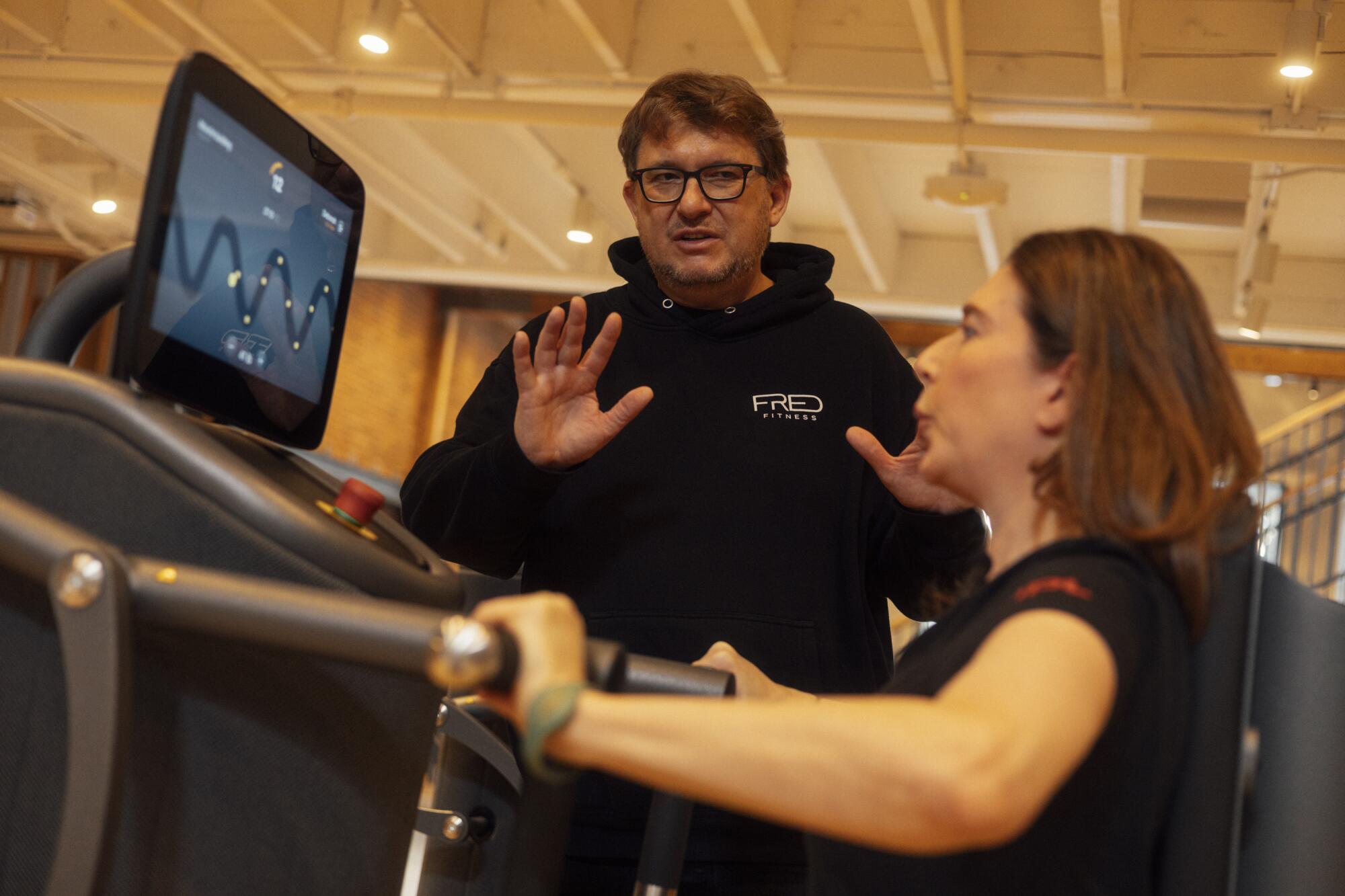
Fred Fitness an AI gym in Santa Monica.
(Chiara Alexa / For The Times)
“It’s a metric we use to give people an idea of where their strength and areas of improvement are compared to their calendar age,” Alvino explains.
From that point on, when you log onto an exercise machine with your wristband, it calls up your personalized training program. The machine then physically adjusts to your height and limb length, raising or lowering its seat and altering the position of its handles according to your body. The AI is also adaptive, utilizing machine learning. So it will evolve with you as you get fitter.
“The machines continue to learn about your capabilities,” Enzensberger says. “And that data is collected and fed into the AI to constantly generate a better training program for you.”
Fred Fitness is the brain child of Andre Enzensberger’s brother, Alfred, who is the president and founder of Munich-based Clever Fit, a fitness franchise with more than 500 locations throughout Europe. Alfred Enzensberger partnered with Philipp Roesch-Schlanderer, CEO of EGYM, a global fitness technology company also based in Munich, in 2023 to create a full AI gym. EGYM wrote Genius, which was deployed in August 2024. They brought in Andre Enzensberger as CEO.
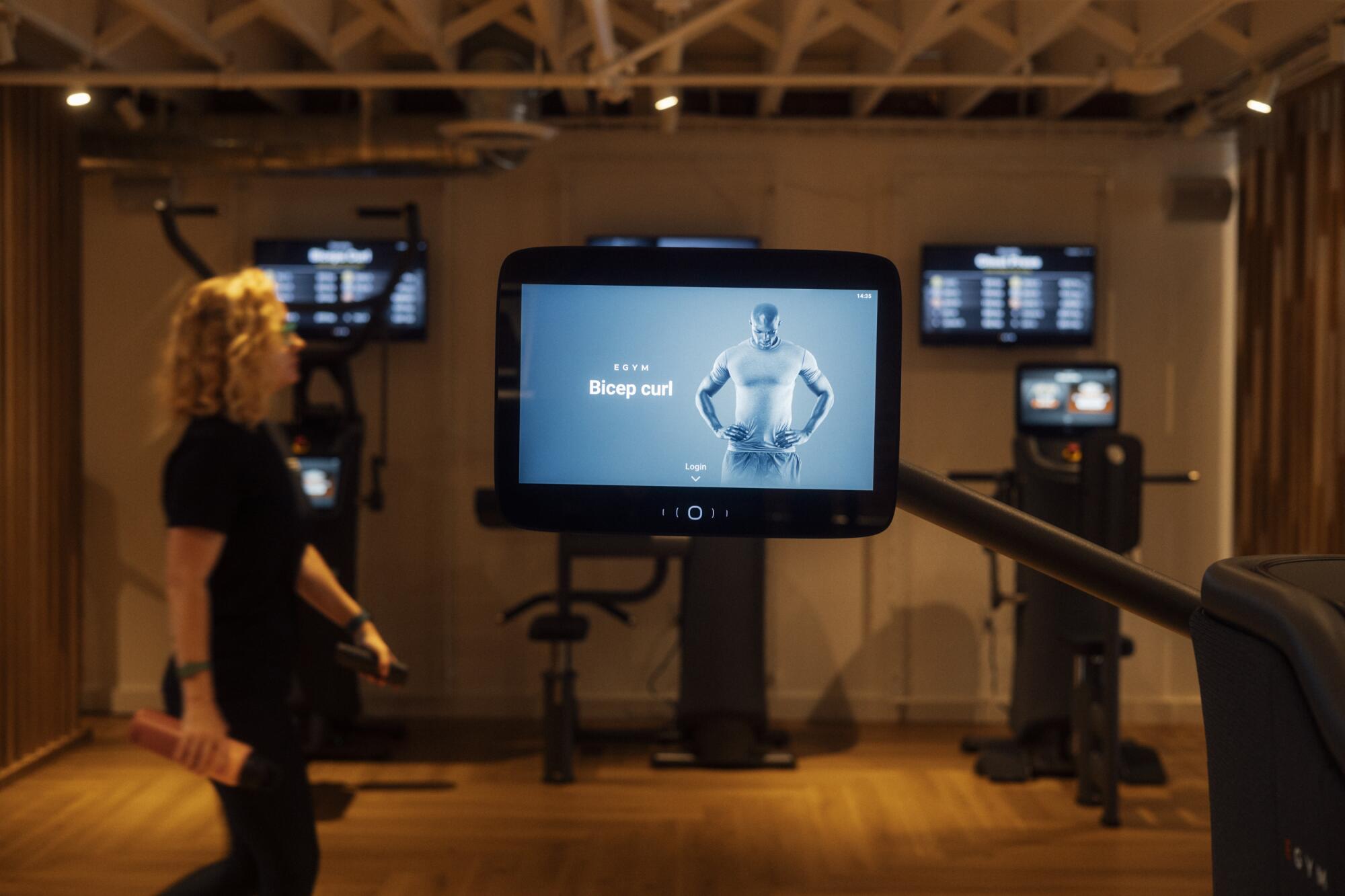
Fred Fitness an AI gym in Santa Monica.
(Chiara Alexa / For The Times)
There are other gyms with smart or AI-powered equipment in Southern California, such as L.A.’s EōS Fitness (with equipment from EGYM) and Smart Fit Method in Orange County. But at Fred Fitness, “Every piece of machinery is tied into the network,” Andre Enzensberger says. “We’re utilizing what the AI system can do on a much larger, fuller scale.”
Los Angeles was the ideal city in which to launch the venture, given its history as a hub for fitness and tech culture, he says. “We wanted to embrace the open-mindedness of the people of Los Angeles. Fred Fitness is groundbreaking and requires people who want to experience training in a new way.”
I enjoyed Genius’ guidance during my workout. The treadmill set itself to a lower speed than I normally run at, though at a higher incline, because Genius knew my exercise goal was strength building, not weight loss. And I loved the gamification element of the weight-lifting machines, even going so far as to laugh out loud mid-rep — though I wonder whether the game would get old over time. But in the end, what keeps me coming back to a gym is the promise of a sauna or steam after my workout. And Fred Fitness, unfortunately, doesn’t provide those amenities, which was disappointing.
But growth is on the horizon. A second Fred Fitness is now underway in downtown Culver City — it’s planning to open in early 2026 — and the company hopes to open four additional facilities within three to five years. The locations under consideration are downtown L.A., West Hollywood and Glendale.
“This is just a modern gym that’s fun to use — and people love it because it takes the guesswork out,” Enzensberger says. “Everything is fully guided.”

Lifestyle
Terry Tempest Williams on why women with big ideas get labeled ‘crazy’ : Wild Card with Rachel Martin
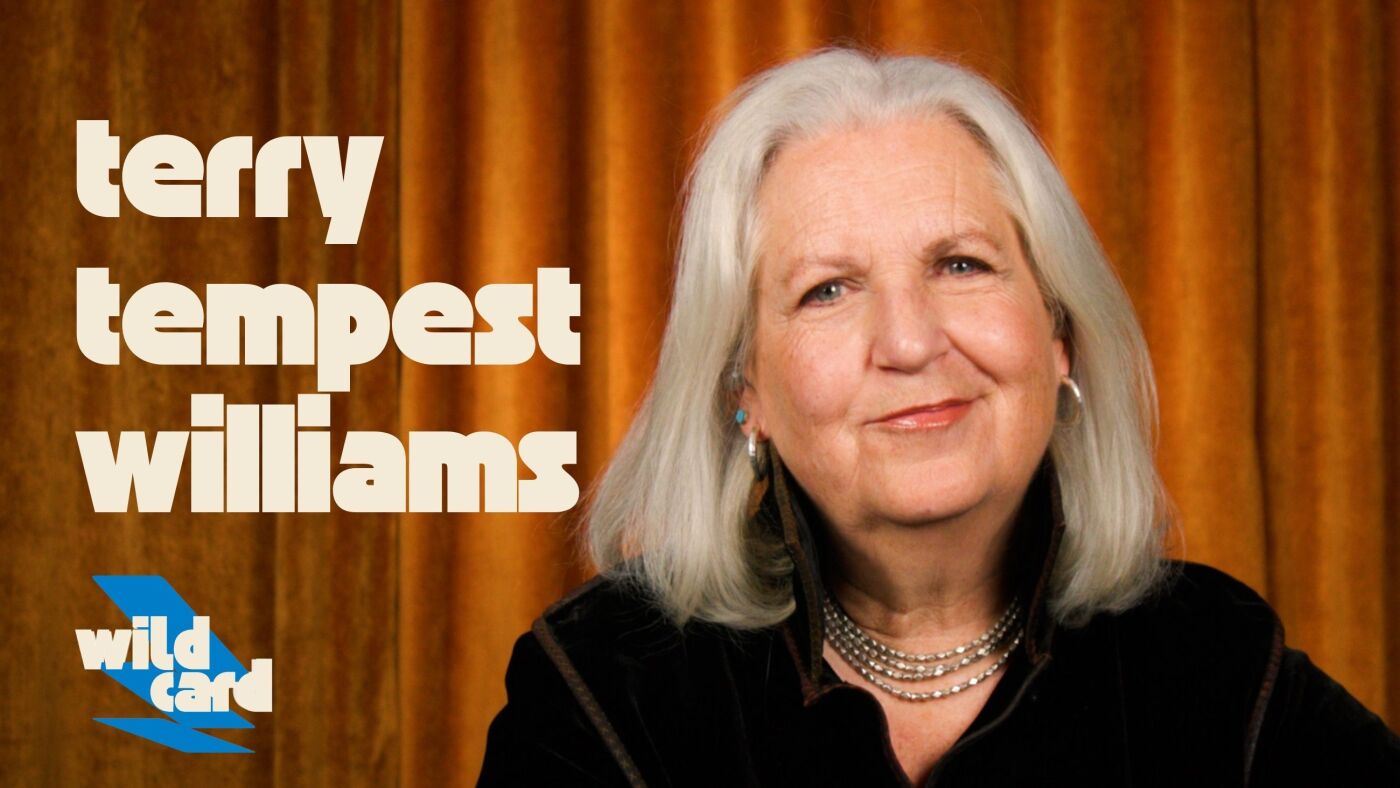
A note from Wild Card host Rachel Martin: I met Terry Tempest Williams about 25 years ago at a writer’s conference in Yosemite Valley. I was a young reporter who was there to do a story about how literature was addressing climate change and she made such a huge impression on me. I had never heard someone talk about the natural world the way Terry did and she had a spiritual depth I hadn’t encountered in my life at that point.
To this day, Terry’s writing always reorients me towards what is good, what is beautiful, and what is true. Her newest book is called “The Glorians.”

For its upcoming Los Angeles venue, experiential art firm Meow Wolf will focus on the art of storytelling, with a specific eye toward skewering our city’s moviemaking magic. To help bring that vision to life, Meow Wolf has entered into a creative partnership with Titmouse, one of L.A.’s most renowned independent animation houses.
The Hollywood-based studio behind popular series such as “Big Mouth” and “Star Trek: Lower Decks” will create animation that will be shown throughout the West L.A. venue, which is on target for a late 2026 opening at the Howard Hughes entertainment complex.
It’s a move that represents a shift for Santa Fe, N.M.-based Meow Wolf. Over the last decade-plus, the art collective has grown beyond its anything-goes, punk-meets-psychedelic roots into an organization with full-scale, maximalist installations in its hometown, Denver, Las Vegas, Houston and the Dallas suburbs. In the past, Meow Wolf kept most of its media in-house.
As part of its larger-than-life participatory art installations, Meow Wolf L.A. will feature a mix of live action and animation, the former filmed by Meow Wolf in its Santa Fe studio. Meow Wolf’s James Stephenson, a senior VP with the company and its creative director of emerging media, said the degree to which the L.A. exhibition will lean into various animation styles necessitated an outside partner. Titmouse’s work, in development by a number of directors with contrasting tones, will be shown on a variety of formats, ranging from cinema screens to full-room projections.
“I really believe in animation as an art form, and I know the Titmouse folks do too,” Stephenson says. “Animation is made by artists. It’s made by artists with their own hands. It’s something that is still very rooted in craft.”
Meow Wolf’s L.A. space is set in a former cinema complex, and will champion its location, taking guests on a journey through a converted movie house and beyond, into a sci-fi-inspired fantasyland with sentient spaceships and a 30-foot-tall mushroom tower. Meow Wolf creatives have spoken of the fantastical movie theater as one that will feature animated, self-aware candy before attendees enter the main exhibition space, making Titmouse’s work some of the first art guests will encounter. Titmouse co-founder Chris Prynoski has said the studio has lined up at least six directors for the exhibit.
An in-progress art installation destined for Meow Wolf L.A. at the art collective’s Santa Fe, N.M., headquarters. The L.A. exhibition will feature animation from Titmouse.
(Gabriela Campos / For The Times)
Titmouse, says Stephenson, is the right partner because “they’re known less for a house style, and more for a house vibe.” Over the years, Titmouse has been behind such diverse shows as “Scavengers Reign,” owning a Jean Giraud influence rooted in French and Spanish surrealism, the lively “Jentry Chau vs. the Underworld,” with an unique color palette that took inspiration from anime and Chinese mythology, the exaggerated comic book feel of Adult Swim’s “Metalocalypse,” and the approachable yet expressive tone of “Star Trek: Lower Decks.”
“Meow Wolf’s vibe is similar to Titmouse’s vibe,” Stephenson says. “It’s artist-first, artist-driven, independent and kinda edgy. They are always trying to find the edge of what’s possible. They try to see how far they can go, and it’s done for fun and in the spirit of taking risks.”
Prynoski says working with Meow Wolf will give Titmouse a sense of artistic freedom it doesn’t always have when delivering content for more traditional Hollywood partners. He says the multi-director approach is a callback to the early days of Warner Bros. Animation, when individual creators put their own stamp on Looney Tunes material.
“I use Bugs Bunny as an example,” Prynoski says. “You’ve got a Friz Freleng Bugs Bunny short. You’ve got a Chuck Jones Bugs Bunny short. You’ve got a Tex Avery Bugs Bunny short. They’re all different versions of Bugs Bunny, and people who are really paying attention can tell which director directed each one. Even though to the layman, these are all Bugs Bunny, but if you lined them up, they are drawing in different styles, sensibilities and techniques.”
Prynoski says that was a centerpiece of his pitch to Meow Wolf, noting that characters will reappear in multiple installations, each handled by a different artist. Meow Wolf L.A., in fact, will be the firm’s most character-driven exhibition, as guests will follow the storylines of three main protagonists throughout the space.
In announcing the partnership, Meow Wolf and Titmouse released an image from an animated work directed by Luca Vitale. It features a key character having a moment with a hummingbird and it’s done in an elegant, slightly anime-influenced style. It’s an image full of movement, reflecting a character in transition with inviting pastels and bold dashes.
“I like that image because I think it captures some of the sense of wonder that we want people to feel,” Stephenson says. “The character is having an encounter with the elusive nature of creativity and reality in a way that makes them have a different perspective of what’s possible.”
Other contributing animation directors to Meow Wolf L.A. include Space Dawg, Felix Colgrave, Alexander Vanderplank and Phimémon Martin, and Jun Ioneda.
Titmouse’s partnership with Meow Wolf will extend beyond the L.A. exhibition. The two will be working on the development of Meow Wolf New York, which is slated to open some time after Los Angeles, and are collaborating on a planned animated series, which Prynoski is spearheading.
Meow Wolf exhibits are the result of sometimes hundreds of disparate artists coming together in a shared space. Distilling that into a signature, singular style for a series could be a challenge. Stephenson pinpoints some guiding principles.
“You really need to feel the hand of the artist,” he says. “You need to feel a DIY aesthetic. You need to feel the materiality. Those are very specific to what we are.”

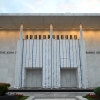
The Kennedy Center on June 28, with its facade signage still covered by a tarp and scaffolding.
Alex Wroblewski/AFP via Getty Images
hide caption
toggle caption
Alex Wroblewski/AFP via Getty Images
On Wednesday, a federal appeals court denied President Trump’s request to stop the removal of his name from Washington, D.C.’s Kennedy Center. The signage on the building has been covered with tarp and scaffolding since June 13, but in a court filing last month, the center’s current executive director said that Trump’s name has been removed.
In their decision, three judges from the U.S. District Court of Appeals for the District of Columbia Circuit said that the president had failed to prove that the arts center would be “irreparably injured” without Trump’s name attached to it.
NPR requested comment from the Kennedy Center, but did not receive an immediate reply.
This latest round of court decisions is part of the ongoing litigation filed by Rep. Joyce Beatty, D-Ohio, against President Trump and the board of the Kennedy Center. In a statement emailed Wednesday to NPR, Beatty said: “Today’s ruling again affirms that this administration’s efforts to rename the Kennedy Center were unlawful. His name no longer desecrates this sacred memorial, which belongs to the American people. Now it is time for the Trump administration to accept this, comply with the law, and take the tarps down.”
In previous court filings, Trump’s legal team had asserted that removing the president’s name from the arts complex, both on the physical building and in its digital materials, would inflict irreparable harm in both time and money already spent. In the denial, the three judges — Patricia Millett, Robert Wilkins and Gregory Katsas — wrote that since Trump’s name has already been removed, “a stay would not avert those harms.”
Furthermore, Trump had claimed that without his name attached, future fundraising would be threatened “and [will] contribute to the financial decline of the Center.” In response, the appeals judges wrote: “Appellants, however, have failed to support this assertion with any specific facts or evidence. They offer only the conclusory assertions of the Kennedy Center’s Executive Director that were made in a factually unsupported declaration.” The center’s current executive director, Matt Floca, specializes in physical plant management.
The presiding judge in the case, Christopher R. Cooper, has ordered that the center provide him a status report on the center’s operation and programming before the end of this month. As of Wednesday, the center’s calendar lists a small roster of programs, including outdoor free movie screenings, workshops for children, and five free live performances in July on its Millennium Stage. In the past, the Kennedy Center presented over 2,000 arts and education events each year, including free daily Millennium Stage performances.
-

 Louisiana7 minutes ago
Parasitic stomach illness that can cause explosive diarrhea rises in Louisiana
-

 Maine14 minutes ago
Is prison in play for Graham Platner?
-

 Maryland17 minutes ago
Office building in Glen Burnie evacuated after shift in parking garage floor
-

 Michigan22 minutes ago
Menominee, Michigan man arrested on sexual assault charges involving a minor
-

 Massachusetts29 minutes ago
Healey administration vows to appeal as Trump rejects Massachusetts blizzard aid request – The Boston Globe
-

 Minnesota32 minutes ago
Minnesota Looks to Add 1,100 Child Care Slots, With Melrose Among the 11 Funded Communities
-

 Mississippi37 minutes ago
Death of Mississippi teen Nolan Wells under investigation
-

 Missouri44 minutes ago
Missouri realtors hold statewide rally to vote no on Amendments 4 & 5

