Good morning. Look, it could happen to anyone: I well remember, for example, the time I added my mum to a thread with my siblings discussing what to get her for Christmas. On the other hand, I don’t have a secure communications facility in my house for when I need to get something out on the family group chat. Also, we rarely digress from pictures of cute kids to setting out war plans for an imminent set of airstrikes on the Houthis in Yemen.
So perhaps the latest Trump administration hullabaloo isn’t that relatable, after all. Two days after the Atlantic’s Jeffrey Goldberg revealed that he had been mystifyingly added to a thread on Signal – an encrypted WhatsApp-like instant messaging app – in which vice-president JD Vance, defence secretary Pete Hegseth, and a host of others chatted about a highly sensitive operation, there are as many questions as answers. How on earth did Goldberg get added in the first place? Why didn’t anybody realise the error? Are White House officials doing this all the time? And how vulnerable are their communications to interception from America’s adversaries?
Today’s newsletter explains this absolute dumpster fire of a story, and why it matters. Here are the headlines.
Five big stories
Spring statement | Rachel Reeves will make additional welfare cuts in her spring statement on Wednesday after the Office for Budget Responsibility rejected her estimate of savings from the changes announced last week. The chancellor is expected to announce an additional £500m in benefits cuts to make up part of the £1.6bn shortfall.
Ukraine | Russia and Ukraine have agreed to “eliminate the use of force” in the Black Sea, though the Kremlin said it was conditional on sanctions relief for its agricultural exports. The warring parties also agreed to implement a previously announced 30-day halt on attacks against energy networks.
Assisted dying | The introduction of assisted dying in England and Wales is likely to be pushed back by a further two years in a delay that supporters fear could mean the law never comes into force. The delay marks the latest major change to the proposals, which have proven deeply contentious in the Commons and beyond.
Gaza | Press freedom organisations have condemned the killing of two journalists in Gaza on Monday by the Israeli armed forces. Hossam Shabat, a 23-year-old correspondent for the Al Jazeera Mubasher channel, and Mohammed Mansour, a correspondent for Palestine Today, died in separate targeted airstrikes.
Society | Non-monogamous people are just as happy in their relationships as those with only one partner but are not “significantly” more sexually satisfied, research suggests. The authors of a new study said their findings challenged what they called a prevailing “one-size-fits-all approach to relationships”.
In depth: How a journalist got a front row seat to US military planning
Donald Trump speaks to the press alongside JD Vance, Pete Hegseth and Mike Waltz days before the Houthi strike. Photograph: Mandel Ngan/AFP/Getty Images
“This is going to require some explaining,” Jeffrey Goldberg writes at the beginning of his Atlantic story about how Pete Hegseth ended up messaging him about an imminent attack on Yemen, and he’s absolutely right.
In brief: Goldberg was added to a Signal thread by Michael Waltz, Donald Trump’s national security adviser, who presumably confused his contact with someone else’s. Goldberg was allowed to lurk on the thread for several days as senior officials – here’s a rundown of the dramatis personae – discussed the timing of the strike against the Houthis, fulminated against European “free-loading”, and celebrated the operation’s success with fire emojis. Eventually, Goldberg removed himself, and then wrote a story about it. Since then, all hell has broken loose.
Advertisement
Here’s what else you need to know about the significant issues raised by this fiasco – and, as a bonus, the best quote from the fallout so far: “Everyone in the White House can agree on one thing: Mike Waltz is a fucking idiot.” (Donald Trump said he was “doing his best”, but the two aren’t mutually exclusive.)
What’s the problem with having national security discussions on Signal?
The most glaring issue is the lack of adequate security protocols for discussions about US military operations – even if, hilariously, Hegseth sent a message to the group saying “we are currently clean on OPSEC” while Goldberg was still in it.
Such conversations are meant to be held in enclosed areas called sensitive compartmented information facilities, or Scifs, which have reinforced physical defences against eavesdropping, tight controls on access, and shields against electronic surveillance. Many senior government officials have Scifs installed at their homes; failing that, they are meant to use secure government-issued devices. Peter Beaumont has more on what America’s adversaries might have learned.
To state the most obvious point: if the discussion had been held under such conditions, a journalist would not have been accidentally added. But even if Goldberg hadn’t been included, significant issues would remain.
Advertisement
While the messaging app Signal is a more secure way to exchange messages than ordinary texting, it is a rung below official government communication channels. One aspect of the risk is that it is possible to download messages to a desktop, which lacks the layers of security in the app itself. The Pentagon warned its employees against using Signal last week.
It is also possible that the participants were using their own devices. In this Politico piece, a former White House official warns: “Their personal phones are all hackable, and it’s highly likely that foreign intelligence services are sitting on their phones watching them type the shit out.”
Is it possible the participants broke the law?
By holding sensitive national security discussions on a commercially available app, the participants may well have violated the US espionage act. Kevin Carroll, a national security lawyer, told the Washington Post: “I have defended service members accused of violating the Espionage Act through gross negligence for far, far less. If these people were junior uniformed personnel, they would be court-martialed.”
Vance, Hegseth and their colleagues may also have been in breach of federal records law – which mandates that messages about official acts be preserved. Many former officials have said that for that reason, they confined their use of platforms like Signal to bland logistical discussions or as a way to direct others to a more secure channel.
Advertisement
That is not what happened here – and because Waltz switched on Signal’s “disappearing messages” function, the discussions might have vanished for ever barring Goldberg’s accidental inclusion. Yesterday, CIA director John Ratcliffe, another participant, claimed that the decisions taken in the group were also formally recorded.
What did we learn about the Trump administration’s view of Europe?
One thing the leak makes absolutely clear: when Vance expresses his disdain for Europe in public, he isn’t putting it on. Part of the discussion about the timing of a strike against the Houthis was focused on the idea that by protecting a trade route used by European shipping, Washington was giving EU countries a free ride.
Vance, who expressed his reluctance to conduct the operation immediately, eventually said: “If you think we should do it let’s go. I just hate bailing Europe out again.” In reply, Hegseth agreed: “I fully share your loathing of European free-loading. It’s PATHETIC.”
The discussion concluded with a suggestion that “we soon make clear” that Europe should contribute to the cost of the operation.
Advertisement
In Brussels yesterday, all of that was greeted with weary dismay. “Horrific to see in black and white,” one European diplomat told the BBC. “But hardly surprising.”
Are there any awkward historical precedents which the protagonists have expressed strong opinions about?
Funny you should ask! After the story broke, CNN put together a montage that showed just some of the times that those involved in the message thread took a stern line on the notorious row over Hillary Clinton’s use of a private email server while in office.
“If it was anyone other than Hillary Clinton, they’d be in jail right now,” Hegseth said on Fox News in 2016. Marco Rubio said in the same year that “nobody is above the law – not even Hillary Clinton.” And Ratcliffe said in 2019 that “mishandling classified information is still a violation of the espionage act”.
Later, Trump’s consigliere Stephen Miller tweeted that because of Clinton’s “illegal” behaviour, “foreign adversaries could easily hack classified ops & intel in real time from other side of the globe.” With that uncompromising line, the White House must be hoping Stephen Miller never hears what Stephen Miller’s been up to.
Advertisement
The administration steered well clear of addressing that aspect of the story. Hillary Clinton didn’t, though: “You have got to be kidding me,” she wrote on X, along with an eyeballs emoji.
How have Trump’s supporters fought back?
The White House has admitted the thread “appears to be authentic”. Still, that didn’t stop Hegseth turning to a familiar strategy in response: attack the media.
“Nobody was texting war plans,” he said, although Goldberg reported that Hegseth himself texted “operational details of forthcoming strikes on Yemen”.
skip past newsletter promotion
Advertisement
after newsletter promotion
Hegseth also sought to discredit Goldberg, among the most eminent journalists in the United States and one with no obvious track record of dishonesty: “You’re talking about a deceitful and highly discredited so-called journalist who’s made a profession of peddling hoaxes.” Later, Trump called him a “total sleazebag”. Waltz, for his part, called him “bottom scum” and suggested he could have got himself added to the group “deliberately” because he “wasn’t on my phone”, a fairly head-scratching claim.
All of that aligned closely with the approach taken by presenters on Fox News. Sean Hannity dismissed it as “the state-run legacy media mob” being “obsessed with an accidentally leaked text”.
Another Will Cain, found a silver lining: “After years of secrecy and incompetence, if you read the content of these messages, I think you will come away proud that these are the leaders making these decisions in America.”
Advertisement
But the idea that there’s nothing to see here doesn’t seem to have landed with everyone. At a hearing before the Senate intelligence committee yesterday, John Ratcliffe and Tulsi Gabbard, the director of national intelligence who was also on the thread, faced intense questioning about their roles, and found it tricky to agree on a strategy: immediately after Gabbard refused to confirm her participation in the thread, Ratcliffe confirmed he had done so and said it was permissible.
“What you’re saying didn’t make sense,” said Democratic senator Mark Warner. Somewhere in Washington, a Republican was probably sending an eyeroll emoji.
What else we’ve been reading
Hamdan Ballal is released from Israeli custody on Tuesday 25 March. Photograph: Léo Corrêa/AP
Lorenzo Tondo spoke to witnesses about the brutal assault on Oscar-winning Palestinian director Hamdan Ballal by settlers, who handed him over to the military, bruised and bleeding. The attack on Ballal, who was subsequently detained, “might be their revenge on us for making the movie. It feels like a punishment,” said Basel Adra, another of No Other Land’s directors. Nimo
The Guardian’s blockbuster invertebrate of the year prize continues with Patrick Barkham singing the praises of the “twerking pollinator with a bum-bag”: it is, of course, the dark-edged bee-fly. Slightly alarmingly, they “use false legs to bumble into a bee burrow and scoff the pollen left for the bee babies”. Archie
Rashid Khalidi is searing in his response to Columbia University’s “capitulation” with the Trump administration’s sweeping policy changes last week. “Columbia barely merits the name of a university, since its teaching and scholarship on the Middle East, and soon much else, will soon be vetted by a ‘senior vice-provost for inclusive pedagogy’, in reality a senior vice-provost for Israeli propaganda,” he writes. Nimo
The bleak sight of Conor McGregor visiting the White House on St Patrick’s Day has not gone down well with most people in Ireland, writes Justine McCarthy – but his putative presidential run risks galvanising the country’s “small but vocal minority on the hard right”. Archie
For those who are mourning the end of Severance (me), Claire Cao has a great antidote: the film Triangle (pictured above) will scratch the “puzzle box” sci-fi plot itch that the Ben Stiller thriller has left. Nimo
Sport
Trent Alexander-Arnold. Photograph: Richard Martin-Roberts/CameraSport/Getty Images
Football | Real Madrid are close to completing a deal to sign Trent Alexander-Arnold on a free transfer this summer. The Liverpool right-back has long been a target for the European champions and there is now a widespread expectation that he will join Carlo Ancelotti’s side when his contract expires at the end of the season.
Football | David Brooks scored in the sixth minute of injury time to rescue a point for Wales in their World Cup qualifier against North Macedonia. The game had been 0-0 until Bojan Miovski’s goal as normal time expired.
Tennis | As Emma Raducanu enjoys her best run of form since her 2021 run to the US Open title, she now comes up against Jessica Pegula in the quarter final of the Miami Open. The match is just reward for her persistence, writes Tumaini Carayol: “to her credit she kept on rolling with the punches and showing up.”
Advertisement
The front pages
Guardian front page 26 March, 2025 Photograph: Guardian
“Fears of further tax rises as Reeves promises to ‘secure Britain’s future’” is the splash on the Guardian today, while the Financial Times says “Reeves to leaven grim spring outlook with £2.2bn defence spending boost.” The spring statement is also previewed in the DailyMail, which has “Don’t shift blame for economy’s woes, voters tell Reeves,” and the Mirror, which runs an interview with Rachel Reeves under the headline “My mission.”
“Victims must see ‘sense of justice being served’” is the lead story on the Express, while “Mortal blow to assisted dying Bill” is the focus in the Telegraph. “JD Dunce hates Britain, hates Europe and hates Ukraine…And could be president at any moment,” says the Star, and the Metro: “Trump backs chump.” The Sun covers a row over the pricing of Oasis tickets with the headline “Definitely Shady”.
Today in Focus
A protester wearing a whirling dervish costume performs in front of Turkish riot police barricades as he tries to march to Taksim Square in Istanbul, Turkey, 23 March 2025. Photograph: Erdem Şahin/EPA
The arrest that plunged Turkey into turmoil
Protesters took to streets after President Erdoğan had his rival arrested. What will happen next? Sami Kent and Ruth Michaelson report
Cartoon of the day | Rebecca Hendin
Cartoon of the day Illustration: Rebecca Hendin/The Guardian
The Upside
A bit of good news to remind you that the world’s not all bad
Advertisement
Mark Nedd, a fisher, on Soubise’s beach. He has been coping with the effects of the sargassum seaweed since he was a teenager. Photograph: Haron Forteau/The Guardian
In Grenada, the persistent issue of sargassum seaweed, which has long plagued the island’s shores, is being reimagined as an opportunity rather than a burden. While the decaying seaweed causes bad smells and disrupts fishing and tourism, innovative solutions are emerging. The Grenadian government, in collaboration with the EU, is exploring ways to turn sargassum into a valuable resource, including clean energy, bioplastics, and fertiliser.
Companies such as Seafields are developing methods to farm the seaweed and harness its potential, which could boost the economy. A bioenergy project is already converting sargassum into biogas and organic fertiliser. “They use diesel to generate electricity 1742975300, which is very expensive for the local population. We are providing a reliable, cost-effective and sustainable alternative,” Benjamin Nestorovic, who works for the Grenada-based bioenergy company SarGas, says, adding that the company plans to expand across the Caribbean.
Bored at work?
And finally, the Guardian’s puzzles are here to keep you entertained throughout the day. Until tomorrow.
Former U.S. Olympian David Hearn (left) walks with his attorney Norman Eisen to speak to reporters and protesters gathered after his arraignment at the Superior Court of the District of Columbia in Washington, D.C. on Thursday.
Finn Gomez/Getty Images
hide caption
toggle caption
Advertisement
Finn Gomez/Getty Images
Former U.S. Olympic canoeist David Hearn pleaded not guilty to damaging the Lincoln Memorial Reflecting Pool in D.C. Superior Court Thursday morning.
Federal prosecutors charged Hearn with a single count of destruction of property causing more than $1,000 in damage to the pool.
Hearn has previously claimed, which his attorneys repeated during a short press conference outside the court, that he simply touched the water in the pool out of curiosity.
Advertisement
The Trump administration had just completed a $14 million renovation of the pool.
But shortly after the work finished, peeling paint and algae gathered in the water. The remodel has been largely criticized as a massive failure and waste of taxpayer dollars.
Superior Court Judge Carmen McLean released Hearn on his own recognizance. His next hearing is scheduled for Aug. 5.
Norm Eisen, one of Hearn’s attorneys, spoke to reporters outside of court following the hearing. He said the administration is using Hearn as a “scapegoat … for their own failures.”
“It is not a crime to touch the reflecting pool, to touch water in the United States of America,” he said.
Advertisement
Prosecutors say there is a host of evidence against Hearn.
Three more people have been criminally charged with destruction of property at the Lincoln Memorial Reflecting Pool.
Officers say they detained Cameron Thiers, Sophie Dennison-Gibby and Justin Carreno one Saturday afternoon in June and described in court documents witnessing them peeling and removing pieces of blue paint from the Reflecting Pool.
One officer “witnessed Carreno reach down into the reflecting pool and pull up a piece of the blue paint,” according to the court documents.
The officer who detained Dennison-Gibby “found 1 additional piece of the reflecting pool liner” in her purse, the documents said.
All three incidents were recorded on the officers’ body worn cameras, they said in the court documents.
Advertisement
Several “partnering law enforcement agencies assigned to the Reflecting Pool” working with US Park Police were involved in detaining the two men and one woman — including officers from Texas, Oklahoma, Montana and California.
One of the officers said in court documents that Thiers “admitted to removing a piece of blue sealant from the Reflecting Pool and still had it in his hand when I made contact with him.”
The three defendants were arraigned in court Wednesday and pleaded not guilty to the misdemeanor charges of destruction of property with a value less than $1,000. The judge ordered them to stay away from the Reflecting Pool.
Lawyers for Thiers and Dennison-Gibby declined to comment. CNN has reached out to Carreno’s attorney.
If found guilty of destruction of property, the defendants could be fined up to $1,000 and face a maximum of 180 days behind bars.
Advertisement
The New York Times first reported that three additional people had been charged with damaging the Reflecting Pool.
President Donald Trump has repeatedly claimed that vandals caused major damage to the pool by gashing the lining after his administration spent more than $14 million on renovations, though he has not provided evidence to support that claim. The officers who charged Carreno, Thiers and Dennison-Gibby did not accuse them of gashing the lining.
Former Olympic canoeist David Hearn was indicted by a grand jury in Washington, DC, last week for allegedly damaging the Reflecting Pool. Hearn — unlike Carreno, Thiers and Dennison-Gibby – was charged with destruction of property with a value of more than $1,000 which carries a maximum penalty of 10 years in prison, if convicted. He is set to be arraigned in court Thursday.
Crews began draining the Reflecting Pool over the weekend to make repairs, according to Interior Secretary Doug Burgum, for the second time in three months.
The move comes after weeks of problems – algae blooms, green-hued water, a chipping bottom and the administration’s allegations of vandalism – that have plagued the iconic landmark, making its woes the subject of national interest.
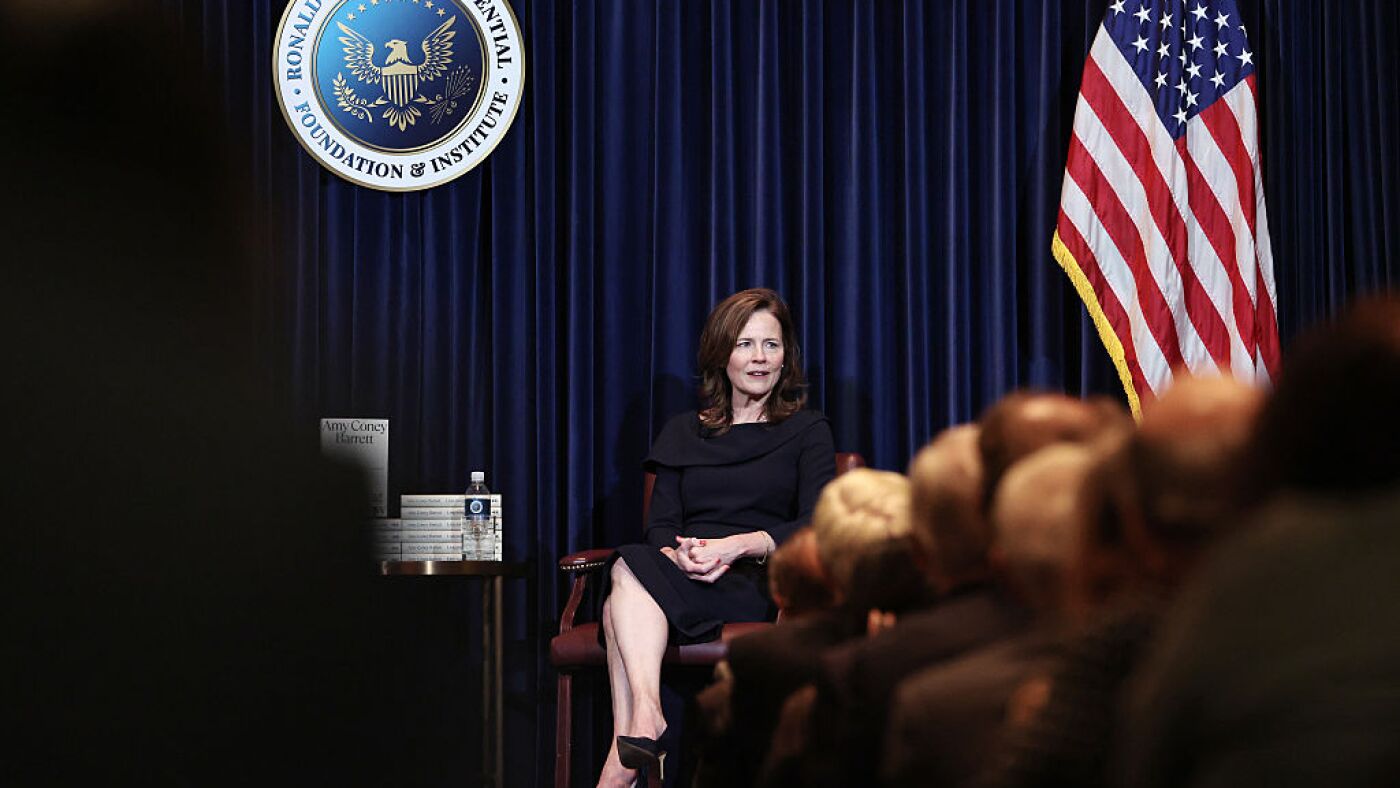
Supreme Court Justice Amy Coney Barrett speaks at the Reagan Library on Sept. 9, 2025, in Simi Valley, Calif. Barrett discussed and signed copies of her new book, Listening to the Law: Reflections on the Court and Constitution.
Mario Tama/Getty Images
hide caption
toggle caption
Advertisement
Mario Tama/Getty Images
Even as the Supreme Court was handing down one legal thunderbolt after another last week, the justices were quietly releasing their annual financial reports. Justice Samuel Alito was the only sitting justice to request an extension, which he has done for 15 years. The disclosures do not give a complete account of the justices’ total income and wealth, but they give insights into their concertgoing, guest professorships and even their involvement in youth sports.
In addition to their salaries, much of the justices’ reported income came from their book deals. Justice Ketanji Brown Jackson led the pack earning more than $1.1 million last year for a total of roughly $4 million since her memoir, Lovely One, was published in 2024.
Justices Sonia Sotomayor, Neil Gorsuch, Amy Coney Barrett and retired Justice Anthony Kennedy also reported income from published books. Earnings from their books ranged from $849,000 for Barrett, to $300,000 for Gorsuch and $88,000 for Sotomayor, whose books include her 2013 autobiography and five children’s books. Justice Clarence Thomas, who previously earned $1.5 million for his 2007 memoir, listed no publisher payments last year, and Justice Brett Kavanaugh, one of 13 co-authors of a 2016 legal treatise, also received no payments last year. Kavanaugh is said to be working on a memoir but he listed no payments for the anticipated book. Alito does have a book coming out in the fall, but with his financial report still outstanding, there is no data on how much he was paid for the work in 2025.
Advertisement
The only two sitting justices who have not written books are Chief Justice John Roberts and Justice Elena Kagan.
Many justices also earned income from teaching at law schools. Roberts reported income from New England Law, located in Boston, and Gorsuch reported teaching income from George Mason University in Virginia. Thomas taught classes at Catholic University in Washington, D.C., and Barrett and Kavanaugh taught at Notre Dame Law School. Barrett graduated from the school and began teaching there 23 years ago; Kavanaugh has family connections to Notre Dame.
The disclosures also report gifts, travel, food and lodging that the justices received in 2025. Jackson and Sotomayor were the only two to report gifts. Jackson was given a painting for her chambers valued at $2,500, and Sotomayor reported a trip to Kansas City to watch the opening of a musical based on her children’s book, Just Ask.
In addition, she reported receiving free tickets worth $4,333 while on “a private trip to Puerto Rico.” The tickets were from the record label that represents Bad Bunny, and her trip coincided with the artist’s months-long concert series in San Juan. Sotomayor’s parents were from Puerto Rico, and she has spent much time there over the years.
Advertisement
The justices also disclosed significant reimbursements for travel throughout 2025. Thomas’ travel, food and lodging expenses were paid for by the Hoover Institution for speaking at a celebration of conservative economist Thomas Sowell.
Sotomayor, Gorsuch, Barrett and Jackson were reimbursed for international travel, where they gave speeches, spoke about their books or taught. Roberts was the only sitting member of the court not to report any gifts or travel reimbursements.
The annual filings also shed some light on the justices’ activities off the bench. Kavanaugh reported that in addition to his duties as a Supreme Court justice, he serves as a coach to multiple D.C.-area Catholic Youth Organization girls’ basketball teams. Coach K, as he is known by his players, wrote the court’s June decision declaring that states can ban transgender women and girl athletes from playing on women’s and girls’ sports teams.
The justices’ salaries are established by law. The chief justice earns the most, at $320,700 per year. The eight associate justices earn $306,600 per year. While that is a lot of money to most Americans, the justices and even their law clerks could earn more the minute they leave their Supreme Court jobs for large law firms.
Roberts was the only member of the court to report investing in individual stocks. Alito in the past has also owned shares of individual stocks, but his report is not due for three months when his extension runs out. For the most part, the justices do not own individual stocks, but do invest in index funds, mutual funds and other such investment programs in order to both make money and limit potential conflicts of interest that would require their recusal from certain cases.
Advertisement
However — and this is a big however — the financial reporting forms the justices are required to fill out are so unspecific and the reporting ranges for investment earnings are so broad that it is impossible to determine any justice’s overall wealth. In addition, the current value of the justices’ homes isn’t reported. Neither is their spouses’ income, which in the case of the chief justice, for instance, likely far exceeds his take-home pay.