Lifestyle
L.A. Affairs: Years after my husband's death, I'm saying goodbye to his pickup truck


“I’m just an American guy in a pickup truck,” said Stephen Beech at the end of one of our early dates. It was Valentine’s Day 1993, and he was dropping me off at my Santa Monica apartment.
His comment was supposed to act as a deterrent as he explained why he wasn’t the man for me. He’d been through a difficult few years. His first marriage had ended, and he wasn’t looking for a serious relationship. Anyway, he pointed out, we were from different worlds. He was a property manager from Philadelphia, I was a British journalist based in L.A. Also, while Stephen was intent on remaining single, I was on a mission to meet the right man and start a family.
But I’d already discovered that the tall, introspective, good-looking man I was falling for had hidden depths. He played classical guitar and he was funny and philosophical too. I’d met him at a part-time master’s program in spiritual psychology at the University of Santa Monica. The fact that he drove a pickup truck only added to the romantic allure.
There was clearly an attraction on his part too. After all, there we were kissing in his blue truck outside my apartment. So we continued dating, and we went everywhere in that blue truck: coffees and dinners, drives along Pacific Coast Highway to Malibu or further north to visit friends in Ojai. I learned more about his reluctance to get involved. Stephen and his first wife had lost their little girl to cancer. He’d been trying to recover from intense grief and rebuild his life without the complications of a relationship.
But our relationship took on an ineluctable momentum, and by October, I was pregnant. When our daughter, Chace, was born in August 1994, we drove home from the hospital in the blue truck. When we bought our house in Santa Monica, Stephen piled all our possessions into the back of the truck. He used the truck to haul paving stones for our yard and plants from the garden center. By the time our second daughter, Ava-Rose, arrived four years later, the truck remained reliable.
Eventually, though, it started to break down. One spring day, I arrived home from work just as Stephen was pulling up outside our house in a gleaming, brand-new, white Dodge pickup. Stephen didn’t get excited about much, but he was smiling broadly as he took me for a spin. Payments were $400 a month, a big chunk of his paycheck, but it was worth it.
The truck became an integral part of life. There were heated conversations in the front and back seats about school, friendships and politics and there were fights about music: whether we should listen to Radio Disney or classical station KUSC. Often the consensus ended up being “The Weight,” our favorite song by Stephen’s favorite band, the Band.
Most mornings he’d take the girls to school — Ava invariably leaving the house in a panic, eating the bowl of oatmeal her dad had made her for breakfast on the road while finishing her homework. He’d drive Ava to fencing competitions all over California. He’d take Ava and Chace to ballet, and he used the truck to cart around equipment when he was volunteering backstage for the Westside School of Ballet’s production of “The Nutcracker” every year.
When our daughters were in their teens, he’d take them and their friends to parties, happy to be the designated parent collecting everyone in the early hours and making sure they got home safely. He was always putting his truck to good use helping out friends and neighbors.
There were often surprise presents delivered in the truck: One birthday, it was a purple wisteria tree; one Valentine’s day, it was a vintage O’Keefe & Merritt stove.
But my favorite memories of Stephen and his truck were more mundane, involving countless serendipitous meetings around Santa Monica. I’d be out walking our dogs, Puck and Chaucer, and Stephen would just happen to be driving along the same road. He’d slow down, left elbow resting on the open window, and stop for a quick chat: “What’s up?”
The truck was emblematic of the man. Trustworthy. Enduring. Reliable. Safe. Strong. Until it wasn’t. On March 12, 2018, Stephen called from work to say he wasn’t feeling well. He was shuffling and unsteady on his feet. I suggested that he should drive to the ER just to check that all was well.
That was the last time Stephen drove his truck. He was admitted to the hospital, had a brain scan and was diagnosed with a brain stem tumor. His condition deteriorated rapidly. My Strong American Guy in a Pickup Truck could no longer drive. After three major surgeries in quick succession, he was in a wheelchair and couldn’t walk. Stephen handed over the keys of his truck to Chace, who’d moved back home from New York where she’d been working to help take care of her dad. (Ava was in her first year at college.) Chace drove us in the truck to oncology appointments until it became too difficult and Stephen needed to be picked up by private ambulance.
Over the next 3½ years, Stephen gradually lost his ability to talk, eat or breathe independently. But he remained courageous and optimistic. Like the sturdy white truck, Stephen’s spirit and will to live were strong.
Today, almost four years since Stephen lost his battle with brain cancer, it’s time to say goodbye to the truck. Chace has already spent thousands of dollars on repairs, so we’ve made the tough decision to donate it to charity.
Some of the deep grief I’ve experienced since Stephen was initially diagnosed with an incurable glioma seven years ago had subsided a little, but it’s back. I miss Stephen and I’m sad that I won’t see the truck when I go out for my early morning walk.
On a recent Sunday morning, I decide to hose it down and wipe away the ingrained grime. I’m sure that wherever he is, Stephen is rolling his eyes, having a laugh at my careless use of the hose as I end up drenched. I’m sure there’s also a wry smile as he watches me take the truck for a drive (my first) along our road, encouraged by Dave, our next-door neighbor.
“You have to drive it once,” says Dave, so I do.
I will miss the white truck: resilient, kind and generous, just like the American guy who owned it. But it’s time to set off on my next adventure, knowing that Stephen’s spirit will always be beside me in the passenger seat.
The author is a senior writer at Thrive Global. Prior to Thrive, she wrote for U.K. and global newspapers, including the Guardian, the Times, the Telegraph and the Mail on Sunday. She also was a TV correspondent for the BBC and other U.K. networks.
L.A. Affairs chronicles the search for romantic love in all its glorious expressions in the L.A. area, and we want to hear your true story. We pay $400 for a published essay. Email LAAffairs@latimes.com. You can find submission guidelines here. You can find past columns here.

Lifestyle
Terry Tempest Williams on why women with big ideas get labeled ‘crazy’ : Wild Card with Rachel Martin
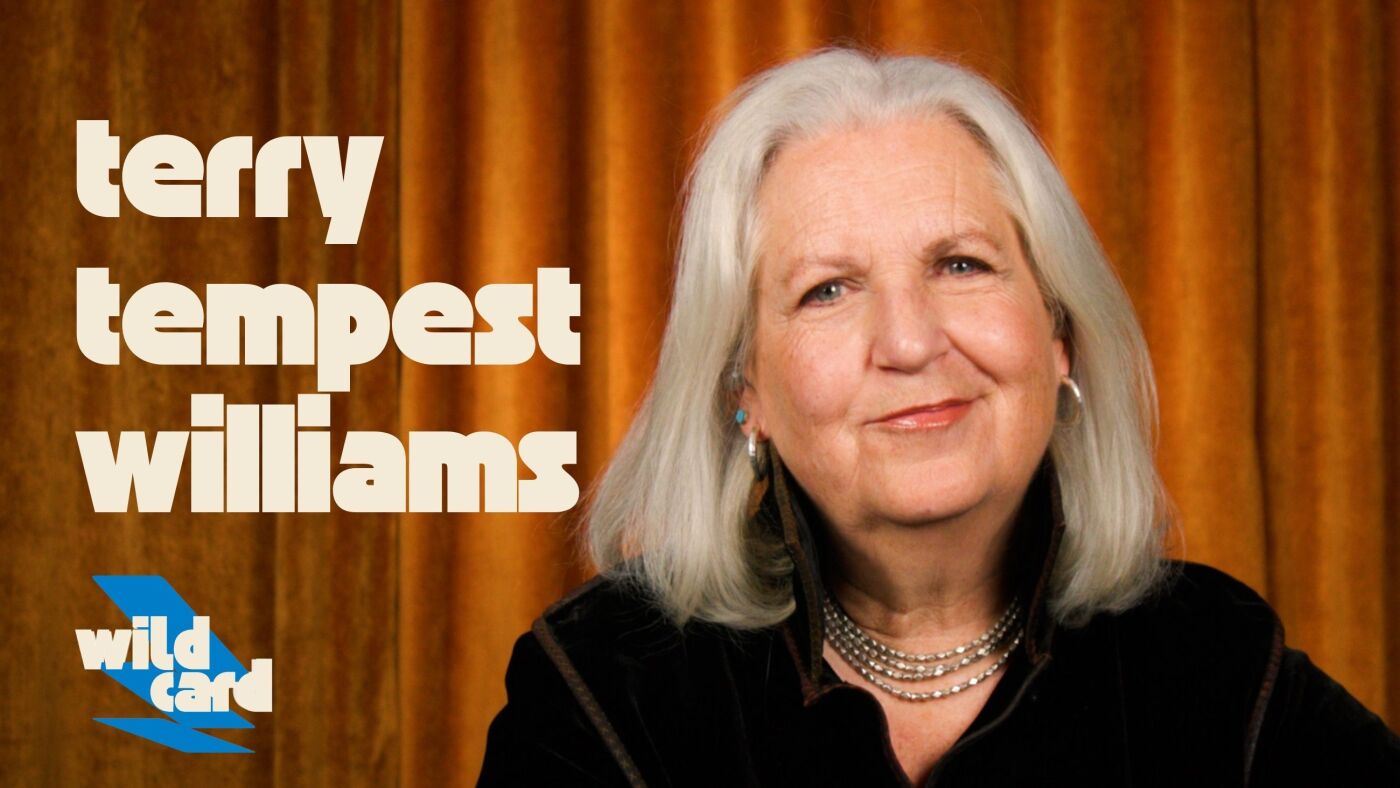
A note from Wild Card host Rachel Martin: I met Terry Tempest Williams about 25 years ago at a writer’s conference in Yosemite Valley. I was a young reporter who was there to do a story about how literature was addressing climate change and she made such a huge impression on me. I had never heard someone talk about the natural world the way Terry did and she had a spiritual depth I hadn’t encountered in my life at that point.
To this day, Terry’s writing always reorients me towards what is good, what is beautiful, and what is true. Her newest book is called “The Glorians.”

For its upcoming Los Angeles venue, experiential art firm Meow Wolf will focus on the art of storytelling, with a specific eye toward skewering our city’s moviemaking magic. To help bring that vision to life, Meow Wolf has entered into a creative partnership with Titmouse, one of L.A.’s most renowned independent animation houses.
The Hollywood-based studio behind popular series such as “Big Mouth” and “Star Trek: Lower Decks” will create animation that will be shown throughout the West L.A. venue, which is on target for a late 2026 opening at the Howard Hughes entertainment complex.
It’s a move that represents a shift for Santa Fe, N.M.-based Meow Wolf. Over the last decade-plus, the art collective has grown beyond its anything-goes, punk-meets-psychedelic roots into an organization with full-scale, maximalist installations in its hometown, Denver, Las Vegas, Houston and the Dallas suburbs. In the past, Meow Wolf kept most of its media in-house.
As part of its larger-than-life participatory art installations, Meow Wolf L.A. will feature a mix of live action and animation, the former filmed by Meow Wolf in its Santa Fe studio. Meow Wolf’s James Stephenson, a senior VP with the company and its creative director of emerging media, said the degree to which the L.A. exhibition will lean into various animation styles necessitated an outside partner. Titmouse’s work, in development by a number of directors with contrasting tones, will be shown on a variety of formats, ranging from cinema screens to full-room projections.
“I really believe in animation as an art form, and I know the Titmouse folks do too,” Stephenson says. “Animation is made by artists. It’s made by artists with their own hands. It’s something that is still very rooted in craft.”
Meow Wolf’s L.A. space is set in a former cinema complex, and will champion its location, taking guests on a journey through a converted movie house and beyond, into a sci-fi-inspired fantasyland with sentient spaceships and a 30-foot-tall mushroom tower. Meow Wolf creatives have spoken of the fantastical movie theater as one that will feature animated, self-aware candy before attendees enter the main exhibition space, making Titmouse’s work some of the first art guests will encounter. Titmouse co-founder Chris Prynoski has said the studio has lined up at least six directors for the exhibit.
An in-progress art installation destined for Meow Wolf L.A. at the art collective’s Santa Fe, N.M., headquarters. The L.A. exhibition will feature animation from Titmouse.
(Gabriela Campos / For The Times)
Titmouse, says Stephenson, is the right partner because “they’re known less for a house style, and more for a house vibe.” Over the years, Titmouse has been behind such diverse shows as “Scavengers Reign,” owning a Jean Giraud influence rooted in French and Spanish surrealism, the lively “Jentry Chau vs. the Underworld,” with an unique color palette that took inspiration from anime and Chinese mythology, the exaggerated comic book feel of Adult Swim’s “Metalocalypse,” and the approachable yet expressive tone of “Star Trek: Lower Decks.”
“Meow Wolf’s vibe is similar to Titmouse’s vibe,” Stephenson says. “It’s artist-first, artist-driven, independent and kinda edgy. They are always trying to find the edge of what’s possible. They try to see how far they can go, and it’s done for fun and in the spirit of taking risks.”
Prynoski says working with Meow Wolf will give Titmouse a sense of artistic freedom it doesn’t always have when delivering content for more traditional Hollywood partners. He says the multi-director approach is a callback to the early days of Warner Bros. Animation, when individual creators put their own stamp on Looney Tunes material.
“I use Bugs Bunny as an example,” Prynoski says. “You’ve got a Friz Freleng Bugs Bunny short. You’ve got a Chuck Jones Bugs Bunny short. You’ve got a Tex Avery Bugs Bunny short. They’re all different versions of Bugs Bunny, and people who are really paying attention can tell which director directed each one. Even though to the layman, these are all Bugs Bunny, but if you lined them up, they are drawing in different styles, sensibilities and techniques.”
Prynoski says that was a centerpiece of his pitch to Meow Wolf, noting that characters will reappear in multiple installations, each handled by a different artist. Meow Wolf L.A., in fact, will be the firm’s most character-driven exhibition, as guests will follow the storylines of three main protagonists throughout the space.
In announcing the partnership, Meow Wolf and Titmouse released an image from an animated work directed by Luca Vitale. It features a key character having a moment with a hummingbird and it’s done in an elegant, slightly anime-influenced style. It’s an image full of movement, reflecting a character in transition with inviting pastels and bold dashes.
“I like that image because I think it captures some of the sense of wonder that we want people to feel,” Stephenson says. “The character is having an encounter with the elusive nature of creativity and reality in a way that makes them have a different perspective of what’s possible.”
Other contributing animation directors to Meow Wolf L.A. include Space Dawg, Felix Colgrave, Alexander Vanderplank and Phimémon Martin, and Jun Ioneda.
Titmouse’s partnership with Meow Wolf will extend beyond the L.A. exhibition. The two will be working on the development of Meow Wolf New York, which is slated to open some time after Los Angeles, and are collaborating on a planned animated series, which Prynoski is spearheading.
Meow Wolf exhibits are the result of sometimes hundreds of disparate artists coming together in a shared space. Distilling that into a signature, singular style for a series could be a challenge. Stephenson pinpoints some guiding principles.
“You really need to feel the hand of the artist,” he says. “You need to feel a DIY aesthetic. You need to feel the materiality. Those are very specific to what we are.”

The Kennedy Center on June 28, with its facade signage still covered by a tarp and scaffolding.
Alex Wroblewski/AFP via Getty Images
hide caption
toggle caption
Alex Wroblewski/AFP via Getty Images
On Wednesday, a federal appeals court denied President Trump’s request to stop the removal of his name from Washington, D.C.’s Kennedy Center. The signage on the building has been covered with tarp and scaffolding since June 13, but in a court filing last month, the center’s current executive director said that Trump’s name has been removed.
In their decision, three judges from the U.S. District Court of Appeals for the District of Columbia Circuit said that the president had failed to prove that the arts center would be “irreparably injured” without Trump’s name attached to it.

NPR requested comment from the Kennedy Center, but did not receive an immediate reply.
This latest round of court decisions is part of the ongoing litigation filed by Rep. Joyce Beatty, D-Ohio, against President Trump and the board of the Kennedy Center. In a statement emailed Wednesday to NPR, Beatty said: “Today’s ruling again affirms that this administration’s efforts to rename the Kennedy Center were unlawful. His name no longer desecrates this sacred memorial, which belongs to the American people. Now it is time for the Trump administration to accept this, comply with the law, and take the tarps down.”
In previous court filings, Trump’s legal team had asserted that removing the president’s name from the arts complex, both on the physical building and in its digital materials, would inflict irreparable harm in both time and money already spent. In the denial, the three judges — Patricia Millett, Robert Wilkins and Gregory Katsas — wrote that since Trump’s name has already been removed, “a stay would not avert those harms.”
Furthermore, Trump had claimed that without his name attached, future fundraising would be threatened “and [will] contribute to the financial decline of the Center.” In response, the appeals judges wrote: “Appellants, however, have failed to support this assertion with any specific facts or evidence. They offer only the conclusory assertions of the Kennedy Center’s Executive Director that were made in a factually unsupported declaration.” The center’s current executive director, Matt Floca, specializes in physical plant management.
The presiding judge in the case, Christopher R. Cooper, has ordered that the center provide him a status report on the center’s operation and programming before the end of this month. As of Wednesday, the center’s calendar lists a small roster of programs, including outdoor free movie screenings, workshops for children, and five free live performances in July on its Millennium Stage. In the past, the Kennedy Center presented over 2,000 arts and education events each year, including free daily Millennium Stage performances.

-
Culture23 minutes ago
Which Version of the ‘Odyssey’ Should You Read?
-
Lifestyle26 minutes ago
Terry Tempest Williams on why women with big ideas get labeled ‘crazy’ : Wild Card with Rachel Martin
-

 Technology38 minutes ago
Google’s Nest Thermostat has hit its best price of the year
-

 World41 minutes ago
Argentinian flight instructor jumps to death from plane, 22-year-old student forced to land alone
-

 Politics46 minutes ago
Omar’s disclosures erased millions, leaving her with potential negative net worth. She won’t explain why.
-

 Health53 minutes ago
Dr Oz links obesity to chronic disease surge, says GLP-1s can ‘jumpstart’ better health
-

 Sports56 minutes ago
Pirates star pitcher makes unfortunate history after being taken out in middle of perfect game bid
-

 Technology1 hour ago
Medical identity theft follows you into the doctor’s office

