Connect with us

West

Vets group patching border fence pledges vigilance amid Trump success: 'There are still gaps'

Published

on

Vets group patching border fence pledges vigilance amid Trump success: 'There are still gaps'
Join Fox News for access to this content

Plus special access to select articles and other premium content with your account – free of charge.

By entering your email and pushing continue, you are agreeing to Fox News’ Terms of Use and Privacy Policy, which includes our Notice of Financial Incentive.

Please enter a valid email address.

Having trouble? Click here.

SAN DIEGO COUNTY, Calif. — A group of U.S. military veterans that formed to respond to the crisis at the southern border has continued its work, even as President Donald Trump has largely followed through on promises to stem the flow of illegal crossings.

“As a country, we were going quietly into the night,” Kate Monroe, a Marine Corps veteran who became the founder of Border Vets, a group of U.S. military veterans who have given their own time and money to patch up holes in the border barrier in Southern California, told Fox News Digital. “It’s not as difficult to secure the nation as people might think.”

Advertisement

The comments come as the group that Monroe founded, Border Vets, has continued its work to patch up potential weak points on the U.S. border with Mexico in Southern California.

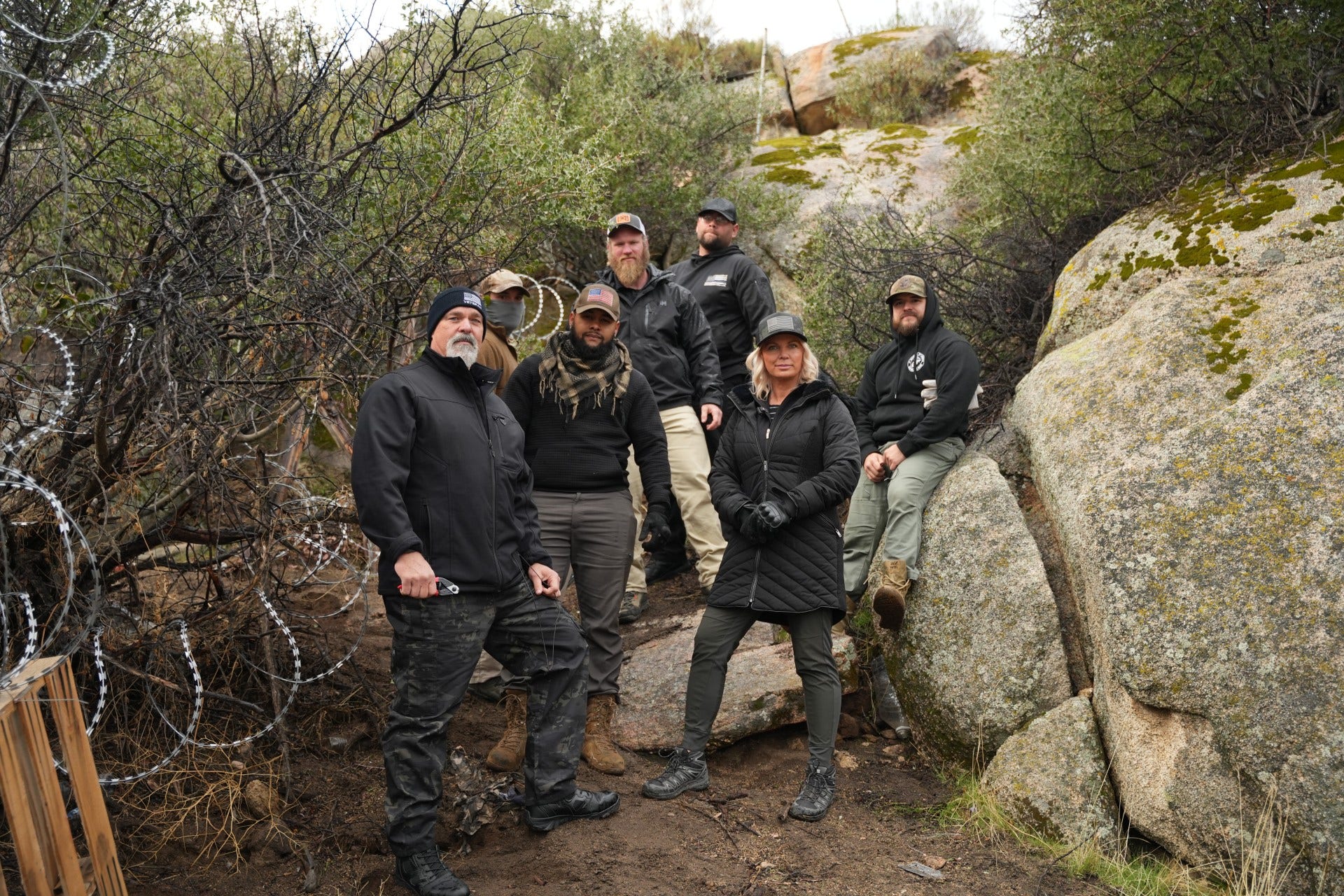
On a rainy and uncharacteristically cold day in San Diego County, Monroe invited Fox News Digital to see the volunteer organization’s continuing work. A group of nearly a dozen U.S. military veterans tagged along for the ride, returning to the infamous “San Judas Break,” a gap in the border wall that at its height was allowing more than 3,000 illegal migrants to spill into the U.S. on a weekly basis.

ICE, DEA ARREST CRIMINAL ILLEGAL ALIENS ON IDYLLIC NEW ENGLAND ISLAND

Border Vets members patched a hole in the barrier at the U.S.-Mexico border in San Diego County, Calif., on March 10, 2025. (Michael Lee/Fox News Digital)

At issue is a gap in the barrier where the fencing erected by the U.S. government meets a hilly rock formation, leaving a tiny pathway into the country for thousands of migrants who knew where to look. While members of the Border Vets patched the hole with razor wire last year, the group returned to the spot to make improvements to the barrier and extend it further up the hill in an attempt to dissuade illegal crossings.

Advertisement

But things have changed at this spot since the Border Vets initially volunteered their own time and money to patch the hole, with illegal crossings now coming to a near standstill in the area since Trump took office in January.

The Mexican Army has also begun to occupy the area, standing up a makeshift encampment on the other side of the border just a couple of feet from where the Border Vets worked.

Border Vets members put up razor wire to patch a hole in the barrier at the U.S.-Mexico border in San Diego County, Calif., on March 10, 2025. (Michael Lee/Fox News Digital)

The Mexican government’s cooperation and Trump’s reentry into the White House have had a profound impact on crossing numbers, with February data showing that just 8,300 people attempted to illegally cross the border last month, the lowest mark recorded since fiscal 2000. 

Agents with the U.S. Customs and Border Protection (CBP) have also had far fewer encounters with illegal migrants compared to the same time period in 2023 and 2024, recording just 30,000 encounters in February 2025 compared to more than 130,000 during the same time period in 2023 and 2024.

Advertisement

Border Vets members put up razor wire to patch a hole in the barrier at the U.S.-Mexico border in San Diego County, Calif., on March 10, 2025. (Michael Lee/Fox News Digital)

VENEZUELAN GANGS ARE FAR FROM A ‘FAKE’ PROBLEM, COLORADO DA SAYS: ‘GIANT ISSUE’

Nevertheless, members of the Border Vets have continued their volunteer work, noting that some migrants have been determined enough to find a way through.

“Things are getting better down at the border,” one Marine veteran who volunteers for Border Vets told Fox News Digital, noting that there are still gaps, not only figuratively, but literal gaps in the border.

“You can see on the footpath that people are just walking through,” he added.

Advertisement

The group insists they have had little trouble with CBP agents patrolling the area, arguing that many have welcomed the assistance, especially during the height of illegal crossings seen in the previous few years. An agent who anonymously spoke to Fox News Digital on Tuesday struck a similar tone, noting that the agency does not stop the group from erecting the makeshift barriers.

In one area of San Diego County near Jacumba Hot Springs, a makeshift shelter built out of wood pallets and tarp, a site that once hosted hundreds of migrants as they waited to make asylum claims to border agents, stood empty.

A makeshift shelter that once housed migrants stands empty amid President Donald Trump’s border crackdown. (Michael Lee/Fox News Digital)

A makeshift shelter that once housed migrants stands empty amid President Donald Trump’s border crackdown. (Michael Lee/Fox News Digital)

In other areas of San Diego County’s border with Mexico on Tuesday, members checked on their patchwork barriers while noting the stark difference between now and just a few short months ago.

Advertisement

“It’s a crazy thing,” Monroe said. “There used to be hundreds of people crossing every time I came, now not one. And it’s not because of the rain, they were coming rain or shine … the difference has just been absolutely amazing.”

CLICK TO GET THE FOX NEWS APP

Members of the Border Vets welcomed the change, though they plan to stay vigilant to prevent the situation from returning to the point of crisis it had reached over the last few years.

“An open border policy that we’ve dealt with for the last four years has been nothing but a detriment to the country,” a Navy veteran member of Border Vets told Fox News Digital. “We’re all struggling, we’re all being dealt a bad hand, and it just doesn’t send the right message to have our borders wide open when every other nation has closed-border policies.”

Read the full article from Here

Advertisement
Continue Reading
Click to comment

Leave a Reply

Your email address will not be published. Required fields are marked *

This site uses Akismet to reduce spam. Learn how your comment data is processed.

Denver, CO

Joey Bosa’s self‑critique sets tone for Bills ahead of Denver trip

Published

on

Joey Bosa’s self‑critique sets tone for Bills ahead of Denver trip


ORCHARD PARK – Thrilled as he was that the Buffalo Bills defeated the Jacksonville Jaguars in last week’s AFC wildcard game, edge rusher Joey Bosa wasn’t exactly in a celebratory mood.

Bosa was signed to a one-year contract in the offseason for one reason, and one reason only: To be an impact performer in the postseason, something the Bills have sorely needed from their defensive linemen.

But Bosa was anything but an impact player last week, and he didn’t need the next day’s film review to know it, or admit it.

Advertisement

Joey Bosa admits struggles after quiet playoff game

He stood at his dressing stall in the cramped visitors’ locker room at EverBank Stadium and flat-out said, “I’m so relieved. It was not my day today. It was not my best day. I need to play much better. I needed to have much more of an impact in the game.”

That’s a pro’s pro right there. No cliches, no spitting out the company line, no resting on the tired “I have to watch the tape” mantra that permeates NFL locker rooms everywhere. Bosa knew he had a bad day, and he was just glad that it didn’t cost the Bills a chance to go to Denver Saturday for the AFC divisional round showdown against the top-seeded Broncos.

According to Pro Football Focus, Bosa played 31 snaps and he made no tackles and was credited with one missed tackle, had four pressures of Trevor Lawrence but never really came close to sacking him, and that meant he had zero stops which are defined by PFF as a tackle that constitutes a failure for the offense.

Advertisement

Bosa even suffered the indignation of getting crushed by wide receiver Jakobi Meyers, who weighs 80 pounds less than Bosa, on a running play that allowed Travis Etienne to get to the edge and rip off a 26-yard run in the third quarter that helped set up a Jaguars field goal which cut Buffalo’s lead to 13-10.

“I’m thankful I get to come back tomorrow and keep working,” Bosa said on Sunday. “That’s all I care about. Move on, learn what I can and be better next week.”

Bobby Babich echoes Bosa’s assessment heading into Denver

And that’s exactly what defensive coordinator Bobby Babich expects him to do. Like so many coaches and players, Babich often speaks a lot of words to reporters without actually saying much of anything substantive, but that wasn’t the case Monday when he agreed with Bosa’s self-assessment of his performance.

“It’s a conversation I’ll have with any player that needs to play better,” Babich said before the practice week began. “There’s no reason not to be 100 percent honest. The guys know the expectations. You guys said it, Joey said it already. He knows what we’re expecting and what he needs to do and what his job is.

Advertisement

“Look, you’re not going to bat 1.000. You need to bat as close to 1.000 as you possibly can, but he knows he needs to play better. We advanced and he has another opportunity to play better. That’s what we need, that’s what we’re looking for and he knows that. And he’ll do it. Don’t let it happen again. Play the way we know Joey Bosa can play. It’s pro football. Do your job at a high level. That’s it. End of story.”

Bosa started the season very well and he was Buffalo’s most effective pass rusher and one of the best in the league during the first half of the schedule. But then the usual bugaboo with Bosa – injuries – cropped up as he suffered wrist and hamstring injuries that curtailed his play in the second half.

He finished the regular season second on the team in sacks (5) and QB pressures (47) behind Greg Rousseau (8 and 55), though PFF loved his overall package and he graded out as their seventh-highest edge rusher, well ahead of Rousseau who was 20th.

As always, you must take PFF grades with a grain of salt, but they at least provide some context, and to their credit they saw against the Jaguars what Bosa knew and they had him as their worst-graded Buffalo player among the 17 who played defense in the Jaguars game.

Bills need Joey Bosa to pressure Bo Nix

The Bills need Bosa to be much better against the Broncos and it will be imperative that the defense doesn’t allow Denver quarterback Bo Nix to get comfortable because while he still suffers from inconsistency, he has the ability to be dangerous.

Advertisement

Nix was one of the hardest QBs to sack in the NFL this season, just 22 times on 680 dropbacks which was tied for third-fewest among the 26 QBs who had at least 350 dropbacks. Nix’s pressure-to-sack rate of 10.1% was the lowest in the league.

That number alone indicates that it’s going to be difficult to get Nix on the ground because he’s also a mobile quarterback who can escape the pocket and run, so the key will be to make him feel under duress while also keeping him contained.

Like all quarterbacks, Nix’s numbers drop when he’s pressured, but in his case it’s a notable decline in effectiveness. When he was kept clean in the pocket, which was 67.9% of the time because the Broncos have a very good offensive line, he completed 69.7% of his passes with 18 TDs, five interceptions and a 7.2 yards per attempt average. But when he was pressured, his completion percentage dipped to 48.0% with seven TDs, six picks and 4.6 average per attempt.

“I think you see, evolution-wise, you see how the quarterback, how Nix is more comfortable in their offense and those type of things,” Babich said. “And I think he knows when to use his legs, he knows when to tuck it and go and all that. He’s certainly really dangerous in that manner, but it’s just you see a maturation of the offense in general.”

Sean McDermott stresses need for all‑hands pass rush

Sean McDermott would love for the Bills to get productive pass rush from the front four, but he and Babich have been creative with their blitz packages in recent weeks, and they will surely use linebackers and defensive backs to get after Nix.

Advertisement

“Yeah, we’re going to need everyone,” McDermott said. “That’s the short answer and the simple truth. We’re going need everyone. It’s a great team, No. 1 seed in the AFC and they’ve earned that. We’re at their place so it’s that type of game. You’ve got to be able to do your 1/11th at a very high level. If we don’t make the adjustments this week and the improvements we need to make, it’s gonna be really hard, awfully hard on us for us to get a win out there. I mean, they’re just that good. So we’ve got a hill to climb in front of us here.”

Sal Maiorana has covered the Buffalo Bills for more than four decades including 36 years as the full-time beat writer/columnist for the D&C. He has written numerous books about the history of the team, and he is also co-host of the BLEAV in Bills podcast/YouTube show. He can be reached at maiorana@gannett.com, and you can follow him on X @salmaiorana and on Bluesky @salmaiorana.bsky.social.


Source link

Continue Reading

Seattle, WA

The Restaurateur: Lily Wu

Published

on

The Restaurateur: Lily Wu


There has never been a grand, overarching plan guiding Lily Wu’s life. Indeed, from her childhood in a small village in northeast China to her standing as one of Seattle’s rising-star restaurant owners, everything has unfolded step by step, but whenever a chance came along, she never hesitated to take it.

“I come from a very poor family, so I still feel that I have nothing to lose,” Wu says. “That encourages me, and I feel I’m brave enough. It’s okay to lose everything, to restart.”

That persistence is what brought her to Flushing, New York, in 2006, on a student visa. It then took her west to Seattle, where she worked in housekeeping for hotels while receiving government assistance. Eventually, Wu’s big ideas about introducing new flavors to the local dining scene saw her return to her home country, where she learned how to make traditional biang biang noodles.

Advertisement

Today, those self-taught techniques draw rave reviews at Xi’an Noodles, which has three locations in the University District, Westlake, and Bellevue. Last September, Wu opened her fifth restaurant—a second Happy Crab outpost, in Ballard, with beautiful waterfront views of Shilshole Bay. There, guests can savor a Cajun seafood boil with Chinese flair, and at a relatively affordable price too (the jambalaya special is $10).

Achieving your dreams is never without hardship, and as an immigrant woman, Wu has faced challenges, working many times harder just to be seen. Years spent dealing with depression and doubts that made her want to put her restaurants up for sale. Finding reliable staff during a labor shortage, in an industry where drug and alcohol abuse has a firm grip. Studying finance, labor law, restaurant management, and food safety to make sure her businesses were compliant and built on fairness.

Advertisement

It took time for Wu to surround herself with good people, but once she found a solid support system—and focused on personal growth—she achieved a new level of success and is now looking to pay it forward. In the future, she plans to open her Happy Crab kitchen through a program for professionals just starting their careers.

“My goal with Chef Night is to create a platform for young people or anyone who dreams of starting their own business—a stage where they can showcase their talent, gain experience, and build confidence,” she explains. “I’d love to welcome anyone who’s passionate about food and entrepreneurship to join, learn, and take their first steps towards their own dreams.”

Already, Wu has had a positive impact on more people than she ever thought possible: 70+ employees make up her extended family, many of whom have been with her for close to a decade.

“Their loyalty means everything to me, and I’m deeply grateful for those who have walked this long road by my side,” she says. “After the pandemic, many restaurants didn’t survive. But we did. We rebuilt, we grew, and we stood back up. To me, influence isn’t about how big your company is; it’s about how many lives you uplift and how much integrity you carry along the way.”

Advertisement


Source link

Continue Reading

San Diego, CA

Should Congress bar big investors from buying single-family homes?

Published

on

Should Congress bar big investors from buying single-family homes?


President Donald Trump said recently on social media he would ask Congress to stop large investors and private equity firms from buying single-family homes.

His plan did not have many details but echoed a common refrain across the U.S. that investors should not own homes and that they drive up prices.

Critics have argued the issue is overstated, with an estimated 4% of single-family rentals owned by institutional investors. Studies over the years have routinely shown San Diego County as having one of the lowest rates of institutional investors.

Still, the move is likely to be popular with voters and even stopping some big firms, like Blackstone, from buying properties could make a small difference in the real estate market.

Advertisement

Question: Should Congress bar big investors from buying single-family homes?

Economists

Ray Major, economist

YES: Institutional investors should be banned from owning single-family homes. The American dream is built on homeownership, and every person in the United States should be able to work hard and afford a home. Institutional investors reduce the supply and increase home prices turning potential homeowners into lifelong renters. This, in the long run, will eliminate the average American’s ability to build generational wealth and pass it on to their children.

Caroline Freund, UC San Diego School of Global Policy and Strategy

NO: Investors have mixed effects on housing affordability. Families who cannot afford to buy benefit from renting in neighborhoods with strong schools. Investors can also stabilize markets during downturns, as they did after the financial crisis when prices collapsed. To improve affordability, limiting ownership by large investors in markets where they have pricing power would make more sense than an all-out ban. And if the goal is to increase housing supply and improve affordability, there are far better tools than investment restrictions.

Kelly Cunningham, San Diego Institute for Economic Research

Advertisement

NO: The vast majority of single-family rental homes are owned by small to mid-size landlords, less than 5% by large investors. Blaming big firms seems a populous desire to make the administration look like caring about home prices and doing something about affordability, but ignoring real drivers of housing costs and actual problems caused by overregulation, development restrictions and compounding fees. Blaming investors could end up with policies having adverse consequences on home markets altogether.

Alan Gin, University of San Diego

YES: Even though institutional investors are a small part of the market, their influence is growing. They are important at the margin, which can have big implications for some communities. By increasing the demand for housing, they cause prices to go up, which leads to housing price inflation as one of the biggest contributors to the elevated overall inflation rate. They can also squeeze out individual buyers, who may have difficulty competing with all-cash offers in a high-interest-rate environment.

James Hamilton, UC San Diego

NO: If an investor buys a home and rents it out, that is one less home occupied by an owner and one more home occupied by a renter. This does not change the overall cost of housing. Moreover, the Constitution does not give Congress or the president the power to impose such a rule. This is a local problem, not a national issue. The real solution is to reduce local fees and restrictions on home building.

Advertisement

Norm Miller, University of San Diego

NO: This limit on institutional ownership is symbolic of populous-driven interference in the housing market, and just like rent controls, it is harmful in the long run, inhibiting capital allocation and new supply in the housing market. Home prices and rent levels are overwhelmingly driven by supply-demand fundamentals: i.e. job growth, migration, zoning constraints, NIMBYs and construction levels. Institutions may manage rents more systematically, using dynamic pricing tools and standardized operating procedures — but they do not set the market. They respond to it.

David Ely, San Diego State University

NO: The shortage of affordable single-family homes is primarily due to insufficient new construction. Existing homeowners choosing not to upgrade because they do not want to give up their low-rate mortgage is a contributing factor. Given the relatively small share of single-family homes owned by institutional investors, restricting their purchase of homes will not materially expand the stock of housing available to households or slow price appreciation.

Executives

Phil Blair, Manpower

Advertisement

NO: The issue is not who owns rental properties, but how few there are available. The private sector has found a real estate investment niche and deserves to be able to exploit it. The law of supply and demand says build more housing and the rental prices will collapse. The administration could be opening up thousands of acres of underutilized land across the country for much-needed housing.

Chris Van Gorder, Scripps Health

YES: The percentages might be low in terms of numbers of homes purchased by large investors, private equity or other corporate investors. But their purchases do escalate the price of homes by reducing the inventory available for those wishing to purchase homes for their own personal use by private assets. I think this could modestly control the price of homes by increasing availability for private purchasers.

Jamie Moraga, Franklin Revere

NO: President Trump proposed banning large institutional investors from buying more single-family homes. The key word “more” suggests a limit, not a sell-off. Instead of an outright ban, Congress could find bipartisan support for assessing a cap on institutional single-family homeownership. A cap could ease competition for first-time buyers, help protect tenants from “mega-landlords” and reduce market concentration. It could also help balance housing affordability, rental supply, and homebuilding impacts.

Advertisement

Gary London, London Moeder Advisors

YES: But this is a bit of economic dodgeball because there are relatively few homes held in institutional portfolios in San Diego. I propose legislation that focuses on 1) zoning and land use policies to encourage new housing construction, 2) incentivize senior citizen downsizing by eliminating capital gains tax and 3) allow a one-time pass-through of existing property taxes for new transactions. Then a more robust resale market would emerge, coupled with demand for new housing.

Bob Rauch, R.A. Rauch & Associates

NO: Institutional investors represent a small share of the housing market, so banning them would do little to lower prices. They also supply rental housing for people who can’t or don’t want to buy. Proposals to restrict who can purchase property mirror the kinds of policies pushed in New York City by Mayor Mamdani. We need to reduce regulations, taxes, and fees that constrain supply. Limiting who can buy homes shrinks the market and discourages construction.

Austin Neudecker, Weave Growth

Advertisement

YES: While institutional ownership currently only represents 4% of the market, funds with increasing algorithmic targeting, cash bids and conversion to rentals can drive prices and create negative externalities, especially impacting first-time buyers. First, run market-specific trials with short sunsets and analyze the impact on prices, supply and rental affordability before broader implementation or allow them to lapse.

Have an idea for an Econometer question? Email me at phillip.molnar@sduniontribune.com. Follow me on Threads: @phillip020


Source link

Advertisement
Continue Reading

Trending
