Lifestyle
Bonding Over Books and Long Car Rides


“Guess where this photo was taken” was the prompt John Sasscer Sanders Jr. gave alongside a photo on his Hinge dating profile. The image captured Mr. Sanders at a book-signing event for the sociologist Matthew Desmond during the 2023 National Book Festival in Washington.
Shannon Shiyi Wu had volunteered at the festival that year, and was familiar with Mr. Desmond’s work. So when Mr. Sanders liked one of her profile photos in September 2023, Ms. Wu checked out his profile and saw the photo from the festival. “I know exactly where that is,” she responded. “That book is ‘Poverty, by America.’” They chatted about how Ms. Wu had read Mr. Desmond’s Pulitzer Prize-winning book, “Evicted,” and visited the exhibit it inspired at the National Building Museum in 2018.
It was the first of many shared interests for the couple. Their first date, days after they matched on Hinge, however, got off to a rough start when Mr. Sanders went to the wrong location of the coffee shop where they had agreed to meet. Once they pieced together the snafu and found each other 30 minutes later, the conversation flowed easily.
[Click here to binge read this week’s featured couples.]
She was “very easy to talk to, very engaging and fun,” Mr. Sanders said. “I thought she had a wonderful, distinctive laugh.”
Ms. Wu, 33, is the director of payment policy at the American Hospital Association. Born and raised in Libertyville, Ill., she received a bachelor’s degree in psychology at Princeton and a Ph.D. from the Johns Hopkins Bloomberg School of Public Health.
Mr. Sanders, 37, who was born and raised in Chevy Chase, Md., has a bachelor’s degree in economics from Rice University, a master’s degree in accountancy from Notre Dame, and an M.B.A. from the University of Virginia Darden School of Business. He is the senior manager of technical accounting at International Game Technology, a company that provides products and services for lotteries and casinos.
Their next dates through the fall of 2023 were a series of thoughtful pursuits, such as seeing a comedy show, trying Peruvian food, visiting the Rothko exhibition at the National Art Gallery, and dining at the Dabney, a Michelin-star restaurant in Washington.
It was on their first weekend away together that December, when Mr. Sanders invited her to his family home on the eastern shore of Maryland, that Ms. Wu realized their relationship had real promise. Looking over at him in the car en route, while listening to her favorite song by her favorite band (“I Need My Girl” by the National), she realized she didn’t want the ride to end. “‘Oh my gosh, I could be really serious with this guy,’” she recalled thinking.
Car rides were also where Mr. Sanders felt his affection blooming, albeit with different audio material. He loved listening to audiobooks like “Bad Blood” by John Carreyrou or “American Prometheus” by Kai Bird and Martin J. Sherwin together while driving. “She has an incredible intellectual curiosity that was engaging from the start,” he said. “I learn so much from her.”
In November 2024, just over a year after they met, Mr. Sanders proposed to Ms. Wu near the Touchstone Gallery in downtown Washington. It was where they had gone on their second date, and steps from the spot where they first kissed. “I had previously said to him, I didn’t want a big scene or anything,” said Ms. Wu of their engagement conversations.
Their wedding on Feb. 28 was low-key as well. They married at the Superior Court of the District of Columbia in a ceremony officiated by George Barbour, the branch chief of the marriage bureau, with just their parents and Mr. Sanders’s brothers and toddler nephew.
“I cried a little when I was reading my vows, and I think he also had to take a few breaths there,” Ms. Wu said. “I can’t imagine doing that in front of 100 or 200 people.”
The small group then shared a family-style meal at Ambar, a Balkan restaurant on Capitol Hill, ending with a hazelnut torte from the Heidelberg Pastry Shoppe in Arlington, Va. Their one more formal wedding touch: taking their portraits amid the soaring spaces and millions of books at the Library of Congress, which organizes the National Book Festival every year.



“The audience is my first editor,” David Sedaris says. His new book is The Land and Its People.
Anne Fishbein/Little Brown
hide caption
toggle caption
Anne Fishbein/Little Brown
Humorist David Sedaris has spent more than three decades writing about the absurdities of modern life and sharing his work in front of live audiences.
“I love attention,” he says of going on tour. “I love going on stage and I love people applauding, love people laughing.”
But reading out loud isn’t just about adoration. Sedaris says he’s always listening for reactions from the crowd and tweaking his work in response.
“The audience is my first editor,” he says. “When they cough, they tell me that I need to cut whatever it is that I’m reading. Of course, when they laugh, that’s fantastic. But I don’t mind a groan. A collective groan is fine with me.”
Sedaris’ daily routine is oriented around getting his steps in (at least 10 miles) and learning German, Japanese, Spanish and French on Duolingo. That’s in addition to his rigorous travel and writing regimen. For Sedaris, it’s all about growing and improving.

“That’s the promise: that you can be better, that you can write better, that you understand better, that you [can] speak a language better, that you can be a better person,” he says. “But it’s not going to happen by accident. You have to work at it. And so that’s what puts me at my desk, and that’s what gets me out of bed every day.”
His latest essay collection, The Land and Its People, casts Sedaris in several roles, including devout brother, itinerant traveler, grieving friend and reluctant caretaker.
Interview highlights

Little, Brown and Company
On whether he’d use AI for writing prompts
A friend of mine … asked ChatGPT to write something in my voice … and she sent it to me. And it was so lame, and then I rewrote it and it was the biggest laugh in the entire book. The audience howls with laughter. I would never have thought to write about this had ChatGPT not written it first. And I thought, well, that’s fair. That’s not plagiarism or anything. If a machine comes up with it and then I rewrite it, that’s perfectly within my rights, right?
Right now I feel like it can’t be dirty in an interesting way. So much of successful comedy is just surprising people, by surprising people with a word they didn’t expect to hear, or an image they didn’t expect. And right now I feel it’s not capable of that, but that doesn’t mean it won’t be capable of it in a year or two. But me personally, if you told me that here was a short story written by ChatGPT, or a book, I do not believe I would want to read it because I want someone on the other end. I want someone who I can write to and I can say, “Wow, I loved your book. I loved your story,” and I want a human to think, “Oh, I just sold a book.”
On why he resisted getting married to his longtime boyfriend Hugh (and eventually got married in secret)
At first we were boyfriends and then people started calling him “your partner.” … Well-meaning straight people thought it was respectful to use the word “partner,” like the same way now that a lot of people think they’re supposed to use the word “queer,” and I can’t stand that word, but they’ve been told that this is the appropriate word now and the word that they should be using. Then gay marriage came along, and then everyone just assumed that Hugh and I were married. …
We got married. I don’t even know when it was. I know it was before the pandemic. It was a shotgun wedding arranged by my banker. And I never told anybody about it. And I told Hugh he couldn’t tell anybody about it, because I don’t like when a man says the word, “my husband.” It’s like “my unicycle.” I met a woman at a book signing once, and she used the phrase, “my son-in-law’s unicycle.” And I thought, “Oh, that must pain you every time you have to say, my son-in-law’s unicycle.” I wanted gay people to get the right to marry, and then I wanted not a one of us to do it. I thought that would have been perfect. To say … “We spit on your marriage. We just want the right to do it.”

On writing up a contract for two of his sisters to not get married — Sedaris is one of six siblings
I drew up contracts all the time when I was a kid. … I made [my sisters] sign a contract swearing they’d never get married. But I didn’t want to lose them. I was just afraid because I didn’t have a word for what I was at that time, but I just knew that I wasn’t like the other boys. And I just thought, “Well, I’m gonna be alone for the rest of my life, and I want my sisters to be with me.” I couldn’t bear the thought of being alone without them, so I got them to sign contracts, swearing they’d never get married. But only Amy and Gretchen. … Neither Amy nor Gretchen got married.

On why good people are often not great characters
If you’re on the page, you’re a character. When you’re in real life, you are a person. Hugh is a good character. My sister Gretchen, I adore my sister Gretchen. She’s not a good character. She is a great person. I have friends who are great people, but not great characters. And it doesn’t have anything to do with being dynamic. Maybe it’s a degree of confidence that makes somebody a good character. …
Confident people always have my ear, even if I don’t agree with them or even if I think their confidence is unearned or that they’re fooling themselves. It doesn’t matter. It gets me to sit up straight and it gets me to listen. … I love the combination of somebody who’s just a horrible person, but just brimming with confidence and just certain that they’re right in all situations. I mean, my dad was like that. Never, never, ever showed any doubt in regard to anything. I didn’t agree with him and I didn’t wanna be him, but it made him a good character.
On whether writing is cathartic for him

I’ve never felt it to be cathartic. It helps me make sense of the world. And it helps me see myself. … I never really wrote about my feelings in my diary. Like, that’s really embarrassing if you look through an old diary and it’s all about your feelings. If it’s about a conversation you had at the barber shop, that’s not embarrassing, right? I could put out a whole book of haircuts, just haircuts I’ve had over the years and conversations with different barbers. Every one of them is recounted in my diary. I don’t recall ever getting a haircut and not writing about it afterwards.
On why he keeps up his rigorous book tour schedule
I don’t know how much of it is about the money. … It’s earning it. Earning those laughs. I mean, it’s going to happen to everybody and then you wind up in a nursing home and you’re talking to a spatula, you know? And hopefully when I’m in that condition, I won’t remember how wonderful it was to have this career. I won’t even know my own name, hopefully, because to be there and to remember joy and know that you’ll never experience it again will be pretty ugly. I said that like somebody who has stage four cancer. There’s nothing wrong with me. I don’t foresee any end to this, as long as people come. Maybe toward the end, I’ll have to pay people to come, and the money will flow in the other direction.
Monique Nazareth and Nico Gonzalez Wisler produced and edited this interview for broadcast. Bridget Bentz, Molly Seavy-Nesper and Beth Novey adapted it for the web.


Route 66 was 20 years old and World War II had just ended when Bobby Troup, an aspiring songwriter from Pennsylvania, decided to go west. As it turned out, that drive in early 1946 did more than anyone could have imagined to establish the road as a symbol of footloose American freedom.

Stories, photos and travel recommendations from America’s Mother Road
Troup, 25 at the time, had already earned an economics degree from the University of Pennsylvania, written a hit song (1941’s “Daddy,” sung by Sammy Kaye), worked for bandleader Tommy Dorsey and served as a Marine through the war years. But to restart his career as a songwriter and actor, he believed that he needed to be in Los Angeles. So he and his wife, Cynthia, pointed their 1941 Buick toward California.
They started on U.S. 40, then picked up Route 66 in Illinois. Along the way, as Troup told author Michael Wallis in the book “Route 66: The Mother Road,” Cynthia came up with a phrase she thought was songworthy.

Bobby Troup, composer of the hit song “Route 66” and grand marshal of Duarte, Calif.’s Salute to Route 66 parade, rides in a 1948 Buick convertible and waves to fans in 1996.
(Louisa Gauerke / Associated Press)
“Get your kicks on Route 66,” she said.
Troup took it from there, creating “a kind of musical map of the highway.”
As Troup later recalled in an introduction to a Route 66 book by Tom Snyder, they heard Louis Armstrong play a club in St. Louis, stopped at Meramec Caverns in Missouri and found that “a good part of the highway was absolutely miserable — narrow, just two lanes, and very twisting through the Ozarks and Kansas.” Then came a snowstorm in Texas.
By the end of the drive, the up-tempo tune was half-done. Then, not quite a week after arrival, Troup landed a chance to pitch a few songs to Nat “King” Cole, who had already won fame with hits including “Sweet Lorraine” and “Straighten Up and Fly Right.”
They were sitting by a piano on stage — after Cole’s last set of the night at the Trocadero on Sunset Strip — when the nervous young songwriter decided to share his unfinished road song.
“I got up on the riser, pulled the piano bench back a little bit — and it went over the side and I fell over backwards,” Troup confessed in a later interview.
Still, Cole “loved it,” Troup recalled. “As a matter of fact, he got on the piano with me and played it.”
This was February. By mid-March, the song was done and Cole was recording it in a studio on Santa Monica Boulevard, part of Route 66.
The finished version name-checked a dozen cities along the route, including these words:
Now you go through Saint Looey
Joplin, Missouri,
And Oklahoma City is mighty pretty.
You see Amarillo,
Gallup, New Mexico,
Flagstaff, Arizona.
Don’t forget Winona,
Kingman, Barstow, San Bernardino.
Won’t you get hip to this timely tip
When you make that California trip
Get your kicks on Route 66.
In April, Capitol Records released “(Get Your Kicks on) Route 66” and the tune quickly rose to #11 on the Billboard chart of top-selling singles. Before 1946 was out, it had been recorded again, this time by Bing Crosby with the Andrews Sisters. That version went to #14.


Musicians Nat “King” Cole, left, and Bing Crosby, circa 1945.
(NBC / NBCU Photo Bank / NBCUniversal via Getty Images via Getty Images)
Coming just as postwar America was rediscovering leisure travel, the song was a big hit — and for many, a painful irony. Even with guidance from the Green Book used by many African American travelers in those days, it would have been deeply risky — and illegal in some places — for any Black man, Nat King Cole included, to eat and sleep on Route 66. This was a year before Jackie Robinson integrated baseball’s major leagues, two years before the U.S. Army was integrated.
As Candacy Taylor puts it in her 2020 book “Overground Railroad: The Green Book and the Roots of Black Travel in America,” “the open road wasn’t open to all.” Into the 1950s, Taylor writes, “about 35% of the counties on Route 66 didn’t allow Black motorists after 6 p.m.” and six of the eight states on the route still had segregation laws. Cole may have helped sell Route 66, Taylor writes, but “the carefree adventure he was promoting was not meant for him.”

Documentary photographer Candacy Taylor at the New Aster Motel in Los Angeles in 2016. In her book “Overground Railroad,” she writes about the discrimination Black travelers faced while driving on Route 66.
(Brian van der Brug / Los Angeles Times)
Two years after recording the song, when the increasingly wealthy Cole and his family bought a Hancock Park mansion and became the neighborhood’s first Black homeowners, many neighbors tried to keep him out, poisoned the family dog and burned racist insults into his lawn.
The Coles stayed put. The family was still in that home on South Muirfield Road in 1956, when Cole became the first African American to host a network television show, and in 1965, when Cole died of cancer at 45.
Troup, who later was divorced from Cynthia and married singer/actor Julie London, went on to record more than a dozen albums and had other songs recorded by Little Richard and Miles Davis. As an actor, Troup filled many guest-star roles on television, played Dr. Joe Early on the 1970s TV show “Emergency!” and had a small part in Robert Altman’s 1970 film “MASH.”

Meanwhile, the song kept rolling. As years passed, Perry Como, Sammy Davis Jr., Chuck Berry, the Rolling Stones, the Manhattan Transfer, Michael Martin Murphey, Asleep at the Wheel, Buckwheat Zydeco, Depeche Mode, Glenn Frey, the Brian Setzer Orchestra and John Mayer recorded versions. At different points in the 2006 movie “Cars,” you hear Berry’s and Mayer’s versions. Troup, who died in 1999, never forgot the difference the song made, both in his life and the way people think about the road.
“On the basis of that song, I was able to go out and buy a house and stay in California,” Troup told Wallis. “I never realized when I was putting it together that I was writing about the most famous highway in the world. I just thought I was writing about a road — not a legend.”

The Rolling Stones are among the countless musicians who have recorded versions of “Route 66.”
(David Redfern / Redferns via Getty Images)
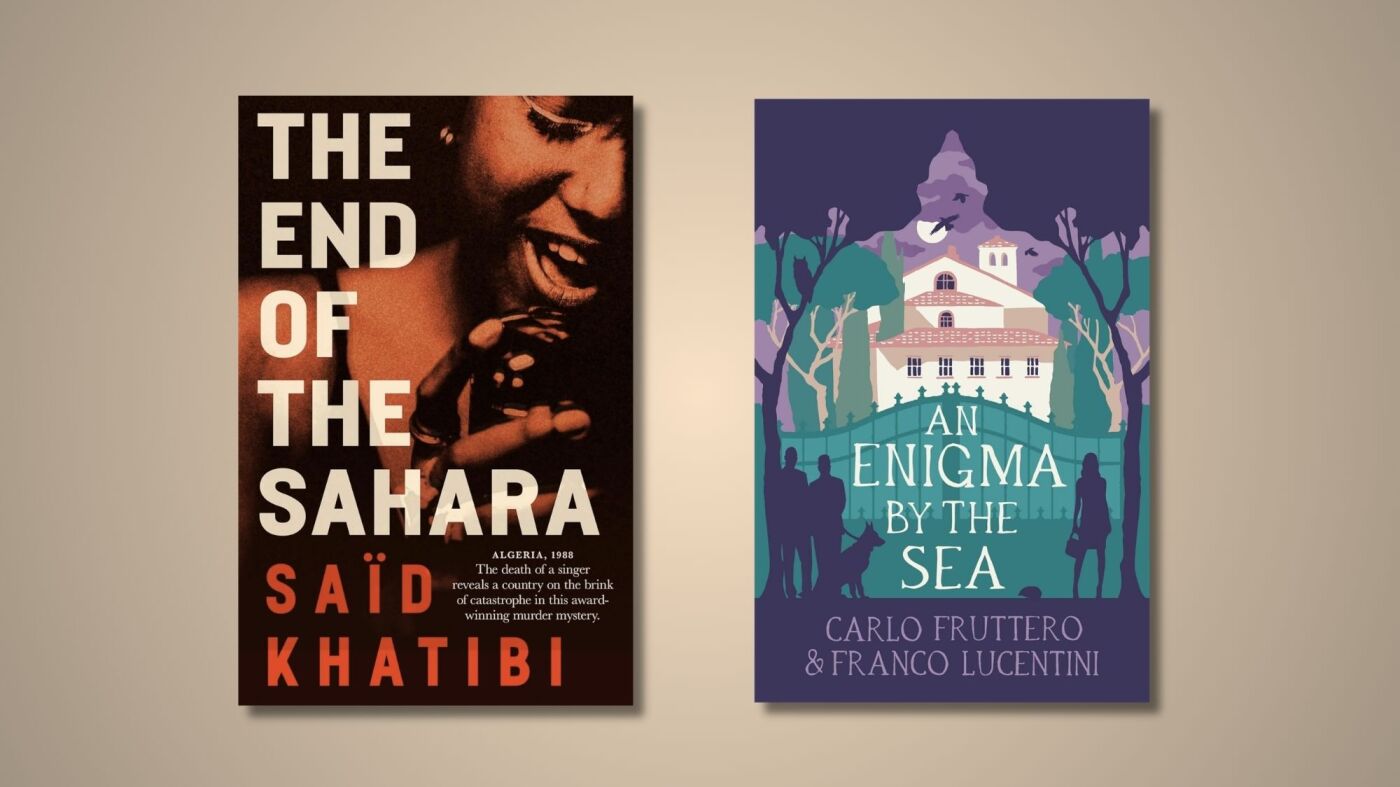
I’ve always loved mystery novels that take me inside different cultures. While lots of English language crime writers are good at evoking other lands — think of Philip Kerr’s Nazi Berlin or Cara Black’s Paris — the richest portraits come to us in translations of books by homegrown writers. These have the revelatory tang you get when novelists know their culture from the inside.
As it happens, two terrific novels of this kind have just come out from Bitter Lemon Press, a small London publisher that specializes in translated mysteries. These new books could hardly be less alike, except for one thing: Each is, in its unconventional way, quite brilliant.
The End of the Sahara is a kaleidoscopic murder mystery by the Algerian writer Saïd Khatibi, a rising star who just won the International Prize for Arabic Fiction. Superbly translated by Alexander E. Elinson, the book’s set in a provincial city on the edge of the Sahara in 1988 Algeria, a troubled time when the ruling socialist government has clearly failed. But you don’t need to know Algerian history to get sucked in by the plot, which centers on the murder of Zakia Zaghouani, a nightclub singer at a local hotel called The Sahara.
Burning with urgency, the story is told by a big cast of characters who all speak to us in first person. There’s Ibrahim, a college grad who’s been reduced to dealing in illegal videos. There’s the hotel owner, Maimoun, a shifty wheeler-dealer who fancied Zakia. There’s Zakia’s fiancee, Bachir, a decent guy found with blood on his shirt. He’s the top suspect of Inspector Hamid, a corrupt, womanizing cop who also fancied Zakia. Bachir’s represented by his cousin Noura, a good-hearted lawyer who’s constantly derided for reaching the age of 30 without a husband.


As we move from suspect to suspect, Khatibi not only makes us feel the textures of these characters’ everyday lives — the looks and smells, the food shortages and emerging Islamist militancy — but he deftly unveils how they are all are trapped together in a spiderweb of lies and betrayal that began in the past.
Using 1988 Algeria as a mirror for present-day Algeria, Khatibi gives us an X-ray of an entire social structure. Even as we learn who killed Zakia, we realize that no one escapes the bone-deep misogyny that underlies her murder and the repressive, post-colonial politics that leave Algerians spinning in circles. As one character thinks bitterly, “It was as if this country’s history just repeats itself rather than moving forward…”

Not surprisingly, life is far cushier along the prosperous Tuscan coast. That’s the setting for An Enigma by the Sea, a new edition of the 1991 novel by the legendary Italian team of Carlo Fruttero and Franco Lucentini. Witty, erudite and socially astute, they play with the mystery genre as they explore the many sides of Italianness.
The place is the Gualdana, a pine-protected seaside enclave where the well-off have holiday villas. “A certain air of secrecy hangs over it,” the opening tells us enticingly.
The time is winter, when only a few residents are around. They’re an assortment of Italian types that includes a rich, disaffected Roman couple; a philandering count who’s arrived with his latest conquest, a fame-hungry model; an old woman addicted to reading Tarot cards; and a smug politician stewing in paranoia. You get a whiff of Upstairs, Downstairs in the relation between these moneyed folks and the locals who service their many needs — the security guards, the wry police commander and the village handyman, who is also, everyone knows, the village cuckold.
Deliciously translated by Gregory Dowling, An Enigma by the Sea starts off like a gently acerbic comedy of manners, as these self-absorbed characters go about killing time — chatting, flirting, bickering, having tea. Then suddenly the story shifts. Three residents inexplicably disappear. Could they have been murdered? Here? The question unleashes the sleuthing instincts of their neighbor, Signor Monforti, a pessimistic depressive who’s a born detective: He spends his life scrutinizing every single thing for clues to impending disaster.

Masters of the light fantastic, Fruttero and Lucentini roll out their mystery with the slyest of touches, weaving discussions of the Greek cynics and the nature of depression into their droll evocation of a gray, chilly off-season resort with its wind storms and dire pizzerias. If Khatibi shows us characters caught in the tragic flames of history, Fruttero and Lucentini look at human folly with a cool, almost ancient amusement at what strange, funny creatures we all are.
-

 Dallas, TX6 minutes ago
Federal, local agencies tout results of North Texas anti-crime operation before World Cup
-

 Boston, MA18 minutes ago
East Boston couple accused in alleged racist attack on restaurant patio after calling in noise complaint
-

 Denver, CO24 minutes ago
Rep. Hurd emphasizes need for consistent, predictable energy policies at Denver roundtable
-
Seattle, WA30 minutes ago
Pollen forensic technique links missing woman cold case to the Pacific Northwest
-
 San Diego, CA36 minutes ago
A South San Diego Mother questions SDPD’S response to her teenage son’s death
-

 Milwaukee, WI42 minutes ago
Final public hearing for MPS budget proposal
-

 Atlanta, GA48 minutes ago
High E. coli levels along Chattahoochee River force business closures after days of rain
-

 Minneapolis, MN54 minutes ago
Mayor Frey vows ‘top-notch’ hire as Minneapolis police chief search looms


