Business
Commentary: How the Carolina wildfires are, perversely, good news for California

To address the most important point up front: The wildfires currently spreading across North and South Carolina are tragic.
Thousands of acres have been burned by hundreds of fires since Saturday, taking property and placing livelihoods at risk. There are no reports of fire-driven deaths, as yet, but evacuations have been ordered and emergency declarations made. Firefighters continue to struggle to bring the blazes under control. The causes include unusually dry conditions and wind gusts of up to 40 mph.
That said, the Carolina fires may have a positive result that will be felt coast to coast, and especially in California: They’re likely to quell all that stupid talk about attaching strings to federal wildfire disaster relief.
The moment Texas or Florida or Mississippi experiences a disaster, that idea will vanish.
— Sen. Brian Schatz (D-Hi.) on the idea of attaching strings to California disaster aid
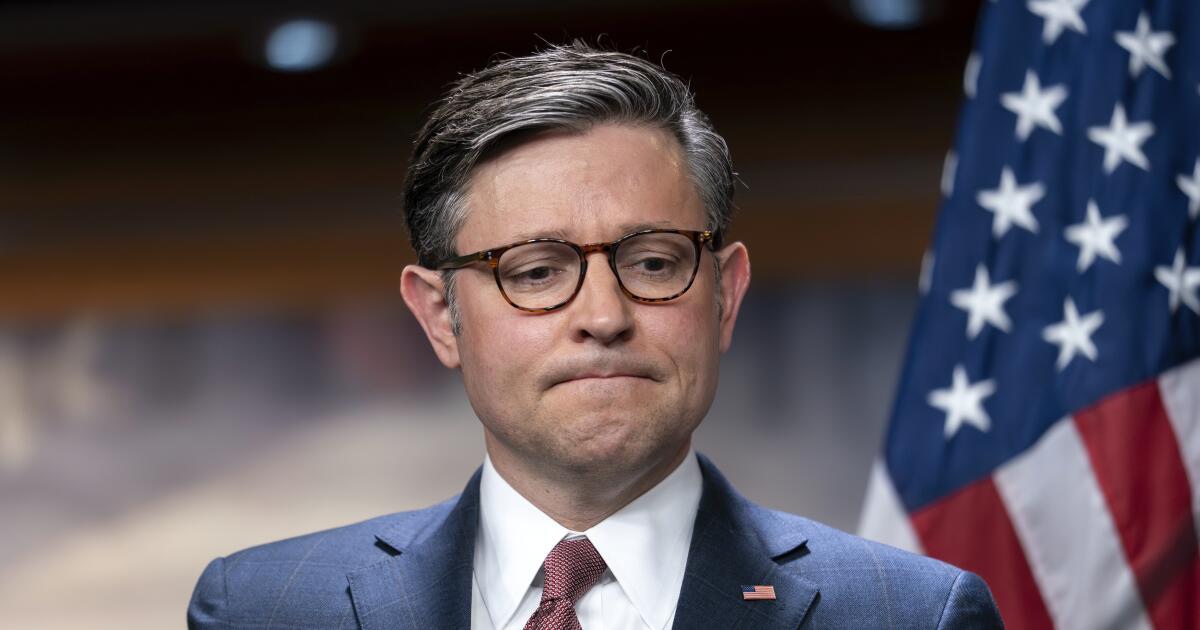
That threat has been made by Trump; his disaster czar, Ric Grenell; House Speaker Mike Johnson (R-La.); Sen. John Barrasso (R-Wyo.), a member of that chamber’s GOP leadership; and Rep. Byron Donalds (R-Fla.), among many others. Also pitching in are members of the right-wing peanut gallery, such as Fox News mouthpieces Sean Hannity and Jesse Watters.
What they’ve tend to have in common is a focus on California policies that had nothing to do with the fires in Pacific Palisades and Altadena but have been long-term targets of conservatives and Republicans.
Grenell called for the California Coastal Commission to be “defunded,” for instance. He didn’t explain what that had to do with the fires, but he called its policies “crazy woke left,” whatever that means. (The commission’s authority to regulate real estate development in the coastal zone, thus angering the developers who are among the GOP’s patrons, may have more to do with Grenell’s complaint.)
The others’ points were equally nonsensical. Trump rehearsed his long-discredited claim that California’s water supply has been wasted to serve the interests of the tiny delta smelt, an innocent bystander. Johnson talked of “our concerns with the governance of the state of California,” which he airily blamed for “complicity … in the scope of disaster.” Donalds said that “if a state is so grossly mismanaged that the initial disaster is not quickly contained, then we have a responsibility to do common-sense things.”
On the CBS program “Face the Nation,” Barrasso asserted that “the policies of the liberal administration” in California “have made these fires worse.”
Before examining the natural disasters that have afflicted these blowhards’ own backyards, it’s proper to note that this isn’t California’s first encounter with political shortsightedness on this majestic scale.
In 1905, a flawed canal cut on the banks of the Colorado River produced a massive flood that threatened to destroy the Imperial Valley, which already was producing crops worth $2 million a year. By the mid-1920s, the valley’s efforts had placed a bill before Congress to pay for a high dam on the Colorado to hold back any further flood threats while providing water for irrigation.
The measure ran into opposition from President Coolidge and his Treasury secretary, the multimillionaire Andrew Mellon, who thought private enterprise should take on the task. Across the Southeast, farmers and their elected officials raised further objections. Cotton growers objected to irrigating 1 million acres in the Imperial Valley, corn farmers objected to a million more acres of corn, and wheat growers to a million competing acres of wheat.
But then nature intervened, with a massive flood in 1927 that killed 246 residents of the Mississippi River valley and breached levees along a thousand-mile stretch of the river. Rep. Phil Swing, who had been elected by Imperial Valley voters with the express goal of bringing the dam measure past the goal line, made sure that nobody overlooked the parallels between the 1927 flood and the disaster at home.
Trainloads of New Orleans business and civic leaders came to Washington to plead for relief. “I took on the New Orleans men,” Swing recalled, “putting to them again and again whether they could see any difference between the Mississippi’s flood threat to their people and the Colorado River flood threat to the people of the Imperial Valley.”
Two landmark federal measures were born as a result: the Flood Control Act of 1928, which created a levee construction program costing an unprecedented $300 million, and the Boulder Canyon Project Act, which authorized the construction of a $165-million high dam on the Colorado, eventually to be christened Hoover Dam.
That brings us back to the present day, and the old adage, “What goes around comes around.”
Republican politicians, to be fair, aren’t unanimous about calling for strings to be attached to disaster relief for California. Among the holdouts are many members of the North and South Carolina delegations, in part because the most recent hurricanes to sweep across the region killed 200 people and caused more than $10 billion in damage — and that happened only last September.
“I would ask those folks to put themselves in the same position as people of western North Carolina,” Sen. Thom Tillis (R-N.C.) said of colleagues who have raised the prospect of withholding aid to California. “You got to be consistent on disaster supplement, period.” Congress passed a$100-billion disaster relief bill after the hurricanes, no strings attached.
But other Republicans either have blinders on or short memories. Consider Barrasso’s home state, Wyoming. “Billion-dollar natural disasters are up 360% in Wyoming over the last 20 years,” according to a study funded by LendingTree and cited by LaramieLive.com. The state is especially vulnerable to wildfires, including a wind-blown fire in 2020 that scorched 177,000 acres, destroyed 66 properties and threatened Cheyenne’s drinking water with contamination.
Louisiana, Johnson’s home state? Since 2004, it’s been hit by 13 hurricanes as well as floods requiring federal assistance. If Johnson were to stick with his insistence that “governance” were to be a factor in the disbursement of federal assistance, observes Louisiana journalist Greg LaRose, the state might “no longer be entitled to federal assistance after hurricanes because state policy has allowed the fossil fuel industry to carve up its coastal marshes, making south Louisiana more susceptible to storm damage.”
The Census Bureau reported that Louisiana had the highest percentage of residents displaced by natural disasters of any state in 2023 — about 8.3%, compared with the national average of 1.6%.
Every state in the union has received federal disaster aid in recent years. How many of them would like to see political strings attached to the funding?
(Carnegie Endowment)
Florida? it might as well be called the “hurricane state,” with the damage caused by more than 20 hurricanes requiring federal aid since 2004, including last year’s Hurricane Milton, which brought some $1.5 billion in federal assistance in its aftermath.
Louisiana and Florida ranked first and second in the level of direct assistance from the Federal Emergency Management Agency and other government agencies from 2003 through 2024, according to an aid tracker compiled by the Carnegie Endowment for International Peace. Louisiana received $47 billion and Florida received $28 billion. California was in the middle of the pack, at $7.6 billion. Every single state received some level of federal assistance.
Barrasso, Donalds and Johnson didn’t reply to questions I sent through their congressional offices about their advocacy of attaching strings to assistance.
It isn’t only the cynicism of GOP politicians claiming to know the factors underlying disasters such as the California wildfires; it’s their evident ignorance of what those factors are.
They talk with cocksure confidence about the virtues of clearing forest floors, moving water hundreds of miles to get to the fire zone, to “crazy woke left” coastal policies, and on and on. But they don’t mention the most important factor: global warming, which they would prefer to wish away.
But they must know deep down that they’re spouting partisan claptrap. Sen. Brian Schatz (D-Hawaii), whose home state residents received $660 million in FEMA assistance after the Maui fire of 2023, according to the Carnegie database, knows how asinine, counterproductive and short-lived the idea of conditions on disaster relief will be in the end. “It’s never going to happen,” Schatz told HuffPost. “The moment Texas or Florida or Mississippi experiences a disaster, that idea will vanish.”

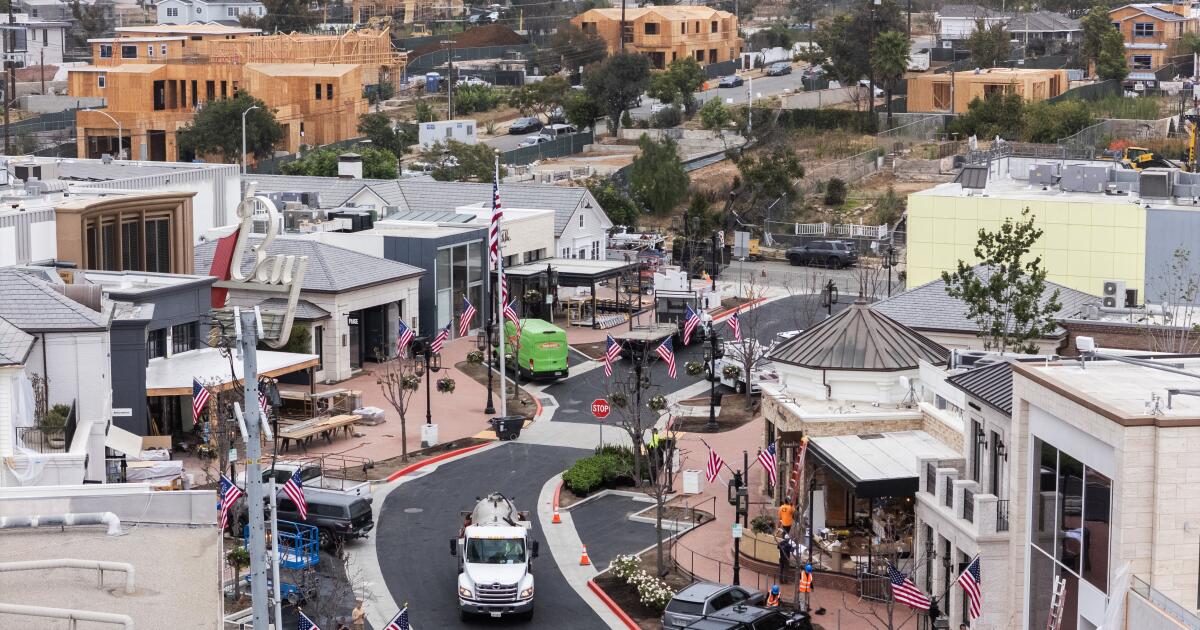
The luxury shopping center in Pacific Palisades will reopen next month after more than $100 million in renovations forced by the January 2025 wildfire that devastated the Los Angeles neighborhood.
Palisades Village will reopen Aug. 15, owner Rick Caruso announced Wednesday. The outdoor center survived the blaze that destroyed homes and other businesses but needed refurbishment to eliminate contaminants that the fire could have spread.
Crews are putting finishing touches on mall buildings after tearing them down to the studs, treating the wood and rebuilding the walls, Caruso said.
“Everybody’s working, and stores are moving their products in,” he said. “It’s a really cool feeling that people have really locked arms and are working together.”
An electrician installs lighting for a restaurant at Rick Caruso’s Palisades Village on Thursday. The shopping center is scheduled to reopen mid-August.
(Myung J. Chun / Los Angeles Times)
Pacific Palisades resident Allison Polhill, who is rebuilding the home of 30 years that her family lost in the blaze, said she is “thrilled” at the prospect of returning to the mall she used to frequent. Its comeback is a boost for the community, she said.
“Every single step that we make to reopen our commercial corridors is going to bring more people back into the Palisades,” said Polhill, who expects to move back into her home at the end of August.
A total of 6,822 structures were destroyed in the Palisades fire, including more than 5,500 residences and 100 commercial businesses, according to the California Department of Forestry and Fire Protection.
Caruso previously attributed the mall’s survival to the hard work of private firefighters and the fire-resistant materials used in the mall’s construction.
The $200-million shopping and dining center opened in 2018 with a movie theater and a roster of upmarket tenants, including Erewhon, which may be the only grocer in the heart of the fire-ravaged neighborhood when it opens.
Caruso’s company was able to fill the mall with tenants despite the long shutdown.
Palisades Village is 99% leased, with the majority of tenants returning, said Jackie Levy, chief financial and revenue officer. Nearly one-third of the shops and restaurants are new to the property.
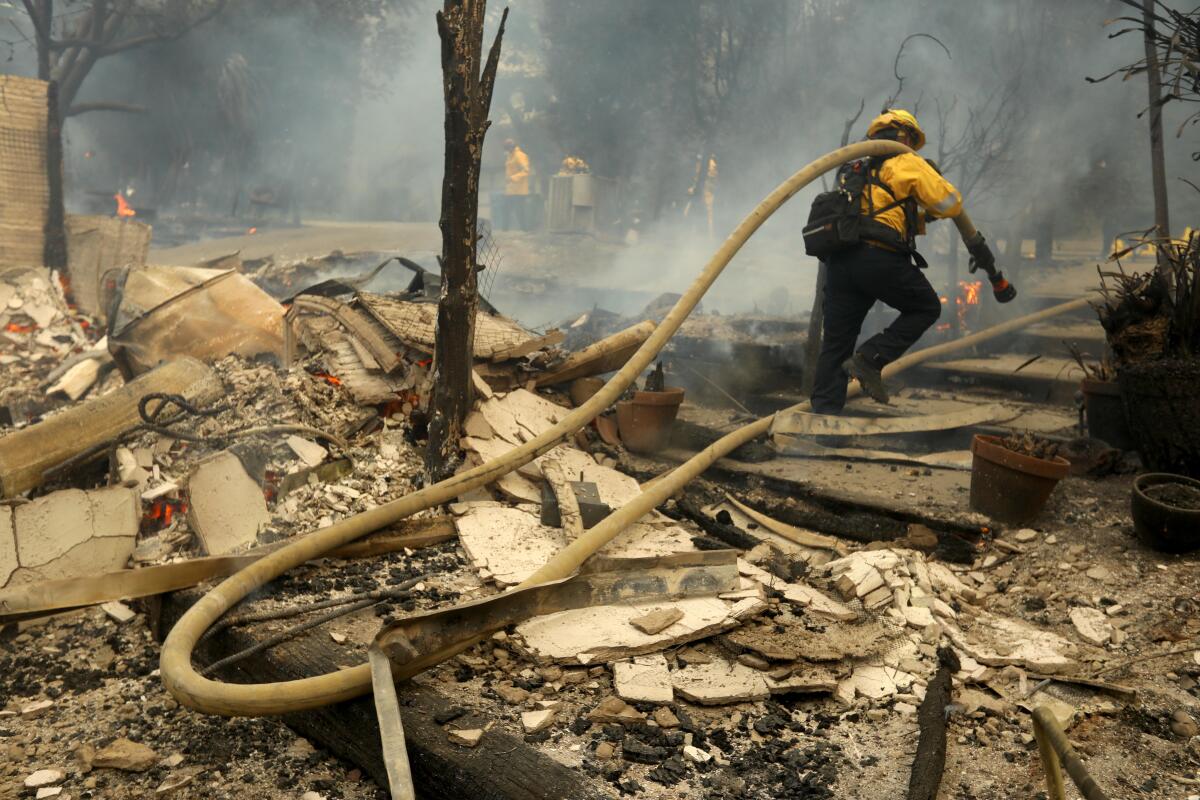
A firefighter carries a hose back to his rig while walking through a destroyed home from the Palisades fire in Pacific Palisades on Jan. 7, 2025.
(Genaro Molina / Los Angeles Times)
Last year, Pacific Palisades-based fashion designer Elyse Walker said she would reopen her eponymous store in Palisades Village after losing her 25-year flagship location on Antioch Street to the inferno.
Other neighborhood shops destroyed in the fire that are reopening at the mall include K Bakery and Loomey’s Toys, which caters to children up to age 12 and used to be across the street from Palisades Elementary Charter School.
“It’s been a journey and I’m excited because I wasn’t sure that there was going to be a place to come back to,” said toy store owner Amanda Rastegar. “Hopefully we can bring some of that magic back.”
Rastegar’s home in the Palisades survived but was damaged by the fire. The family returned about eight weeks ago. Her last memory of the fire was a burning supermarket.
“I just couldn’t wrap my brain around what was happening,” she said. “By the time I left, Gelson’s was on fire.”
Among the returning tenants is Angelini Ristorante & Bar. Well-known Los Angeles chef Gino Angelini said he will be in the kitchen next month for a return of the Italian restaurant.
“We won’t do a big celebrity open,” he said. “We want to have a very soft opening and see our customers come back.”

Construction takes place at Rick Caruso’s Palisades Village on Thursday. The shopping center is scheduled to reopen mid-August.
(Myung J. Chun / Los Angeles Times)
An elaborate celebration would not feel “correct for me,” Angelini said, because the devastation has been “very sad” for so many.
Other new tenants include local chef Nancy Silverton, who has agreed to move in with a new Italian steakhouse called Spacca Tutto. Women’s activewear retailer LESET will open its first West Coast location.
Caruso said he is optimistic that customers will return to the center, even though many Pacific Palisades residents are still dispersed. One tracking system estimated that about 30% of the Village’s customer base was impacted by the fire, he said.
“That means 70% did not get impacted, so there’s a lot of customers still left out there,” Caruso said. Historically, the center drew customers from as far away as Beverly Hills and Calabasas, as well as Malibu, Brentwood and Santa Monica.
He also hopes many will be inspired to visit the revived mall.
“I believe in the goodness of people and I believe that people are going to want to support the Palisades,” he said. “They’re going to want to be there and support the businesses that have had the courage and the heart to reopen.”

Walmart is rapidly expanding its network of electric vehicle chargers designed for customers to use while they shop.
The network could help fill gaps in EV infrastructure in states with greater need for chargers. Walmart, which has more than 5,000 locations in the U.S. and hundreds in California, says more than 90% of Americans live within 10 miles of one of its stores.
The chargers also offer an incentive for customers to choose Walmart — Walmart Plus members will receive a 10% discount off an average price of $0.46 per kilowatt-hour of energy at the company’s chargers.
Walmart chargers are already available at more than 75 locations in 17 states, with Texas boasting the most charging stations, followed by Florida and Arizona.
Matthew Nelson, Walmart’s director of energy policy, said last week on LinkedIn that the network will soon reach 29 states, including California.
“We are delivering on the promise of affordable, reliable and convenient charging,” Nelson said in his post.
According to Walmart’s website, six charging stations are coming to California soon, though the company did not offer a specific timeline.
The chargers will be installed at stores in Antelope, Brea, Fresno, Stockton, Suisun City and Vallejo.
Most charging sites in California will include eight to 16 fast-charging stalls, said Walmart spokesperson Kelsey Bohl.
The company first announced plans in April 2023 to install its own EV chargers at Walmart and Sam’s Club stores, with a goal of installing thousands of chargers by 2030. Partnering with ABB E-Mobility and Alpitronic, it added 25 new charging sites this past May and six more in June.
“Walmart is building a leading retail-integrated EV fast-charging network, focused on delivering an affordable, reliable and convenient charging experience where customers already shop,” Bohl said in an emailed statement. “Customers can charge while they shop, access stations through the Walmart app they already use, and benefit from affordable pricing.”
The charging stations already available include 612 individual charging stalls using 400-kilowatt chargers. Each stall has a dual charging cord with both Combined Charging System and North American Charging Standard connectors. The standard connectors, designed by Tesla, are smaller and lighter than the combined systems.
The primary way to pay for the chargers is through the Walmart app, but the company is also experimenting with built-in credit card readers to allow those without the app to use the stations.
Customers can check charger availability on the Walmart app. The company said the chargers will be available 24 hours a day.

Robotaxis could be turning into robocops.
A self-driving Waymo reported two teens to San Mateo, Calif., police on Monday after they were found drinking alcohol and shooting toy guns in the back of the vehicle.
According to a social media post from the San Mateo Police Department, officers detained two 15-year-olds after the Waymo they were riding in contacted the department and stopped in a parking lot until law enforcement arrived.
“Parents do you know where your teens are?” the San Mateo Police Department wrote on Facebook following the incident. “Waymo does!”
Officers removed both teens from the vehicle and determined they were using toy guns to shoot Orbeez out the windows. Orbeez are small, water-absorbing beads sold at toy stores.
“Toy guns, water guns, and BB guns all pose real dangers, especially to an untrained eye,” the Police Department said. “The simple handling of them can cause fear in [passersby].” “
A video posted on Facebook shows at least five officers and a police dog responding to the scene and approaching the Waymo with their weapons raised.
Waymo did not immediately respond to a request for comment.
Waymo vehicles have internal cameras and microphones that may be used in an emergency or to “promote safety and security,” according to Waymo’s online support page.
The cameras are also used to ensure the vehicles are clean and to help find lost items, according to the support page.
The company said it does not use facial recognition or other biometric identification technologies to identify individuals.
“In more urgent circumstances, support may access live video during a trip,” the Waymo page said.
The San Mateo Police Department’s Facebook post has garnered nearly 60 comments, with one user accusing Waymo of “snitching.”
“At least they got a designated driver?!” one user commented.
-

 Tennessee1 minute ago
Data centers driving up Tennessee power bills, report finds
-

 Texas6 minutes ago
Family demands investigation after US man killed by ICE agent in Texas
-

 Utah13 minutes ago
Turn your miles into meals
-

 Vermont16 minutes ago
Poll: Most young Vermonters say they’re likely to leave state amid affordability concerns – VTDigger
-

 Virginia21 minutes ago
MEOC Organization hosts annual summer picnic for Southwest Virginia seniors
-

 Washington28 minutes ago
Future uncertain for site of former Mount Washington church destroyed in massive fire
-

 Wisconsin31 minutes ago
South Milwaukee, Wisconsin, officials in standoff with homeowner over year-round skeleton display
-

 West Virginia36 minutes ago
West Virginia coach Rich Rodriguez wants to save college football. Here’s his pitch:

