Lifestyle
She gave her rent-controlled apartment a cottagecore update worthy of 'Little Women'


As an avid collector of vintage decor, Catie Brown feels lucky she doesn’t have to cope with one of Los Angeles’ most common rental dilemmas: limited space.
“I wanted a two-bedroom apartment but didn’t think it was financially feasible,” Brown says of moving out on her own for the first time after graduating from Stanford.
In this series, we spotlight L.A. rentals with style. From perfect gallery walls to temporary decor hacks, these renters get creative, even in small spaces. And Angelenos need the inspiration: Most are renters.
Out of all the apartments she looked at while searching for a place to live in 2022, Brown, now 27, fell in love with the one she initially dismissed — a nondescript ground-floor apartment in a two-story, 15-unit complex built around a swimming pool.
“It was much more appealing in person than in the Zillow photos,” Brown says. Other pluses: It was rent-controlled ($1,700 a month at that time and now $1,762) and had been vacant for months. “The property manager docked the rent a bit because it had been sitting for a while,” she says.
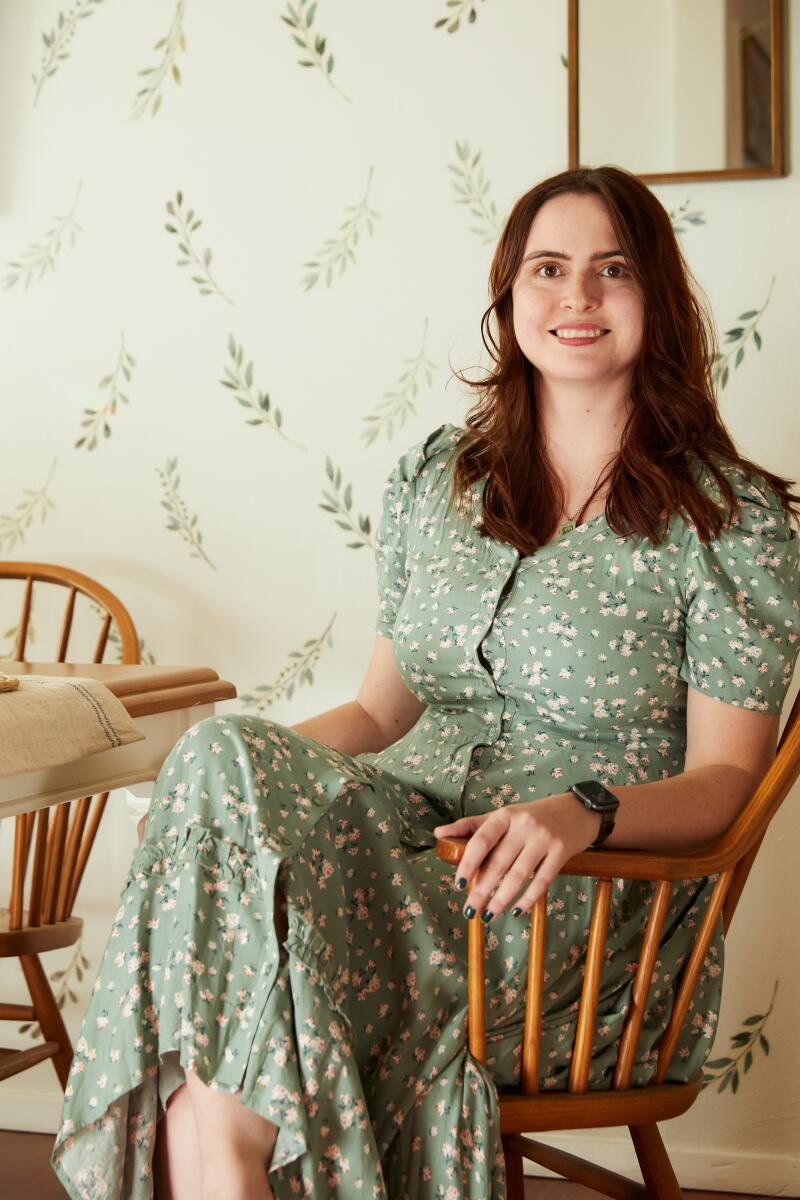
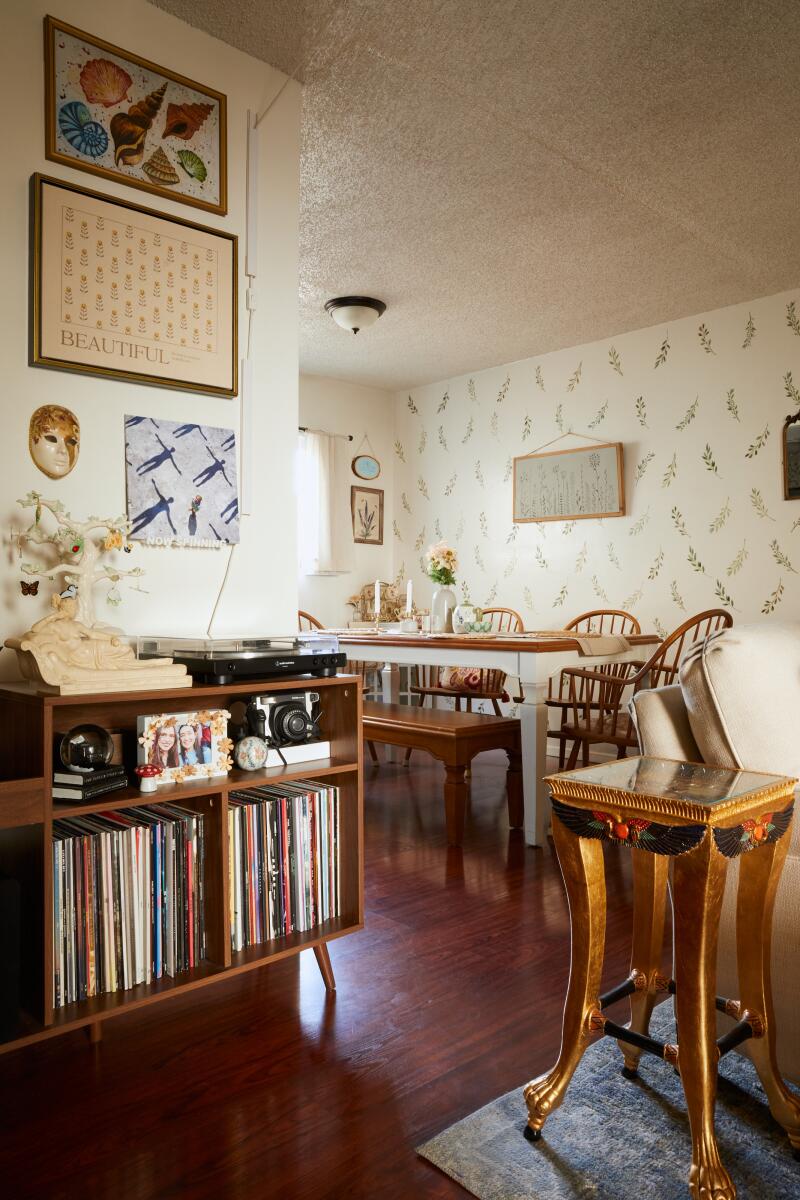
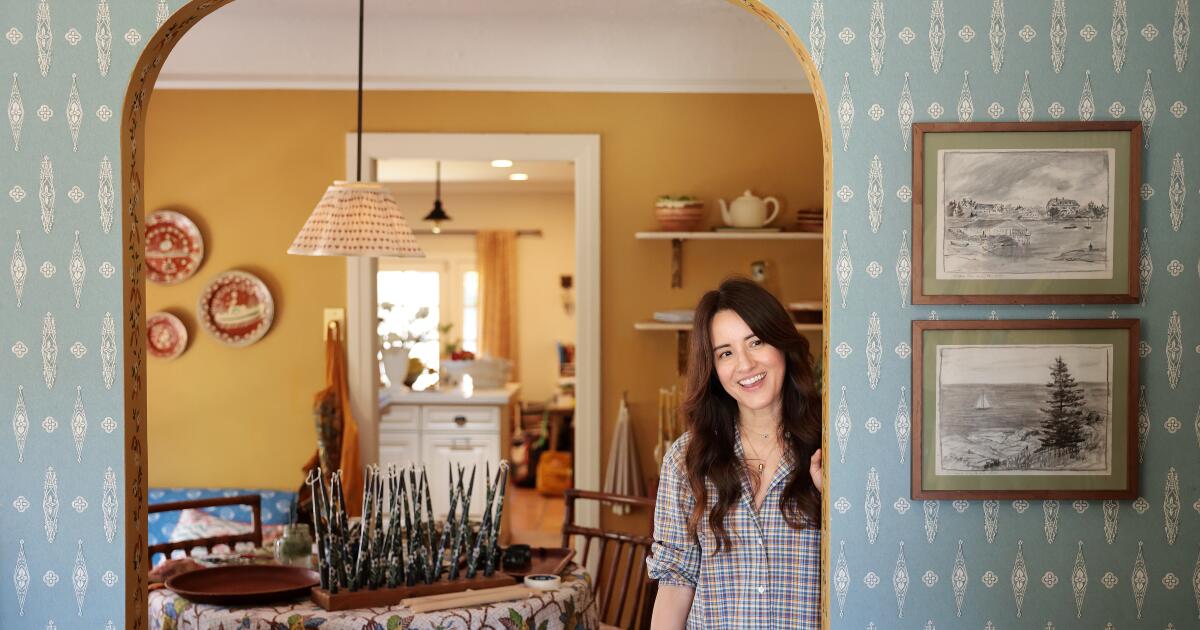
Brown in her dining room, where she installed peel-and-stick wallpaper to make a statement. When she moves, she can remove it.
Located in Mid-City, bordering Culver City, Brown was impressed with its multiple bedrooms and hardwood floors, unlike the gray vinyl floors popular with L.A. landlords and scorned by renters. It was also a relatively easy commute to her job in downtown Los Angeles as a marketing coordinator and within walking distance of her gym, making it a practical and convenient choice.
During the COVID-19 pandemic, Brown had to leave campus and move back in with her parents in Thousand Oaks, where she was once again living in her teenage bedroom. Like many people during the pandemic, she became obsessed with cottagecore design — a romantic trend that celebrates an idealized version of country living and evokes a simpler time. “I was very crafty as a kid, and the pandemic just emphasized that,” she says.
Brown’s apartment, which she likes to call her “Culver City cottage,” is filled with vintage finds and cherished treasures that are inspired, in part, by her love of historical novels and classic literature like “The Secret Garden,” “Anne of Green Gables” and “Little Women.”
Cottagecore appeals to her, she says, because it reminds her of her childhood dreams. “I’m an aspiring novelist, and it made me feel like a book character,” Brown says while offering a scone in her cozy living room. “I was ready to embrace this side of myself I’d always been a bit embarrassed of in the past.”

An Egyptian-themed souvenir Brown’s grandmother purchased at the King Tut exhibit serves as a side table in the living room.
As a “history nerd,” Brown likes to showcase things that illustrate the human experience, such as a thrifted recreation of a clock from the Titanic. Her personal connection? “The movie was released the year I was born,” she says.
Brown has found that adhering to her vintage and cottagecore aesthetic allows her flexibility “as long as the treasures and art I choose to display stay within that,” she says. “The content itself can change, such as a movie poster being swapped out, so long as I choose a vintage style movie poster.”
It’s an aesthetic she has worked to bring into every room.

Stacks of books, movies, dolls and whimsical knicknacks are displayed on the bookshelves in Brown’s office.
“I’ve found a way to strike a balance so it feels cozy and welcoming but not overwhelmingly full,” she says. Brown also utilizes temporary ways of adding personality to her rental, such as the peel-and-stick floral wallpaper in the kitchen and dining room and installing shelves to display her vintage treasures.
In the living room, a gold Egyptian side table her grandmother purchased in the gift shop of the King Tut exhibit rests next to a cozy tufted couch. “My grandmother was passionate about history and museums, so my family passed down a few things of hers that were in storage,” she says. The walls display personal touches like an artwork she purchased in Provence, France, at her cousin’s wedding, hand-embroidered necklaces by Brown, botanical prints bought from vintage stores and a Venetian mask brought home from a trip to Italy.
Traditional elements, like a faux fireplace and a tiny trove of potted plants outside her front door, add to her cottagecore aesthetic. “It’s not a cottage without a garden,” Brown says, smiling.

Assorted artworks in the entrance to the apartment hide a heating vent on the wall.
The second bedroom serves as an office where Brown is finishing her novel, which she describes as a “retelling of an Irish myth.” When asked if the story influenced her decor, she mentioned some subtle touches, such as artwork from Ireland, a sign she made in the Irish language and Belleek pottery.
Above her desk, she has installed film on the window to block the view of another apartment a few feet away. In addition to a reading corner and a craft table, she hopes to add a sewing area. “I love painting and crafting knickknacks,” she says, “it reminds me of my childhood, of the carefree joy of making things.”
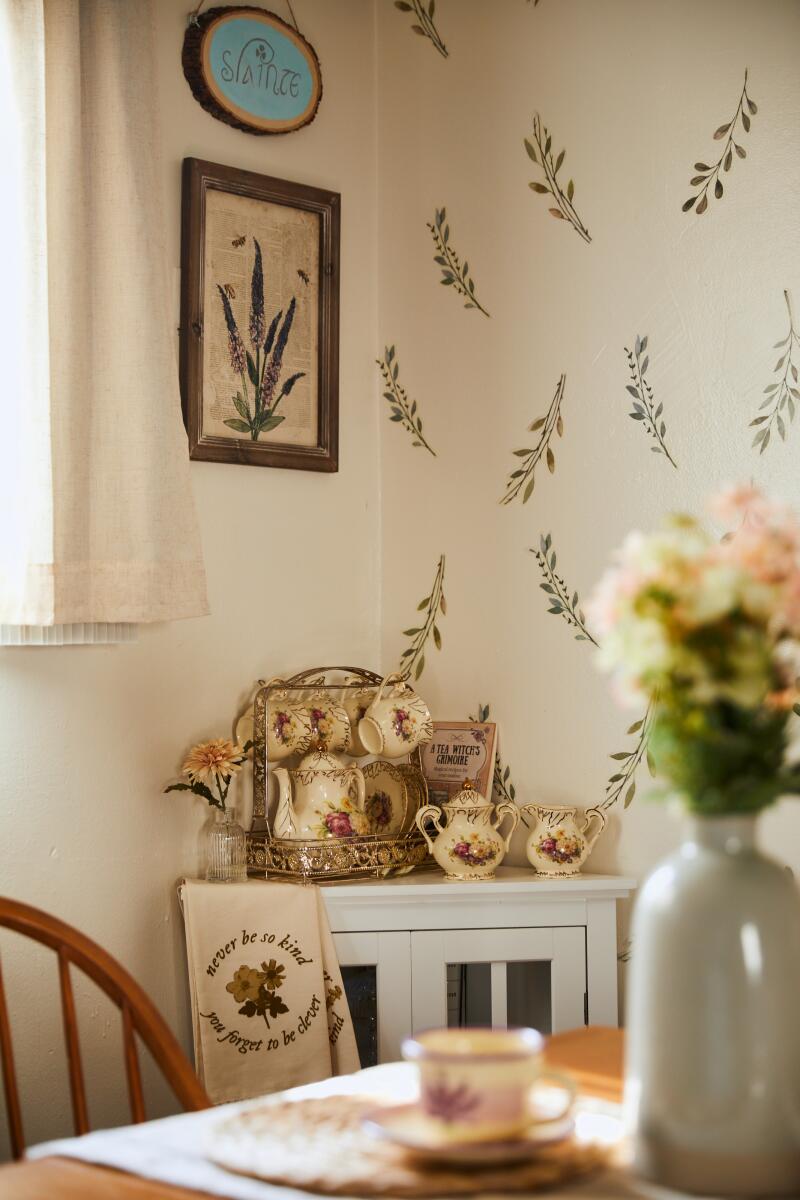
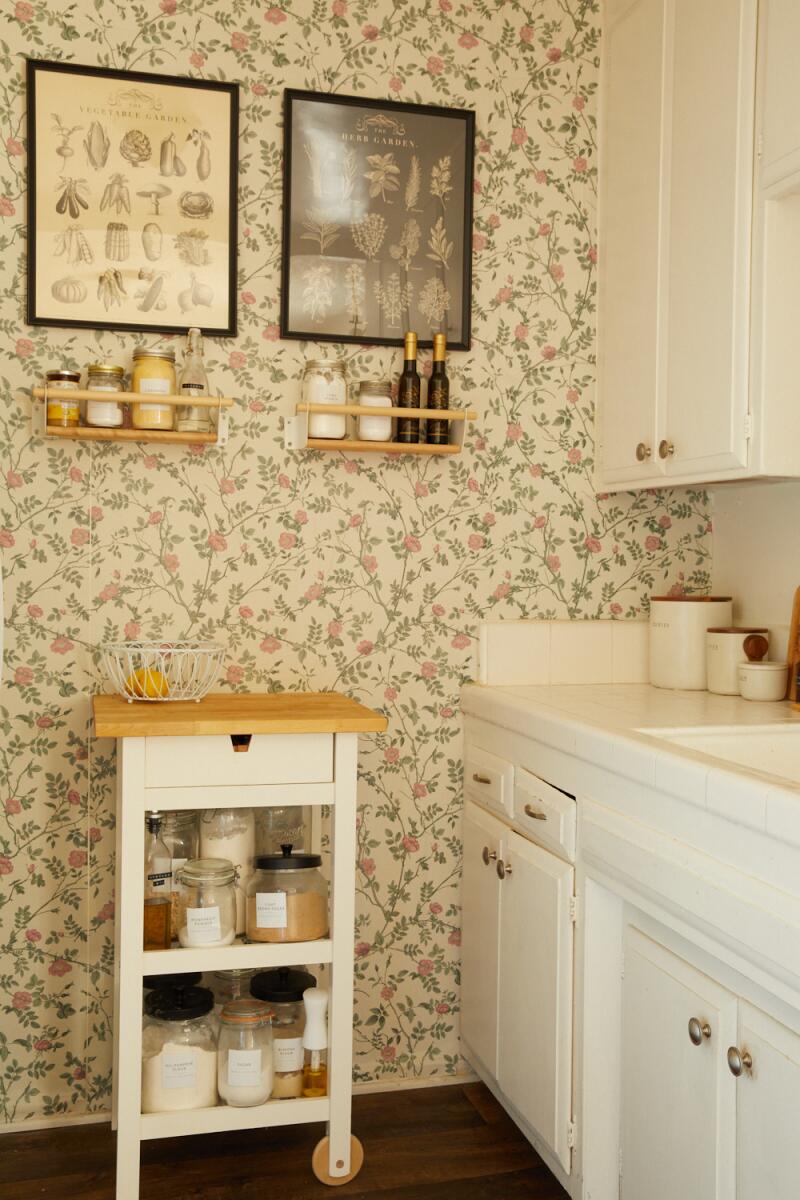
Floral peel and stick floral wallpaper in the kitchen and dining room can be removed when Brown moves out.
There is also a puzzle board, which Brown notes can help reduce stress and calm an anxious mind. “Sometimes I put it away, but I’m happier having it accessible,” she says.
Brown has several whimsical items in the primary bedroom, including crystals and treasures from her thrifting, like the Ladurée macaroon box she purchased in France for $15 and a tea tin that holds her curlers. She enjoys swapping out the botanical prints based on the season and uses a personal checklist when looking for antiques. “EBay, Facebook Marketplace, Etsy, Poshmark and Instagram,” she says. “I go down the list. The hunt is so much fun.”
Brown tries not to purchase new things, except for some knickknacks from Joann’s and Michaels (always on sale) and an Ikea pendant and shelving. She inherited many of her larger furnishings from her aunt, including her farmhouse-style dining room set, and enjoys looking for treasures at the Melrose Trading Post at Fairfax High School. Once, she drove an hour to Claremont to pick up a marble sculpture and has met people in parking lots to pick up her purchases. Some pieces have moved on: “I used to have a smaller cabinet for my record collection,” Brown says of the piece she purchased and later resold on Facebook Marketplace.
While Brown admits that living in a 1963 apartment contributes to its affordability — “No one can believe how much my rent is,” she says — it also adds charm. Yet even with the luxury of two bedrooms, space can become limited for such a passionate collector.
“I can’t have any more cabinets,” she says firmly. “If I get more things, I’ll have to start releasing some books.”
Rooted in the present, Brown has made her apartment a home inspired by the past.
“I don’t want it to feel like I’m totally stepping back in time,” Brown says, “but it still has the coziness of a home from another era. When a friend of mine slept on the couch recently after the Palisades fire, he said this was the homiest apartment he could have evacuated to.”


Lonnie Bunch III is the 14th Secretary of the Smithsonian. He’s pictured above in September 2017.
J. Scott Applewhite/AP
hide caption
toggle caption
J. Scott Applewhite/AP
In a memo addressed to staffers sent Tuesday, the secretary of the Smithsonian, Lonnie G. Bunch III, defended the institution after the White House issued a 162-page report that characterizes the National Museum of American History as a place which has become “subject to institutional capture by a radical, activist ideology that is fundamentally opposed to telling the noble, honest story of the great country we know and love.”
In his email, which NPR has obtained, Bunch wrote in part: “While there will always be room for improvement, this report is not a fair characterization of the work and totality of the National Museum of American History. At the Smithsonian, our work is driven by scholarship, accuracy and an uncompromising commitment to tell the fullness of America’s story. As public servants and the keepers of this institution, we are charged with helping a nation find understanding, hope and clarity and as part of that duty, we are dedicated to excellence, reflection and growth.”

He continued: “We remain focused on what grounds us: a steadfast commitment to scholarship, nonpartisanship, independence, accuracy and integrity. For nearly 180 years, the Smithsonian has worked alongside partners across government — from the White House to Congress to our governing Board of Regents — guided by our enduring mission to increase and diffuse knowledge. That purpose remains: to pursue knowledge with rigor and to serve the American public with clarity and care.”
The White House report was issued on July 4 by the Domestic Policy Council under the title “Saving America’s Story: How Ideological Capture at the Smithsonian Institution’s National Museum of American History Erases Our Heritage.”

The council faults the National Museum of American History on a multitude of fronts, saying it underemphasized the Founding Fathers and early colonial and Revolutionary history; was not sufficiently celebratory of the country’s 250th anniversary; and that it engaged in “anti-white,” “illegal alien” and transgender activism.
It also accuses the museum of trying to “indoctrinate” teachers and students through its exhibitions, programming and teaching resources.
In the report, the council also specifically criticizes museum director Anthea Hartig, who has led the National Museum of American History since 2019 and is concurrently the president of the Organization of American Historians, calling her “an activist advancing an ideological agenda contradictory to the museum’s founding purpose of fostering patriotism.”

The Trump administration has made the Smithsonian museums one of its primary targets in its efforts to reshape cultural narratives to align with its viewpoints. In August 2025, the White House requested a “comprehensive internal review” of eight Smithsonian museums, including the National Museum of American History, following an executive order issued by President Trump in March 2025 in which he called for the removal of “improper ideology” from the Smithsonian’s offerings.
According to the Smithsonian’s charter, all of its 21 museums, 14 education and research centers, and the National Zoo are meant to be run independently of the federal government. The Smithsonian is overseen by Bunch and a board of regents, which includes Vice President Vance, Supreme Court Chief Justice John Roberts and other members appointed by Congress.
In an interview with NBC’s Meet the Press on Sunday, Bunch spoke about the Smithsonian’s 250th anniversary special exhibition at the Smithsonian Castle, which is called “American Aspirations.”
He told NBC: “It’s really important for people to understand that America is much an ideal as it is a place, that it’s a series of aspirations that have really shaped who this country is. And so for me, what is so powerful is to say, ‘Let us honor the words of Thomas Jefferson and the founders, but let us use those to challenge us to be better.’”
Jennifer Vanasco edited this story.

It was after the death of her son, Laith, that Esme Saleh decided to become a folk artist.
She had always been creative, experimenting with watercolors and learning to sew and embroider at a young age.
“I had a creative inkling,” she said, “but I never pursued it.”
Everything changed on Aug. 17, 2013.
In this series, we highlight independent makers and artists, from glassblowers to fiber artists, who are creating original products in and around Los Angeles.
When Saleh was nine months pregnant, she woke up with stomach pains and presumed she was in labor. She and her husband, Nasim, immediately went to the hospital, where doctors checked her and put the baby on a heart monitor. Saleh’s blood pressure was high, however, and the baby’s heart rate kept dropping. After about an hour, his heartbeat stopped. Doctors rushed her in for an emergency C-section, but it was too late. Laith did not survive.
Saleh lost a tremendous amount of blood and developed postpartum HELLP syndrome, a dangerous form of preeclampsia, but doctors were able to stabilize her.
When she woke up, the first thing she asked was, “How’s my baby?”

After losing her son in 2013, Esme Saleh left her job as a television producer. Since then, she has sold her hand-painted candles to local designers in Los Angeles and to LVMH in Paris.
“Aug. 17, 2013, was the most difficult day of my life, and Aug. 22 was the second most difficult, the day we drove home with an empty car seat,” she said of her and her husband’s new reality.
They named their son Laith Finn Saleh.
“His first name means ‘lion’ in Arabic. His middle name is an ode to Huckleberry Finn — sharp wit, kind heart, strong moral compass — all the attributes he’s imparted on us in spirit,” said Saleh, 45.
After such a devastating loss, she found it difficult to trust the world again. “It was hard to trust anything,” she said. “The medical system. Myself. It made me realize the fragility of bringing anything to life. We take so much for granted.”
So after years of working as a television producer, Saleh left broadcast journalism and leaned into her creative spirit.
She grew up in San Diego. Her mother was raised on a farm in Mexico, and her father moved from Tijuana to Los Angeles to be near her mother, who started working for a family in Sherman Oaks at 16. They eventually settled in San Diego, where Saleh’s father, now a church deacon, worked as a car salesman.


“The word Mystic has also become a driving force of what this journey means to me,” Saleh says. “A magical, otherworldly journey that has led me to some beautiful friendships, projects and unlimited well of curiosity. When I paint each pair of candles, it feels like I’m imparting a piece of that magic.”
“He always wanted to be a weatherman on TV,” she said, explaining how he hoped to get his big break on television by doing a weather report from the car lot.
Saleh wanted to be a broadcast journalist as her father had. After graduating from San Diego State, she interned in the sports department at CBS affiliate KFMB-TV although she didn’t know much about sports. She enjoyed sharing information with people, learned how to write plays of the week and felt she had found the right career.
But during a summer class at Mesa College, she started to think journalism might not be for her.


Saleh’s home is filled with her artwork. “My home expresses a lot of the things that I do,” she says. “If it works here, then I feel like I can put it out in the world.”
“I’m an empath — a sensitive soul — so when I was reading news about death and destruction, my eyes could not lie,” she said. Her professor told her, “This may not be your thing.” But when she arranged flowers on camera, she really came alive. She decided to work behind the scenes as a producer.
Her professor helped her get her first network news job in 2003, and she moved to Los Angeles, working on hard news and entertainment coverage.
After losing Laith a decade later, she couldn’t keep doing red-carpet interviews and acting like everything was fine. “It all felt so different, superficial and hard,” she said. “I felt like there was a bigger purpose out there for me. It’s in the small things that we find the big things.”
She started by painting folk art-inspired invitations for a friend’s baby shower. She painted delicate flowers, oranges and leaves on glass, leather and even lampshades. She created a logo. “I was just trying to say yes to things that were really scary,” she said. “Laith gave me the courage to do that.”

“I was just trying to get out of hole,” Saleh says of taking up painting after her son died.
Her first son, she said, became “a catalyst for painting.”
Then, at the first Thanksgiving during the COVID-19 pandemic when people could gather again, she had a light-bulb moment. “I was setting the table and didn’t have flowers or anything to add to decorate, so I thought, ‘I have these candles. I’m going to paint them and make them fancy,’ ” she said.
Her guests were impressed.
As time went on, painting taper candles helped her find joy again, and others noticed too.
“The one thing I hear when people pick up a pair of my candles is, ‘This makes me so happy. It makes me feel like there’s life here,’ ” she said.
1

2

3

1. Saleh sometimes leads painting workshops where participants can decorate items like ornaments and lampshades.
2. Leather napkin rings Saleh has painted for Nathan Turner. 3. Saleh’s hand-painted candles retail for approximately $42 to $50.
One of the hardest parts of losing a child “is that you’re not just grieving the person, you’re grieving the future you imagined with them,” said Chicago-based grief specialist Carla Harvey. “A lifetime of love suddenly has nowhere to go. Creating art doesn’t erase grief, but it can become a way to carry it.”
Saleh created her brand Mystic by Esme in 2021, but it took her some time before she could gather the courage to try to sell them.
When she brought a shoebox full of samples to Nickey Kehoe, the L.A. store agreed to carry her candles. “I was beside myself,” Saleh said.
“Her candles were absolutely beautiful, and she had a fantastic spirit that made selling them a no-brainer,” said interior designer Todd Nickey, co-founder of Nickey Kehoe.

Saleh gets a surprise kiss from her dog Olive while painting candles at her dining room table.
Saleh viewed her new side project as a way to earn extra money for piano lessons for her 11-year-old son Linus, who is an entrepreneur like his mother. “I felt proud painting the candles while he was in lessons in the next room,” she said. “It became this circular economy, and it led to bigger opportunities for me.”
Last year, luxury conglomerate LVMH commissioned Saleh to paint 465 pairs of candles, or 930 candles in total, for its Chaumet jewelry brand. The collection was unveiled at an elaborate event at the Abbaye des Vaux de Cernay, just outside Paris.
“It was fun,” Saleh said about the process, which took six months from conception to delivery. “I felt like I was dressing my candles up for a party.”
Always a hard worker, which she attributes to being a first-generation child of immigrant parents, Saleh has now created a candle collection for Pierce and Ward in Los Feliz, leather napkin holders for interior designer Nathan Turner and pomegranate wrapping paper for Olive Ateliers. The candles retail between $42 to $50 for a pair, and recently, she developed a handsome pewter candle shaver that will be released in the winter.

Her dining room can sometimes feel like “an assembly line,” Saleh says.

Saleh holds a pair of candles she has embellished with florals.
Occasionally, she leads painting workshops, and she loves helping others tap into their creativity. The most meaningful one for her was an ornament workshop attended by several victims of the 2025 Los Angeles wildfires. “Without saying anything, we understood each other,” she said. “I understood that they were trying to create memories.”
Saleh knows what it means for things not to last — “impermanence,” she calls it — whether it is homes, candles or life itself.
She paints every day in the art-filled dining room of her home (unless it’s Little League season), surrounded by her family, candles and her two dogs, Lennon and Olive. ”Painting is like meditation,” she said. “You can sit in your dining room and tune everything out and just be in the moment.”

Even the family’s summer bucket list receives an artistic flourish.

An arch inside Saleh’s home receives a personalized touch.
She knows painting candles isn’t new, but she believes her motivation and the care she puts into each candle makes them special beyond their looks.
She has learned to look at the world that way, that painting in her dining room has offered her healing and joy, that she can trust herself and her body, that continuing to be inspired by her two boys — “one in spirit and the other here on Earth” — means that Laith will always be with her.
Many people think healing means moving on, said grief specialist Harvey, but “it’s really about finding ways to move forward while keeping the people we love woven into our lives. That’s what I see in her candles, not an ending, but an ongoing relationship with her son.”
“I feel like my son is channeling through this medium,” Saleh said, her voice breaking as she painted a taper. “He’s whispering to me, ‘Mom, this is your path.’ That has been my driving force. We’re going to grow this together.”
Lifestyle
Terry Tempest Williams on why women with big ideas get labeled ‘crazy’ : Wild Card with Rachel Martin
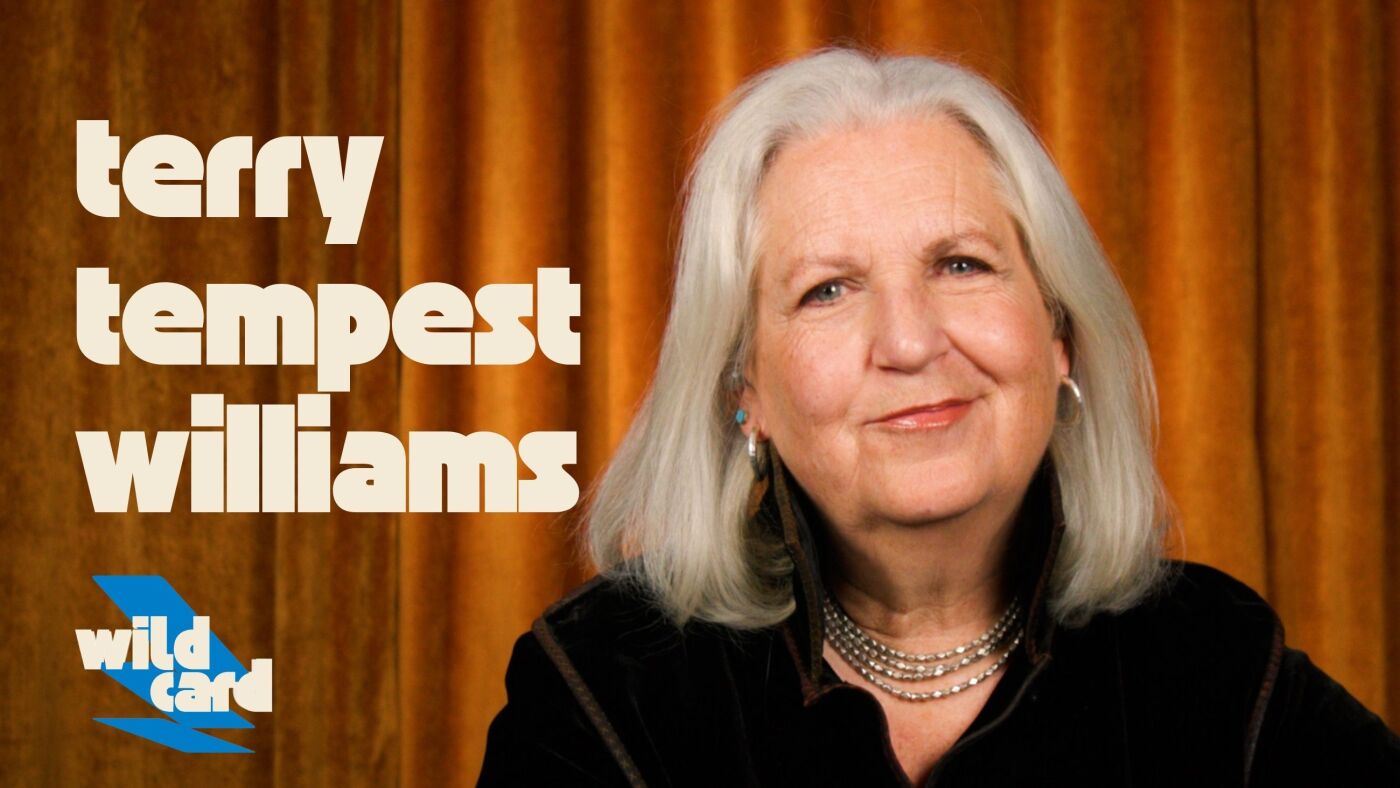
A note from Wild Card host Rachel Martin: I met Terry Tempest Williams about 25 years ago at a writer’s conference in Yosemite Valley. I was a young reporter who was there to do a story about how literature was addressing climate change and she made such a huge impression on me. I had never heard someone talk about the natural world the way Terry did and she had a spiritual depth I hadn’t encountered in my life at that point.
To this day, Terry’s writing always reorients me towards what is good, what is beautiful, and what is true. Her newest book is called “The Glorians.”
-

 Los Angeles, Ca41 minutes ago
O.C. police prep for beach, theme park ‘takeovers’ promoted on social media
-

 Detroit, MI1 hour ago
Detroit city leaders to DHS: Stop ICE pursuits which endanger the community
-

 San Francisco, CA1 hour ago
SF Supervisor Jackie Fielder hosts listening session after medical leave
-

 Dallas, TX1 hour ago
The Stewpot artists find healing, purpose and income through art in Dallas
-

 Miami, FL1 hour ago
Can Jason Marshall push for a starting spot – The Splash Zone 7/10/26
-

 Boston, MA1 hour ago
Police investigating shooting in Downtown Crossing – Boston News, Weather, Sports | WHDH 7News
-
 Denver, CO2 hours ago
Denver mayor announces new $100 million plan to bring in 10,000 jobs
-

 San Diego, CA2 hours ago
WEBTOON Brings Top Creators for San Diego Comic-Con Panels

