Alaska
Flying people and freight around the state is important in building and maintaining connections


Flying is a big part of the Alaska lifestyle.
For many of us, that means out-of-state travel, or even out of the country.
But just as we fly off to Seattle or Frankfurt and other points abroad, airplanes also take travelers to the far reaches of the state.
The big jets go to many destinations around the state. Alaska Airlines flies 737s to Nome, Cordova, Bethel, Juneau, Kodiak and Utqiagvik every day. Also in the mix are the smaller regional jets operated by Horizon Air: the E175s.
The smaller jets fly between Anchorage and Fairbanks, King Salmon and Dillingham, plus other destinations as required.
But there are a bunch of other communities in the state that Alaska Air and Horizon don’t reach. The communities are too small, or the airstrips aren’t big enough, or both.
Air travel to and from most of these communities is restricted to planes that accommodate nine passengers or fewer. A few larger communities in Western Alaska enjoy service with larger planes. Ravn Alaska flies the wing-over twin-engine Dash-8 with 29 to 37 passengers. Aleutian Air operates the 50-passenger Saab 2000.
The air carriers are changing things up — and it affects travelers around the region.
Last December, Ravn Alaska advised the U.S. Department of Transportation that it intended to halt its essential air service flights on April 29 between Anchorage and St. Mary’s, as well as between Anchorage and Unalakleet.
For reference, it’s expensive to fly to either destination, between $450 and $545 one-way, with at least 14 days’ advance notice.
The U.S. DOT put a hold on Ravn’s plan, ordering the carrier to continue flying until another carrier is found. Sterling Airways, the parent corporation for Aleutian Airways, submitted bids to serve the two communities, with a subsidy of at least $5.8 million. ACE Air Cargo also submitted a bid, requesting a subsidy of more than $4.4 million. ACE also does quite a bit of charter passenger flights with its fleet of 19-passenger Beechcraft 1900s.
Kenai Aviation submitted a bit with no subsidy for Anchorage-Unalakleet and was awarded the route. According to Jacob Caldwell, Kenai Aviation’s president, the carrier will fly a nine-passenger King Air twice each day between Anchorage and Unalakleet. Fares start at $495 each way.
There’s been no award yet for the Anchorage-St. Mary’s route. Ravn will continue to fly three times per week until a new carrier is selected.
The essential air service program for small, rural communities started in 1978 when airlines were deregulated. The qualifications for communities has changed over time, but right now there are 65 routes in Alaska that qualify.
[Nonstop flights from around the country and from Bush Alaska are an essential part of Anchorage’s economy]
Prices for travel to Alaska’s smaller communities almost always generate sticker shock for travelers from Anchorage.
Anchorage-Kenai tickets cost $145 each way on either Grant Aviation or Kenai Aviation. Tickets to Homer on Ravn or Aleutian Air cost between $143 and $190 each way.
Fares to Valdez went down when Ravn won a $6 million annual essential air service contract. Today, the one-way fare is $89.
Flights to Dutch Harbor cost $689 one-way on Aleutian Airways, which now is the only carrier that flies there, since Ravn pulled out.
Ravn is the only carrier flying from Anchorage to St. Paul Island and the fare is $770 one-way.
There are many small air carriers providing service between Anchorage and smaller communities around the state. That includes Alaska Air Transit, which flies to the Prince William Sound communities of Chenega and Tatitlek. Iliamna Air Taxi and Lake and Pen Air both fly from Anchorage to communities on the Alaska Peninsula. Many other smaller carriers offer charter service around the state, which makes sense if you have a small group that can fill the plane.
Mike Reeve, grandson of Reeve Aleutian Airways’ founder Bob Reeve, flies all over the state with his fleet of King Airs. His carrier, Reeve Airways, operates two scheduled routes: between Anchorage and Gulkana and between Anchorage and McGrath.
In the summer, Reeve also flies from Anchorage to McCarthy twice each week.
Reeve gets an essential air service subsidy for the Anchorage-Gulkana run. Although he doesn’t receive a subsidy on the flights to McGrath, he continues the daily flights “to develop the market.”
Kenai Aviation’s Joel Caldwell, Jacob’s father, also spoke about developing the market with the increased frequency to Unalakleet. Currently, Ravn flies four times per week in the Dash 8. With Kenai Aviation’s twice-daily flights, Caldwell said travelers could fly back and forth to Anchorage in one day.
Both Reeve Airways and Kenai Aviation submitted proposals to fly between Anchorage and Seward, supported by an essential air service subsidy.
Air carriers in Alaska have a multitude of issues to consider before starting a new route. Many carriers only fly freight and mail. Evert’s Air Service and Ryan Air both fly freight and mail almost exclusively. Still, Ryan flies a passenger flight five days a week between Anchorage and Aniak. And Evert’s flies passengers to several villages out of Fairbanks.
If a carrier elects to fly passengers, there’s the mix of passengers, freight and mail to configure on each flight. Also, passengers have their own checked luggage.
Flying the mail is an important contract for rural air carriers. Postal revenue can be a decisive factor in making a route profitable. Another important factor for passenger air carriers is medical travel, often paid by insurance or Medicaid.
Matt Atkinson is one of the owners of Wright Air Service in Fairbanks. On the tarmac in Utqiagvik, Atkinson was unloading a Cessna 208 that just arrived from Nuiqsut and Deadhorse. Next to him was a pallet of boxes and other freight that needed to go to Wainwright, 86 miles west of the airport. There were foodstuffs, Amazon packages and a young girl’s bicycle crammed into the plane.
“Passengers are important,” said Atkinson. “But you win the hearts and minds of our people with mail and freight.”
[Recent events put aviation safety at the front of mind for travelers]
Next weekend, Alaska’s air carriers will get together for their annual convention. At the top of the agenda is aviation safety, which was brought in to crystal focus following the crash of the Bering Air flight last month. But there’s also a seminar of dealing with the U.S. Postal Service, which is an important partner in Alaska aviation.
Flying people and freight around the state never has been easy. But those companies and individuals dedicated to that mission play an important role in connecting people around the state.

:quality(70)/cloudfront-us-east-1.images.arcpublishing.com/adn/BGUGJPHX7FCV7N73NTBRM3DOYY.JPG?w=400&resize=400,240&ssl=1 "Ravn Alaska halts service to Unalaska and two other Western Alaska communities")
:quality(70)/cloudfront-us-east-1.images.arcpublishing.com/adn/BGUGJPHX7FCV7N73NTBRM3DOYY.JPG?w=80&resize=80,80&ssl=1 "Ravn Alaska halts service to Unalaska and two other Western Alaska communities")

Alaska
Tomorrow Alaska Burns $190 Million Of Taxpayer Money To Drag Oil Companies Into The Arctic Refuge

There’s a place in the far northeast corner of Alaska that almost no American has ever seen and almost every American would tell you to protect. In June the sun never sets. The light is low and golden for twenty hours and soft and golden for the other four. The tundra goes electric green with cottongrass and dwarf willow and Arctic poppy. The Porcupine River runs cold and clear off the Brooks Range. And 143,000 caribou fan out across the coastal plain to give birth to their calves. They’ve been doing this for thousands of years. The herd walks 1,500 miles from interior Alaska and the Canadian Yukon to the same patch of tundra, every spring, to deliver the next generation onto the same ground their grandmothers were born on.
Right now, this week, the herd is on the plain. The calves are being born. Polar bear mothers, the sea ice failing them, have moved their dens onshore. Snow geese feed in the wetlands. Musk oxen, brought back from extinction in the 1930s, move in slow shaggy ranks across the high ground. More than two hundred bird species nest here every summer. Some flew in from Argentina. Some flew in from New Zealand. Some flew in from the edge of Antarctica. The Gwich’in people, who’ve shared this country with the Porcupine herd for thousands of years, call this place Iizhik Gwats’an Gwandaii Goodlit. The Sacred Place Where Life Begins.
Tomorrow morning at 10 a.m. Alaska time, in an office building in downtown Anchorage, the Bureau of Land Management will open sealed bids on the right to drill it. The only confirmed bidder is the State of Alaska itself, putting up $190 million in taxpayer money to drag oil companies into a refuge they’ve already refused to drill twice.
The only entity that has confirmed it will bid tomorrow is the Alaska Industrial Development and Export Authority. AIDEA is a state-owned Alaska corporation. Its money is Alaska taxpayer money. Three weeks ago, AIDEA’s board voted 6-1 to authorize $190 million for tomorrow’s bidding and the seismic exploration that would follow if it wins anything. That’s on top of the roughly $12 million in Alaska public money AIDEA already spent in 2021 buying refuge leases that have, five years later, produced zero barrels of oil, zero dollars in revenue, and a pile of pending litigation. AIDEA’s existing leases were canceled by the Biden administration, reinstated by a federal judge, and tied up in court ever since.
Let me explain what’s happening here, because the official press releases will not.
AIDEA wants the drilling. The Alaska political establishment has wanted the drilling for fifty years. Two prior federal lease sales on this same land asked whether private industry actually wanted to drill it, and private industry said no. The 2021 sale drew almost no major oil company bids. The 2025 sale drew zero bids of any kind. None. Exxon sat out. So did Chevron. So did Shell and ConocoPhillips. Every one of the six largest American banks refuses to finance Arctic Refuge drilling. Every major oil company has, on the record, in repeated lease sales, walked away.
So the Alaska political class is using state public money to bring the drillers in. AIDEA director Randy Ruaro told the Anchorage Daily News in May, “We’re absolutely interested.” His board voted to spend $190 million the next week. The lone no vote came from Andrew Guy, president of the Indigenous-owned Calista Corp., who said the agency hadn’t explained what the $190 million was actually for. The board went ahead anyway.
AIDEA’s bid serves a single purpose. The state’s development bank locks up acreage tomorrow so that an oil major can take a sublease later, when political weather changes or new federal infrastructure makes the project feasible. Call it what it is. A $190 million Alaska taxpayer downpayment on the destruction of the most pristine wildlife refuge in the country. Alaska is paying nearly a quarter of a billion dollars to make sure the drilling pipeline stays alive when the actual market has rejected it twice.
The Trump administration will call the result a successful sale tomorrow afternoon. The Alaska delegation will call it industry vindication. Alaska taxpayers will eat the $190 million. The federal government will pocket the bid money. The polar bears and the caribou will be one auction closer to gone.
When Congress opened the refuge to drilling in the 2017 Tax Cuts and Jobs Act, the Congressional Budget Office estimated the two mandated lease sales would generate $1.82 billion over ten years. Pro-drilling members of Congress sold the program as a $1 billion offset against the bill’s $1.9 trillion price tag. The actual federal take from the 2021 sale was $8.2 million. The take from the 2025 sale was zero.
When Congress passed the One Big Beautiful Bill Act last summer and mandated four more sales, CBO revised the revenue estimate down to $452 million across the entire ten-year window. Taxpayers for Common Sense, the nonpartisan watchdog that’s tracked this program for a decade, calls even that estimate wildly inflated. Their projection based on twenty years of actual North Slope bidding data is $3 to $30 million in total federal revenue across all four sales combined.
To translate that, 2017 voters were told the program would pay for itself. The actual pace at which the program is paying for itself is roughly the cost of an elevator retrofit on a single Senate office building. We’ve written before about the lie behind ‘unused’ public land and the math that doesn’t add up on public lands logging. This is the same con, run on the same talking points, for the same beneficiaries. The pattern repeats. The federal government promises billions in extractive revenue. Actual revenue arrives in the low millions. The land is ruined regardless.
The reason the math doesn’t work is structural. There are no roads on the coastal plain. The Trans-Alaska Pipeline stops a hundred and twenty miles to the west at Prudhoe Bay. The airstrips, the housing, the processing capacity that any commercial operation would require, all of it would have to be built from scratch, in a place where winter lasts nine months and the working window for surface infrastructure is measured in weeks. A new field in the Refuge would take seven to ten years to develop before the first barrel reached a refinery. Whatever crisis the Trump administration cites tomorrow to justify the sale will be eight years in the rearview by the time any oil moves.
Goldman Sachs ran these numbers in 2017 and called Arctic exploration economically unjustifiable. The market agreed twice. Tomorrow, Alaska public money will try to override the market.
The man running tomorrow’s sale is Doug Burgum, the former North Dakota governor that Trump confirmed as Interior Secretary in January 2025 with a mandate to maximize fossil fuel extraction from federal lands. Burgum’s previous job was running the third-largest oil-producing state in the country. The Associated Press, citing state records, reported that his administration coordinated with oil industry lobbyists on regulatory strategy while his own family was leasing land to oil companies.
In October 2025, Burgum reopened the entire 1.56-million-acre coastal plain to leasing. In December 2025, Trump signed six Congressional Review Act resolutions overturning BLM management plans that had protected the coastal plain along with five other major federal land units. The CRA carries a permanent bar against the agency issuing comparable protections without new congressional action. The same Interior Department also opened the entire Gulf of Mexico oil and gas program by convening the God Squad for the first time in thirty years to exempt the program from the Endangered Species Act. Over the heads of fifty-one Rice’s whales. Tomorrow’s auction is one move in a campaign.
The Gwich’in Steering Committee was unequivocal. “Secretary Burgum’s intentions to pilfer sacred land in the Arctic Refuge to the highest bidder flies in the face of the rights of the Gwich’in as Indigenous people and, quite frankly, in the face of common sense.” On April 28, Steering Committee Executive Director Kristen Moreland sent letters to eight major oil company executives formally requesting they decline to bid tomorrow. The day after, 13 conservation organizations sent a parallel letter to 11 oil executives reminding them of the reputational risk of bidding. As of this writing, none of those companies has publicly confirmed they will. None has publicly confirmed they won’t.
Look at the numbers, then think about what they mean.
The Porcupine caribou herd has dropped from 218,000 animals in 2017 to 143,000 in the most recent 2026 survey. A thirty-five percent decline in nine years. The coastal plain is their calving ground. The geographic reason there’s still a Porcupine herd at all.
The Southern Beaufort Sea polar bear population, the bears that den on the coastal plain, has dropped to a draft 2025 estimate of 819 bears. The 1980s estimate was upwards of 1,500. They’ve been listed as threatened under the Endangered Species Act since 2008, the law Doug Burgum’s Interior Department is currently dismantling through regulation. Three-quarters of the coastal plain is now their primary denning habitat, because sea ice denning is no longer viable. The mothers dig their dens in snowdrifts behind the dunes. They give birth in those dens in winter. The cubs are smaller than a softball when they’re born and weigh roughly a pound. They cannot be moved.
Seismic exploration uses 90,000-pound thumper trucks that pound the tundra in winter to map subsurface geology. The forward-looking infrared technology the oil industry uses to locate polar bear dens before driving over them has been documented missing more than half of known dens in field-tested conditions. When the technology misses a den, the truck drives over it. When the mother bear flees her den early, the cubs die.
Read that again. The technology misses more than half the time. When it misses, the cubs die. Tomorrow morning, Alaska is committing $190 million of public money to bring that equipment into the highest-density polar bear denning habitat in the United States. The hunters and anglers who love the Refuge know this as well as the scientists do. The same audience who saw the 1.4 million acres of the Dalton Corridor transferred to Alaska last month, severing the wildlife corridor between Gates of the Arctic, the Arctic Refuge, and two adjacent refuges. The same audience who watched 58 million acres of national forest get opened to industrial logging in March. The pattern is the pattern. The country we hand to our kids will have less of this in it every year we tolerate this.
Two full ANWR lease sales under the original 2017 Tax Cuts and Jobs Act mandate happened. Both flopped. CBO cut its revenue forecast in half. The banks won’t finance. The majors won’t bid. The Indigenous nation whose existence depends on the caribou opposes it. The polar bears are at a fraction of their historical numbers. The hunters and anglers who rely on those public lands are watching the access disappear. And the State of Alaska is throwing a quarter of a billion dollars in public money at the problem tomorrow to keep the political show alive.
Ninety-nine percent of one million public comments on the original program opposed drilling. Two-thirds of registered voters consistently oppose drilling in polling. The United Nations Committee on the Elimination of Racial Discrimination has sounded alarms three times about the human rights violations entailed in opening the calving grounds without Gwich’in consent. Multiple federal lawsuits are pending against the 2025 Record of Decision under the APA, the Wilderness Act, ANILCA, the Refuge Act, NEPA, the ESA, and the underlying statutory authorities. The Center for Biological Diversity and Defenders of Wildlife have served notice of intent to sue under the Endangered Species Act over polar bear impacts. The administration is conducting the sale anyway.
It’s a familiar pattern from this Interior Department. Move fast. Transfer the asset. Generate facts on the ground. Let the courts try to unwind them later. Once a lease sells, it encumbers the land for years. Active leases generate environmental reviews and seismic permits and road petitions and infrastructure proposals and an institutional momentum the courts struggle to undo even after they rule the underlying decisions unlawful. That’s the point of holding the sale anyway.
We Will Never Forgive or Forget Those Who Sell Our Public Lands is the name of a piece we ran last summer. It feels more applicable every week. Tomorrow morning, the State of Alaska is adding a $190 million line item to that ledger.
The U.S. House and Senate hold the keys here. The OBBBA mandate that compels tomorrow’s sale was written by Congress and signed by the president, and only Congress can rescind it. Find out how your senators and representative voted on every public lands measure of 2025 and 2026 in the Congressional Public Lands Scorecard. Call them. Tell them you want HR 3067, the Arctic Refuge Protection Act, advanced. Tell them you want the OBBBA Arctic Refuge mandate repealed. Tell them you noticed.
Tell them you noticed that the only confirmed bidder is using public money to bring oil companies to a place those companies don’t want to be.
Tell them you noticed the math has never worked.
Tell them you noticed what they’re selling, and you know we don’t get this one back.
Raise some hell,
Will
If you value reporting like this, become a paid subscriber. We’re funded entirely by readers. There are no other revenue streams. Two brothers and the people who read us. That’s the whole operation.

When Westin Nelson of Skagway became the first Alaska hunter on record to harvest a mule deer, he may have been doing the state a favor.
Mule deer, better known as inhabitants of the Rocky Mountain and Great Plains regions, have been expanding their range northward, including into Alaska. As they do so, they are expanding the risks of parasites and some contagious diseases.
The most concerning issue is the winter tick, or Dermacentor albipictus. It has yet to be documented in Alaska, but it has wiped out much of the moose population in New England and started causing problems for moose populations as far north as Canada’s Yukon and Northwest Territories.
In recent years, nearly half of the mule deer examined in the Whitehorse area were found to be tick-infested, said Dr. Kimberlee Beckmen, the Alaska Department of Fish and Game’s wildlife biologist. That is ominous for Alaska, she said.
“All it takes is one mule deer with one female tick on it to come into Alaska, and that would completely devastate our moose population,” Beckmen said.
Mule deer have been well-established in the Yukon Territory since at least the 1980s, and in Alaska, people have been spotting them on sometimes fleeting occasions for a little over a decade.
Most sightings have been in the northern part of the Southeast Panhandle, but some were as far north as Interior Alaska. Three mule deer were reported in 2013 near Delta Junction, one was photographed near the Fort Knox mine outside of Fairbanks in 2016 and one was struck by a vehicle and killed in North Pole in 2017, according to the Department of Fish and Game.
Though they are related to the Sitka black-tailed deer that live in territory stretching from the British Columbia rainforest to the Kodiak Archipelago, mule deer are different from their Alaska cousins.
The contrast is striking, said Nelson, the Skagway hunter.
“These deer are big, maybe twice the size of Sitka black-tailed deer,” he said. “Mule deer have enormous ears. They have ears like a mule.”

Adult Sitka black-tailed deer generally weigh 80 to 120 pounds, according to the Department of Fish and Game, while adult mule deer often weigh more than 200 pounds.
Nelson said he has seen mule deer occasionally in the Skagway area over the past few years. He had a light-hearted competition with a friend about who would be the first to hunt one. It was not until April when circumstances came together to result in a successful hunt — right in that friend’s yard.
“I just happened to kind of get lucky,” Nelson said.
The rules for hunting mule deer in Alaska, where the species is non-native and considered “deleterious,” are liberal. There are no seasonal restrictions and no bag limits. Even though it took until this year for Nelson to become the first hunter on record to harvest a mule deer in Alaska, state officials first authorized mule deer hunting in 2019.
The caveat for mule deer hunters is that the Department of Fish and Game wants them to submit tissue samples for testing. That is to screen for signs of tick infestations and for numerous problems like brain worm, also known as “moose sickness,” chronic wasting disease, different types of hemorrhagic diseases, bluetongue, worm infestation and other diseases or parasites.
Nelson provided abundant samples to the department: the hide, head and neck, liver, heart, lungs, spleen, lower colon and two lower legs with the hooves attached, according to officials with the Department of Fish and Game.
Importantly, Beckmen with the department said, there were no signs of hair loss or breakage in the hide, indicating that any tick infestation during the past winter was unlikely.
Nelson said he has been reading up on mule deer and the state’s concerns about ticks and other dangers. But he downplayed any contributions he might have made to state wildlife safety. “I wouldn’t say I’m super-noble or anything. I just wanted to get one,” he said.
Climate change, along with factors like road-building and agricultural development, have allowed mule deer to thrive in new territory even as some habitat is lost to development, according to the Department of Fish and Game.
Climate change is also helping spread the winter tick northward and westward.
The ticks do not travel on their own. Rather, they grow from eggs that are laid on the ground in the spring that grow into larvae that climb up plants in packs to latch onto passing hosts in the fall, a process known as “questing.” If they stay attached all winter, they develop into adults that repeat the cycle by dropping from their hosts in spring to lay eggs. Shorter winters and later snowfalls are increasing opportunities for successful questing by the ticks, scientists say.
In New England, moose have been found with tens of thousands of winter ticks embedded in their skin. The blood loss they cause can be fatal, especially to young moose. In Maine, for example, biologists in 2022 found that 86% of the moose calves they had collared died from tick infestations. In New Hampshire, the moose population now is only about half of what it was in the 1990s, according to state biologists there.

While mule deer can become infested with winter ticks, they also are able to get rid of them fairly effectively through self-grooming.
Moose lack those grooming skills. That results in moose rubbing and scratching off so much of their hair that they are called “ghost moose” because their bald spots make them look white.
Mule deer are not the only species expanding their range to Alaska.
Another such species is the mountain lion, also known as cougar. The Alaska Board of Game early this year approved a first hunting and trapping season for mountain lions. It is set to start on Aug. 1 in parts of Southeast Alaska.
Originally published by the Alaska Beacon, an independent, nonpartisan news organization that covers Alaska state government.

Officials with the University of Alaska have tapped the commander of the U.S. Army 11th Airborne Division’s Arctic Aviation Command as the new permanent chancellor of the University of Alaska Fairbanks.
Col. Russell “Russ” Vander Lugt was selected from four finalists after an eight-month search process. He will be the top executive of Alaska’s leading research institution, which describes itself as “America’s Arctic university.” He will replace interim chancellor, and former U.S. Ambassador to the Arctic, Mike Sfraga, who succeeded former chancellor Dan White who announced his retirement in May of last year.
Vander Lugt is a senior U.S. Army officer, an Arctic scholar and UAF alumni, with over two decades of executive leadership experience, according to a university announcement on May 27. He has served as commander of the 11th Airborne Division’s Arctic Aviation Command at Fort Wainwright in Fairbanks since Aug. 2024.
“I’m humbled to be selected to lead the University of Alaska Fairbanks during this pivotal time,” Vander Lugt said in a statement with the announcement.
“I look forward to leading through trust, transparency, and teamwork as we see Alaska and the Arctic transformed through education, research, and public service. I’m committed to building on the strong foundation Chancellors Sfraga and White have established, and working closely with university leadership and governance to support and advance UAF’s mission,” he said.

Vander Lugt will step into the permanent chancellor role on Sept. 8. Sfraga’s last day was Friday, and university officials have selected Larry Hinzman, director of the UA Arctic Leadership Initiative, to serve as interim chancellor through the summer.
Vander Lugt has had a long career with the U.S. Army in various roles in Alaska, where he is stationed in Fairbanks, and across the U.S. His resume lists deployments to Europe and the Middle East.
He served in executive leadership roles that include the Alaskan Command, a division of the U.S. Northern Command, the 601st Aviation Support Battalion, and the 1st Stryker Brigade Combat team. He also taught history and military leadership as an assistant professor at the U.S. Military Academy at West Point and was a professor of military science and department chair at Embry-Riddle Aeronautical University in Prescott, Arizona.
He holds a master’s degree and doctoral degree in Arctic and Northern Studies, which he completed in 2022 at the University of Alaska Fairbanks.
Vander Lugt’s hire is the latest in major leadership changes in the University of Alaska system — former UA President Pat Pitney retired last month and former university attorney Matt Cooper was named as her successor. Cooper will begin as university president in early August, and Michelle Rizk, vice president of university relations and chief strategy, planning and budget officer, is serving as interim president. Cheryl Siemers was appointed permanent chancellor of the University of Alaska Anchorage in March, after serving as interim chancellor since the retirement of former chancellor Sean Parnell last year.
Vander Lugt’s base salary will be $309,000, according to the university’s announcement.
The University of Alaska Fairbanks serves roughly 7,500 students. It employs more than 800 faculty and nearly 2,000 staff across urban and rural campuses in Fairbanks, Kotzebue, Nome, Bethel and Dillingham.
Originally published by the Alaska Beacon, an independent, nonpartisan news organization that covers Alaska state government.
-

 Los Angeles, Ca53 minutes ago
Overnight military training brings loud flash bangs, simulated gunfire to quiet Pasadena neighborhood
-

 Detroit, MI1 hour ago
Detroit Lions add UDFA rookie WR during OTAs
-

 San Francisco, CA1 hour ago
How to watch San Francisco Giants vs. Milwaukee Brewers
-

 Dallas, TX1 hour ago
3 different Cowboys 53-man roster projections pinpoint contested roster spots
-

 Miami, FL2 hours ago
Jeff Hafley suggests Miami Dolphins entertain Malik Willis Tush Push
-

 Boston, MA2 hours ago
Karen Read sues the police agencies that investigated her Boston police boyfriend’s death
-
 Denver, CO2 hours ago
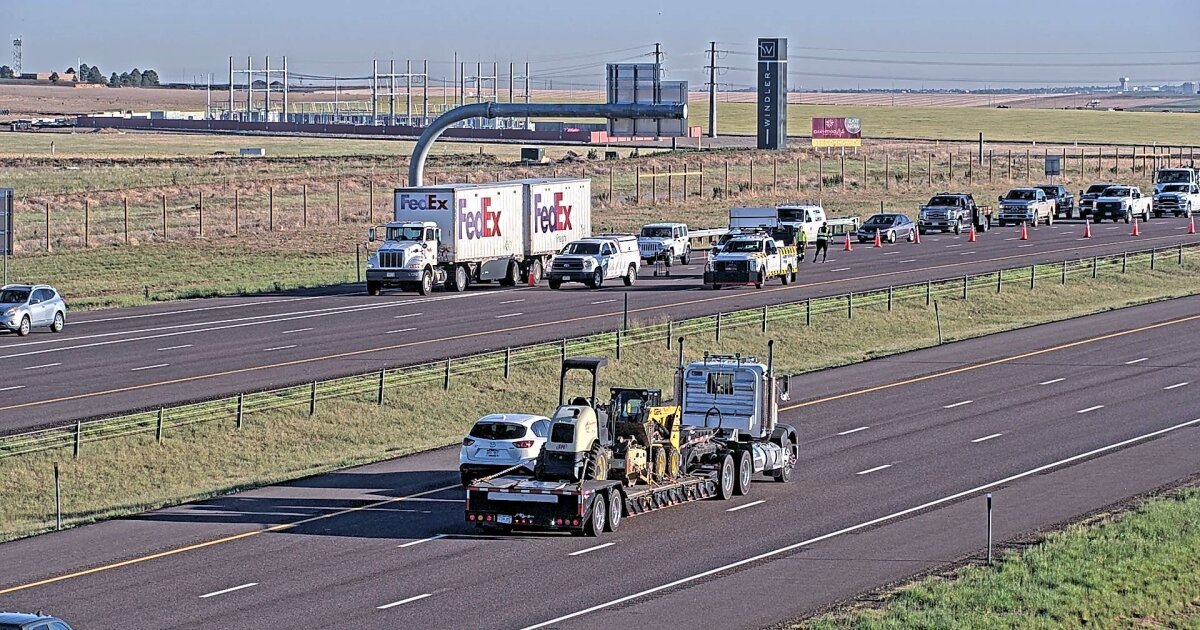
Pedestrian dies after hit by car on southbound E-470, Aurora police say
-

 Seattle, WA2 hours ago
Seattle paying $2.6M to settle sexual harassment lawsuit filed by four female SPD officers – MyNorthwest.com

