Sports
16 stats: Can Connor McDavid become the NHL’s first $20 million player?


Last week the NHL announced massive jumps to the salary cap coming over the next three seasons: $95.5 million in 2025-26, $104 million in 2026-27, and $113.5 million in 2027-28. This is a huge deal, one that carries immense implications for the league’s contract landscape.
Players are about to get paid, none more so than the league’s very best: Connor McDavid. His current deal ends in 2026, just in time for the cap to jump over $100 million. McDavid’s next deal will be seismic, there’s no doubt about that. The question is just how high his salary will go. Can he be the NHL’s first $20 million player?
That’s obviously a mind-boggling number at the moment, but this is the best player in the world we’re talking about. In an exploding cap environment, he’s worth a whole lot.
A league-max deal is 20 percent of the cap and during the 2026-27 season that amounts to $20.8 million. According to my model, McDavid is currently the only player in the league projected to be worth 20 percent of the cap or more. He’s the league’s only blank check player and in 2026-27 would have a projected value of $21.3 million.
Normally, a player’s age (McDavid will be 29 at the time of signing) would be a big factor in any contract projection. At some point on any long-term deal, McDavid’s value will drop below league-max value and that could happen as soon as Year 3 or 4. McDavid being an extreme outlier at the top of the league could mean there’s more room to drop than modeled, too. But with a rapidly rising cap, McDavid’s decline will likely be much slower than the rapid growth of the salary cap’s upper limit.
Everything depends on how much the salary cap continues to grow after 2027-28, but even the most conservative outlook puts McDavid north of $20 million on a long-term deal. On average, McDavid is expected to be worth 18.5 percent of the cap on an eight-year deal. A $20 million deal comes out to 15.8 percent on average on the aggressive side (5 percent growth) but could be as high as 16.9 percent on average on the conservative side (2 percent growth).
In either case, McDavid would be well worth it. On the conservative side, he’s worth $21.8 million over eight seasons. On the aggressive side, his average value comes out to $23.5 million. That’s a huge number, but it’s worth noting that at 5 percent growth, a $20 million contract would be worth 15 percent of the cap by Year 5 of a new McDavid deal. In fact, it already drops to 17.6 percent in Year 2 at the already-planned increase to $113.5 million.
In every other major men’s sports league, the top players are making major dough. The highest-paid NFL, NBA and MLB players all clear $50 million per season. The NHL is still playing catch-up on that front and McDavid has a chance to pave the way for that by raising the bar in a serious way.
And in a rapidly rising cap environment, even a deal as high as $20 million leaves room to add around McDavid, especially as it ages. Win-win — even if a deal of that caliber comes with major sticker shock.
16 stats
1. Long-term deals adding even more value
With the increased cap over the next three years, any long-term deal already signed immediately looks better than it did a week ago (and that was already accounting for max growth of 5 percent per year).
There are almost 150 skater deals with three years of term or more remaining after this season and the average surplus value of those deals nearly doubled from $626,000 to $1.16 million per year. Of those deals, 67.1 percent now qualify as positive value deals, up from 57.8 percent. That’s a big shift, one that puts more focus back on the ice where it belongs.
2. Cap Court with Pierre-Luc Dubois, Mark Scheifele, Mika Zibanejad, Nazem Kadri and J.T. Miller
Colleague Sean McIndoe has a recurring feature here called NHL Cap Court where he debates whether specific contracts around the league are good or bad. His latest edition goes hand-in-hand with the previous point, offering an appeal process to previously questionable deals.
It’s a really interesting topic with the cap rising significantly, and I wanted to check what I had for these specific players in terms of market value — both before and after the cap announcement. Here’s what I got.
Pierre-Luc Dubois
Contract: $8.5M x 6 years
Previous Value: $8.2M x 6 years
Current Value: $9.0M x 6 years
Mark Scheifele
Contract: $8.5M x 6 years
Previous Value: $8.0M x 6 years
Current Value: $8.7M x 6 years
Mika Zibanejad
Contract: $8.5M x 5 years
Previous Value: $5.5M x 5 years
Current Value: $5.9M x 5 years
Nazem Kadri
Contract: $7M x 4 years
Previous Value: $6.1M x 4 years
Current Value: $6.6M x 4 years
J.T. Miller
Contract: $8M x 5 years
Previous Value: $7.5M x 5 years
Current Value: $8.2M x 5 years
A rising cap can’t save Zibanejad’s deal until he turns things around himself, but it did flip Dubois, Scheifele and Miller from slightly negative to slightly positive.
3. Elias Pettersson is still worth the money
Last note on future market values.
For those wondering, forward Elias Pettersson’s average market value over the next seven years is still $12 million — even with the model downgrading him during his current slump. The upside there is still tremendous and the Canucks front office would be out of its mind to give up on him one season into his eight-year deal. There’s a good reason why a kettle of vultures is circling above Vancouver.
4. Quinton Byfield taking on bigger defensive challenge
On a team with Anze Kopitar and Phillip Danault, it speaks volumes that Byfield is the one getting the majority of the team’s matchup minutes.
That’s something that really started in early January against the Lightning, a home game where Byfield played 13 minutes head-to-head against Nikita Kucherov, while Kopitar and Danault played just under five minutes combined.
Since that day, Byfield has played 93 minutes against the opposing team’s top forward while Kopitar has played 56 minutes and Danault has played 51 minutes. In terms of average Offensive Rating faced, Byfield is at plus-4.2 compared to Kopitar’s plus-2.3 and Danault’s plus-2.1. Big difference. Byfield has been the go-to shutdown guy and he’s getting the results to match with a 56 percent expected goals rate fueled by allowing just 2.0 xGA/60, both among the best marks on the team.
That’ll be an interesting development to watch down the stretch. Can Byfield’s emergence down the middle help solve the Kings’ McDavid-Leon Draisaitl problem in the playoffs?
5. Can Kevin Fiala have a second-half resurgence?
Another thing that can help: getting the real Fiala back. He’s the closest thing the Kings have to a true offensive game-breaker, but he’s been way too quiet this season to earn that notion. Fiala has just 31 points in 49 games this season, a 52-point pace that would be his worst since 2018-19.
Under the hood, it’s business as usual for Fiala. At five-on-five he’s still pushing play, he’s still getting chances and he’s still scoring. Ditto for the power play. The problem has mostly been his teammates — at five-on-five they’ve scored on just 4.8 percent of their shots with Fiala on the ice. That’s the 25th-worst mark in the league with only two top-six players (Josh Norris and Nazem Kadri) above him.
That’s probably not Fiala’s fault either. According to data tracked by Corey Sznajder, Fiala is the team’s leader in scoring chance assists per 60 at 5.8. That’s one of the best marks in the league, comparable to elite playmakers such as Nikita Kucherov and Mitch Marner — his teammates just aren’t finishing.
Fiala is playing good hockey and it feels like the results will come soon.
6. Nashville’s shooters shoot line
When Nashville signed Steven Stamkos and Jonathan Marchessault, one of the big questions facing the Predators was who was going to get them the puck. They were adding two shooters to a team that already had Filip Forsberg and was pretty short on passers. In that vein, it felt like a risky fit.
The solution, apparently: Put all three together. Shooters shoot, baby.
Andrew Brunette put the trio together just over 20 games ago and the move has helped the team jump-start their offense (to an extent). The line is generating roughly the same amount of scoring chances as Forsberg’s previous top line with Ryan O’Reilly and Gustav Nyquist, but has more than doubled them up on goals. In 250 minutes, the new-look top line has scored 4.0 goals per 60, up from 1.83.
Maybe it’s just a hot streak or simple regression to the mean, but it also might be a testament to having so many scoring threats on one line. That creates a bit more spacing for each player, allowing them to execute to a higher degree.
It also helps that Stamkos has taken on a playmaker role in his move back to center. According to data tracked by Sznajder, Stamkos has earned 9.6 shot assists per 60 this season, up from 6.1 last season, with an equal reversal in his shot rate. His shot-pass ratio has also completely flipped. That change has likely been the key to unlocking this line.
7. Home-ice disadvantage in Utah
Only one team, the Sharks, have a worse points percentage at home than hockey’s newest franchise. The Utah Hockey Club sits at 9-12-6 at home, a 73-point pace that falls well below the team’s 91.5-point pace on the road.
The difference is even more stark when compared to how this very team did at Mullett Arena over the previous two seasons. The former Coyotes were legitimately one of the league’s best home teams, going 43-34-5 compared to 21-47-14 on the road. That’s a 91-point pace compared to a 56-point pace, a 35-point difference.
In their first season, Utahns haven’t received much bang for their buck watching their new team play.
8. Miro Heiskanen out long-term
The Stars lost Heiskanen to injury on Jan. 28 and after surgery, he’s now being listed as month-to-month.
That’s obviously a big blow to Dallas’ already slim chances of catching the Jets for the Central Division crown, leaving the Stars in the dreaded Central Division 2v3 gauntlet.
With Heiskanen, Dallas’ chances of winning the Central were an already slim 11.8 percent. If he misses the remainder of the regular season, those odds drop to 7.6 percent.
Surgery for Heiskanen went as expected, no surprises. The initial hope is to have Heiskanen back before the playoffs but Stars will have a better idea of the timeline after initial healing and once he begins rehab. https://t.co/qTScIHfDz7
— Pierre LeBrun (@PierreVLeBrun) February 4, 2025
9. Harley Time
As bad as the Heiskanen injury news is, it’s nice that the team has a budding elite defenseman behind Heiskanen who looks ready to step up. Thomas Harley already looks like a star and he’s about to get a terrific opportunity to show just how bright he can shine.
The 23-year-old defenseman turned a lot of heads in his first full season and this year he’s showing it was no fluke. With Heiskanen experiencing a down year by his standards before the injury, Harley has arguably been Dallas’ best defenseman. Harley has a plus-10.2 Net Rating on the year which not only leads the Stars, it’s a top-10 mark among all defensemen. He’s been phenomenal.
The question for Harley now is whether he can handle big boy minutes without Heiskanen next to him. Harley is fourth on the Stars in offensive quality of competition faced this season, but has been the team’s top choice for that role on a pair with Ilya Lyubushkin in the team’s three games without Heiskanen.
Small sample size, but so far so good with Harley earning 53 percent of the expected goals during that time and outscoring opponents 3-1 — both well above average marks relative to the team. Harley looks like the real deal.
10. Dylan Samberg: defensive stud
I don’t know if a lot of people outside of Winnipeg grasp how crucial Samberg is to the team’s defensive might. Over the last month, only Josh Morrissey has been given more ice time for the Jets than Samberg. He has effectively become the No. 2 in command on Winnipeg’s back end, earning that distinction in ability, not just ice time.
That all starts with Samberg’s defensive capability with his plus-four projected Defensive Rating being the best mark on the team. That’s something that shined through last season even after accounting for his easier usage and has only grown since. Samberg looked like a legitimate difference-maker then, a guy who could really step up in a top-four role. That’s exactly what we’ve seen this season … and then some.
Samberg has been so good defensively that he’s also started earning the coaching staff’s trust in an even bigger role.
Prior to his injury, Samberg faced the fourth-toughest minutes on Winnipeg’s blue line. Since returning he’s been the team’s top shutdown option. During that stretch, Samberg has taken his game to new heights despite the added degree of difficulty, earning 65 percent of expected goals and 72 percent of actual goals.
Winnipeg has a good one in Samberg and his ascent is a key reason for the team’s success this season.
11. Adam Fantilli stepping up in Sean Monahan’s absence
The sophomore slump hit Fantilli hard to start the season. A lack of top power-play time will have a big effect on his tepid scoring totals, but Fantilli’s work at five-on-five was also concerning. A lot of that has changed in the absence of Monahan, Columbus’ top center.
When the Blue Jackets needed Fantilli most, he stepped up. Offensively, Fantilli has been great. He leads the Blue Jackets with seven goals and 12 points in 13 games and has been playing 20 minutes per night. There’s still work to be done at five-on-five, but at the very least there’s been encouraging progress. Fantilli’s 42 percent xG was right around the team average, a big improvement from the 35 percent he was at previously which was among the worst marks on the team.
A lot of the work Fantilli still needs to do comes on the defensive end and that’s a tall task being thrust into a role at the top of the lineup. Still, he’s done some admirable work in Monahan’s absence which provides some optimism for the future. Next year could be the year he really takes flight.
12. Luke Hughes: defensive defenseman?
One of the knocks on Hughes in his rookie season was his play without the puck. In Year 2 he’s made some big strides though, leading to a plus-2.3 Defensive Rating, a top 50 mark among defensemen.
That’s a curious jump for a defender whose reputation skews toward offense, especially after his rookie season, and it’s not just a result of playing the softest minutes on the team either. According to data tracked by Sznajder, Hughes leads all defensemen in his ability to deny entries at 21.7 percent and his ability to force dump-ins at 63 percent. That’s easier to do against soft competition who aren’t prone to entering the zone with control in the first place, but it’s still a nice sign for the second-year defender. The league’s best defenders — Jaccob Slavin, Gustav Forsling, Jonas Brodin, MacKenzie Weegar and Mattias Ekholm — all excel at this particular skill.
13. Lane Hutson rushing up the ice
One of the things that separates the best offensive defensemen from the rest is their ability to join and lead the rush. Quinn Hughes, Cale Makar, Roman Josi, Zach Werenski — all elite.
This is obvious from watching him but put Hutson’s name on that list, because it’s something he’s already elite at. Hutson has some of the highest entry volume in the league among defensemen and carries the puck in 56 percent of the time according to tracking data from Sznajder. That’s top 10 in the league.
14. McLellan easing Moritz Seider’s burden
The Red Wings have been unbelievably hot under new coach Todd McLellan with a 15-4-1 record that has the team in a playoff spot. A run like that feels almost miraculous given where the team was when he was hired and McLellan obviously deserves a lot of credit. It also makes you really question some of Derek Lalonde’s decisions when he was coach.
One of those decisions was the bafflingly difficult burden placed on Seider. Lalonde gave him the absolute toughest matchups in the league and it did a number on his numbers. McLellan has eased things considerably and it’s made a difference.
Lalonde had Seider facing opponents with an average Offensive Rating of plus-3.0, 2.5 higher than the remaining team average (excluding his primary partner). Under McLellan, that burden has eased to a plus-2.5 opponent Offensive Rating faced, just 1.1 goals higher than team average.
That’s made a big difference for Seider, who leads the team’s defensemen in xG under McLellan at 49.7 percent. Under Lalonde, he was middle of the pack at 45.4 percent.
15. Red hot Pasta
David Pastrnak’s New Year’s resolution: catch fire. After a slow start to the season, Pastrnak is extremely back. Since January 1 Pastrnak leads the entire league in goals with 14 and points with 29. He’s three goals and six points up on second place and it doesn’t feel like he’s slowing down anytime soon.
16. Spencer Knight: goalie of the present?
One of the big questions facing Florida this season was its goaltending, especially in front of a weakened defense corps. Sergei Bobrovsky is 36 and had been a bit uneven during much of his Florida tenure while Knight was still mostly unproven.
The worries about Bobrovsky seem legitimate now as he has an .901 save percentage and has allowed two goals above expected this season. But Knight has been a pleasant surprise behind him with a .906 save percentage and 7.5 goals saved above expected. Among the 44 goalies that have played 20 games or more, Knight ranks 15th in goals saved per game while Bobrovsky ranks 35th.
Knight is the team’s goalie of the future, but it feels like the future might be coming sooner than expected. It’s time to give him some more starts and see what he can do with it. A fresher Bobrovsky come playoff time wouldn’t hurt either.
— Data via Evolving Hockey, Natural Stat Trick, Hockey Stat Cards and All Three Zones
(Top photo of Connor McDavid: Perry Nelson / Imagn Images)



NEWYou can now listen to Fox News articles!
CM Punk appeared on “Friday Night SmackDown” ready to take on any challenger that was ready to step to him after winning the Undisputed WWE Championship against Sami Zayn.
Punk entered the ring in Oklahoma City and called back to the “Monday Night Raw” after WrestleMania 42 when he told Cody Rhodes he’d be ready to deliver if a championship opportunity fell “out of the sky.”
COMPLETE PRO WRESTLING COVERAGE ON FOX NEWS DIGITAL
Cody Rhodes and CM Punk face off during SmackDown at Paycom Center in Oklahoma City, Okla. (Craig Ambrosio/WWE via Getty Images)
“When championship opportunities fall out of the sky, CM Punk catches them,” he said.
Punk named potential SmackDown superstars he’d think might come for the title, including Gunther, Finn Balor, Royce Keys, Damian Priest and Trick Williams. He even said that Zayn could come back around and get his rematch if he wanted. He didn’t mention Rhodes’ name, but the “American Nightmare” came out uncalled and marched his way down to the ring.
“I don’t think you and I can run away from each other anymore,” Punk told Rhodes.
Cody Rhodes looks on during SmackDown at Paycom Center in Oklahoma City, Okla., on July 10, 2026. (Craig Ambrosio/WWE via Getty Images)
Rhodes agreed and mentioned that Punk would want a match with him, just “say when.” It was a quick retort from Punk, who said, “when.” SmackDown general manager Nick Aldis, who was in the ring for the segment, booked the match for SummerSlam.
Punk will defend the Undisputed WWE Championship at SummerSlam, which takes place Aug. 1 and 2 at U.S. Bank Stadium in Minneapolis.
First, however, Punk and Rhodes will be involved in a tag team match at Saturday Night’s Main Event in New York City next week. Aldis made the match after Gunther demanded that Aldis put him in a match against Punk. Gunther was hoping it would be for the championship. Instead, Gunther will tag with Zayn.
Gunther didn’t take too kindly to that and attacked Aldis. Rhodes came back out to break up the calamity. He wanted to take on Gunther after the show went off air but Gunther walked away.
Gunther makes his entrance during SmackDown at Paycom Center in Oklahoma City, Okla., on July 10, 2026. (Rich Wade/WWE via Getty Images)
CLICK HERE TO DOWNLOAD THE FOX NEWS APP
Punk definitely has his hands full as he moves to SmackDown to become a fighting champion.
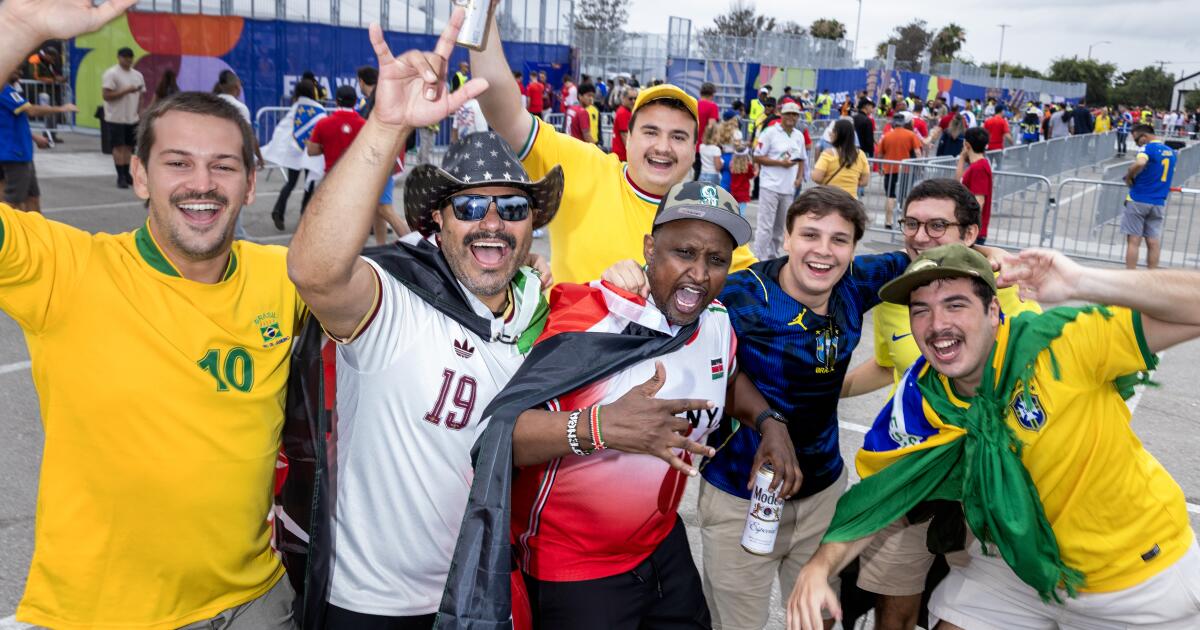
World Cup tourists are coming to L.A. for the soccer, but they’re staying for the $21 smoothies and Double-Doubles.
As the last Los Angeles FIFA World Cup event ended Friday, soccer fans were eating like locals and famous chains from the region were cashing in.
In the weeks that L.A. has hosted the World Cup, international soccer enthusiasts have flocked to big brands from the area, often in large groups wearing their countries’ jerseys.
It is a phenomenon seen at many of the host cities. In Dallas, giant gas station Buc-ee’s is the main attraction. For people visiting New Jersey, deli shops have been a hot ticket. In L.A., the place to be between matches was Erewhon.
Thirsty international sports fans gathered for pictures outside different Erewhons, wandered their aisles smiling, and, of course, picked up pricey smoothies.
While Erewhon would not comment on its business, mobility data company Arity, which uses phone data to track consumers, said Erewhon visits at the outlets around SoFi Stadium were quadruple what they were a week earlier on June 12, the day of the U.S. national soccer team’s opening match there.
Arity looked at what stores people visited within a 10-mile radius of SoFi that day and also found surges in visitors to nearby El Pollo Loco and Trader Joe’s.
Locals have spotted groups of people in Korea jerseys huddled together, trying to decide what to order at In-N-Out.
Some complained on social media that international tourists at Trader Joe’s were buying up all the mini canvas tote bags.
Soon after the Belgium vs. Spain quarterfinal ended Friday, the In-N-Out near SoFi had a long line of soccer fans stretching out the door in bright red and yellow and black jerseys and matching striped hats and scarves.
One of the workers said he had to explain “spread” and “animal style” to foreign football fans.
“I didn’t know this place existed,” a fan from Romania said while waiting in line.
Los Angeles and other cities and states that have hosted the event need the soccer fans to spend money to make the event worth all the time, effort and money it requires.
A rosy 2024 report projected the World Cup could bring more than $800 million to the L.A. region as 180,000 people converge on the area to sleep, eat and spend.
There were early concerns people weren’t turning up for the event because of the high ticket prices and the difficulty of obtaining visas for citizens of some countries.
However, at least for some L.A. hotels, there was a surge of last-minute visitors which pushed up occupancy and room rates.
While sports fans are not in the region to shop, they do make time for it.
World Cup customer spending is also apparent in beer sales. Andrew Heritage, the chief economist at the Beer Institute said beer purchases at entertainment and attractions in L.A. – outside of World Cup spaces – were up around 10% from normal.
“That tells me that fans in the L.A. area have decided to extend their stay and take in all the other things that the area has to offer, rather than just the match itself,” he said.
On social media, the purpose of these shoppers is clear: grab a quick souvenir or local specialty and take a selfie.
The data from Arity suggests that fans are very efficient when they spend at local spots, diving in, getting what they want and getting out as soon as possible, said Jeff Schlitt, a director at the company.
“Normally you’re there for an hour. They’re going to be there for 15, 18 minutes,” he said. “Why is that? Because they were purpose-driven shoppers.”
For some travelers, the more popular American chains aren’t unfamiliar. But some of the native L.A. fare still comes as a surprise.
As one Belgium-Spain matchgoer from the Netherlands stood taking a picture of the In-N-Out sign after the game, he said he’d never had a burger like the one he’d just tried.
“We only have McDonald’s and Burger King,” he said. “It’s way better.”

NEWYou can now listen to Fox News articles!
The face of baseball will not be at Tuesday’s All-Star Game.
Shohei Ohtani was scratched from his start on Friday as the Los Angeles Dodgers said he will also miss the Midsummer Classic with what the team called left knee irritation.
Ohtani, for obvious reasons, has become an All-Star Game fixture. He has earned the honor in each of the past five seasons and made his first start in 2021.
Starting pitcher Shohei Ohtani #17 of the Los Angeles Dodgers warms up before the MLB game against the Arizona Diamondbacks at Chase Field on June 03, 2026 in Phoenix, Arizona. (Photo by Christian Petersen/Getty Images) (Christian Petersen/Getty Images)
The two-way phenom is on his way to winning his fifth MVP award in his last six seasons as he is hitting .290 with a .939 OPS and pitching to a minuscule 1.79 ERA, the second-lowest in the sport among pitchers with 80-plus innings. His OPS is also the seventh-best mark in the league.
The Dodgers said Ohtani will be the team’s designated hitter up until the break, but he will “have some interventions on his knee to put him in the best position for the second half of the season.”
Ohtani dealt with knee issues earlier in the season.
It is certainly a big hit for the game as the other face of the sport, Aaron Judge, will miss the game due to a fractured rib that has kept him out since late May.
Shohei Ohtani #17 of the Los Angeles Dodgers gets ready in the on deck circle against the Arizona Diamondbacks at Chase Field on June 01, 2026 in Phoenix, Arizona. (Photo by Norm Hall/Getty Images) (Norm Hall/Getty Images)
DODGERS WILL AGAIN VISIT WHITE HOUSE TO CELEBRATE WORLD SERIES CHAMPIONSHIP, OFFICIAL SAYS
Ohtani hit 99 home runs combined in 2024 and 2025, leading the National League with a 1.025 OPS in that span. Ohtani did not pitch in 2024 after elbow surgery but returned to the bump last year and owned a 2.87 ERA and 11.9 K/9, a figure he also put up in 2022 that led the American League.
The “Japanese Babe Ruth” is the only player in MLB history to have 300-plus plate appearances and 40-plus innings in six separate seasons (Ruth only did it twice and never stole 50 bases), and he has more than excelled at both.
Shohei Ohtani pitches for the Los Angeles Dodgers against the San Francisco Giants at Dodger Stadium in Los Angeles, California, on May 13, 2026. (Gary A. Vasquez/Imagn Images)
CLICK HERE TO DOWNLOAD THE FOX NEWS APP
Ohtani is not hitting like he has in the past, but certainly the best pitching performance of his career will make up for it. He “only” has 20 homers and 56 RBI this season.
Follow Fox News Digital’s sports coverage on X, and subscribe to the Fox News Sports Huddle newsletter.
-

 Ohio5 minutes ago
Has there been an explosion of chipmunks this year? Yes. Here’s why
-

 Oklahoma8 minutes ago
How Will Oklahoma Softball Benefit From SEC Revenue Distribution?
-

 Oregon13 minutes ago
Razor clam harvesting set to close soon on north Oregon Coast
-

 Pennsylvania20 minutes ago
Pennsylvania Wins “Best in Show” at The Great American State Fair – Tri-State Alert
-

 Rhode Island23 minutes ago
How Federal Hill became Rhode Island’s iconic Little Italy food hub
-

 South-Carolina28 minutes ago
Editorial: SC Legislature left DUI and THC bills for dead; DUI restrictions can be revived
-

 South Dakota35 minutes ago
South Dakota GFP Commission Holds July Meeting
-

 Tennessee38 minutes ago
Forward Chris Washington Talks First Month With Tennessee Basketball | Rocky Top Insider

