Politics
Real, fake or overblown? Sorting fact from fiction in fraud allegations surrounding Newsom, California

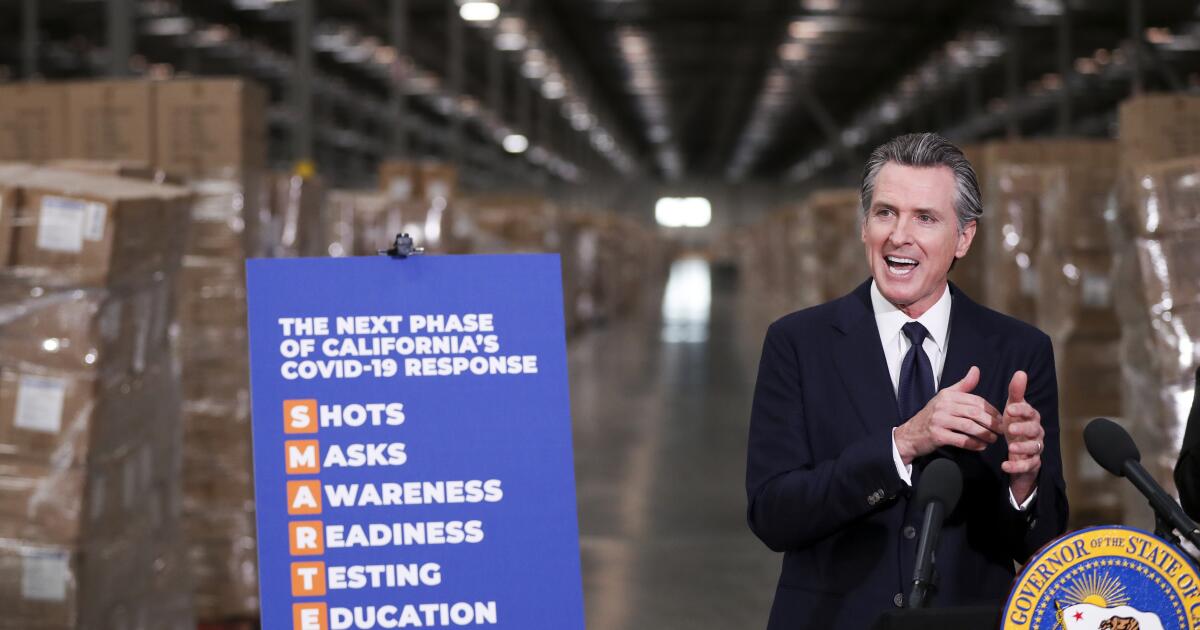
SACRAMENTO — The year opened with President Trump declaring that “the fraud investigation of California has begun,” a move that quickly set off a barrage of allegations from his administration and Republican allies questioning the integrity of state programs and the leadership of Gov. Gavin Newsom.
The accusations, amplified across social media and conservative outlets, have pushed California and its Democratic leadership to the center of a broader national political fight over waste, fraud and abuse.
Newsom has dismissed the claims as politically driven, arguing that the administration is singling out Democratic-led states while ignoring similar problems elsewhere. The governor also responded by highlighting fraud cases in Republican-led states and by criticizing Trump’s own record and business dealings.
Against that backdrop, it has become increasingly difficult to separate substantiated fraud from fabricated or recycled claims, to distinguish old findings from newly raised allegations and to determine who can credibly claim credit for uncovering wrongdoing — all amid a toxic and deeply polarized political climate.
Dan Schnur, who teaches political communications at USC and UC Berkeley, said allegations of malfeasance in California is a particularly ripe target for Republicans because Democrats have controlled the state Legislature and governor’s office for years.
Democrats hold a supermajority in both the Assembly and the Senate, meaning they hold at least two-thirds of seats in both houses, and not a single Republican has been elected to statewide office in California since 2006, when Gov. Arnold Schwarzenegger and Insurance Commissioner Steve Poizner were reelected.
“There is no shared responsibility here for Republicans,” Schnur said. “If you had a state in which Republicans were actually competitive, they would bear some responsibility for these problems.”
Audits and prosecutions show that California has experienced its share of fraud, particularly in complex programs involving emergency aid, healthcare and unemployment insurance. The state paid out billions of dollars in fraudulent unemployment claims during the COVID-19 pandemic, and the California State Auditor has issued repeated warnings about state agencies that are “at high risk for waste, fraud, abuse, or mismanagement.”
Along with recycling a barrage of years-old allegations of financial malfeasance in California and other Democratic states, the Trump administration elevated claims of child-care fraud in Minnesota last month, prompting Gov. Tim Walz to drop his reelection plans to focus on the growing political crisis in his state.
Fraud allegations are increasingly being deployed as a political weapon against Newsom, a leading Trump critic and a potential 2028 Democratic presidential contender. Politicians have always railed against government waste, fraud and abuse, but now those issues are being “weaponized into a partisan issue,” Schnur said.
For the public, it can be hard to discern the truth. Here is a look at three of the central fraud allegations — and what the evidence shows.
Child-care funding
President Trump used his social media platform, Truth Social, to accuse California of widespread fraud last month, drawing a link between his administration’s investigation into child-care spending in Minnesota and programs in the Golden State, and announcing a major federal “fraud investigation” into the state’s actions.
“California, under Governor Gavin Newscum, is more corrupt than Minnesota, if that’s possible???” wrote Trump, using a disparaging nickname for the governor.
The Trump administration then moved to freeze $10 billion in federal funding for child care in five Democrat-led states — California, New York, Colorado, Illinois and Minnesota — over “serious concerns about widespread fraud and misuse of taxpayer dollars.”
In a trio of Jan. 6 letters addressed to Newsom, the U.S. Department of Health and Human Services said it was concerned there had been “potential for extensive and systemic fraud” in child care and other social services programs that rely on federal funding, and had “reason to believe” that the state was “illicitly providing illegal aliens” with benefits.
The letters did not detail evidence to support the claims. The governor’s office dismissed the accusation as “deranged.”
A federal judge subsequently blocked the Trump administration temporarily from freezing those funds. In that ruling, U.S. District Judge Vernon Broderick said he didn’t understand why the government was making it harder for states to access child-care money before any wrongdoing had been discovered.
“It just seems like the cart before the horse,” he said.
Hospice funding
Days after Trump’s social media post about alleged corruption under Newsom’s watch, Dr. Mehmet Oz, administrator for the Centers for Medicare & Medicaid Services, and Bill Essayli, the top federal prosecutor in Los Angeles, held a joint news conference on public benefits fraud, but offered few details about the scope of their investigation.
The officials accused “foreign actors” of draining billions from public healthcare programs in California, referencing bogus hospice providers first exposed by The Times in 2020 and later investigated by California Atty. Gen. Rob Bonta.
Essayli placed the blame for bad actors squarely on Newsom, calling him “the fraud king.”
Weeks later, Oz released a video of himself walking in the Los Angeles neighborhood of Van Nuys as he questioned why dozens of alleged hospices were operating along four blocks. He blamed the “Russian Armenian Mafia” and made his remarks while pointing to an Armenian bakery, prompting accusations of racism from the Armenian community.
Newsom’s office last week hit back by highlighting state efforts to fight fraud, while pointing to a 2025 Axios story on the Trump administration’s decision to pause a federal program to crack down on bad hospice operators.
Bonta’s office said it has filed criminal charges against 109 individuals over hospice fraud-related offenses and launched dozens of civil investigations.
Newsom, speaking at a Bloomberg event Thursday in San Francisco, said the allegations have been recycled and misrepresented. Later that day, he filed a civil rights complaint against “baseless and racist allegations against Armenian Americans in California” made by Oz.
“Hospice, we’ve been after that for years and years before Oz was even on the scene,” Newsom said. “In 2021, we did a moratorium on new hospice programs, 280 we shuttered.”
The Center for Medicare & Medicaid Services said earlier this year that — in addition to California — Arizona, Nevada, Texas, Ohio and Georgia are being monitored following allegations of fraud and waste.
EDD fraud
The state’s Employment Development Department, known as EDD, reported in 2021 that approximately $20 billion was lost due to fraud, largely in the federal Pandemic Unemployment Assistance (PUA) program.
While unemployment fraud was rampant across country during the pandemic as governments rushed to provide support, California’s problems stood out.
The state itself admitted in 2021 that it failed to take precautions that had been implemented in other states, including using software to identify suspicious applications and cross-checking benefit claims against personal data on state prison inmates.
Rep. Kevin Kiley (R-Rocklin) said department mismanagement and fraud often overlap and cited EDD as a prime example.
“When there is a lack of internal controls, a lack of diligence of how funds are used, that makes it easier for those who want to take advantage of the system to profit,” Kiley said.
EDD’s own tracker said the state has recovered more than $6 billion in stolen funds and opened more than 2,300 unemployment fraud investigations since the pandemic began, leading to nearly 1,000 arrests and more than 670 convictions.
The department said it has expanded fraud enforcement through partnerships with law enforcement, new identity-verification technology and a dedicated fraud task force.
But, reports of mismanagement at EDD have continued. A recent audit also found EDD wasted $4.6 million by paying monthly service fees for more than 6,200 cellphones that went unused for at least four consecutive months between November 2020 and April 2025 — including some devices that were inactive for more than four years.
At the same time, “EDD continues to have high rates of improper [unemployed insured] payments, including fraudulent payments, and it needs to improve the customer service it provides to UI claimants,” another report found.
What’s next?
Newsom said there is a reason the Trump administration is not pointing to fraud in Republican-led states.
“This is about polarization, politicalization, weaponization,” Newsom said Thursday.
Asked what the Trump administration will discover in probing California for fraud, Newsom said investigators will find a state “taking that issue very, very seriously.”
“We absolutely are here to be a partner, to go after waste, fraud and abuse,” Newsom said.
State audits show vulnerabilities persist. The California State Auditor has repeatedly flagged Medi-Cal eligibility discrepancies that have exposed the state to billions of dollars in questionable payments, while also warning that weaknesses in information security across state agencies remain a high-risk issue.
Curtailing waste could be particularly important during the upcoming year as California and its state-funded programs head into a period of volatile fiscal uncertainty, driven largely by events in Washington and on Wall Street. Newsom’s own optimistic budget proposal projects a $3-billion state deficit for the next fiscal year despite no major new spending initiatives.
The nonpartisan Legislative Analyst’s Office warned in November that California faces a nearly $18-billion budget shortfall.
It will also be a key issue in upcoming elections. A group of Republicans running for statewide offices, including California gubernatorial candidate Steve Hilton, pegged that the state’s annual estimate of fraud, waste and abuse across state programs at $250 billion, an estimate that includes unverified public tips submitted to a campaign-run website.
The group cited the estimate as justification for creating their own “California Department of Government Efficiency,” or CAL DOGE, a nod to a similarly named federal initiative promoted by Elon Musk that generated headlines but has not produced documented savings or formal audit findings. CAL DOGE is not currently a state department, despite its name.
Who deserves credit when fraud is prosecuted has also become a point of contention. After a man was arrested last month for fleecing L.A.’s homeless services program for $23 million, critics of Newsom were quick to blame the governor. Newsom responded by saying the case was uncovered by local investigators working with law enforcement, which he added is “exactly the kind of accountability and oversight the state has pushed for.” (The Los Angeles district attorney’s office ran a parallel, independent investigation.)
Essayli responded on social media by saying no one made an arrest until Trump and Atty. Gen. Pam Bondi “appointed me to investigate and charge fraud offenses in California.”
Kiley, the California Republican congressman, said despite the partisan fighting over fraud, the issue should rally both parties.
The “easiest” way to solve the state’s budget problems and improve government services for taxpayers is to “minimize and eventually eliminate fraud,” said Kiley.



Politics
EXCLUSIVE: FBI adds alleged COVID fraudster accused of taking $5M from kids’ meal program to Most Wanted list

FBI makes first arrest from its ‘most wanted fraudsters’ list
FBI Director Kash Patel announces the first arrest on the “Most Wanted Fraudsters” list. Said Ereg, a Minneapolis man, is accused of stealing over $4.2 million from a federal child nutrition program during the COVID-19 pandemic. Minnesota Senate candidate Michele Tafoya emphasizes the need for accountability for fraudulent activities.
NEWYou can now listen to Fox News articles!
EXCLUSIVE: The FBI is adding Fahad Mohamed Nur to its Most Wanted Fraudsters List, accusing the Minnesota businessman of allegedly stealing more than $5 million that was intended to feed children during the COVID-19 pandemic.
Nur has been on the run since 2022 and is wanted for his alleged role in a fraud scheme that exploited Minnesota’s Federal Child Nutrition Program during the COVID-19 pandemic, according to the FBI. The bureau alleges he owned a vendor and purported food supplier that received more than $5 million in fraudulent program funds by submitting fake invoices before laundering the proceeds.
The Bureau believes Nur has ties to Somalia and may currently be living there.
The FBI is offering a reward of up to $150,000 for information leading to Nur’s arrest and conviction.
OWNER OF DAYCARE IN VIRAL NICK SHIRLEY VIDEO CHARGED IN $4.6M DAYCARE FRAUD SCHEME, PROSECUTORS SAY
Fahad Mohamed Nur has been on the run since 2022 and may be in Somalia, according to the FBI. (Federal Bureau of Investigation)
Nur is the latest addition to the FBI’s Most Wanted Fraudsters List, which officials say has already resulted in the arrests of two fugitives within weeks of its launch.
“Under President Trump’s and Vice President Vance’s leadership with the White House Task Force to Eliminate Fraud, the FBI’s historic ‘Most Wanted Fraudsters list’ has already seen tremendous success – with two subjects brought to justice in a matter of weeks, apprehended out of Somalia and the Philippines,” FBI Director Kash Patel said in a statement to Fox News Digital.
Patel said the early arrests demonstrate that the FBI is aggressively pursuing fugitives accused of stealing from American taxpayers.
FBI ADDS 2 FUGITIVES TO ‘MOST WANTED FRAUDSTERS’ LIST AMID HISTORIC $6.5B HEALTHCARE TAKEDOWN: PATEL
FBI Director Kash Patel conducts a news conference at the Department of Justice on Thursday, December 4, 2025. (Tom Williams/CQ-Roll Call, Inc via Getty Images)
“Our newest subject – Fahad Mohamed Nur – has been on the run since 2022 for allegedly stealing over $5 million from a child nutrition program in Minnesota.”
Patel added: “Collectively, the Task Force has already uncovered more than $13 billion in fraud, and the rapid success of the Most Wanted Fraudsters List should show all Americans that this FBI will [be] at the forefront pursuing the worst of the worst who stole from hardworking American taxpayers.”
DR OZ WARNS MEDICARE SCAMMERS ARE STEALING BILLIONS — AND YOUR PERSONAL INFORMATION COULD BE NEXT
Federal agents enter an office building as a search warrant is executed at Ultimate Home Health Services over potential Medicaid fraud, on December 18, 2025 in Bloomington, Minnesota, United States. (Christopher Juhn/Anadolu via Getty Images)
Federal officials say the investigation is part of a broader government effort targeting pandemic-era fraud.
“The Department’s robust partnership with the FBI and the White House Task Force to Eliminate Fraud has already delivered historic results. That partnership grows even stronger today with the addition of this latest subject to the Most Wanted Fraudsters list,” said Acting Attorney General Todd Blanche. “President Trump has made it clear: Fraudsters no longer have a safe haven in America. Law enforcement will continue to use every tool at its disposal to bring those who steal from American taxpayers to justice.”
The White House Task Force to Eliminate Fraud, led by Vice President JD Vance, has already uncovered more than $13 billion in fraud, according to the FBI.
CLICK HERE TO DOWNLOAD THE FOX NEWS APP
Anyone with information about Nur’s whereabouts is urged to contact the FBI at 1-800-CALL-FBI, their local FBI office, the nearest U.S. Embassy or Consulate, or submit a tip online at tips.fbi.gov.

With the 2026-27 season premiere of “60 Minutes” just two months away, CBS News leadership is getting closer to deciding who will fill the recent departures of longtime correspondents Scott Pelley, Sharon Alfonsi, Cecilia Vega and Anderson Cooper.
Seth Doane, a longtime correspondent based in Italy who is often seen on “CBS Sunday Morning,” is under consideration, along with chief investigative correspondent Jim Axelrod, who currently has a lead role in the “Eye On America” series featured on the “CBS Evening News with Tony Dokoupil.”
Sir Trevor Phillips, a British journalist and former politician who recently joined CBS News as senior global affairs correspondent, is expected to have a role on the program, according to people briefed on the plan. Phillips had a long career in the U.K., producing and writing documentaries and most recently hosted the Sky News program “Sunday Morning with Trevor Phillips.”
Phillips received a knighthood in 2022 for his service to equality and human rights for the U.K. But he also generated controversy over his career for comments about the British Muslim community, which led to a yearlong suspension from the Labour Party in 2020.
A CBS News representative declined comment beyond saying the division is looking at a number of internal and external candidates.
Dokoupil is expected to deliver four “60 Minutes” pieces a season. Major Garrett, the network’s chief Washington correspondent, will also have a contributor role.
Matt Gutman, hired from ABC News last year as national correspondent, is under strong consideration. He is being put in front of test audiences, according to several people at the network.
Holly Williams, a foreign correspondent working out of Istanbul for CBS News since 2012, and Mariana van Zeller, a journalist for National Geographic Channel, are both said to remain in contention.
The newcomers will join Bill Whitaker, Leslie Stahl, Jon Wertheim and Norah O’Donnell, who are all returning as correspondents. O’Donnell will also continue in her role as senior correspondent for the network, occasionally anchoring specials.
The rebuild of the talent line-up comes after the upheaval at the program that has occurred since Bari Weiss joined CBS News as edtior in chief in October.
Longtime correspondent Scott Pelley was fired last month after confronting management about the May 28 dismissal of his colleagues Alfonsi and Vega along with the program’s executive producer Tanya Simon and her second-in-command Draggan Mihailovich.
In February, Cooper decided not to sign a new deal as a “60 Minutes” contributor, as the CNN anchor cited a desire to spend more time with his family. But Cooper has reportedly told colleagues that he does not want to work for Weiss.
The internal disruption at “60 Minutes” followed a highly successful season. In its 57th season, “60 Minutes” was the most watched news program on television with an average of 9.1 million viewers a week according to Nielsen data. The program bucked the overall decline in traditional TV viewing by growing 9 percent over the previous season.
After the dismissal of his “60 Minutes” colleagues, Pelley accused Weiss of trying to “murder” the program and claimed she was putting “her thumb on the scale” for more favorable coverage of the Trump administration. He was fired with cause after confronting management at a June 1 meeting.
Weiss came to CBS when parent company Paramount acquired her digital web site The Free Press, known for its criticism of progressive policies and its strong support of Israel.
Weiss was hired by Paramount Chief Executive David Ellison with a mandate to move the news division to the political center. The pronouncement has created the perception that CBS News is looking to placate the Trump administration as Paramount sought regulatory approval for its $111 billion acquisition of Warner Bros. Discovery, which will also give the company ownership of CNN.
The noise surrounding Weiss has hurt CBS News despite strong reporting that is often far from being pro-MAGA. This past weekend’s “CBS Sunday Morning” featured a segment from national security correspondent David Martin about the Department of Defense interfering with the editorial independence of Stars & Stripes, the military newspaper.
Trump complained vehemently about his last interview with O’Donnell on “60 Minutes,” — conducted the day after a gunman tried to enter the White House Correspondents Assn. dinner in Washington on April 25.
Politics
Abbott orders probe after Texas hospital advertises ‘birth packages’ in Mexico: ‘Citizenship is not for sale’

NEWYou can now listen to Fox News articles!
Texas Gov. Greg Abbott ordered an investigation into a Texas hospital Tuesday after it confirmed to Fox News that it advertised Spanish-language “Birth Packages in South Texas” on billboards in Mexico promoting childbirth services to pregnant foreign nationals near the U.S.-Mexico border.
Mission Regional Medical Center confirmed to Fox News that it was responsible for the advertising campaign, which promoted deliveries starting at $3,950 for a natural birth and $5,525 for a C-section and directed viewers to a website, havemybabyinTEXAS.com, that has since been taken offline.
The billboards also displayed a telephone number beginning with “001,” the country code used to place calls to the United States from Mexico.
‘WEAPONS OF MASS REPRODUCTION’: WATCHDOG UNVEILS ACTION PLAN TO CURB BIRTH TOURISM AFTER SUPREME COURT RULING
Gov. Greg Abbott speaks during a bill signing in the State Capitol on April 23, 2025, in Austin, Texas. (Brandon Bell/Getty Images)
“The marketing materials regarding maternity services are no longer in use due to any unintended misunderstanding,” a hospital spokesperson said in a statement to Fox News. “We do not support or facilitate any unlawful activity and work to comply with all applicable federal and state laws and regulations.”
The spokesperson said the campaign included two billboards located within approximately five miles of the hospital near a U.S.-Mexico border crossing. The hospital said both billboards and the website were removed Monday after images began circulating on social media. The spokesperson also said the campaign began in 2021 but did not specify when the billboards were installed.
Abbott on Tuesday directed Texas Health and Human Services Commission Executive Commissioner Stephanie Muth to investigate Mission Regional Medical Center for potential violations of state law and contractual obligations.
REPUBLICAN ACCUSES SCOTUS OF BETRAYING US, PUSHES BILL RESTRICTING BIRTHRIGHT CITIZENSHIP, PREGNANT VISITORS
A Spanish-language billboard promotes birth packages at Mission Regional Medical Center, advertising pricing for natural deliveries and C-sections in South Texas. (Right Angle News)
Images of the billboard circulated on social media before the hospital said it removed the advertisements Monday.
“Birth tourism’ is an illegal practice that exploits the extraordinary hospitality that the United States and Texas offer to millions of foreign travelers each year,” Abbott wrote in a July 7 letter obtained by Fox News. “Unfortunately, thousands of foreign travelers come to the United States under false pretenses to give birth and secure citizenship for their children.”
TRUMP SUFFERS MAJOR SUPREME COURT DEFEAT AS JUSTICES UPHOLD BIRTHRIGHT CITIZENSHIP
An English-language billboard promotes birth packages at Mission Regional Medical Center, advertising pricing for natural deliveries and C-sections in South Texas. (Right Angle News)
Abbott directed HHSC to “immediately and thoroughly investigate” the hospital and said any violations should be referred to the Texas Attorney General for civil enforcement and to the appropriate district or county attorney for potential criminal prosecution.
“American citizenship is not for sale and Texas will not permit our healthcare system to be used as a magnet for birth tourism,” Abbott wrote.
The governor also said he plans to work with the Texas Legislature during its next session “to strengthen state law and eliminate birth tourism in Texas.”
“Unfortunately, birth tourism operations are not a new phenomenon,” General Counsel of the Oversight Project Kyle Brosnan said to Fox News Digital in a statement. “The Supreme Court’s egregiously wrong decision in the birthright citizenship case is going to open the floodgates to the birth tourism industry. Our country is much more than a pile of magic dirt. The only answer to these type of practices are criminal investigations and the mass deportation of illegal aliens.”
Mission Regional Medical Center also said it intends to cooperate with state officials.
CLICK HERE TO DOWNLOAD THE FOX NEWS APP
“We intend to work cooperatively and transparently with local and state officials,” the hospital said in a statement obtained by Fox News. “Our focus remains on delivering safe, high-quality care to every patient who seeks our services.”
The investigation comes as President Donald Trump’s executive order seeking to limit automatic birthright citizenship for some children born in the United States remains the subject of ongoing legal challenges.
-
 News5 minutes ago
Supreme Court financial disclosures reveal how their books add to their income
-

 Los Angeles, Ca1 hour ago
Waymo video could determine charges after teens’ bizarre California ride
-
Detroit, MI2 hours ago
DPD investigating after human remains found in home on Detroit’s west side
-

 San Francisco, CA2 hours ago
Bay Area Teen Waymo Riders Nabbed For Allegedly Shooting Projectiles From Robotaxi
-
Dallas, TX2 hours ago
Role Call: Tyrus Wheat looking to make most of second stint with Cowboys
-

 Miami, FL2 hours ago
2026 Miami Football Early Opponent Preview, Game 8: North Carolina
-

 Boston, MA2 hours ago
Boston sues social media companies over ‘addictive’ features, joining nationwide litigation
-

 Denver, CO2 hours ago
Peyton Watson landing spots: Could Nuggets star actually leave Denver?

