Lifestyle
19 Winter Olympic storylines we’re watching (they’re not just about sports)


The un-retirement of Alpine skier Lindsey Vonn, Olympic debut of NHL players including like Connor Hellebuyck and return of halfpipe snowboarder Chloe Kim are among some of the biggest storylines at these Winter Games.
Hans Bezard/Agence Zoom, Jonathan Kozub/NHLI , Maddie Meyer via Getty Images
hide caption
toggle caption
Hans Bezard/Agence Zoom, Jonathan Kozub/NHLI , Maddie Meyer via Getty Images
Want more Olympics updates? Get our behind-the-scenes newsletter for what it’s like to be at these Games.
There’s no shortage of Winter Olympics storylines to watch — and we’re not just talking about sports.
Hundreds of athletes will vie for medals in 16 different sports over the course of a jam-packed 2 1/2 weeks in the Milan Cortina Games. They will compete at venues spanning a nearly 9,000-square-mile swath of northern Italy, in front of in-person spectators (a welcome return after the COVID-19 restrictions in Beijing in 2022) and on an even bigger world stage.

Rising stars — and one new sport — are making their Olympic debuts, while familiar fan favorites are returning, some in pursuit of a comeback after many years away. Lifelong dreams are on the line, but there are also geopolitical tensions, environmental questions and so much more.
Here are some of the threads we’re following:
1. Iconic American women are chasing comebacks

Lindsey Vonn grimaces after crashing in a women’s downhill race in Switzerland on Friday.
Fabrice Coffrini/AFP via Getty Images
hide caption
toggle caption
Fabrice Coffrini/AFP via Getty Images
Legendary American athletes — many of them women — across multiple sports are returning to the Olympic stage after years away. They may include Lindsey Vonn, who retired as the winningest female skier in history in 2019 but returned to competition after a partial knee replacement in 2024. She qualified for the Games at age 41 amid a triumphant World Cup season, but hurt her knee in a crash just a week before the opening ceremony. Figure skater Alysa Liu reversed her teenage retirement and now brings a 2025 world title and renewed love of the sport to her second Olympics. Another former teenage phenom, halfpipe snowboarder Maddy Schaffrick, clinched a spot in her first Olympics at age 31, over a decade after retiring from burnout in 2015. And Alpine skier Breezy Johnson is aiming for redemption on the same Cortina slopes that destroyed her knee and her last Olympic dreams just weeks before she was set to compete in Beijing in 2022.
-Rachel Treisman
2. International tensions may be uniquely high for U.S. athletes
There’s always a political dimension to the Olympic Games, but this year, U.S. athletes could face a uniquely tense atmosphere. The Trump administration has sparred with European athletes over a wide range of issues, including repeated threats against Denmark’s sovereign territory in Greenland. (The U.S. and Denmark men’s hockey teams are scheduled to face off on the ice on Feb. 14.) Some Italian politicians have also voiced concern about the role of U.S. Immigration and Customs Enforcement (ICE) agents who plan to help with security at the Winter Games. Milan Mayor Giuseppe Sala told local media that after the violence in Minneapolis, ICE agents are “not welcome” in his city. Vice President Vance, a frequent critic of European leaders, is expected to attend the opening ceremony at the Games on Feb. 6.
-Brian Mann
3. NHL players return to the Olympics

Brothers Brady and Matthew Tkachuk are among the NHL players set to make their Olympic debut for Team USA.
Bruce Bennett/Getty Images
hide caption
toggle caption
Bruce Bennett/Getty Images
Olympic hockey hasn’t included players from the world’s top professional league for more than a decade. Finally, that era is over, and we get to see some incredible teams play in a best-on-best format (although the tournament won’t include a Russian team, due to Russia’s invasion of Ukraine in 2022). Some of the league’s biggest stars, like Edmonton’s Connor McDavid, Toronto’s Auston Matthews and Colorado’s Nathan MacKinnon, are well into their careers without having had the chance to play for Olympic gold, and that changes next month. The star power on Team Canada alone runs from MacKinnon and McDavid to the legend Sidney Crosby and the San Jose Sharks’ 19-year-old phenom Macklin Celebrini. The Americans are no slouches either, with Matthews, the Tkachuk brothers and a trio of talented goaltenders led by Connor Hellebuyck, last year’s NHL MVP — and they’ll have their eyes set on the first Team USA gold since the “Miracle on Ice” in 1980.
-Becky Sullivan
4. Ski mountaineering makes its Olympic debut
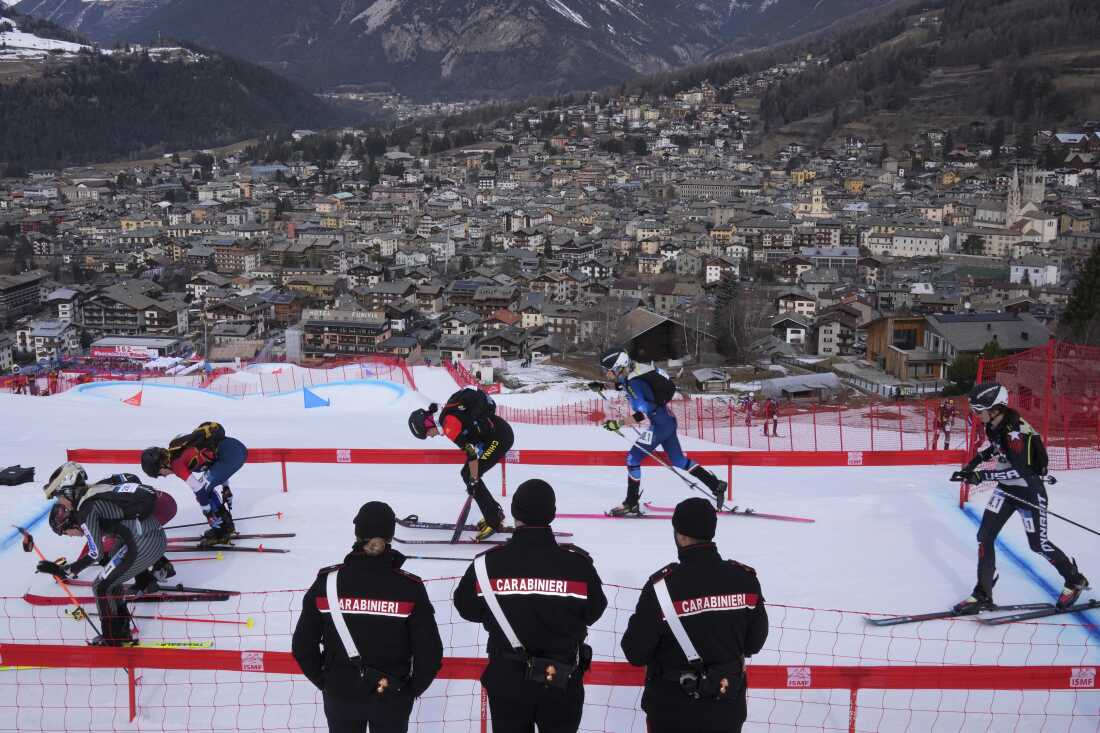
A 2025 Ski Mountaineering World Cup women’s mixed relay event in Bormio, Italy, where the sport will make its Olympic debut.
Antonio Calanni/AP
hide caption
toggle caption
Antonio Calanni/AP
These Games feature several new medal events and one entirely new sport: ski mountaineering. In “skimo,” as it’s called, athletes race both up and downhill, alternately wearing and carrying their skis in backpacks. Alpine countries like Italy, France and Switzerland tend to dominate in skimo (after all, that’s where the sport has its roots), but there will be a pair of rising American stars to root for: Anna Gibson and Cameron Smith, who earned the U.S. its inaugural Olympic skimo spot with a historic World Cup mixed-relay win in December in Utah.
– Rachel Treisman
5. A new generation of U.S. curlers takes the rink
For the first time in 20 years, the U.S. will not be represented by curling legend John Shuster at the Olympics. Shuster competed in every winter Olympics from 2006 to 2022, and led the U.S. men’s team to a surprise gold medal at the 2018 Pyeongchang Games. At the 2025 U.S. Olympic Trials, Shuster’s team was defeated by a crew of Gen-Z curlers led by 24-year-old Danny Casper, whose team is currently ranked sixth in the world. On the women’s side, Team Peterson — led by sisters Tabitha and Tara Peterson — heads to the Olympics a second time. And Olympics newbies Korey Dropkin and Cory Thiesse, world champions in 2023, will represent the U.S. in mixed doubles.
-Pien Huang
6. Mikaela Shiffrin wants to put her 2022 Olympic disappointment behind her

Mikaela Shiffrin smiles after placing first in the Audi FIS Alpine Ski World Cup Women’s Slalom in late January, just days before the start of the Olympics.
Millo Moravski/Agence Zoom/Getty Images
hide caption
toggle caption
Millo Moravski/Agence Zoom/Getty Images
Mikaela Shiffrin is the most decorated skier ever, full stop. Nobody, man or woman, has won more races than Shiffrin, who has 108 World Cup wins, 12 season titles (in three different disciplines) and five overall titles to her name. But Olympic success has proved more elusive for Shiffrin. She has won just three medals in her three Olympic appearances — including a stunning shutout in 2022 when she missed the podium in all five of her events. Then, in 2024, Shiffrin sustained a freak injury that could have derailed her career. In a race that fall, she crashed and sustained a mysterious but severe puncture wound that sidelined her for months. Now, though, Shiffrin has returned to top form in her signature event, the slalom. She has competed in eight World Cup slalom races so far this winter and won all but one (in which she finished second). You’ll have to be patient, though: The women’s slalom is one of the very last alpine skiing events of the entire Olympics.
-Becky Sullivan
7. The logistical feat of a widespread winter Games
Organizers are calling these the most geographically widespread winter Games in history, spanning an area of roughly 8,495 square miles. They are co-hosted by metropolitan Milan and the Alpine resort town of Cortina d’Ampezzo, dispersed across four main competition clusters and six Olympic villages. Even the opening ceremony is spread out, hosted primarily at Milan’s historic San Siro Stadium with simultaneous athlete processions at venues in Predazzo, Livigno and Cortina. And, in a historic first, two Olympic cauldrons will ignite the action: one in Milan and one in Cortina. The Feb. 22 closing ceremony will take place between the host cities, at a Roman amphitheater in Verona.
-Rachel Treisman
8. Could the U.S. win its first-ever biathlon medal?

Deedra Irwin, pictured warming up before an event in 2023, could be Team USA’s best hope for its first ever medal in biathlon, which combines cross-country skiing with precision rifle shooting.
Anders Wiklund/TT News Agency/AFP via Getty Images
hide caption
toggle caption
Anders Wiklund/TT News Agency/AFP via Getty Images
Biathlon is the only winter Olympic sport in which the U.S. has never won a medal. Brutal! The sport is way bigger in Europe, and athletes from countries like Norway and France have traditionally dominated. Then, at the 2022 Games in Beijing, Deedra Irwin came closer than any American before her when she finished in seventh place in the women’s individual event. Now, she’s back for a second try. Like many American biathletes, Irwin took a winding path to the sport. She didn’t even grow up around guns — her first memory of firing a gun was at a ladies’ night at her college’s shooting range — and she didn’t attempt the sport until she was in her mid-20s, after pursuing a career as a Nordic skier (and living out of her car). Meanwhile, the 23-year-old Campbell Wright just scored his first ever podium finish in a World Cup race. (“Not gonna lie, I’ve been wanting a podium pretty bad. Maybe too much … but today it worked out!” he wrote on his Instagram after.) It’s the second Olympic appearance for Wright, who’s ranked No. 10 in the world, but his first for the U.S. after the dual national switched his national allegiance from New Zealand.
-Becky Sullivan
9. In-person spectators are back
The COVID-19 pandemic restricted in-person spectators and required masks (with some exceptions) at the last Winter Olympics, in Beijing in 2022. Many athletes have shared that they’re looking forward to competing in front of crowds, feeding off the energy of a packed arena and getting to take in the moment with their loved ones by their side. Figure skater Alysa Liu, who competed in Beijing, told reporters: “I had a lot of fun at that one. Everyone’s saying, ‘Listen, that one’s nothing compared to what a real Olympics is like.’”
-Rachel Treisman
10. Environmentalists say the Games are damaging a delicate ecosystem

Clouds hang over the ‘Seceda’ Dolomites mountain in the northern Italian province of South Tyrol, which is hosting Olympic biathlon events.
Matthias Schrader/AP
hide caption
toggle caption
Matthias Schrader/AP
The Italian Dolomites are a protected UNESCO World Heritage Site, and organizers promised to use the Games to “showcase the importance of protecting sensitive mountain ecosystems.” But environmentalists say water resources are being strained, and construction projects have further contributed to the “urbanization” of a mountain system already stressed by overtourism. As the region faces warmer and shorter winters due to climate change, most sporting events will take place on artificial snow and ice. The organising committee estimates it will require 250 million gallons of water — the equivalent of nearly 380 Olympic swimming pools — taken from local rivers, streams and lakes, which environmental groups say could strain the local ecosystem. Eight key environmental organizations in a joint statement denounced the Games’ sustainability claims as “greenwashing” and pointed out that the organizing committee has failed to conduct in-depth environmental surveys of the impact of these changes on the Dolomite region.
-Ruth Sherlock
11. After doping scandals in Beijing and Paris, will Milan have clean competition?
The Milan Olympics open at a time of deep division among international agencies that police athletes to prevent the use of performance-enhancing drugs. The World Anti Doping Agency (WADA) has long served as the global leader protecting clean sport. But critics say WADA failed to properly investigate doping scandals ahead of the Beijing Winter Olympics, involving a Russian figure skater, and at the Paris Summer Games, involving a group of Chinese swimmers. “It necessarily and unfortunately clouds the confidence heading into these [Milan] Games,” said Travis Tygart, head of the U.S. Anti-Doping Agency, in an interview with NPR. In a statement this month, WADA President Witold Bańka called for unity. “We hope that, like us, you are feeling revitalized and eager to work together to advance clean sport in 2026,” he said. But trust remains at a minimum, with the U.S. government withholding its WADA dues in an effort to press for reform.
-Brian Mann
12. U.S. figure skaters are poised to make the podium — and history

The recently nicknamed “Blade Angels” — Alysa Liu, Amber Glenn and Isabeau Levito — will represent Team USA in women’s figure skating.
Jamie Squire/Getty Images North America
hide caption
toggle caption
Jamie Squire/Getty Images North America
This is arguably the strongest figure skating team the U.S. has sent to an Olympics in years. The stacked roster of Alysa Liu, Amber Glenn and Isabeau Levito could win the U.S. its first women’s singles gold since 2002. On the men’s side, Ilia “Quad God” Malinin is favored for gold — and poised to become the first person to land a quadruple axel (a jump that only he can do) at an Olympics. In ice dance, seven-time reigning national champions Madison Chock and Evan Bates are looking for redemption after finishing just off the podium in Beijing in 2022. The U.S. is also seeking to defend its 2022 gold medal in the team event, with Japan now its main rival in light of Russia’s effective exclusion from the Olympics.
-Rachel Treisman
13. Can the U.S. work its way up the medal count?
The U.S. won 25 medals in 2022, placing fifth in the overall medal count behind Norway, the Russian Olympic Committee, Germany and Canada. Norway has long dominated the Winter Olympics medal count, going into this year with a total of 405 and a record 148 gold. The U.S. is hoping some of that special sauce might rub off on its ski jumping team, which has won only one medal ever, at the inaugural 1924 Olympics. After 2022, the ski jumping federations of the U.S. and Norway officially partnered to share coaches, training facilities and sports scientists. That has given the U.S. a boost and at least one Olympic medal contender: 20-year-old Lake Placid, N.Y., native Tate Frantz, who moved to Norway to train and work with Norwegian coaches and jumpers. “I’d say it was extremely important,” Frantz told NPR. “It pushes you astronomically.” The U.S. is also hoping the return of NHL men’s hockey players to Team USA will give the men a shot at a gold medal for the first time since 1980.
-Rachel Treisman
14. Team USA bobsled moms could medal

Bobsledder Kaillie Humphries holds her son, Aulden Armbruster, during the 2025 IBSF World Championships. She went through IVF treatments while competing.
Al Bello/Getty Images
hide caption
toggle caption
Al Bello/Getty Images
Several elite athletes are back at the top of their sport after giving birth. Kaillie Humphries is back on competing in her fifth Olympic Games (her second for Team USA; she represented Canada for her first three competitions — or four, if you count the year she served as an alternate). She has a 1-year-old son, born after several IVF attempts. “I got back in the bobsled 4 1/2 months postpartum, so it wasn’t the ideal timeline,” Humphries says, “I’m not a spring chicken anymore.” Still, Humphries is a top contender in monobob, for which she won a gold medal at the 2022 Beijing Olympics, and won again at the IBSF World Cup in January. She’s joined by Elana Meyers-Taylor, the most decorated Black athlete in Winter Olympics history, and a fellow mom who’s also back for her fifth Olympics. Meyers-Taylor returned to competitive bobsledding after the birth of each of her children, now 3 and 6. “It’s been quite a bit on my body,” she says, citing years of breastfeeding, lack of sleep, back pain, and getting older, “I might not win every race and every day might look crazy and chaotic…But I wouldn’t trade it for the world, clearly,” she says.
-Pien Huang
15. U.S. men look to end a 46-year medal drought in cross-country skiing

Gus Schumacher, pictured at the FIS Nordic World Ski Championships Trondheim in 2025, could earn U.S. men their first cross-country ski medal in almost half a century.
Lars Baron/Getty Images
hide caption
toggle caption
Lars Baron/Getty Images
Alaskan Gus Schumacher is the strongest medal contender for U.S. men, who have won only a single Olympic cross-country medal, Bill Koch’s silver in the 30K in 1976 in Innsbruck. American women Jessie Diggins and Kikkan Randall took the first-ever U.S. gold in cross country in the team sprint in Pyeongchang 2018. Diggins won a silver and bronze in Beijing in 2022. On the World Cup tour, Schumacher has shown he can beat the world’s best in middle-distance events in the skate skiing discipline. He’s having his best World Cup season ever, with two sprint podiums on successive days in the last races before the Olympics. Vermonter Ben Ogden is another to watch. He has turned heads with bold tactics in the more traditional classic technique and has had good results in skate skiing races, too. A hard truth, though, is the dominance of the Norwegian team and a strong field of Europeans. But don’t count the U.S. out for a medal in the four-man relay, it’s a notoriously unpredictable event and Schumacher, Ogden and John Hagenbuch were on the team that won the event in the 2019 Junior World Championship.
-Eric Whitney
16. Multiple snowboarders could land a historic three-peat
U.S. snowboarder Chloe Kim became the first woman ever to win two Olympic gold medals in halfpipe in 2022. Since then, she’s added jaw-dropping new tricks to her repertoire, including landing a cab 1260 (3 1/2 revolutions) in competition — another female first — and a 1440 in practice. She’s aiming for gold again, even after a last-minute shoulder injury kept her from training in the weeks leading up to the Games. Two other women are also hoping to become the first snowboarders to three-peat in consecutive Winter Games: The Czech Republic’s Ester Ledecka in parallel giant slalom and Austria’s Anna Gasser in big air.
-Rachel Treisman
17. The U.S. sends its strongest long track speedskating team in decades
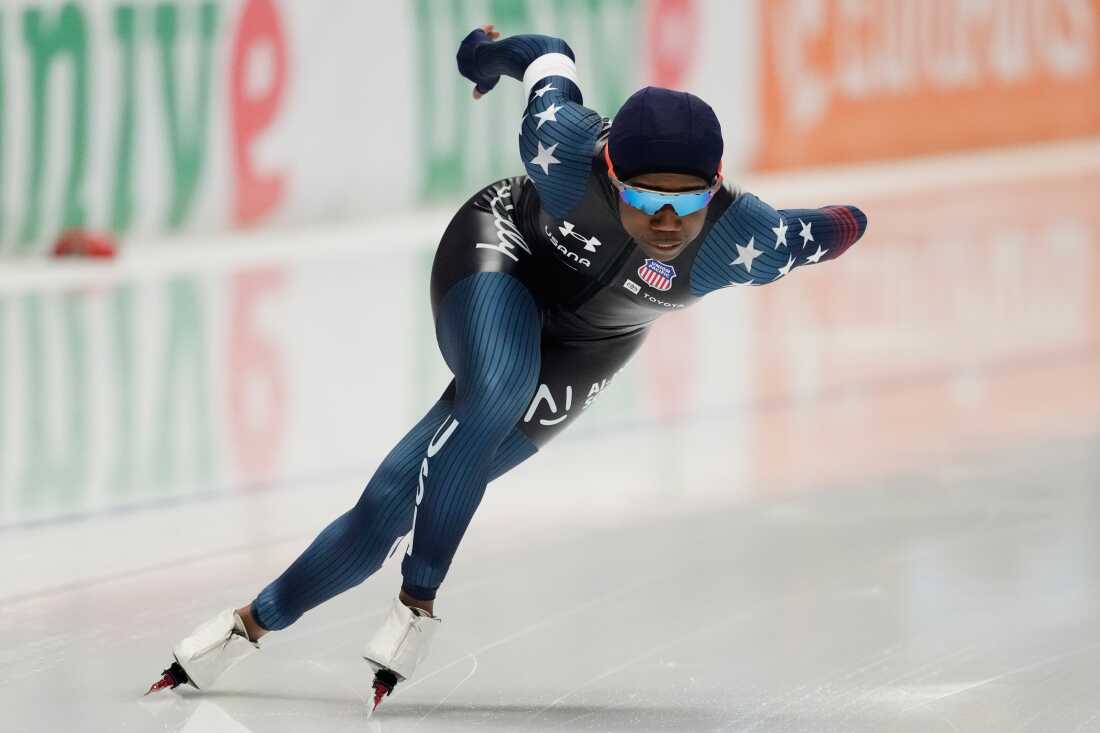
U.S. speedskater Erin Jackson, pictured in January, is the defending Olympic gold medalist in the women’s 500-meter event.
Matthias Schrader/AP
hide caption
toggle caption
Matthias Schrader/AP
The prolific Jordan Stolz — a favorite in the 500, 1000, 1500 meters and the mass start event — is poised to make speedskating history unseen since U.S. speedskater Eric Heiden won five gold medals in the 1980 Lake Placid Olympics. After a strong finish at the World Cup, Erin Jackson now heads to Milano Cortina to get ready to defend her Olympic title at her third Games, skating fast and turning left in the Women’s 500 and 1000. Four-time Olympian Brittany Bowe brings her decades of inline speedskating experience, explosive power and technique to the Women’s Team Pursuit. The Women’s and Men’s Team Pursuit — which involves two teams of three people racing in tandem — is going to be hot at these games. Team USA has dominated this event over the past four years, mastering the precision, technique and grace that consistently yields top results. Skaters are a mirror image of one another during every lap of the race. It’ll be much like watching synchronized swimming. Any slight misstep may be the difference between coming in first or 10th.
-Rolando Arrieta
18. Some Russian athletes can compete, but not under their own flag
The International Olympic Committee (IOC) suspended Russia and its ally Belarus after the invasion of Ukraine in 2022. But it did allow a small number of heavily vetted athletes from those countries to compete as “Individual Neutral Athletes” (AIN) in Paris in 2024, without any national anthems, flags or colors (instead represented by a turquoise logo). Similar rules apply to these Games, with neutral athletes’ participation at the discretion of each international sports federation. Russian athletes — even top NHL players like Alex Ovechkin and Nikita Kucherov — will be noticeably absent from the hockey rink, while a select handful will compete in sports including figure skating, cross-country skiing and short-track speedskating.
-Rachel Treisman
19. Women cross-country skiers will race on equal footing with men for the first time
Women have long struggled to achieve parity at the Winter Olympics, and the 2026 Games mark another milestone. Female cross-country ski racers were first allowed to compete in a single short-track event at the 1952 Winter Games in Oslo. This year, women will compete in the same number of events — a total of six — as their male counterparts. They’ll also ski the same distances, including the grueling 50k endurance race. “I’m really really excited to have equal distance for men and women at the Olympics,” three-time U.S. Olympic medal-winner Jessie Diggins told NPR. Diggins plans to compete in all six events at Milan-Cortina. “I think it’s really cool and an important way to show, especially young women in sport, hey, you got this,” she said.
-Brian Mann


Inde Navarrette and Michael Johnston in Obsession.
Focus Features
hide caption
toggle caption
Focus Features
Two big horror films, Obsession and Backrooms, just smashed all box office expectations. So much of their success has been driven by Gen Z, which is now the biggest moviegoing demographic. But what makes a movie a Gen Z movie? Today we’re bringing you an episode of NPR’s It’s Been a Minute. Host Brittany Luse talks about this trend with Sam Adams and Reanna Cruz.
If you want to hear more about these movies, check out these episodes:
In ‘Obsession,’ love hurts. It really, really, really hurts.
‘Backrooms’ brings YouTube horror to the big screen
Zendaya brings ‘The Drama,’ we bring the spoilers
Connect with Pop Culture Happy Hour:
Letterboxd / Facebook
Our weekly newsletter
Support Pop Culture Happy Hour+

I regret to inform you I’ll need to keep this introduction brief. Not because there’s any lack of things to say about July’s crop of notable new releases; it features award-winning journalists and several different flavors of anxiety about our bleak ecological future and data-dominated present, as well as the welcome returns of several beloved novelists.
No, these books certainly deserve some love, dear readers. It’s just that I’m finding it a bit tough to type while bearhugging a box fan. And since it seems that may be my last best chance to get through this latest U.S. heat wave here on the east coast without sweating through my shirt, I feel some urgency to get back at it.
So enough with the ado. With any luck, you’ll soon be cracking open one of these great reads on the beach — or in front of a decent air-conditioning unit, at any rate.

You Won’t Get Free of It: Stories of Mothers and Daughters, by Rachel Aviv (July 7)
Aviv, New Yorker staff writer and finalist for this year’s Pulitzer Prize, has a fairly extensive purview in her role as reporter at large. Still, when reviewing her latest work, Aviv noticed a crucial throughline: “I realized that, to some degree, I’d been writing about mother-daughter pairs for the last decade,” she explained to the Paris Review. Seeing this, she decided to collect and revise half a dozen of those stories, which cover ground from a daughter’s troubling fugue states to the immigrant nannies who must leave their own children behind, to Alice Munro’s daughter, whose claims of sexual abuse went unheeded yet regularly resurfaced in her mother’s fiction.

Country People, by Daniel Mason (July 7)
In Mason’s first novel since North Woods, 2023’s critical darling and book club stalwart, readers are plopped right back in the New England woods but the time scale has shrunk considerably. Whereas North Woods spanned centuries, his new novel confines itself to a single year, during which Miles, loving family man and lackadaisical Ph.D. candidate, plans to finally buckle down on that derelict degree of his and reassert his worth to one and all! At least, that’s the idea. But plans don’t stand much of a chance when there are eccentric neighbors to befriend and mysterious local legends to investigate.

Catch the Devil: A True Story of Murder, Deception, and Injustice on the Gulf Coast, by Pamela Colloff (July 14)
This is the first book from Colloff, a veteran investigative journalist for ProPublica and The New York Times Magazine. She has won multiple National Magazine Awards for stories focused on miscarriages of justice – such as her 2019 piece about Paul Skalnik, a grifter, fabulist, sexual predator and snitch, whose fabrications can be linked to dozens of wrongful convictions in Florida, including some sending the innocent to death row. Here Colloff expands upon that investigation, which gets a lot more room to breathe in the transition from magazine article to full-length book. What emerges in this disturbing account is a portrait of one man’s callous cruelty, and the law enforcers who had no problem tolerating a deal with the devil, provided it kept juicing the conviction rate.

Cloudthief, by Nathaniel Rich (July 14)
Though it’s his fiction we’re discussing here, it’s important to note Rich’s reporting has earned plaudits, too, as well as a few film adaptations. No matter the medium, climate change is usually on his mind, as well as the blunt, rather bleak, prognosis he offered on Fresh Air in 2019: “There’s a huge range of outcomes … ranging from the not very good to the apocalyptic.” Which is to say I’m surprised to find myself describing his newest response to global catastrophe as a rollicking good time – and not just because I’ve never said those words, in that order, in my life. This spry, funny caper features a freelance environmental reporter who inadvertently breaks bad, careening under the influence of lust and a light wallet toward the novel’s big centerpiece: the planned heist of a massive data center.

Data Empire: The Power of Information to Organize, Control, and Dominate, by Roopika Risam (July 14)
And now, for another book centered on data – albeit from a rather different angle. This illuminating history from Risam, a Dartmouth professor, traces the practice of collecting information – and the power conferred by possessing it – from the bones that were humans’ first archives, to the omnipresent systems that shape (or outright determine) life today. As Risam asks, “What has it meant – and what will it mean – when records that once served only to help us remember, come to rule?” A pressing question (see: those data centers), which you’re probably better served trying to answer with the help of Risam than, say, Alexa or Claude.

It Will Come Back to You: Stories, by Sigrid Nuñez (July 14)
For someone with nine novels to her name, Nuñez got a later start than you might expect, having published her first book when she was already in her mid-40s. More than three decades later, now a spry 75 years old, the National Book Award winner has gotten around to publishing her first collection of short stories. The 13 stories here have been culled from across her career, but each one resonates clearly with the warm timbre of her voice: simple, unadorned prose and mundane setups, from which she consistently manages to tease out glimpses of truth, elusive and profound.

They Stole a City: Wilmington’s White Supremacist Coup and the Families Who Live with Its Legacy, by Lauren Collins (July 14)
The only coup d’etat to succeed on U.S. soil is, at most, a distant historical afterthought these days. To be honest, I can’t recall reading a single textbook entry that even remarked on the 1898 race massacre in Wilmington, N.C., an action led by white supremacists that left many (historian estimates say up to 300) Black Wilmingtonians dead and permanently scarred a community newly aware of its simmering animus and vulnerability to violent overthrow. So I’m grateful for Collins’ new chronicle of the infamous event, which fills in some serious gaps in the American collective memory and explains how its perpetrators cultivated the disorienting silence that persists in the historical record today.

Yellow Pine, by Claire Vaye Watkins (July 21)
I don’t think I’ve ever actually laid eyes on the Mojave Desert but after reading Watkins’ latest novel, it feels like I can picture it more vividly than some streets I’ve actually lived on. No, it’s “not a beginner’s wilderness,” as Watkins concedes in Yellow Pine, but this landscape so redolent of death is also deceptively robust with life, if only you’re patient enough to find it. Too bad, then, that it’s also on fire. And choked by drought, irradiated by military test sites and soon to be sacrificed to a massive new solar array named, inexplicably, Yellow Pine. But those aren’t the only complications confronting the book’s main character, Rose, whose aspirations of becoming a kind of climate hermit warp a bit under the pressure of a rekindled love and the pendulum swing of rage and despair at the state of the world.

Cool Machine, by Colson Whitehead (July 21)
Ray Carney is back, for what regrettably appears to be the last time. The lifelong Harlemite, hard-luck furniture dealer and ambivalent crook starred previously in Harlem Shuffle and its sequel, Crook Manifesto. His perspective is our window on the changing eras of the historically Black neighborhood, from the mid-1950s on. In this, the final installment in Whitehead’s brisk, exceedingly entertaining Harlem Trilogy, readers catch up with Carney around the start of the 1980s, following him deeply into Reagan’s decade. The novel also represents the end of an era for Whitehead, whose attention has been exclusively occupied with these characters since he won Pulitzer Prizes for consecutive novels, The Underground Railroad and Nickel Boys.

Beginning Middle End, by Valeria Luiselli (July 28)
The gifted young Mexican writer returns this month with her fourth novel, the second she has written in English and her first since Lost Children Archive launched to widespread plaudits more than seven years ago. Her new book, like her previous one, also concerns the travels of a small family – only this time, the road leads not through the American Southwest but Sicily. And the history sought by its mother-daughter main characters is not a record of bureaucratic cruelty but something much more intimately personal: the links shaped and tested by generations of shared heritage and experience.



-

 Alaska4 minutes ago
Opinion: Alaska’s whale-strike risk is growing while regulators keep studying the obvious
-

 Arizona11 minutes ago
Arizona Lottery Mega Millions, Pick 3 Evening results for July 7, 2026
-
Arkansas14 minutes ago
Arkansas Lottery Mega Millions, Cash 3 winning numbers for July 7, 2026
-

 California26 minutes ago
California still hasn’t released Newsom’s Baby2Baby diaper contract as lawmakers weigh longer public records delays
-

 Colorado29 minutes ago
Colorado River, public lands reopen as Snyder Fire containment increases
-

 Connecticut34 minutes ago
Opinion: A lifeline in CT’s childcare desert
-

 Delaware41 minutes ago
Talk & Film Bring Delaware’s Revolutionary Story to Life at Archives’ First Saturday Program – State of Delaware News
-
 Florida44 minutes ago
Heat alerts expand across Florida as dangerous temperatures return

