Denver, CO
Tell us: What do you want to see at Denver’s newest city park in Park Hill?


Denver will soon open its newest park after the city announced a plan to acquire the 155-acre Park Hill Golf Course, a long-debated property in northeast Denver.
The city will give a plot of land it owns near Denver International Airport to the former golf course’s owners, Westside Investment Partners, in exchange for the future park, Mayor Mike Johnston said earlier this month.
Denver Parks and Recreation plans to open the area to the public this summer but will continue to develop amenities there after soliciting input from the community about what residents want to see in the space. It will be one of the largest parks in the city.
Let us know what you want to see at the park and what you think it should be named using the form below:
Originally Published:



If you use Santa Fe Drive as a part of your daily commute, you will notice full closures this weekend on a popular section, from Florida Avenue to Evans Avenue, for the installation of a pedestrian bridge.
Once the 370-foot pedestrian bridge is completed, it will connect the east and west portions of Denver’s Overland neighborhood. This bridge will be used by pedestrians and bicyclists.
The Denver Department of Transportation and Infrastructure says this closure is needed to keep the traveling public safe. Large cranes will be used to set the two spans in place. Each one weighs about 215,000 pounds and is 180 feet long.
Once the bridge is completed in 2027, it will create a safer connection for pedestrians and bicyclists. It will link neighborhoods to trails, transit, parks, and local businesses without requiring residents to cross heavy traffic.
“Our neighborhood is quartered by transportation routes, so having a safe pedestrian bridge that can take people from one side to the other is an amazing development that neighbors have been asking for for years,” Jenn Greiving, President, Overland Park Neighborhood Association, said.
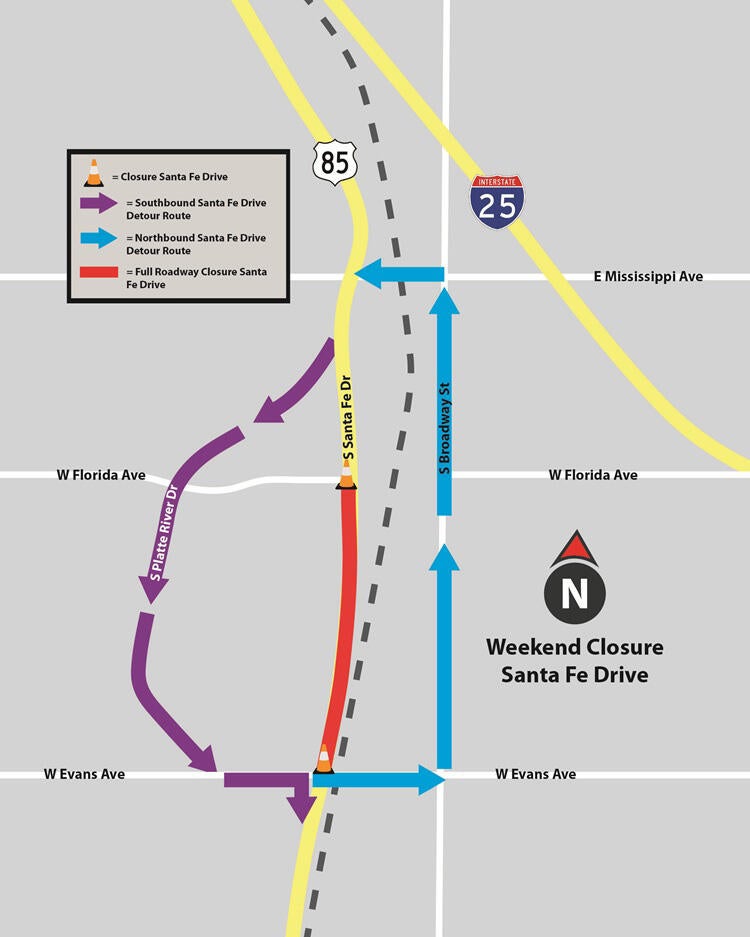
The Santa Fe Drive closure will begin at midnight on Saturday, July 11, and end on Monday, July 13, at 5 a.m. There will be detours in place. This includes:
- Southbound Santa Fe Drive Detour: Traffic will be routed to Platte River Drive to reenter southbound Santa Fe Drive at the West Evans Avenue on-ramp.
- Northbound Santa Fe Drive Detour: Access to northbound Santa Fe Drive will be at Mississippi Avenue via South Broadway Street.
- On-Ramp Closure: The West Evans Avenue on-ramp to northbound Santa Fe Drive will close at noon on Friday, July 10, to prepare for the full weekend closure and will remain closed until 5 a.m. on Monday, July 13. Traffic will be detoured to South Broadway Street to re-enter northbound Santa Fe Drive via Mississippi Avenue.
- Off-Ramp Closure: The southbound Santa Fe Drive off-ramp to West Evans Avenue will close for the full weekend period and remain closed until Friday, Sept. 11, while crews build new sidewalks and perform other concrete work at the southwest corner of the project. Detours will be posted to West Florida Avenue, West Dartmouth Avenue or West Hampden Avenue to bypass the ramp closure
During this closure, DOTI will reopen the underpass on Iowa Avenue. This is a new ADA accessible pathway that will be available between Santa Fe Drive and Acoma Street.

DENVER (KDVR) — Two officers, one now formerly of the Denver Police Department, face multiple charges relating to separate incidents in the past two months.
According to a release, now-former Denver Police Officer Gabriel Lucero was issued a citation for third-degree assault, official misconduct and false reporting, while Officer Javon Leach was cited for reckless driving and eluding.
The incident involving Lucero reportedly occurred on May 22 just before 1 a.m. in the 500 block of 16th Street. According to a release, Lucero was involved in an assault at a business, as he allegedly assaulted a person and walked away as others continued to assault the victim.
Security guards and an off-duty officer escorted him and the group out; however, Lucero reportedly identified himself as a Denver police officer and attempted to re-enter by using his police badge.
Lucero reportedly provided a false name without any other information, and further investigation verified Lucero as the person involved. Lucero was hired in 2025 and, due to his current probationary status, was fired as of Wednesday.
The incident involving Leach occurred around 1:41 a.m. on June 21, when Leach was reportedly pulling out of a parking lot on Larimer Street, attempting to drive against traffic.
Leach reportedly refused commands to stop as he left the area. Officials said he was found just seven minutes later, traveling at high speeds northbound on Park Avenue West.
He reportedly fled a traffic stop and continued to drive away, and officials deemed Leach to be the suspect following an investigation. He was placed in an off-line assignment while the case progresses, as they are considered misdemeanors.
“The Denver Police Department’s administrative review of Leach’s incident will begin once the criminal case is adjudicated, and that process includes the Denver Department of Safety and the Office of the Independent Monitor, a civilian oversight agency,” the release said.

Denver Nuggets standout forward Peyton Watson could find himself on another team before you know it.
With the Nuggets reportedly open to a sign-and-trade of Watson, could Denver really lose a core piece to their rotation?
It’s hard to imagine many teams being able to shoulder the financial weight of a Watson contract at this point because of the aprons and such, but he’s absolutely an asset to any contending team.
We’ve gone through and identified a few teams that make sense for Watson in the fall… including the one he’s already on at the moment. Hey, he might stay home, you never know!
The Clippers have been linked to Watson as a possible destination; he could help them immensely.
The Pistons have also been linked to Watson, which would help them a lot to contend for an NBA title.
Look, HYPOTHETICALLY, the Nets could move around some cap space with some player trades and such and get a deal done. They are one of the only teams in the NBA right now not in the negative with cap space.
The Grizzlies are the team with the least amount of negative cap space right now, per Spotrac. If they really wanted to pull off a Watson sign-and-trade… it would be hypothetically possible from a money standpoint.
Denver Nuggts
Look, it’s very possible Watson just stays in Denver on a brand-new deal. Who knows at this point?
-

 Milwaukee, WI8 minutes ago
Milwaukee leaders condemn ICE arrests as agency ignores City mask ordinance
-

 Atlanta, GA10 minutes ago
Georgia Secretary of State opens investigation into voter registration mailers sent to deceased residents
-

 Minneapolis, MN15 minutes ago
Minneapolis chief communications officer Adam Fetcher out amid possible criminal charges
-

 Indianapolis, IN23 minutes ago
Indiana Workforce Pell Grant options limited so far
-

 Pittsburg, PA26 minutes ago
Pennsylvania leaders take new approach to cracking down on robocalls
-

 Augusta, GA31 minutes ago
Augusta domestic violence shelter faces shortfall after Georgia funding veto
-

 Washington, D.C37 minutes ago
Why Gov. Kim Reynolds turned down previous request to send National Guard to D.C.
-

 Cleveland, OH40 minutes ago
LGBTQ+ Ohio Nonprofit Guide

